
Autonomous Estate: When Disconnecting from Networks Costs More Than Connecting
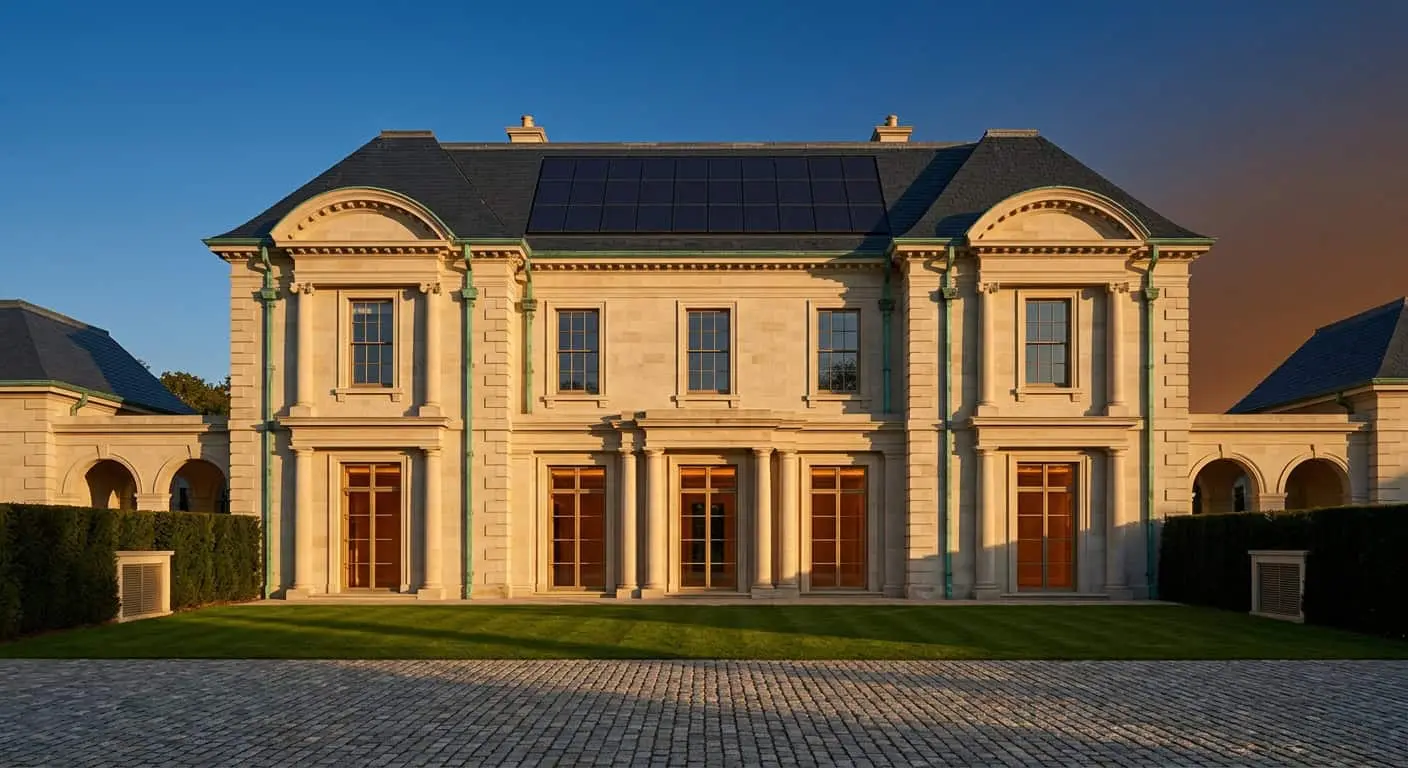
Yesterday a client sent me a bill for utility infrastructure connection for a plot 80 kilometers from Moscow. 14.7 million rubles. For 450 kW of power he actually needs. Plus gas — another 3.2 million. Plus water and sewer if we’re lucky. Then we sat down to calculate: what if we don’t connect at all? Not from ideology, but from cold calculation. So this conversation was born — about how autonomous engineering of a country estate went from being an eco-toy over the last five years into a financial instrument comparable to choosing between renting and owning.
Architecture changes faster than we think. Ten years ago a geothermal loop was the whim of an eco-enthusiast — today it’s standard engineering for any serious house of 1,000+ m². But the most interesting part is not the technology. The interesting part is that autonomy stopped being about ecology. It became about control over an asset and how much that asset will be worth in 2040.
In this article I’ll break down the economics of an autonomous 1,500 m² estate without marketing romance. Where the numbers work, where they don’t, and why wealthy European families are massively abandoning centralized networks — even though in Europe connection costs a fraction of ours.
Why connection became more expensive than disconnection
Let’s start with numbers. A plot of 50 acres, distance from the main line — 600 meters. A typical story for Novaya Riga or Minskoe direction.
– Electricity, 250–450 kW: from 8 to 20 million rubles, and that’s just papers and cable to the property line
– Main gas line: 2.5–6 million, plus 1.5–2 years waiting
– Central water supply: if they extend it at all — from 1.5 million
– Sewage: usually autonomous anyway
Total: 12–28 million rubles for the right to pay monthly for a resource that’s cut off three times a winter.
Now the second column. A 60 kW geothermal heat pump with five 120-meter boreholes — 9–12 million under contract. A 30 kW solar station with LiFePO4 battery storage for 80 kWh — 6–8 million. A 100 kW diesel generator reserve — another 1.5 million. A water treatment station from your own borehole — 1.2–2 million. A septic with biological treatment — 800 thousand.
Sum: 18.5–24 million. Comparable to connection. But then — a fundamental difference.
Economics of autonomy over 15 years
Here’s where things get interesting. A connected house pays. Monthly, with indexation that over the last 10 years has outpaced inflation by 30–40%. Let’s calculate conservatively: a 1,500 m² house with a pool and outbuilding consumes heating and electricity worth 80–120 thousand rubles monthly during the heating season. Over 15 years — 12–15 million rubles just for resources, not counting price increases.
An autonomous house over the same 15 years will spend: heat pump service (30k/year), battery replacement in 12–15 years (1.5–2 million), diesel for the generator (conditional 50k/year), water treatment filters and membranes (40k/year). About 4–5 million over 15 years.
The difference — 8–10 million in favor of autonomy. But that’s not the main number. The main one is different.
Autonomous engineering as a liquidity instrument
Here’s a thesis you rarely hear from engineers, because they think in kilowatts, not capital. In 10 years, a house connected to the grid will be illiquid. More precisely — liquid with a 20–30% discount.
Why? Watch what’s happening in the premium residential market. A 300–500 million ruble estate buyer in 2035 is someone for whom resource stability matters more than cost. He’s seen rolling blackouts, substation accidents, stories of neighbors freezing without heating for three weeks in January. He won’t buy a house dependent on the utility company.
At the studio, over the last three years we’ve observed this on deals. A house with full autonomy sells faster and for more. One of our 2019 projects — an 1,800 m² estate in Istrinsky District — resold in 2023 with an 18% premium specifically for engineering independence. The buyer said straight out: “I’m paying for not having to call Mosenergo.”
Autonomy is not ecology. It’s an option on future asset liquidity.
What exactly makes an estate autonomous: the engineering stack
I’ll break it down layer by layer, without which the system falls apart.
Heat: geothermy plus heat recovery
Borehole heat exchangers to a depth of 100–150 meters, a “ground-to-water” heat pump with conversion efficiency of 4–4.5. For a 1,500 m² properly insulated house you need 50–70 kW of heat. Mandatory forced supply-return ventilation with 85–90% heat recovery — this is not optional, it’s required. Without it, geothermy loses half its sense because heat escapes with the exhaust air.
Electricity: sun, storage, backup
At Russian latitudes, a solar array works effectively for 8 months a year. Winter — backup from batteries and diesel. Realistic scenario: 25–40 kW of panels, 60–120 kWh of battery storage, an 80–100 kW diesel generator in an enclosure with auto-start.
Typical mistake — economizing on battery. Client says “smaller batteries, the generator will recharge them.” A year later he’s replacing batteries because discharge-recharge cycles wore them out twice as fast as calculated.
Water and sewage
An artesian borehole 80–120 meters, a water treatment station with reverse osmosis for potable line, separate softener for domestic. Septic — only with biological treatment and aeration, not the 200k hack. A proper module for an estate costs 600–900 thousand and delivers water on the outlet you can water the lawn with.
Typical mistakes and myths when switching to autonomous
Here’s where most people lose money.
Mistake one: autonomy as an overlay on ready design. Engineering independence can’t be “added” at the finishing stage. A geothermal circuit is laid before the foundation, heat recovery requires architectural ducts in the floor slabs, solar dictates roof geometry and orientation. If you come to me with a finished design and ask to “make it autonomous” — 80% of the time that means redesigning from scratch.
Mistake two: belief in a single source. “We’ll put in geothermy and that’s it.” No. Any autonomous system is always minimum three circuits with redundancy. One source = one point of failure = a frozen house at -28°C.
Mistake three: economizing on automation. An intelligent controller that switches modes by itself, balances load between batteries, grid (if there is one), and generator — that’s 5–8% of the system budget. Without it you get not an autonomous estate, but a collection of expensive hardware that needs a staff engineer to manage.
Mistake four: calculating “by average temperature.” Autonomy is designed not for average -8°C, but for extreme -32°C with wind. Otherwise you freeze for three days a year or burn through diesel by the ton.
Mistake five: refusing backup grid connection if it’s cheap. If the main line is 50 meters away and connection costs a million — connect and leave it as backup. Autonomy philosophy shouldn’t become stubbornness.
How we design autonomous estates
Our approach rests on one rule: engineering is primary, architecture is its consequence. This sounds heretical for an architect, but it’s the truth of the XXI century.
At input we do an energy audit of the future house: calculate heat loss in each space, consumption profile by hour, seasonal peaks. Only after this does an architectural concept appear, where windows are oriented for insolation, roof is angled for solar, technical rooms account for heat pump noise and ventilation equipment sound.
Then — a three-circuit model: primary source (geothermy + solar), backup (diesel + batteries), emergency (grid if available, or second generator). Each circuit works autonomously, automation balances them.
And last — the service model. An autonomous estate can’t be handed over and forgotten. We always offer the client a service contract: remote monitoring, planned maintenance four times a year, emergency call-out. Without this, in 3 years even the most expensive system turns to pumpkin.
When autonomy is not justified
I’ll be honest because it matters. Autonomous engineering isn’t a universal answer.
If the plot is in a village with normal utilities, connection costs 1.5–3 million, the house is under 600 m², and you’re there 4 months a year — forget it. Payback goes past 25 years, you just overpay for philosophy.
Autonomy starts making economic sense at 1,000+ m², with permanent or semi-permanent habitation, and on a remote plot where grid connection costs 5 million+. That’s its native environment. Everything else is either ideology or marketing.
What will happen in 10 years
We’re approaching a generation of houses not connected to external utilities at all — not from infrastructure poverty, but from technology wealth. Hydrogen storage replacing lithium batteries. Photovoltaics integrated into the roof itself instead of separate panels. Heat pumps with COP above 6. All this is already in pilots in Switzerland and Germany, and will hit the mass premium market in 7–10 years.
And when that happens, houses designed under the grid paradigm will look like landline phones in the smartphone era. Technically working, morally obsolete, losing value every year.
So when a client asks me: “Is it worth putting 20 million into autonomous engineering right now?” — I don’t answer with numbers. I ask: “Are you building this house for 5 years or for a generation?”
If for a generation — the answer is obvious.
If you’re thinking about building and want to figure out whether an autonomous model makes sense for your specific plot and lifestyle — write us. Our first conversation is always about economics and honest calculation, not sales. Sometimes we actually talk clients out of autonomy. Because the studio’s reputation is worth more than one project.

Author
Next step
Discuss your project
An hour at the studio with Oleg Reznikov: your site, your brief and relevant studio projects.