
Hamptons vs Côte d’Azur: Where the Rich Are Building in 2026 and Why
We get one call regularly. Client returns from trip — either Southhampton or Saint-Tropez — carrying two suitcases: one with tan, second with someone else’s architectural dream. Sits across from us and says: “Want house look like this”. Shows photo. We already know which one.
Over past eighteen months in international architecture press, two camps clearly formed, and elite mansion construction 2026 trends literally split in two. One side — restrained coastal classicism of American East Coast, Hamptons Style. Other — revived, heavy, ochre Mediterranean villa, Villa méditerranéenne. Two poles, two philosophies, two completely different clients. And — more important for us with you — two very different answers to question of how big house should look in Moscow region in five years.
In this article we’ll break down why wealthy in US and Europe made directly opposite bets, which model better sits on Russian request, what from it we already adapt in our projects. And why 2026 — turning point for those laying facade right now.
Two camps, two geographies, two philosophies
Let’s start with honest portrait of each.
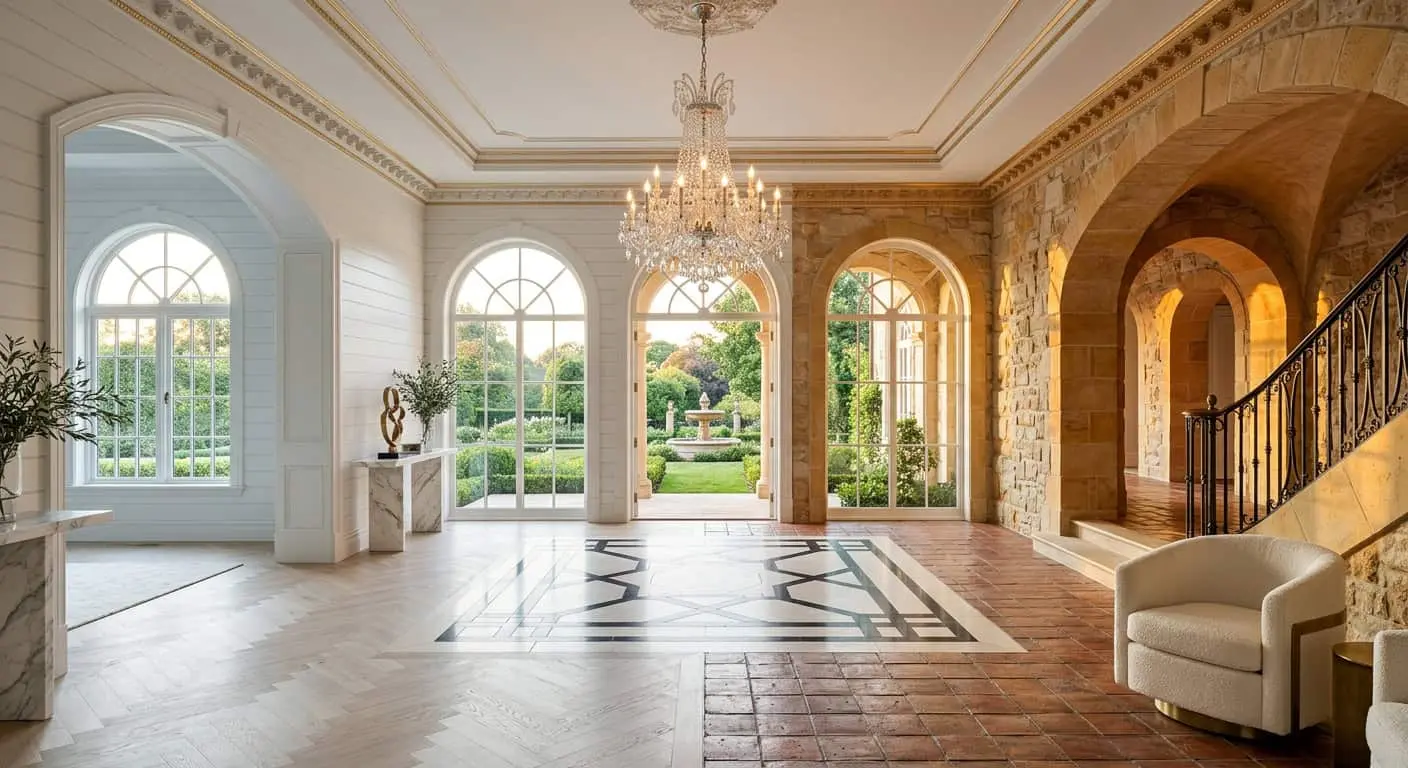
Hamptons — this is about white cedar siding (or fiber-cement replica), gray tile roof, porticos with thin columns, symmetry, large rectangular windows with mullions, covered verandas and lawn to horizon. Palette — bleached oak, linen, sand, muted blue. Inside — high ceilings, lots of light, minimal carved detail, maximum air. This is architecture of understatement. House that doesn’t shout budget, though budget is always serious there.
Côte d’Azur in 2025–2026 version — completely different story. Return to what ten years ago everyone fled: thick stone walls, warm ochre and terracotta, tile, arched openings, heavy wooden shutters, wrought elements, patina. New Mediterranean villa doesn’t hide being dense, hefty, almost fortress-like. It’s about rootedness, about “house for centuries”, about rejecting transparency for privacy.
Two camps gathered different people around themselves. American client tired of glass modernism, goes to Hamptons for quiet and nobility. European client survived decade of minimalism, goes to Villa méditerranéenne for substance, for material, for feeling that house existed here forever.
Why wealthy in US chose restraint
Interesting paradox. Last fifteen years America exported hyper-modern to world — giant cantilevers, glass-to-floor facades, flat roofs, concrete. California modernism became international currency.
Then something clicked.
We tie it to several things. First — saturation. When everyone has equally impressive glass parallelepipeds, impressiveness stops working. Second — maintenance fatigue: flat roof, giant glazing, open cantilevers — this endless contractor bills. Third — client generation shift. Forty-year-olds who made money in 2010s building second and third houses — and no longer want to live in window display.
Hamptons gave them language to speak expensive, but quietly. This style reads as status inside the club, but not as demonstration outside. For someone who spent ten years on magazine covers, that’s exactly right.
Why Europe returned to stone
Mediterranean story different, less obvious.
Mediterranean architecture never left — left was attitude. In 2010s stone villas felt “parental”, somewhat tired, old-money-in-bad-sense. Fashion was white Pawson-esque parallelepipeds hidden in olive groves.
And now young European elite — often those who grew up in these white parallelepipeds — return to parental stone. Except rethought. Walls thicker. Window openings deeper. Materials more honest: not plaster fake stone, but stone. Not fake shutters, but real wooden ones that actually close.
This reacts to climate anxiety (thick walls — thermal mass, summer cool without AC), to geopolitics (fortress-house sounds different now), to general fatigue of digital world. Heavy architecture gives what glass doesn’t: feeling of shelter.
And here starts interesting for us.
Elite mansion construction 2026 trends: what from this works in Russia
Last two years we watch closely what from these two models really works on Russian plot — not in Pinterest photo, but 25 kilometers from Moscow Ring Road, in February, at minus eighteen, with actual development footprint, insolation, family habits.
And observation, reason we write this.
Villa méditerranéenne in Russia almost never works. Sorry if disappointed.
Several reasons. Ochre and terracotta stone in our light — especially winter, gray sky, snow-reflected — reads foreign. Designed for Mediterranean sun that pulls warm tone from stone. Here same stone becomes dirty, heavy, visually tired. Arched shutters on facade in Moscow region — looks like decoration.
We saw dozens of attempts. Almost all by third year of use start looking tired, by fifth — frankly out of place.
Hamptons — unexpectedly — lays much better. Light facade in northern light works. Symmetry and classical proportions don’t conflict with Russian estate code — opposite, resonate with it. Tall windows with mullions, covered verandas, muted palette — all this sits organically in birch and pine forests.
But even here there’s “but”. Pure Hamptons doesn’t suit us either.
Where Hamptons breaks against Russian climate and Russian request
American coastal classicism designed for soft winter and ocean moisture. Wooden siding likes when air is salty and temp doesn’t drop below minus ten. Here it lives, but needs different material and detail approach.
Second — windows. Original Hamptons — windows big, but still windows, not entire-wall glazing. Russian premium client last ten years fell in love with panoramic glazing, not ready to give it up. And correct — from our house opens forest view, and closing it with six-part mullion grid would be crime.
Third — layout. American cottage layout builds around first-floor open space with island kitchen. Russian client 45+ often wants different: separate kitchen, separate living, separate dining, plus mandatory office, plus first-floor guest bedroom. That’s not American house. That’s estate.
And here we come to main conclusion.
Our approach: Hamptons skeleton, contemporary classicism skin
In our practice fairly definite formula formed, and we think it reflects elite mansion construction 2026 trends in their Russian reading.
We take from Hamptons its architectural skeleton: symmetry, proportions, restrained palette, covered veranda or terrace, high ceilings, light facade palette, calm roof geometry. This frame, this is what makes house noble from distance.
Then overlay what’s been Russian contemporary classicism DNA for ten years: big glazing at key points (living, dining, master), clean frames without excessive mullions, contemporary facade materials instead of wooden siding, denser walls, proper roof under our snow load.
And from Mediterranean villa take one, but important: attitude to detail. Recess depth. Material honesty. Stone weight where it belongs — baseboard, fireplace portal, terrace elements.
Result is house that is neither Hamptons nor Villa méditerranéenne. It’s something third — and this third option, by our observation, now rapidly becomes main request on market. Elite mansion construction 2026 trends — it’s not copying Americans and not copying French. It’s synthesis where Russian contemporary classicism finally gets solid international reference without losing identity.
Typical mistakes of those trying to transplant style “as in picture”
Since we mentioned, we’ll list what we see most. Not theory — it’s real-project post-mortem that come to us for redo or completion.
Mistake one: picking style by vacation photo. Went to Provence, fell in love with ochre villa and ordered same under Zvenigorod. Two years later looking at it confused why house looks like prop. Because architecture born from place, light, climate, not from memory.
Mistake two: language mixing. White siding Hamptons-style plus arched French shutters plus Italian tile plus English bay window. Each element separately — good. Together — catastrophe. We call it “architectural mishmash”.
Mistake three: facade material economy. Hamptons forgives much, but not cheap siding. If you chose this language, fiber-cement must be premium, proper texture and board geometry. Difference between good and bad fiber-cement — it’s difference between hundred and three-hundred million house. Visually.
Mistake four: ignoring landscape. Hamptons is not house, it’s house in landscape. Dunes, pines, hydrangeas, gravel paths, low hedges. Without this even perfectly built house hangs in void. Villa méditerranéenne without terraces, cypresses, proper retaining wall — not villa at all. Facade without context doesn’t work in any style.
Mistake five: refusing architect for “ready project”. At this budget level buying standard project — it’s like tailoring suit to someone else’s measurements. Every plot needs individual answer. Every. No exceptions.
What this means if you’re laying facade in 2026
We call 2026 turning point for practical reason.
Projects launching now will hit facade stage in 2027–2028. Exactly when Russian premium market finally forms clear divide. Some houses will look like thoughtful synthesis we discussed. Others — belated chase of foreign fashion. Difference will be visible to naked eye.
If you’re looking at pure Hamptons — stop and ask: in five years when this style becomes mass in Moscow region, will your house be one of twenty similar? If looking at heavy Mediterranean villa — ready for it to age not nobly but poorly because material and light don’t match?
Elite mansion construction 2026 trends require from client exactly one: don’t pick camp. Pick synthesis. Pick architect able to assemble that synthesis.
Our position: three principles we don’t deviate from
To not leave you with abstractions, briefly formulate how we work this theme practically.
First. We never design facade before spending two-three hours on site. Light, surroundings, relief, neighbors, wind rose — all this dictates style more than client Pinterest.
Second. We believe in material honesty. If facade stone — it’s stone, not plaster with texture. If wood — it’s wood with proper treatment for our climate, not imitation. Long-term — it’s cheaper.
Third. We think big glazing — it’s not trendy trick, it’s way to connect house to place. In Russian landscape where half-year is winter and view has huge value, refusing it for stylistic purity — is foolishness. So we adapt Hamptons to vitrage, not vitrage to Hamptons.
Instead of “thus”
Briefly: rich in America tired of glass and went for restraint. Rich in Europe tired of minimalism and returned to stone. Both moves — reactions, both can’t directly transfer to Russian plot.
But inside American movement lies something that surprisingly exactly matches already-formed Russian contemporary classicism language. Proportions, symmetry, restraint palette, light facade, high ceilings — all this we already had. Just now there’s international reference legitimizing it and simultaneously freeing from temptation to copy pure.
Elite mansion construction 2026 trends — it’s, on our view, exactly this freedom. Calm confidence in own path, backed by understanding where world moves.
If you’re now at stage of choosing — style, architect, direction — come talk. We love these conversations. Will show objects where formula already works, honestly say what suits your plot, what better leave on picture.

Next step
Discuss your project
An hour at the studio with Oleg Reznikov: your site, your brief and relevant studio projects.