
Built-In Cold Plunge at Home: Design and Care Guide
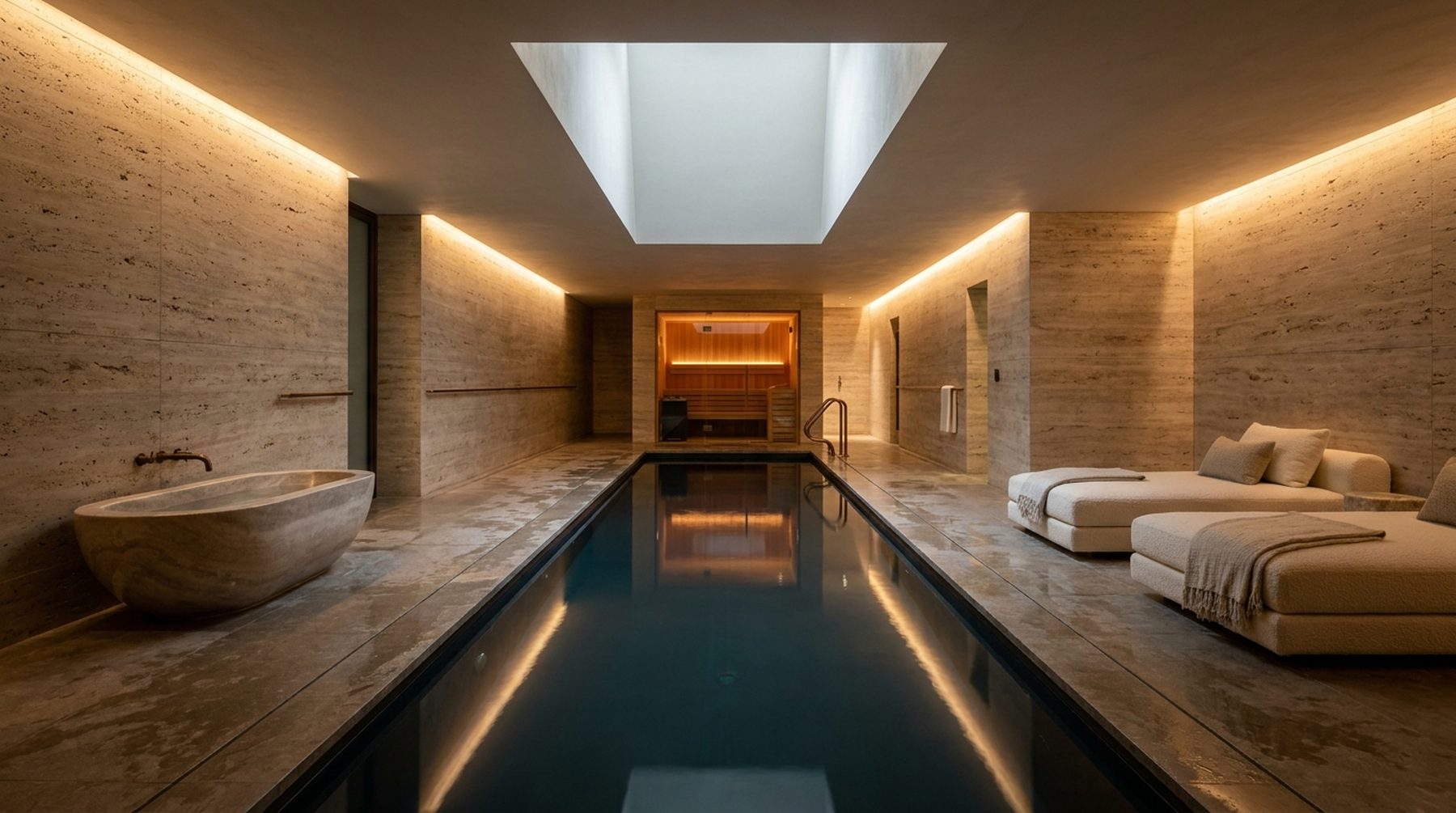
A built-in cold plunge is a small dedicated pool, usually holding 2–4 cubic metres of water kept at 6–12 °C, placed a few steps from the sauna or hammam. In a private residence the chiller is the cheapest part of it. The real work is the structure, the plant room, water treatment and, above all, the air of the spa.
Last winter a client called me at eleven at night, straight back from Dubai. He did not want to talk about a leak or a contractor’s invoice. He asked one thing: “Can we have water like that in our spa, eight degrees, all year round?” We can. By the next morning I knew the conversation would not be about water at all. It would be about the floor slab, the dew point and the noise of a compressor behind the guest bedroom wall.
Why cold water moved into the house
In Russian bathhouse culture cold water has always been there: an ice hole, a snowdrift, a wooden barrel by the door. What is new is that people now want it on schedule and with a thermometer. A barrel by the door is freezing in January and 22 °C in July.
The trend came from resorts rather than doctors. In August 2025 the Khaleej Times reported that Dubai residents were spending more than AED 70,000 (around $19,000) on home ice baths. In summer 2026 the Four Seasons Resort at Jumeirah Beach built its wellness programme around a new cold plunge held at 8–11 °C, paired with sauna and steam rooms. Heat, cold, rest, repeat. What clients try in a hotel, they want at home a year later.
There is some science behind it, though less than the marketing suggests. In 2021 Danish researcher Susanna Søberg published a study in Cell Reports Medicine on young men who swam in cold water two or three times a week, looking at brown fat and thermoregulation. The popular “11 minutes of cold a week” figure grew out of that work. The sample was small, so I never promise clients weight loss. I promise something simpler: after the sauna, 8 °C water wakes you up better than coffee.
What a cold plunge pool is really made of
The basin
For a private home a basin of about 1.2 × 2.0 m with roughly 1.2 m of water is enough to stand in up to your shoulders. That is close to 3 cubic metres, or about 3 tonnes of water, before you add concrete and stone. So the basin belongs in the structural design from day one. On an upper floor it is rarely worth the cost; on a ground-bearing slab at basement level it is straightforward.
The finish follows the rest of the spa: marble, travertine or mosaic. If you choose a stainless steel shell, specify grade 316. Its molybdenum content resists chlorides far better than the cheaper 304.
The chiller
Residential chillers typically hold water at roughly 4–10 °C. They produce heat and noise, much like an air conditioning unit. They belong in a ventilated plant room on a dedicated circuit with residual current protection, not inside the spa itself.
Filtration and sanitation
Cold water grows algae more slowly than warm water, but it still does. The usual setup is a pre-filter for hair, a cartridge filter, then UV or ozone, ideally both. UV lamps need replacing every 12–18 months.
Pipework
The return line from the chiller should be insulated along its full length. Otherwise you are cooling the screed, not the water.
The mistake almost everyone makes: condensation
A home spa typically runs at around 28 °C and 60 % relative humidity. The dew point of that air is about 19.5 °C, so any surface colder than that starts to sweat. A basin at 8 °C and its metal handrail sit eleven degrees below the dew point. Condensation runs down the coping, along the pipes under the floor and into the wall the basin touches.
We once took apart someone else’s plunge with exactly this story. Onyx, concealed lighting, everything from the hotel brochure. Behind the wall, in the dressing room, it smelled like a cellar. The basin was built tight against an external wall with no insulation break, and the extract fan had been sized for the sauna alone.
The cure is design, not more expensive stone. Size dehumidification for the whole spa including the cold water. Insulate the basin from the walls and slab. Choose a coping material that hides droplets and mineral marks. Fit a cover for when the plunge is not in use: it saves cooling energy and removes half the humidity problem.
Where it belongs in the plan
The plunge is always the second link in a chain. The first is heat, so the right place is three or four steps from the sauna door, with no turns and no thresholds. The third link is rest: loungers, a blanket, tea. We draw this route at concept stage, before we lay out the guest bedrooms. The plant room sits directly behind the spa wall with its own door from the corridor, so the service engineer never walks through the spa.
How to care for a home cold plunge
A built-in plunge is easy to live with if the routine is written down from the start. This is the checklist we hand over with the house:
Daily: skim the surface, check clarity and temperature, close the cover after use.
Weekly: rinse the pre-filter, check pH and sanitiser levels if you use a chemical system, wipe the waterline and the handrail.
Monthly: clean or replace the cartridge filter, inspect the pump and hoses, confirm the UV or ozone unit is working, check the chiller’s air intake is clear.
Every 12–18 months: replace the UV lamp. Drain and refill according to your water treatment specialist’s schedule, more often with heavy use.
Every season: have the dehumidification system serviced. In a cold plunge spa it works harder than anywhere else in the house.
Our approach
We do not sell the cold plunge as a gadget. We ask how the owners use the sauna, how many people use the spa at once and who in the family will actually go in. That decides the size, the steps, the handrail and the depth. Then the order is fixed: plan, structure, mechanical and electrical as one package, and only after that stone and lighting. The client who called at eleven at night now has an 8 °C plunge two steps from the sauna, dark stone, low light and a cover that slides into a niche.
FAQ
What temperature should a home cold plunge be?
For a residence we set 10–12 °C by default, with the option to go down to 6–8 °C. Hotel spas such as the Four Seasons in Dubai work at 8–11 °C. Colder than about 5 °C makes sense only for trained users. Beginners should start warmer, keep immersions short and keep their head above water.
Can a cold plunge go on an upper floor?
Technically yes, but it is expensive. A 3 m³ basin holds about three tonnes of water alone, plus concrete and stone. The slab must be designed for that load from the start. The most reliable location is a basement or ground floor on a ground-bearing slab.
Do I need a chiller, or is tap water cold enough?
If you want a stable temperature all year, you need a chiller. Tap water arrives warm in summer, and in a spa at 28 °C the basin warms up quickly. Without active cooling the plunge becomes a cool bath for half the year.
How often should the water be changed?
With proper filtration and UV or ozone treatment, water can stay in the basin for weeks. Many manufacturers suggest a full drain and clean monthly, or more often with heavy use. Your service contractor should set the schedule based on regular water tests.
Who should avoid cold plunging?
Sudden cold immersion triggers a gasp reflex and sharp rises in heart rate and blood pressure in the first minute. Cardiologists advise people with heart disease, high blood pressure or circulation disorders to avoid it unless their doctor agrees. That is why we always specify adjustable temperature and a handrail.

Author

Next step
Discuss your project
An hour at the studio with Oleg Reznikov: your site, your brief and relevant studio projects.