
Portfolio · A palace residence
Reggia
Grand neoclassicism by a mirror pool — a palace in ceremonial reflection
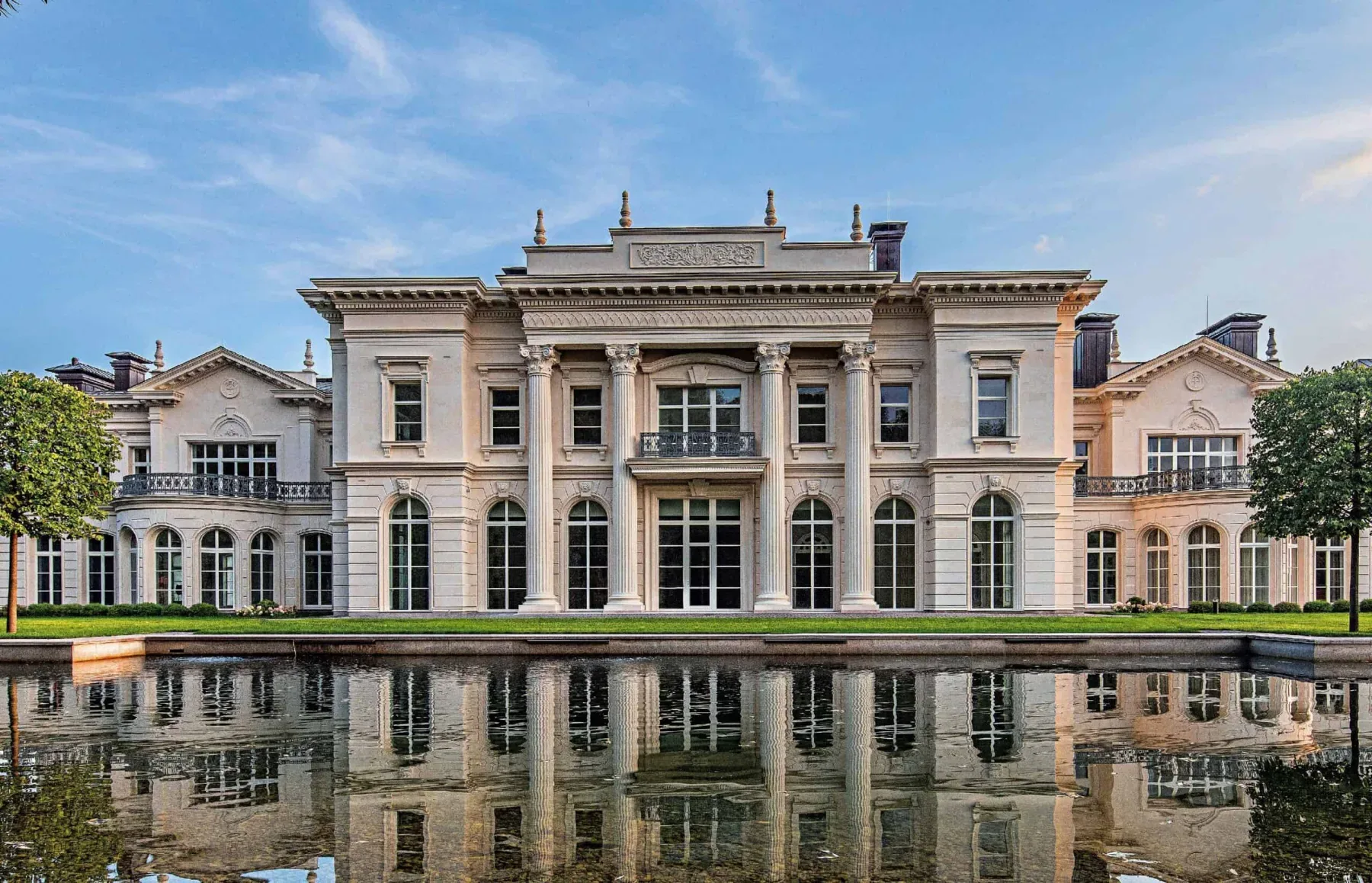
The client wanted not a large house but a palace — a residence of European scale that looks into water like the great estates of Versailles and Caserta. Not showy luxury, but grandeur in proportion and symmetry. So Reggia was born: cream limestone, a ceremonial risalit with paired Corinthian columns and a large mirror pool in which the palace is doubled whole.
Below is the path from idea to image to house: the risalit and paired columns, the attic crest, the curved orangery wings, the mirror pool and the evening reflection.
A palace gathered around an axis
The composition is built on a strict axis. At the centre projects a risalit with paired fluted Corinthian columns, crowned by a high attic with a carved relief panel. To the sides the wings spread in mirror, and at the flanks the palace opens two curved orangery wings with arched glazing. Heavy modillion-and-dentil cornices hold the whole order. The grandeur here is not in the size but in the order.

Risalit and paired columns
The risalit gathers the façade to itself, while the curved wings gently turn the palace toward the water — the scale reads at once, but without heaviness.
An orangery wing
The orangery wings are more than symmetry: they tie the palace to the park and fill the side rooms with light.


Paired columns and the attic crest
The heart of the palace is the central risalit. Paired fluted Corinthian columns rise across two storeys to their carved capitals; above them, a heavy cornice and a high attic with a carved relief panel and stone urns. This is the crest of the house: the relief in the attic gathers the gaze and gives the façade a name. Beneath the columns, a central balcony and a tall ceremonial entrance.

A palace should have a crest — a sign by which it is known. We made it the relief in the attic: it crowns the axis of the house and gives the façade character, not merely scale.
Cream limestone and carving
The whole palace is of cream limestone: smooth planes, the fluting of the columns, the profiles of the heavy cornices, keystones and mascarons above the windows, the carving of the capitals and the attic. The stone is chosen for its nobility and for the way it holds light: by day the limestone is warm and ceremonial, in the golden hour it warms to honey, and the shadow of the modillions and dentils models the cornice in full volume. The luxury is in the quality of the carving, not its quantity.


A true palace is known up close: by the cleanness of the fluting, the precision of the capital, the shadow of the cornice. Grandeur is built of details, not imposed by scale.
Curved wings and a ceremonial court
The arrival obeys the symmetry of the palace. Wrought-iron gates open the view onto the ceremonial court; the drive leads exactly to the risalit on axis. Two curved orangery wings gently embrace the space before the house, and the formal park of clipped topiary and lawns continues the geometry of the façade. From above the whole idea is clear: the palace, the curved wings and the rectangle of the mirror pool gathered into one ceremonial figure.

Arrival on axis
From the ceremonial side the palace is composed and solemn, while the curved wings give it a wide, welcoming gesture.
The garden side
The palace is equally ceremonial from every side: from the forecourt, from the mirror pool and from deep in the park.


At dusk the palace burns in the water
The main view of the palace is from the water. The large rectangular mirror pool lies exactly on axis and doubles the whole façade, down to the last capital. By day a calm, pale palace floats in the water; at dusk all the windows and the arcade light up amber, and a second, fiery palace burns upside down in the dark surface. In winter the frozen pool turns the reflection to ice, and the warm light of the windows is especially bright against the white.

The palace in reflection
The pool is not decor but part of the architecture: it doubles the façade and gives the palace depth and ceremonial calm.
Fire in the water
In the evening the palace reaches full strength: light, symmetry and reflection gather into one solemn scene above the water.


A palace by the water lives twice: once in stone, once in the reflection. Reggia was built so the water always answers the façade, and the sunset doubles its grandeur in fire.
From the studio journal
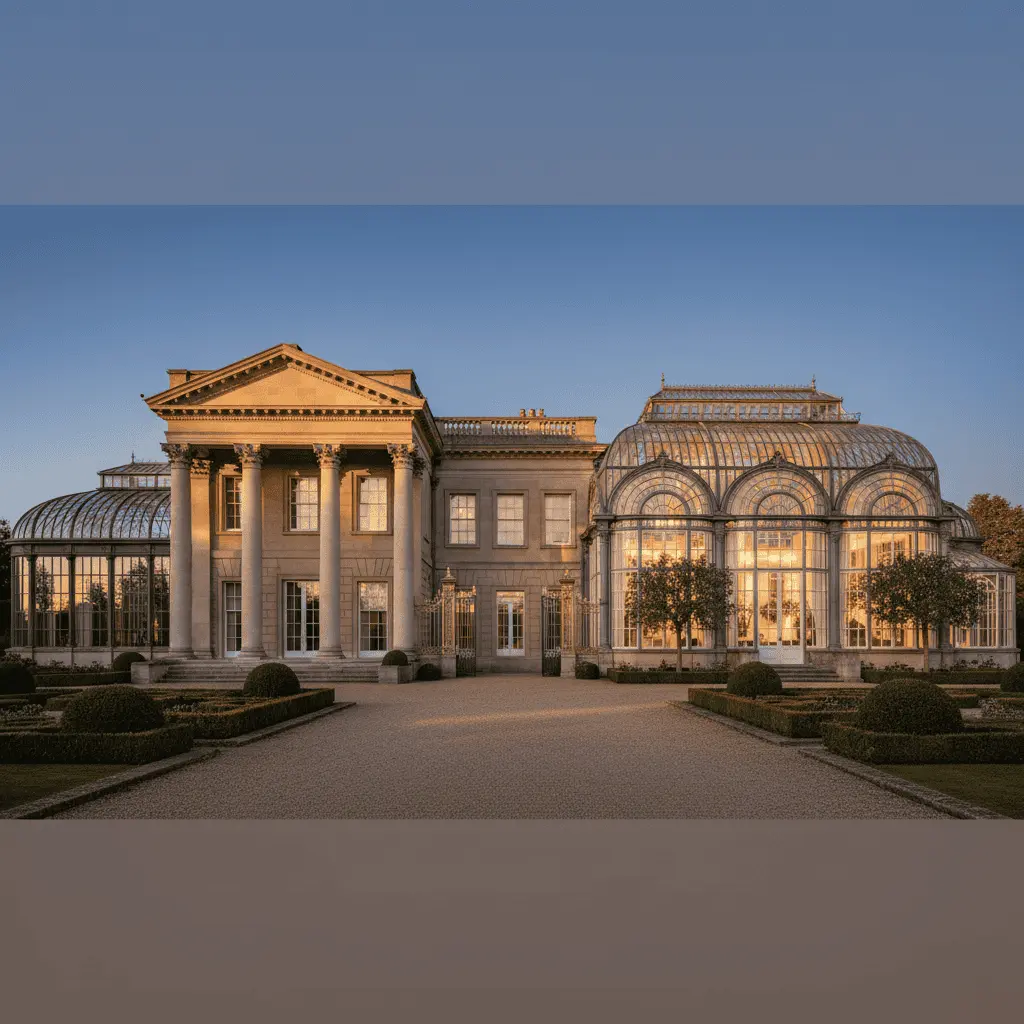
Orangery instead of a winter garden: what the 80 million ruble difference buys
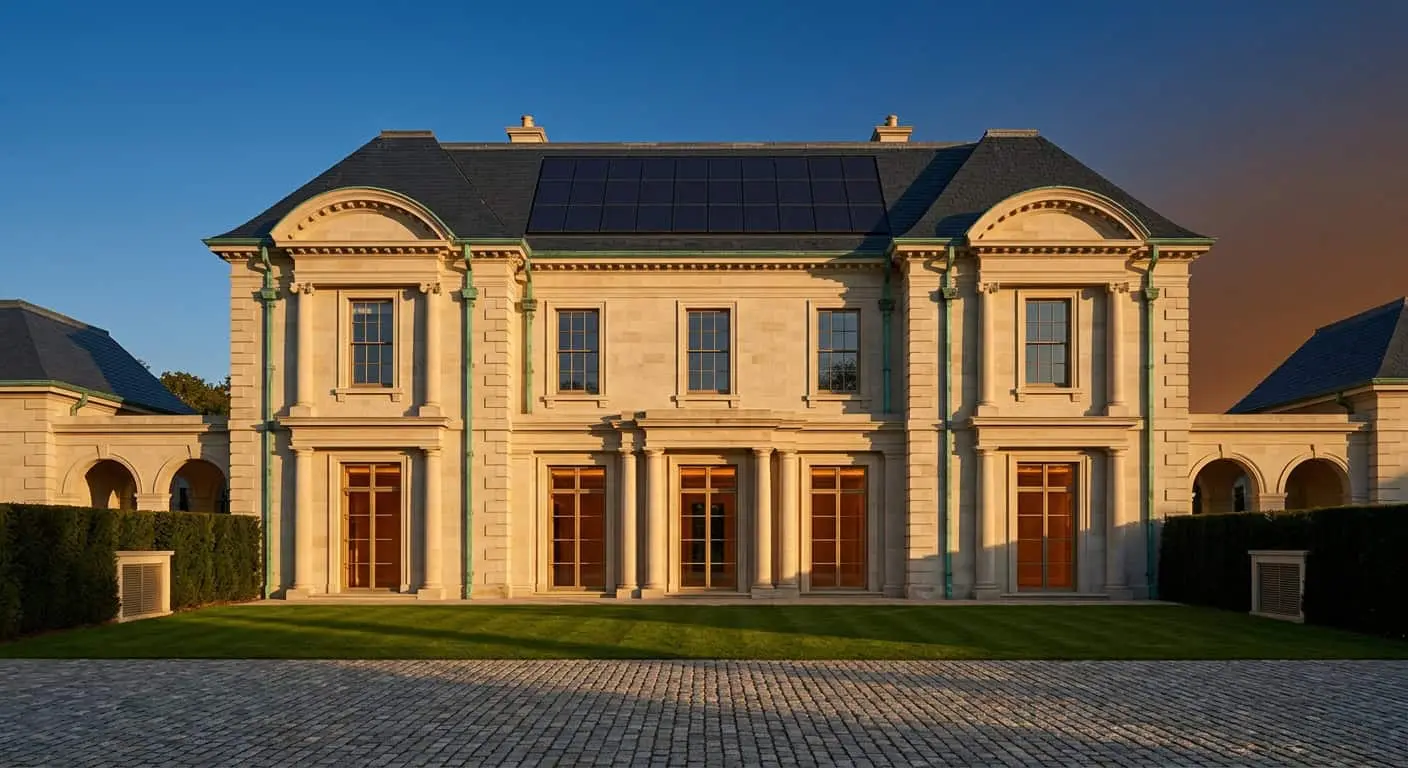
Autonomous Estate: When Disconnecting from Networks Costs More Than Connecting
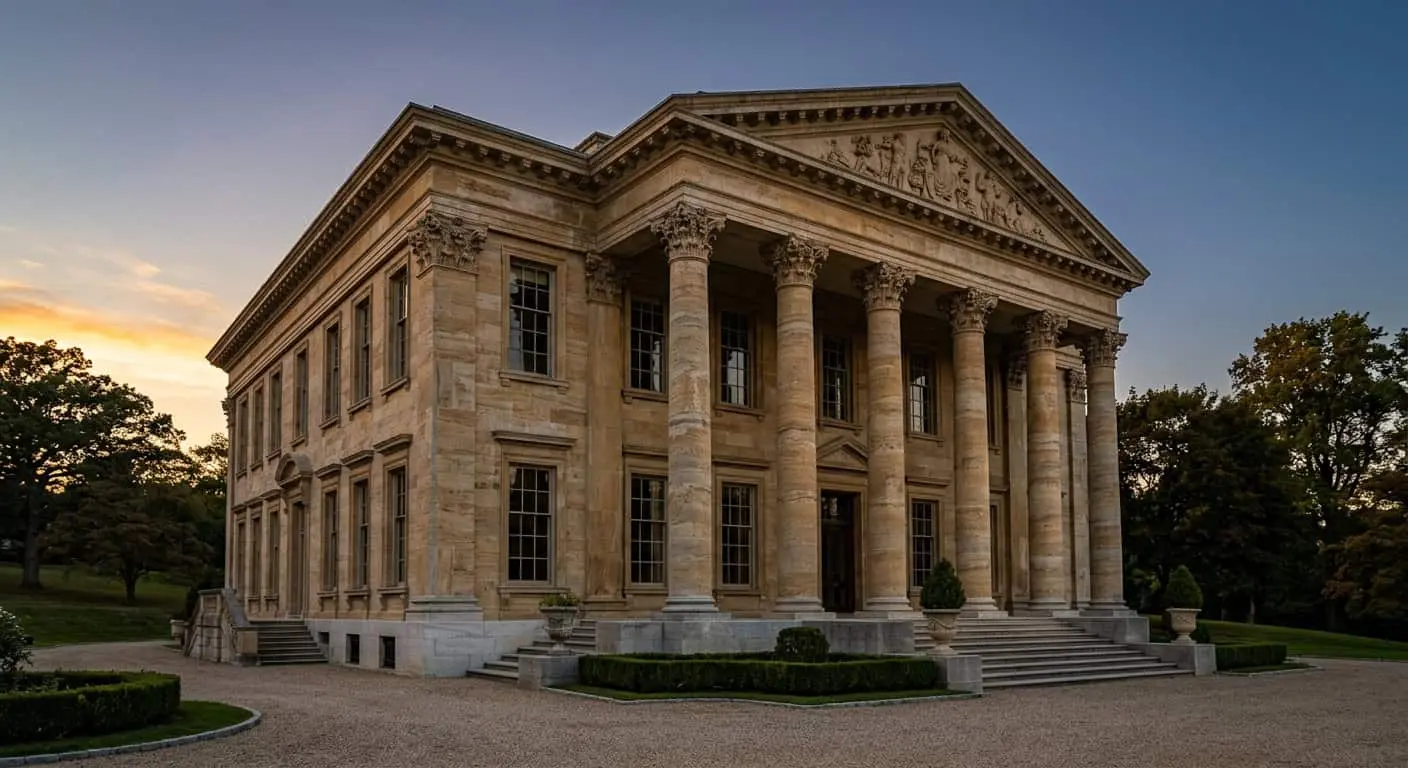
Why Concrete Columns are Gauche: An Honest Conversation About Natural Stone
Related studio service: Architectural design
Next step
A home begins with an idea — let’s discuss yours
We design and build residences of palace scale — with true proportions, honest stone and attention to every detail. A full cycle: architecture, hands-on construction supervision, interiors and a ceremonial landscape with water — from the first image to the reflection of the palace in the pool at sunset.