
Why Concrete Columns are Gauche: An Honest Conversation About Natural Stone
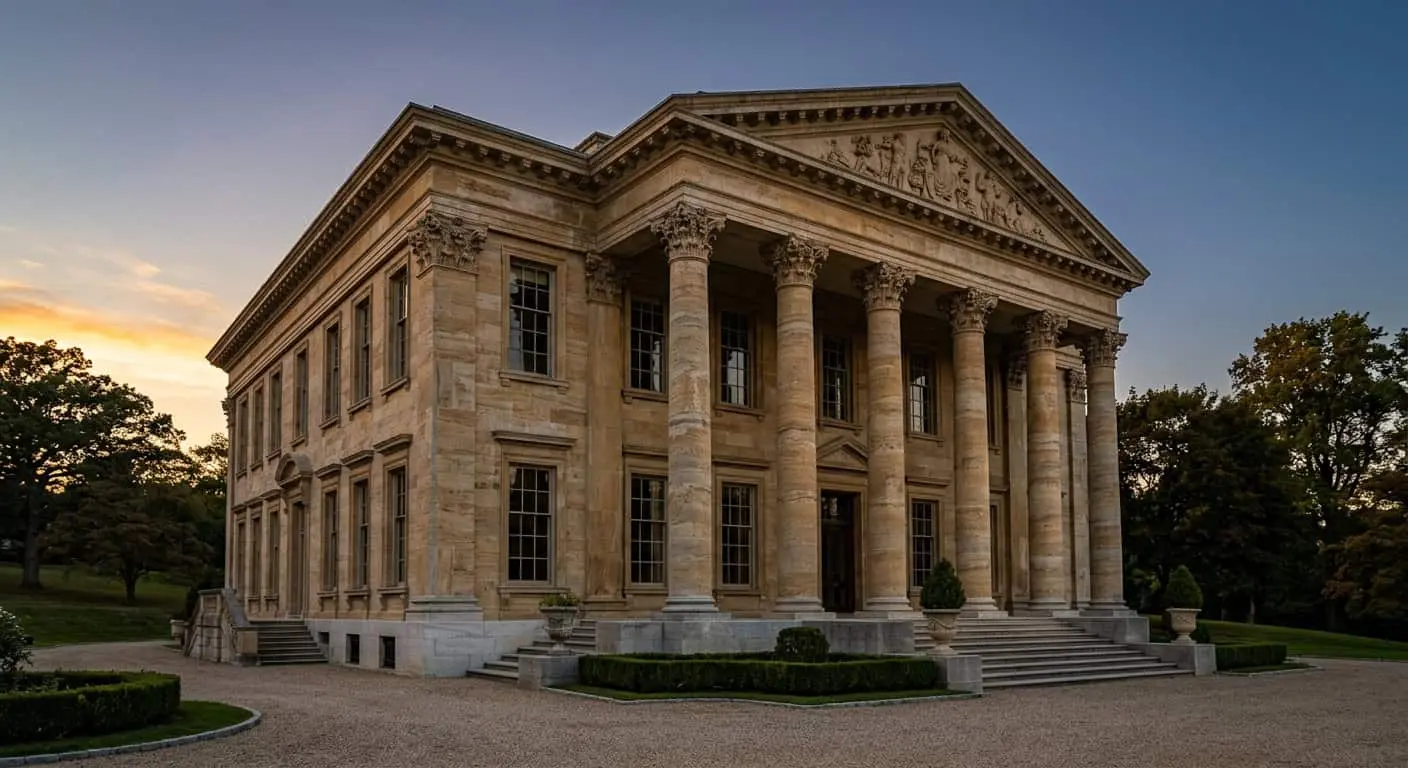
We often get calls with the same request: “We want neoclassical. Like Palladio, but on a budget.” Then the interesting part begins — it turns out “on a budget” means concrete columns with marble chips and coating “as travertine”. And when we explain why in our practice we don’t take on such projects, the client gets offended. And after five years — calls again. Already with photos of cracks and a request to “do something about it”.
This article is about why natural stone columns aren’t luxury and not an architect’s whim, but the only way to make a classical facade that will be worth more in twenty years than on delivery day. About how saving 15 million on the facade turns into minus 80 million to the residence’s value. And about how we tell real neoclassicism from theatrical set dressing from the first glance.
The conversation will be honest. Sometimes — uncomfortable.
Suburban “classics”: what we see on the used market
Drive through Rublyovka, Novaya Riga or Minsk Direction. Look at mansions built in 2010–2015. Those very ones that once rented out for photo shoots with champagne and glossy magazine publications.
Eight out of ten today are in terrible condition. Not because they were poorly maintained. But because they were built fast and “smart”: concrete columns, faced with plaster with marble chips, capitals from polyurethane, cornices from foam with reinforcing mesh.
This isn’t a house. It’s a movie set.
After three winters, the plaster starts peeling at the base — where snow melts and refreezes forty times a season. After five years, the “marble chips” yellows unevenly: faster on the south facade, slower on the north. After seven — longitudinal cracks appear along the columns because the concrete core and decorative layer have different thermal expansion coefficients. By year ten, the facade looks like a set from an abandoned film studio.
And then the owner puts the house up for sale. The realtor looks at the facade and quietly cuts the price by 30–40%. Because the buyer in this segment isn’t a fool — they see that the facade will need to be redone. And redoing a facade on a finished house costs one and a half times more than doing it right initially.
Why concrete and plaster lose to physics
There’s no mystery here. There’s materials science.
A concrete column with decorative coating is a composite of materials with different properties. Concrete shrinks for the first 3–5 years. Plaster is rigid but porous. Polymer additives in “marble chips” are destroyed by UV radiation. Reinforcement inside, at micro-cracks, begins to corrode, and corrosion goes outward — rust streaks appear.
Limestone, travertine, or granite behave differently. They’re monolith. They have one expansion coefficient throughout the cross-section. They don’t peel from themselves. They don’t yellow — they patinate, meaning they acquire a noble tone that architects call “the patina of time”. This is why people go look at Rome, Florence, and Paris.
Portuguese limestone Moca Creme, which we often specify in projects, exists in 16th-century buildings. Five hundred years. Without restoration.
And now honestly tell me — how long will plaster with chips last on a house facade in Istria district?
How to tell real natural stone columns from imitation
There are several markers we advise checking even without a specialist. If you’re looking at someone else’s house — or accepting your own from the contractor.
Joints of blocks. A solid stone column shaft is assembled from 3–5 drums (if the column is over 3 meters tall). Joints are minimal — 1.5–2 mm, filled with restoration compound the color of stone. A concrete imitation either has no joints at all (bad — means it’s a monolith with coating) or they’re rough and noticeable.
Base and capital. On a real Ionic or Corinthian capital, you see the hand finishing of the stone carver. Acanthus leaves have varying depth of undercut, details don’t repeat identically. A polyurethane casting is identical on all columns. Suspiciously perfect.
Weight and sound. Knock. Stone sounds muffled and dense. Concrete with plaster — hollow, rattling sound. This is the simplest check you can do in three seconds.
Ends and bevels. On solid stone you see the structure in the cut — veins, pores, pattern. On imitation, the cut is gray concrete under a thin decorative layer.
The economics of the question: 15 million that turns into 80
Let’s calculate. Without emotions.
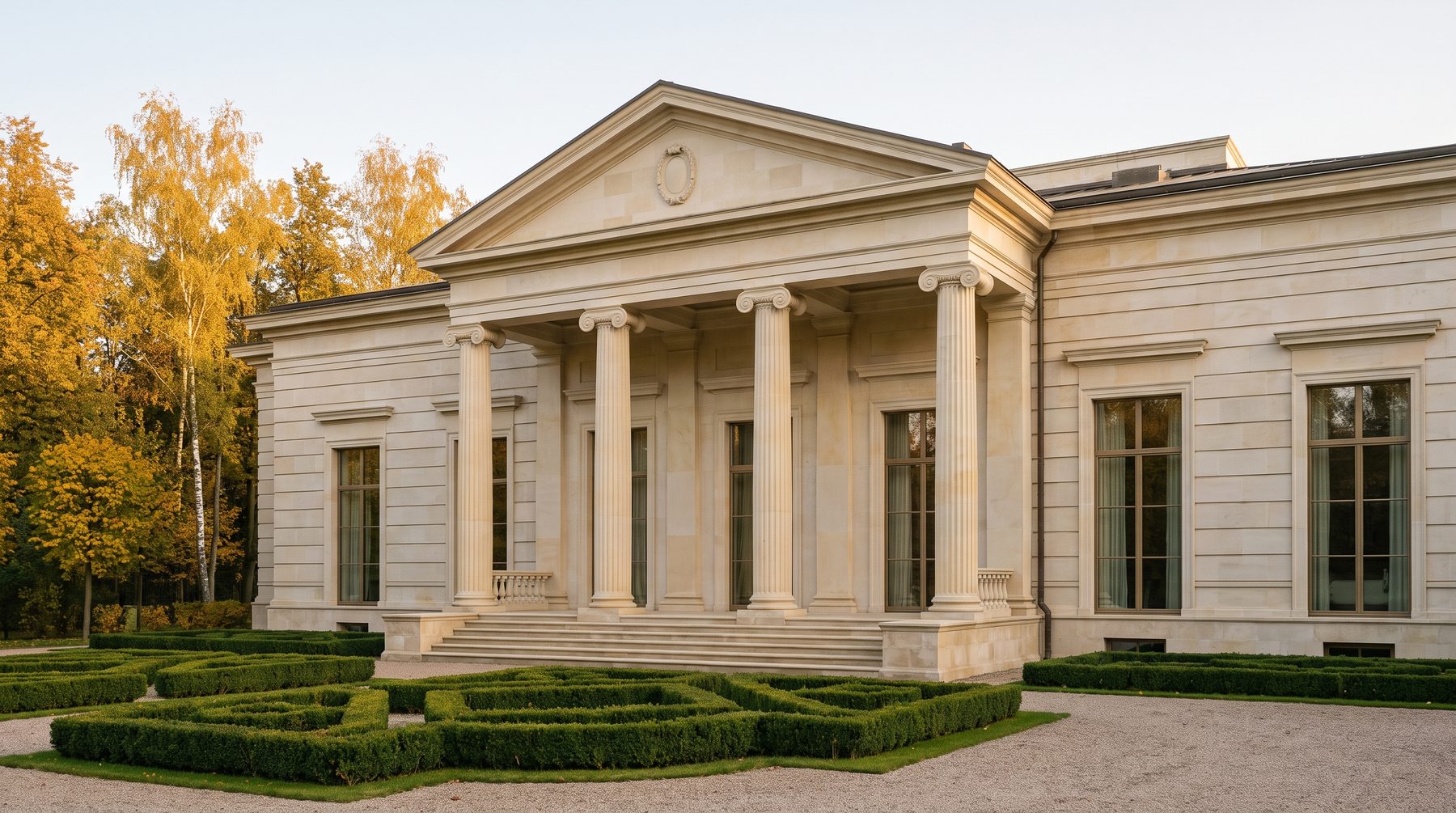
Classical portico on six columns, 4.5 meters high. Base diameter — 500 mm. Material — Italian travertine Navona or Spanish Crema Marfil depending on the task.
Solid stone with installation, delivery and processing: roughly 12–18 million rubles. Depending on grade, country of origin and capital complexity.
Concrete with decorative plaster and polyurethane decor: 2–3 million.
The difference — 12–15 million. Seriously? Yes. But let’s continue.
A residence of 800 m² in a good location with real stone facade sells with a 15–25% premium to market. A residence with “crumbling classicism” — at a 20–30% discount from fair price because the buyer factors in facade repair.
On a home worth 300 million, this is the difference between +60 million and −80 million. A 140 million spread. Because of a decision that cost 15.
And that’s not even counting maintenance. A stone facade is washed once every 5–7 years with soft chemistry. A plaster one — is restored every 3–4 years, and each restoration costs 1.5–2 million.
Our approach: why we specify natural stone columns from the start in the concept
When people come to us with a brief for a classical or neoclassical mansion, we say on the first meeting: either stone or not classical. Find another architect or another style.
This isn’t arrogance. It’s professional honesty.
Classical architecture is the architecture of proportions and material simultaneously. Vitruvius, Palladio, Rossi — they all designed in stone. The proportions of the order, entasis of the shaft (that slight swell in the middle of the column), the play of light on polished and sanded surface — all this works only with real material. A concrete imitation is flat and dead. Light doesn’t live on it.
In our practice, there was a telling project. A residence in Gorki-8, 2018. The client insisted on concrete columns faced with acrylic stone — “the neighbor did it that way and it seems fine”. We refused to work on those terms and offered a compromise: reduce the portico from eight columns to four, but make them from solid Dagestani limestone. The savings on quantity completely covered the material difference. The house was delivered in 2020. In 2023 it sold for 22% above the district’s market square meter price. The new owner came to look and said: “I’m buying it for this portico”.
Four columns. Real ones. Defeated eight — fake ones.
Typical customer mistakes when choosing column material
Over ten years we’ve assembled a collection of decisions clients later regretted.
Mistake one: saving on stone grade while maintaining “correct” column quantity. Client wants an eight-column portico but hasn’t got the budget for eight travertine ones. Takes cheap sandstone of questionable origin. After two winters the sandstone starts crumbling — it doesn’t tolerate Moscow freeze-thaw cycles well. Better four from good limestone than eight from questionable sandstone.
Mistake two: trusting a contractor who “has done this before”. Work with natural stone requires different technologies. You need installation on stainless anchors, proper thermal insulation layer, ventilated gap. A crew that plastered facades simply can’t do it. We always ask to show 2–3 completed objects with stone columns aged at least 5 years.
Mistake three: polished stone on exterior columns. Beautiful on render, disaster in reality. Polished surface outdoors gets micro-cracks from temperature fluctuation and loses shine in 2–3 seasons. For exterior — only grinding, bush-hammering or thermal treatment. Leave polishing for interiors.
Mistake four: mixing stone types without understanding. Customers sometimes want “columns from one stone, bases from another, capitals from a third”. Theoretically — possible. In practice, stones live differently: one darkens, another lightens, a third gets moss in the shade. In ten years the facade becomes blotchy. We usually make columns from one breed, allowing contrast only on the plinth.
What stone we use and why
There’s no universal answer. Choice depends on style, climate, budget — and what matters — on the character of the future owner.
Travertine (Italian, Iranian, Turkish). Classic for neoclassical and Mediterranean style. Warm, alive, with characteristic pores. Requires hydrophobic treatment every 5–7 years. Ideal for south and southwest-facing facades.
Limestone (Portuguese, Dagestani, Crimean). Our favorite for Russian manor neoclassicism. Soft in processing — allows complex capitals and cornices. Portuguese Moca Cream — one of the best for frost resistance.
Granite. For strict, masculine architecture. Stalinist Ampir, modern neoclassicism with a brutal accent. Almost eternal, but cold in feeling and difficult to process complex profiles.
Marble. Only for interior columns or very protected porticos under deep overhang. On an open facade in the Moscow region — a choice you’ll regret.
Natural stone columns are never just material. It’s always a conversation about the character of the house. A travertine portico sounds different from a granite one. You need to feel it.
What to do if the house is already built with concrete columns
Honest answer: depends on age and condition.
If the house is 2–3 years old and columns haven’t started failing yet, you can do preventive hydrophobic treatment and reinforce the plaster layer. This will extend the facade’s life by 5–7 years.
If the columns are 5+ years old and cracks have appeared — there’s one solution. Demolition and replacement with stone. We’ve done several such reconstructions. It costs roughly the same as from scratch, sometimes more — because of demolition work and fitting to existing proportions.
But there’s an alternative few know about. Facing existing concrete columns with natural stone slabs 30–40 mm thick on a special substructure. You get a real stone facade without full demolition. Proportions need recalculating — the column gets thicker, the entablature needs adjustment. But it’s a real way to turn “set dressing” into real architecture.
We did such reconstruction on a 2012 building. It cost more than starting from stone. But cheaper than tearing down the facade. Client is happy — the house looks like a residence again, not a peeling set.
Instead of a conclusion
Architecture is about time. About what the building looks like not on delivery day, but in 10, 20, 50 years. This is why we’re so insistent about materials. This is why natural stone columns are not an option but the only serious way to do classical.
You might argue: “We’re not planning to live in this house fifty years”. Fair. But a house built for decades sells for more even after five. The market feels authenticity. The premium-segment buyer tells stone from concrete the same way a collector tells an original from a print.
If you’re now at the design stage and uncertain — come to our office. We’ll show you stone samples, calculations for specific porticos, and photos of our projects of various ages. No obligation. Just so you make the decision with open eyes.
And if you’ve decided to build fast and cheap — build. Just don’t call it classical. And don’t be surprised in five years.
Next step
Discuss your project
An hour at the studio with Oleg Reznikov: your site, your brief and relevant studio projects.