
Art Deco Without the Gold: How Geometry Came Back
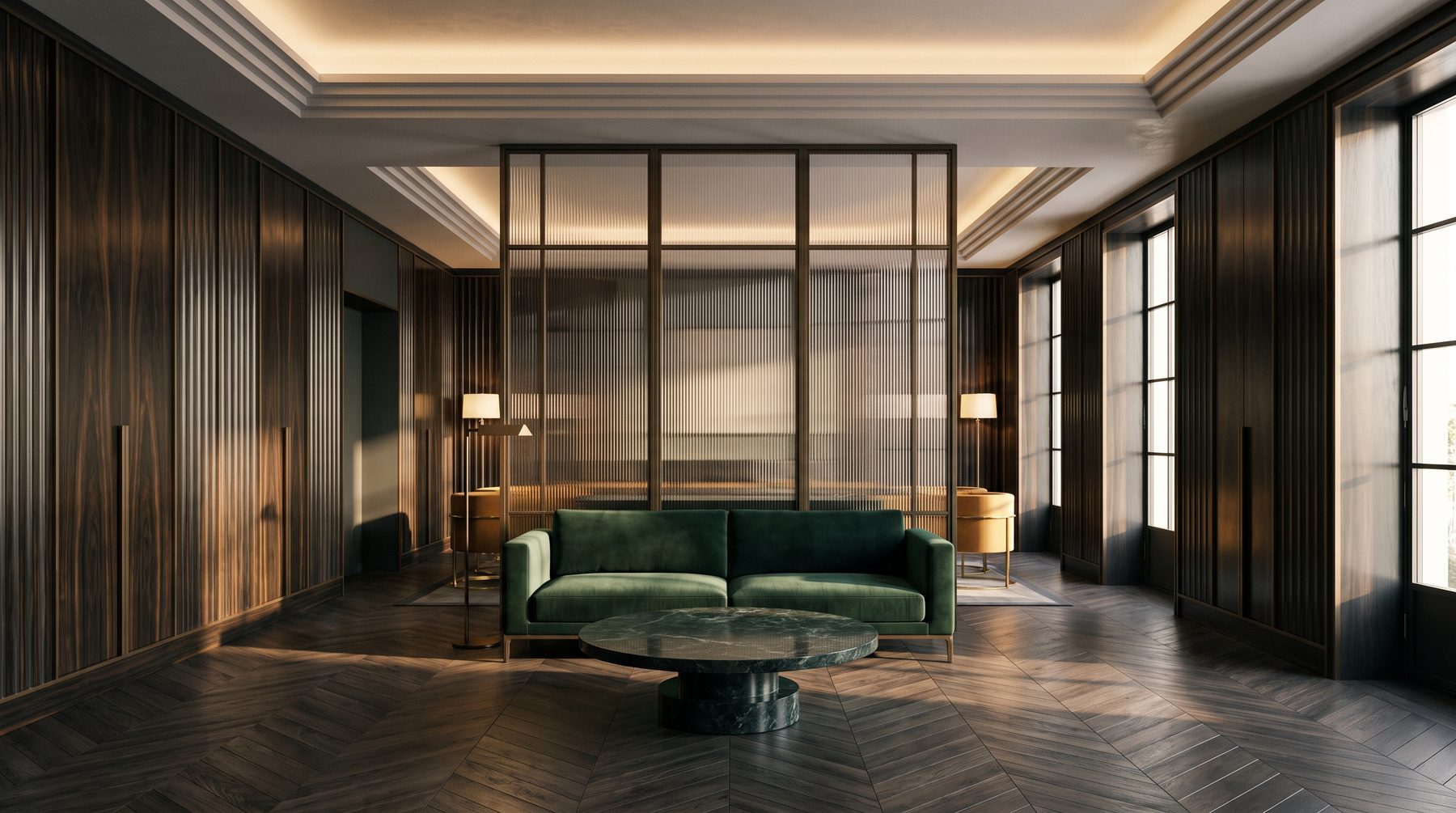
Modern Art Deco is a matter of geometry, not gilding. A stepped cornice, fluted door fronts, a chevron floor, hard symmetry and two or three noble materials. Very little metal is left, and what remains is matte: a line of dark bronze about as thick as a pencil. What reads as expensive today is order, not shine.
Last autumn a client arrived with a folder of printouts. Twenty pages of gold mouldings, mirrored diamond panels, cascade chandeliers, black-and-white marble in a chequerboard. “I want Art Deco,” he said, with the look of a man braced for an argument.
I didn’t argue. I only asked whether he had been to Paris that winter.
Because from 21 October 2025 to 29 March 2026 the Musée des Arts Décoratifs was running “1925–2025. One Hundred Years of Art Deco” — a century since the International Exhibition of Modern Decorative and Industrial Arts that gave the style its name. And the pieces on show looked nothing like his printouts. There is almost no gold in them. There is geometry.
The centenary that took the style out of costume
A hundred years makes a convenient headline, but the renewed interest didn’t come from the anniversary. Houzz, surveying a community of more than 70 million homeowners and 3 million professionals, put Art Deco among its leading predictions for 2026: searches for “Art Deco” rose 22% over three quarters against the same period in 2024, and “Art Deco bathroom” rose 144%. One room delivered growth half again as strong as the style overall. Hold that thought.
The reason is simple and almost physiological: people are tired of interiors with no properties. For fifteen years high-end construction scrubbed houses down to white plasterboard and hidden skirtings, and at some point it turned out that a forty-million-rouble living room and an office lobby differ only in the view from the window. Art Deco came back as the one historical style that can be expressive without sliding into palace pastiche.
But here is where it gets interesting. It didn’t come back whole.
Geometry instead of gold: what today’s Art Deco is made of
Break the current version down into parts and metal barely appears on the list. What remains is this.
Fluting. Vertical machining across veneer and stone — the most visible device of the past two seasons. It works at every distance: from three metres it is texture, from thirty centimetres it is the grain reading inside each rib. Fluting has taken over the role inlay played a century ago.
Reeded glass. Transparency without visibility. A screen between hall and living room, bar fronts, a panel beside the stair. Reeding gives verticality where glass usually leaves a hole.
Stepped form. A cornice in three offsets, a fireplace surround with breaks, a cabinet plinth in two steps. It quotes the twenties directly, but quietly now: a 20–30 mm offset rather than a tiered ziggurat.
Chevron. Not herringbone — true chevron, with the boards mitred so the joint forms one continuous arrow. Roughly one and a half times the laying cost of herringbone, and the difference registers immediately.
Sunbursts. The one element that is almost always surplus in a modern reading. One mirror per house. More than that and it becomes a themed party.
The palette has shifted too. Instead of black-and-white chequerboard: emerald, ochre, charcoal, dark green stone, deep wine. Colour has grown warmer and darker, and contrast has moved out of hue into texture — matte against reeded, veneer against plaster.
The materials that make the style expensive
Art Deco was always a style of materials rather than forms. Its forms are simple; its surfaces are not.
Macassar ebony. The striped wood of the era. It arrives as veneer 0.6 mm thick; a finished wall panel is around 13 mm and roughly 14 kg per square metre. In a room 3.2 metres high that is nearly 45 kg per linear metre of wall — a dull figure right up to the moment you discover that the framing and fixings for such a panel belonged in the structural drawings, not in a conversation held after the plastering.
Shagreen. Galuchat, ray skin, with its granular surface. Table tops, cabinet fronts, mirror frames. In the twenties it covered whole planes; today it appears as inserts, because a single skin is small and the layout becomes a job of its own.
Parchment. Jean-Michel Frank’s device: a wall clad in fine-grained hide laid out as a map of joints. The quietest luxury available — from two steps it is simply a pale wall, from one you can see it was assembled by hand from a hundred rectangles.
Verre églomisé. Mirror painted or leafed on the reverse of the glass. It is the only place where gold still belongs in a modern Art Deco interior, and even there it is muted, aged, uneven.
How seriously the market takes all this shows at auction. A pair of Émile-Jacques Ruhlmann stools in Macassar ebony and silvered bronze, circa 1926, sold at Bonhams for $209,000 against a high estimate of $90,000 — more than twice what was expected. A pair of Cannelé armchairs from the same commission made $81,250. Buyers were not paying for gold. They were paying for cabinetry and proportion.
Five mistakes that make Art Deco look cheap
Here is where most people go wrong.
One: gold as the primary metal. Polished brass on the skirting, the door frame, the legs, the chandelier and the tap all at once. In this style metal is an accent, not a finish. One alloy per room, matte or brushed, and no more than five per cent of the visible surface.
Two: three geometries in one room. Chevron underfoot, diamonds on the wall, a sunburst overhead. Each device is good alone; together they fight. The working rule is one hero pattern: if the floor is chevron, the walls hold the vertical with fluting and keep quiet.
Three: gloss everywhere. Polished marble, lacquered veneer, mirrored inserts, high-gloss enamel. In the twenties shine was a technological novelty; today it is the signature of a cheap reading. Take stone honed, veneer in matte oil, and leave the gloss to églomisé and glass.
Four: the wrong proportion. Art Deco was born in rooms with ceilings from three and a half metres up. A stepped cornice in a room 2.9 metres high eats the last centimetres and turns it into a shoebox. Under a low ceiling you keep fluting, chevron and colour; the cornice is the first thing to go.
Five, and the most expensive: style as appliqué. The decoration is invented once the shell is finished. Then it emerges that a panel weighing 45 kg per metre has nothing to hang on, that there is no cable for the concealed light in the cornice offset, and that the recess for the églomisé mirror lands exactly on a riser. The geometry of this style is structure, not finish. We fix those decisions while the floor slabs are still being drawn, so that interior decoration picks up prepared surfaces instead of rescuing the situation.
Our approach: three rules we don’t bend
First. One metal, one pattern, one hero per room. Everything else is background. Discipline of palette reads as expense more reliably than any expensive material, and that is probably the central lesson of the centenary.
Second. Geometry goes into the axes. The fluting module is tied to door width and window rhythm so no rib is cut off mid-pier. Chevron is laid from the axis of the enfilade, not from a corner. This is not fussiness: a pattern set off-axis reads as a defect even to someone who cannot say why.
Third. Material is chosen for use, not for the picture. No shagreen on a table where children eat. No parchment in a corridor with dogs. No Macassar facing a south window without film on the glass — striped ebony fades faster than walnut, and in three years the panel by the window will be lighter than the panel deep in the room. That filtering happens early, at the stage where the character of the rooms is still being set — see how we structure an interior concept: the Deco we build rests on wood, stone and light, with almost no metal in frame.
Where it works in a 1,000 m² house, and where it doesn’t
It works where people pass through rather than settle for hours. The hall and the stair volume are the best places: geometry reads in movement, and that is exactly where expensive joinery repays itself. A study comes second — fluted panels around the perimeter make an excellent backdrop for video calls and kill the echo.
And bathrooms. That 144% jump in searches is no accident: a small room, expensive stone needed only in two or three slabs, and a hundred per cent of the effect. A bathroom is the cheapest way to get real Art Deco into a house — and the most common one.
It does not work in children’s rooms, in the spa, or in the kitchen-dining room where a family spends five hours a day. The style demands attention: what is magnificent for a ten-minute passage starts to press on you by the fifth hour. In those rooms we keep only the material and the proportion, and drop the geometry.
One last thing, about money. Art Deco does not get expensive at the design stage; it gets expensive at the ordering stage. Complex machined joinery, veneer cut from a single batch, stone from a single block — these are long-lead items with a three to four month production cycle, and they cannot be topped up along the way. That is why our schedule of materials and furniture closes before finishing begins.
The client with the folder of printouts ended up with a hall in fluted Macassar panels, a cornice of two offsets and a single églomisé mirror on the end wall. The gold in that room covers roughly the area of a palm. He shows the hall to everyone who walks into the house.
Frequently asked questions
How does modern Art Deco differ from the historical style
The modern version keeps the geometry, symmetry and expensive materials but drops almost all the gold, gloss and ornamental overload. Metal is reduced to matte bronze in an accent role, the palette has moved towards emerald, ochre and charcoal, and decorative devices are rationed: one hero pattern per room instead of three at once.
Does Art Deco suit a house with three-metre ceilings
Partly. Stepped cornices and tall portals need at least 3.5 metres or they visually consume the height. At around three metres the devices that work are full-height fluted panels, a chevron floor, deep colour and reeded glass — none of which take verticality away, and all of which add it.
What does an Art Deco fit-out cost
The cost is set by joinery, not by style: veneered panels with complex machining, veneer cut from one batch and stone from one block run two to three times an ordinary fit-out. It is wiser to economise on area than on quality — a full Art Deco hall and bathroom is cheaper and more convincing than a diluted version throughout the house.
Which materials are essential to Art Deco
None are essential; several are characteristic — striped Macassar ebony, shagreen, parchment, verre églomisé, honed stone with strong figure, and matte bronze. Two or three of them are enough. What matters far more is discipline: one metal, one hero pattern, and geometry tied to the axes of the room. Without that, even the most expensive materials read as scenery.

Author

Next step
Discuss your project
An hour at the studio with Oleg Reznikov: your site, your brief and relevant studio projects.