
Why a Marble Hall Costing 40 Million Looks Cheaper Than Travertine for 12
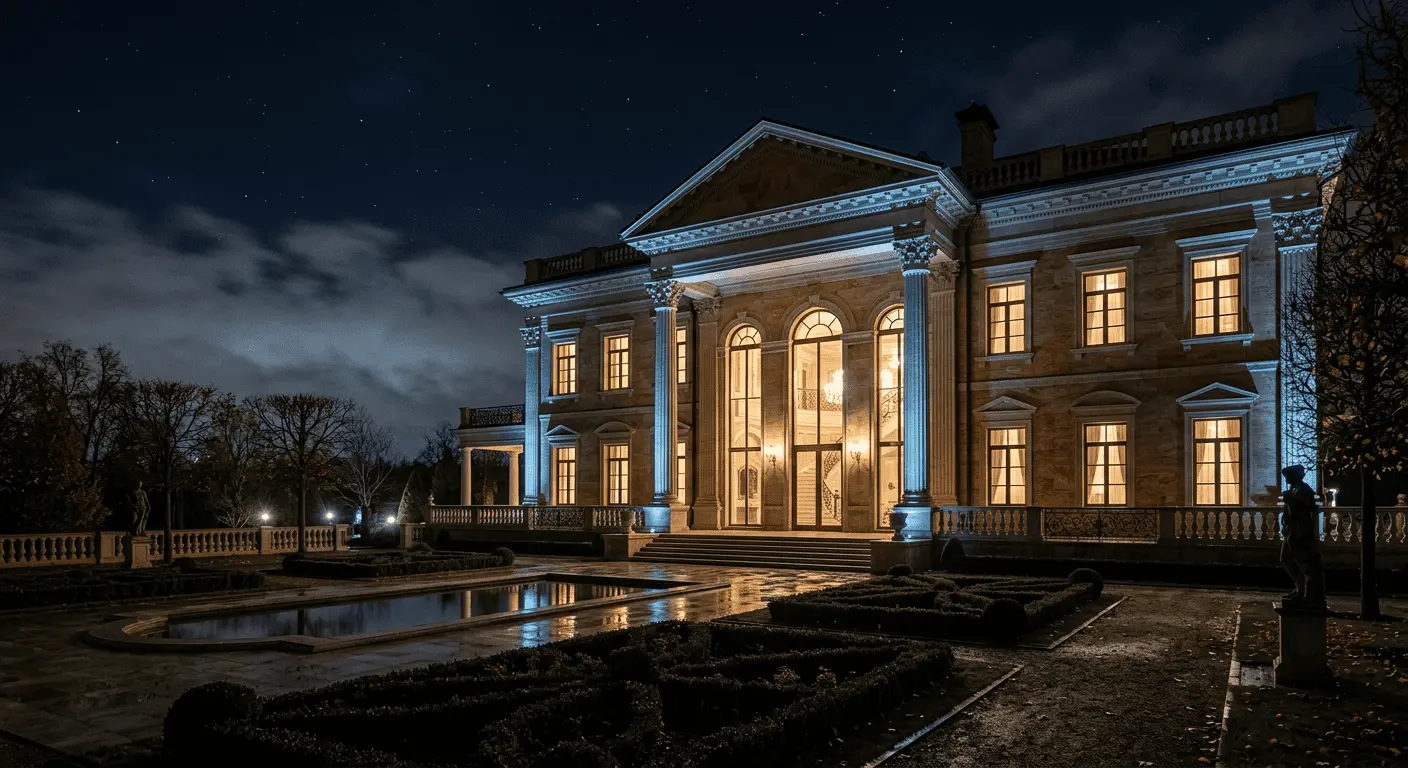
Recently we walked into a newly completed mansion in the Moscow region. 1800 square meters, architect with a name, unlimited budget. Grand hall marble Calacatta from floor to ceiling — book-matched, polished surface, golden vein running through the entire wall like a flourish. The contractor proudly named the sum: 41 million for just stone and installation.
And you know what we thought, standing in this hall? “Business-class apartments by Fili metro”.
This isn’t snobbery. It’s an observation accumulated over years. The most expensive marble in Russia has stopped being a sign of status — it became a sign of budget. And those, if you think about it, are completely different things. In this article we’ll break down why grand marble halls — Calacatta or Statuario — increasingly read as “expensive new construction”, while travertine for a third the price reads as a European residence. And how clients wanting premium get the exact opposite effect.
Stone price and its status value — these are different axes
Here’s the thesis everything starts from: material cost and its ability to create a sense of nobility — these aren’t the same thing. These axes sometimes align, but usually — don’t.
Calacatta Borghini retail — 45–70 thousand rubles per square meter of slab. Good Italian Romano Classico travertine class — 12–18 thousand. Three to four times difference. But try walking through any premium-class developer project of the last five years. Entry groups, lobbies, restrooms in showrooms — there it is, Calacatta. Sometimes real, often ceramic “under Calacatta”, but visually an average person doesn’t tell them apart.
And here’s what happens to perception: the brain reads not price, but pattern. And the pattern of bold contrasting vein on white background is now permanently linked to mass-market segment.
Grand hall marble: why Calacatta no longer works
Ten years ago everything was different. Calacatta, Statuario, Arabescato — these were materials that most people saw only in museums and classical European interior photos. Rarity equaled status.
Then came the developer boom. And Turkish quarries learned to supply similar patterns in industrial volumes. Then ceramic, which today imitates Calacatta so well you can’t tell up close. Result: grand marble hall with thick gray vein on white field became visual cliché.
We often tell clients: if your hall looks like a developer’s render — something went wrong. Even if you spent forty million on it.
There’s a second problem, more subtle. Calacatta and Statuario are loud stones. They demand attention. In a private residence, where the owner needn’t prove anything to anyone, loud stone works against the owner. It shouts: “look how much this costs”. But a real residence whispers: “we’ve lived here for generations”.
What makes stone “residential”
In our practice we’ve identified several signs by which stone reads as “ancestral” rather than “expensive”:
Matte, non-polished finish. Antique, satin, light bush-hammered, flame-finished. Polishing — this is restaurant and hotel lobby. In a private house polish is appropriate locally: countertop, fireplace wall fragment. But not the entire hall in mirrors. Polished grand hall almost always looks younger than its money.
Warm color palette. Cream, sand, light walnut, gray-beige. Cold white with gray vein — this is commercial architecture language. Warm palette — residential language. Especially — residence where people want to return at eight in the evening.
Quiet pattern. Fine travertine cavities, uniform limestone structure, restrained Crema Marfil vein. Stone should be background, not soloist. Soloist should be architecture: proportions, light, staircase, door portals.
Slab format and layout. Enormous slabs 3×1.5 meters with book-matching — this is again lobby language. In a residence, medium-format slabs laid “like old masonry”, sometimes with intentionally imperfect joints. This reads as “the house has stood long”.
Story from practice: how 12 million travertine outplayed 40 million marble
About three years ago a family came to us, already begun construction with another studio. House 2100 square meters, art deco with French accent. Hall was designed in classical Calacatta, marble budget — about 38 million.
We looked at the project and said: will look like a five-star hotel reception in Sochi. The client got offended first. Then asked for an alternative.
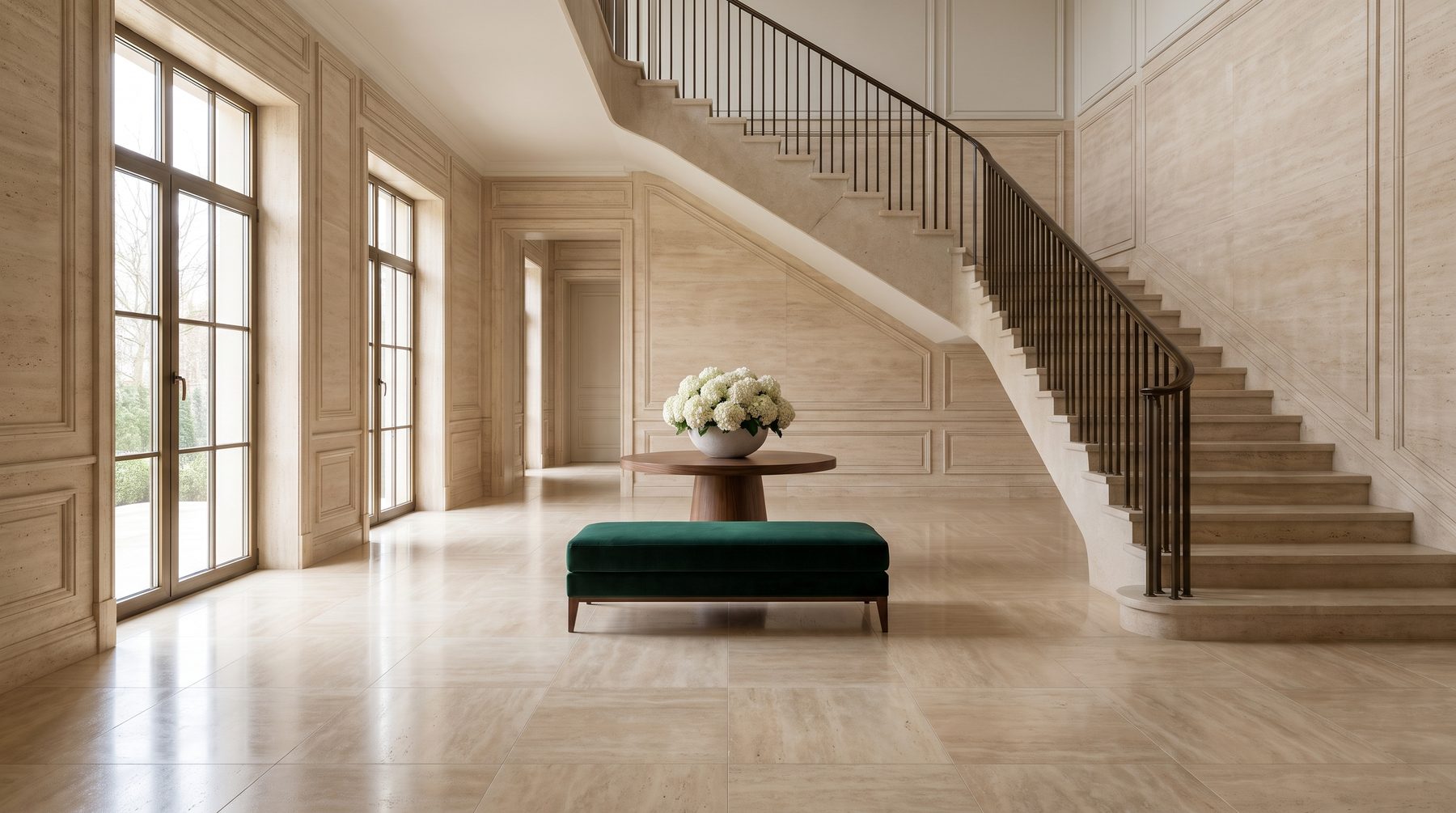
We offered travertino navona with filled pores, Spazzolato finish (brushed + satin), laid in 80×40 slabs with offset, with matte natural-based lacquer. Warm, almost caramel tone. Walls — same stone but thicker panels with 5 mm chamfer creating shadow. Floor — herringbone from same material but different cutting, to avoid monotony.
Stone budget — 11.8 million. More than three times cheaper.
What came out in the end. A hall you enter and spend the first three seconds thinking the house is seventy years old. That people lived here before the current owners. That it’s not “made”, it “exists”. Not one guest in two years since moving said “how expensive”. But everyone says “how beautiful”.
That’s the difference between expensive and premium.
Grand hall marble and the myth of “eternal value”
Separately worth discussing the myth marble sellers often use: “it’s an investment, it’s for centuries, it will never go out of style”.
It will. Already is.
Fashion for specific stone types exists just like fashion for stained oak versus rustic oak. In the eighties, status was verde alpi green marble. Today bathrooms in 25 m² studios are finished in it. In the nineties — rouge royal red. Now you barely buy it — not because the quarry closed, but because nobody wants it.
Calacatta will follow the same path. Already starting to. In ten years, a grand marble hall in Calacatta will date a house as precisely as euro-renovation with arches dates a nineties apartment.
Travertine, limestone, sandstone, chalk — these are stones used in European residences five hundred years and will be used another five hundred. They don’t go out of fashion because they never went into it. They’re the basic language of architecture, not a seasonal accent.
Typical client mistakes
Over years of practice we’ve seen the same scenarios. We’ll list them so you don’t repeat.
Mistake one: choosing by showroom photo. Client goes to the salon, sees backlit Calacatta slab on black velvet and falls in love. But a slab in the salon and 200 square meters of same stone in a real hall — these are two different impressions. Salon lighting is dramatic, home — diffused. What looked like a sculpture becomes background. Loud stone in diffuse light loses half its effect and gains all its “bought” heaviness.
Mistake two: “if expensive — it shows right away”. Logic makes sense, but it’s wrong. A guest entering the house doesn’t know the stone cost. He reads general impression: harmonious or not, warm or cold, expensive-looking or not. And “expensive-looking” — this is a composition question, not accounting.
Mistake three: full matching of everything with everything. When floor, walls, staircase, portals and even first-floor restroom are from one material — this isn’t luxury, it’s monotony. In real residences materials combine: floor stone, wooden border, walls with stone baseboard, marble fireplace portal. Texture variety — sign of a lived-in house, not a studio apartment.
Mistake four: polish everywhere possible. We said it but will repeat. Polished floor in 80 m² hall — this is a bank vestibule. Matte, satin, or brushed finish with light waxed finish — this is a house.
Mistake five: economizing on installation with expensive stone. A paradox, but constantly seen. They order Calacatta for 60 thousand per meter but pay 3 thousand per meter for installation by a crew that tiled a supermarket yesterday. Seams flow, chamfers are uneven, book-matching is off by 2 mm — and stone is dead. Installation of noble stone sometimes costs more than the stone itself. This is normal.
How we approach stone choice for the grand zone
In Reznikov Studio, stone choice for the hall — this is always a last step, not first. First — architecture, proportions, movement scenario, light. Then — overall material palette. Only then — specific stone, which should support that palette, not overtake it.
We almost always recommend clients don’t rush to the showroom. First — look at completed objects. European XIX-century residences, Tuscany villas, Paris mansions. See how stone looks after fifty years of use. Find that matte, patina, softness that new Calacatta will give only in half a century — if ever.
Then — we go to the quarry or warehouse. Not the showroom. The warehouse where slabs stand in daylight, where you can see them together, compare, reject. Stone choice in a lit showroom — it’s like choosing a wife in a nightclub. Technically possible, but for a responsible decision it doesn’t look like it.
Third: we always make 1:1 mockup. At least 2×2 meter wall fragment with actual layout, actual seam, actual finish. Because a grand marble hall on a render and the same hall in reality — these are two different objects. Render doesn’t convey texture, doesn’t convey stone’s warmth, doesn’t show how it behaves in side light from the window.
When marble is still appropriate
To not create the impression we’ve declared war on marble — we haven’t. Marble is superb. But it needs different place.
Fireplace in library — portal from black marquina or deep verde alpi with matte treatment. Excellent. Countertop in master bath — Statuario with fine vein, locally, as accent. Perfect. Floor fragment as medallion under dome in hall — Carrara with mosaic inlay. Expensive and purposeful.
But a grand marble hall entirely, from baseboard to ceiling, in polished Calacatta — this solution worked in 2015. Today it reads differently.
Brief summary for those who read to the end
Stone price — this is accounting. Stone status — this is culture. Different categories, and mixing them is dangerous for both budget and result.
Travertine, limestone, chalk, sandstone, quiet cream Crema Marfil marble, wild slate — this is the language real residences speak. Quiet, confident, needing no confirmation.
Calacatta and Statuario — also superb materials, but they need different context: public, exhibition, accent. In a large grand hall of a private house they almost always lose to more modest but correctly chosen stone.
We’re not against expensive. We’re against expensive that looks mass-market. And for reasonable that looks ancestral.
If you’re now choosing materials for your house and aren’t sure Calacatta is right — write us. We don’t sell stone and don’t take commissions from quarries. We just honestly say what from chosen will work and what in five years will want redoing. Sometimes this conversation saves the client thirty million. Sometimes — just saves the house from looking younger than its money.

Author

Next step
Discuss your project
An hour at the studio with Oleg Reznikov: your site, your brief and relevant studio projects.