
How to Care for Travertine: An Architect’s Checklist
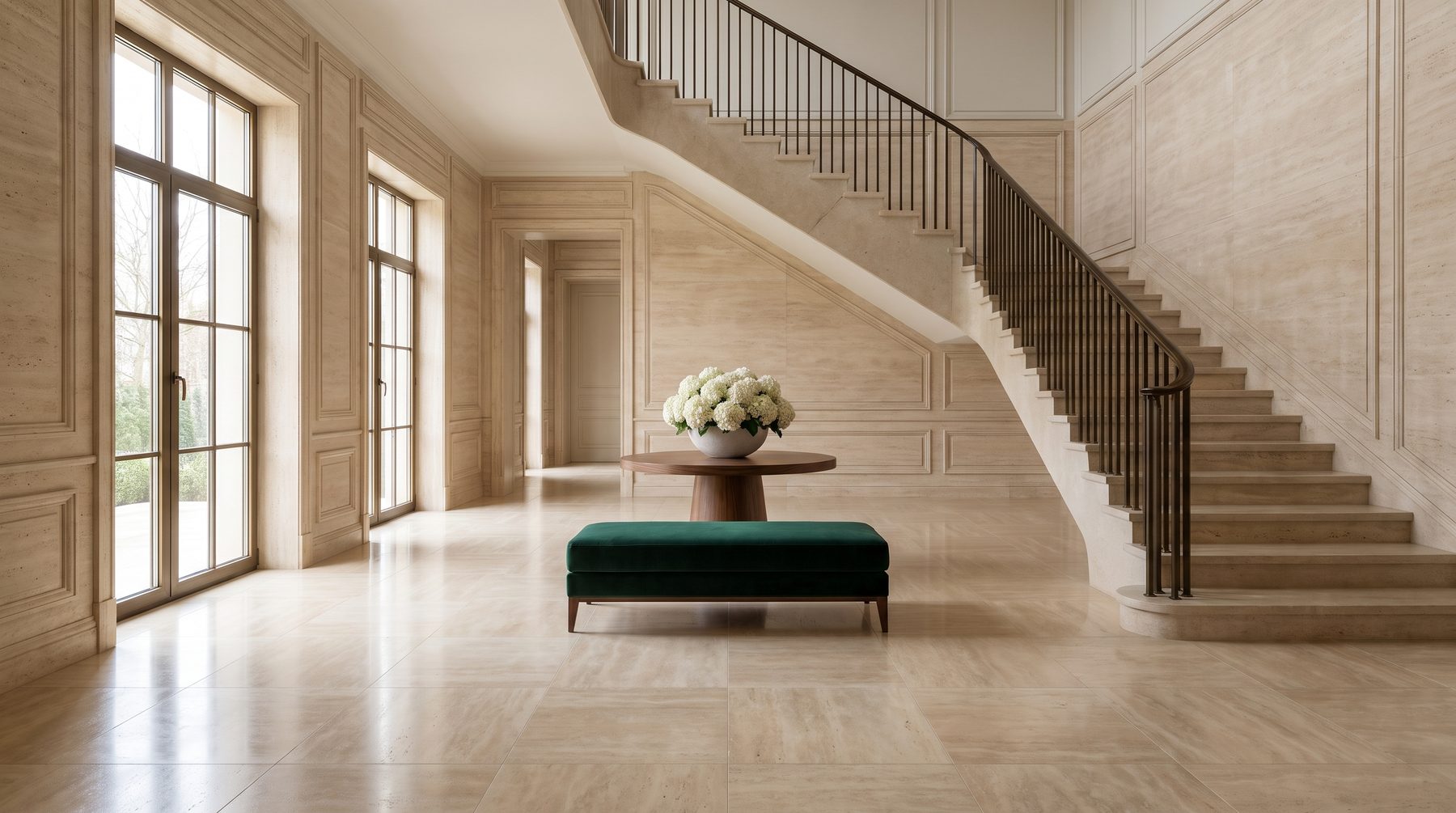
How to care for travertine comes down to three rules: clean only with a pH-neutral stone cleaner, reseal every one to two years when a water-drop test says so, and keep every acid away from it, including vinegar and limescale removers. Travertine is almost pure calcite, so it dulls from chemistry rather than age. A honed surface can be restored. A polished one has to be protected.
A year ago a client called us about a house we had handed over three years earlier. The floor of the main bathroom, a pale Roman travertine, was covered in dull, cloudy patches, as if someone had wiped it with a wet cloth and the pattern had frozen in place. No leak, no faulty stone. Ten minutes into the conversation the cause was clear: the new housekeeper had been cleaning the shower glass and the floor with the same limescale remover. The label said it plainly: contains acid.
The stone had not failed. It had simply done what calcite does when it meets acid. That is the one thing worth understanding before you put travertine in a house.
Why travertine dulls: chemistry, not wear
Travertine forms at hot springs. Water saturated with carbon dioxide reaches the surface, the gas escapes, and calcium carbonate settles layer by layer. The escaping bubbles leave the pores that give the stone its character. Depending on the deposit, porosity can reach 40 percent and density ranges from about 1.55 to 2.6 g/cm³, which is why the first thing I ask a supplier is which quarry and which bed the slabs come from.
The second number matters more. Travertine is roughly 99 percent calcite and rates only 3 to 4 on the Mohs hardness scale. Granite sits at 6 to 7, and the quartz sand people carry in on their shoes is a 7. Grit scratches travertine the way sandpaper scratches wood.
That gives you two different problems, and people confuse them all the time:
A stain is something absorbed into the pores: wine, oil, coffee. It is darker than the stone and sits inside it. A sealer protects against stains.
An etch is where acid has dissolved the top layer of calcite. It is lighter, dull and slightly rough to the touch. A sealer does nothing against etching, because it works inside the pores while acid reacts with the surface itself. This is where most owners go wrong: they hear “the stone is sealed” and assume lemonade is now harmless.
The Romans understood this stone better than we do. The Colosseum is built of travertine from Tivoli and has stood in the rain for two thousand years. The same quarries near Tivoli supplied some 16,000 tons of stone for the Getty Center in Los Angeles. Travertine lasts for centuries. In the rain, not under a bottle of bathroom cleaner.
Daily and seasonal care checklist
This is the page we hand to everyone who cleans a house with travertine floors.
Every day
Dry-mop with microfiber or vacuum with a soft brush head, never with metal rollers or stiff bristles. Put a proper entrance mat system at every exterior door: a grille outside, a rug inside. It does half the work of keeping a hall floor looking new.
Every week
Damp-mop with a cleaner made for natural stone, pH around 7, diluted as the label says. Ordinary soap leaves streaks, which show badly on polished stone. Never use vinegar, lemon, bleach, ammonia or anything sold as a limescale or rust remover. Alkaline cleaners above pH 9 remove grout haze and grease, but they belong in a stone restorer’s kit, not in the weekly routine.
After a spill
Blot, don’t wipe. Wiping drives pigment deeper into the pores. If the spill was acidic, blot first and then rinse the spot with clean water: acid needs only minutes to leave a mark.
Once a year
Do the water-drop test. Place a few drops of water on the busiest spot and wait five minutes. If the stone darkens, the sealer is worn and it is time to reseal. If the water beads, you are fine. Most floors need resealing every one to two years. Wet areas such as showers and pool surrounds need it more often, dry living rooms less often; Australian restorer Stone Doctor, for example, suggests about two years for wet rooms and five for dry ones.
Every few years
Have a stone professional hone the traffic lanes and refill any pores that have opened up. Factory fills are cement, epoxy or polyester resin, and they wear out of the busiest areas over time. That is normal, not a defect.
Honed or polished: the decision that sets the care routine
This choice is made at the design stage, and it shapes the life of the floor.
Honed travertine, matte or satin, forgives almost everything. Etch marks are far less visible because there is little contrast between a damaged and an untouched patch, and grit scratches disappear into the texture. Repairs can be local: a restorer works only the damaged area with diamond pads of the right grit and the patch doesn’t show.
Polished travertine gives the depth of colour and reflections that people fall in love with. On a floor it demands museum discipline. A dull ring from a glass is visible from across the room, and polishing a single spot without leaving a patch is a skill many installers simply do not have.
Here is an unpopular view: in a family home I recommend polished travertine on a floor in maybe one case out of five. On walls, a fireplace surround, a headboard wall or a console top where nobody sets down a glass of juice, absolutely. There it ages beautifully. We wrote more about texture and the return of unfilled stone in our piece on open-pore travertine interiors, and compared it with another warm material in terracotta vs travertine.
We made this mistake ourselves once. Years ago we specified polished travertine for a kitchen island. Within a month it had dull rings from lemons and wine glasses. We re-honed it to a matte finish at our own cost, and since then we put travertine on kitchen work surfaces only after an honest conversation about how it will look a year later.
Where travertine works and where it doesn’t
Works well: entrance halls and galleries with proper matting, living rooms, bedrooms, walls and fireplace cladding, the dry zones of bathrooms, and exterior paving or facade details if the stone is chosen for frost resistance.
Works with conditions: showers, steam rooms and pool decks. Choose filled stone, seal it for wet use and keep a separate, clearly labelled bottle of neutral cleaner in that room. In a steam room, where the stone is constantly hot and wet, consider a denser stone for the floor and keep travertine for walls and benches.
Avoid: busy kitchen worktops, bars and laundry floors where descalers live on the shelf. There the stone will etch every week, and you will be disappointed every week.
How we plan for care at the design stage
We stopped treating stone care as the owner’s problem a long time ago. If we specified the floor, we are responsible for how it looks in five years. So every project with natural stone includes:
A finish chosen for the room’s use. Polish where stone is looked at, honed where it is walked on, decided before the stone is ordered.
A stone passport. Quarry, batch, finish, type of pore filler, sealer brand and date applied, plus a few spare slabs from the same batch, because travertine from a different batch almost never matches in tone.
A one-page care sheet for housekeeping and any cleaning contractor, with photos of the approved products. Without it, every crew cleans stone the way it cleans ceramic tile.
The bathroom I started with took two days to restore: honing, sealing, a new bottle of neutral cleaner and a care sheet taped inside a cabinet door. The housekeeper was never really at fault. Nobody had told her.
FAQ
What is the best way to clean travertine at home?
Dry-mop daily to remove grit, and damp-mop weekly with a pH-neutral cleaner made for natural stone. Avoid vinegar, lemon, bleach, ammonia and limescale removers, because they dissolve calcite and leave dull etch marks. For heavy grout haze or grease, call a stone professional rather than reaching for a stronger household product.
How often should travertine be sealed?
Usually every one to two years, but the water-drop test is more reliable than the calendar. Put a few drops of water on a high-traffic spot; if the stone darkens within five minutes, reseal. Wet areas need it more often than dry living spaces. Use a penetrating sealer, not a film-forming coating.
Can I remove etch marks myself, or do I need a professional?
Very light etching on honed stone can sometimes be improved with a marble polishing powder made for calcite stone, used strictly as directed. Anything deeper, or any etching on polished travertine, is a job for a stone restorer, who hones the area with diamond pads and brings it back to the original finish without leaving a visible patch.
Should I treat one spot or the whole floor?
Spot repairs work well on honed travertine because the finish blends easily. On polished floors a single repaired spot often looks brighter or duller than its surroundings, so restorers sometimes work a whole area up to the nearest joint lines. The water-drop test will tell you whether sealing needs to be done everywhere or only in the busiest areas.
Is travertine a good choice for a shower?
It can be, if the pores are filled, the stone is sealed for wet use and only neutral cleaners are used in that room. The real risk in showers is not water but acidic limescale removers. If the household relies on them, choose a denser stone for the shower and keep travertine for the walls outside the wet zone.

Author


Next step
Discuss your project
An hour at the studio with Oleg Reznikov: your site, your brief and relevant studio projects.