
Handmade Objects in an Interior: Why They Are Ordered a Year Ahead

Handmade objects in an interior are not the decor you pick up in the final month. They are the longest lead-time items in the whole project. Studio ceramics take three to four months; a forged light fitting or a hand-knotted rug runs anywhere from six months to a year. Which is why they belong in the budget and the schedule alongside the furniture — not after it.
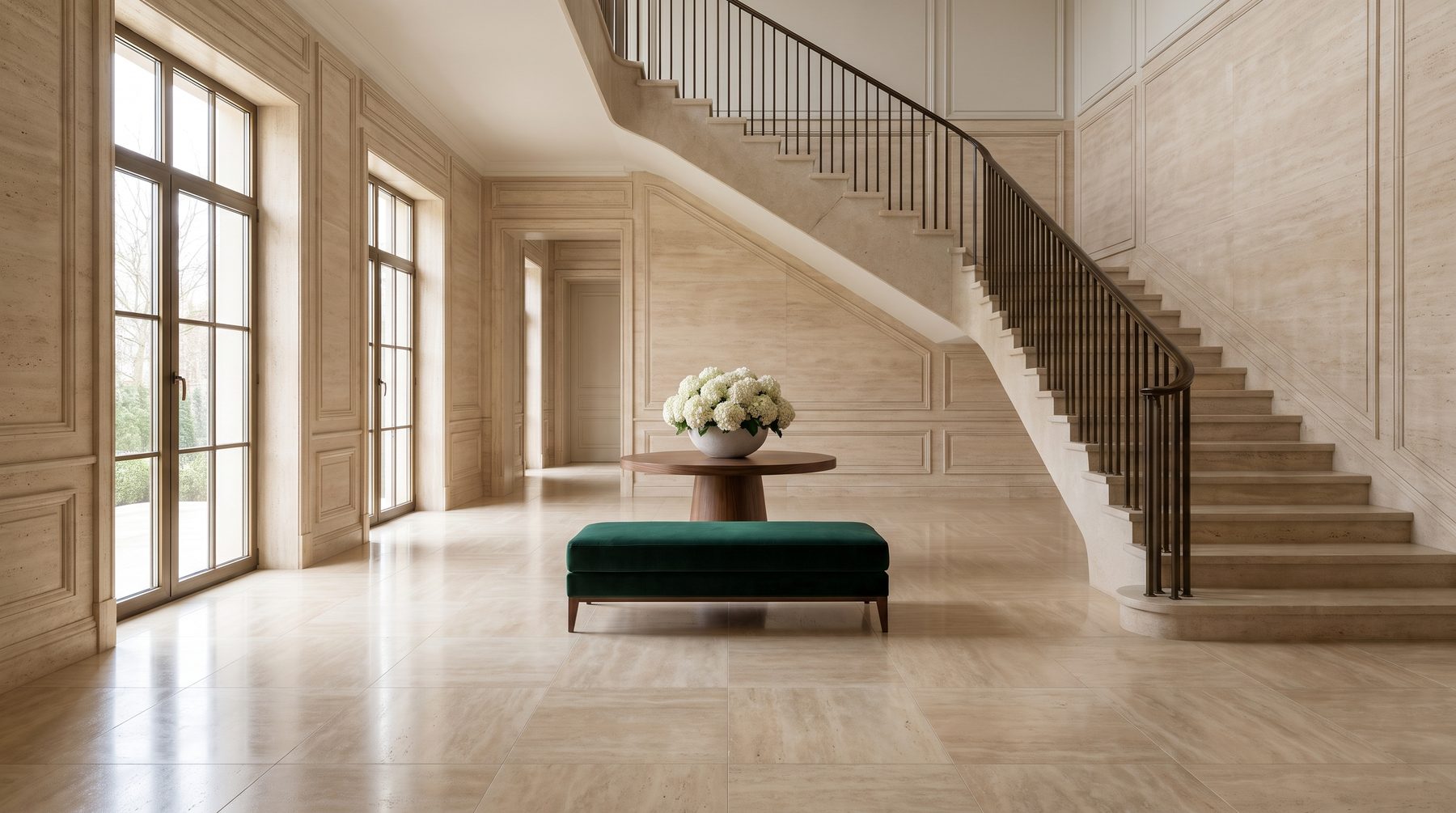
A year ago we handed over a house outside Moscow, 1,100 square metres. Everything was in place: stone laid, curtains hung, lighting scenes programmed. One thing was missing — a vessel for the niche in the entrance hall. The client brought it back herself from a trip, for the equivalent of about £400: heavy, slightly off-centre, with an unglazed patch on one side. We set it into the lit niche, and the whole hall seemed to exhale.
A week earlier we had been going through a catalogue with her where a vessel of much the same silhouette cost four times as much. It was flawless. And completely dead.
Paris puts craft back at the front of the hall
From 10 to 14 September 2026, Maison&Objet runs at Paris Nord Villepinte — Europe’s principal fair for objects and interiors, with more than 1,700 exhibitors. The September edition is themed “Pulse in Motion”, developed with the trend agency NellyRodi. Paris Design Week runs alongside it, 10 to 19 September, through the Marais.
The part worth watching is not the general programme but a single sector: Fine Craft — métiers d’art. At its entrance this season stands “In Materia”, an installation curated by Elizabeth Leriche: four zones — GERMA, TERRA, FUSIO, CRYPTA — built around five materials, wood, fibre, glass, earth and stone. Among the makers shown are Berangère Céramiques, the wood turner Pascal Oudet and Atelier O’laine; part of the selection was made by Ateliers d’Art de France.
Notice what has been placed at the entrance. Not a new sofa collection. Not a brand. Material and process. A fair that lives on furniture sales is putting people who work with their hands on the front line.
This is not a Parisian whim. It is what we have been watching happen in our own specifications for three years.
Why handwork now outranks the label
The logic of the wealthy client has changed, and it changed quietly.
Fifteen years ago status in an interior was read through names. A guest walked in, recognised the armchair, recognised the light fitting, and did the arithmetic. Recognisable meant expensive. Today that same logic works against the owner. A recognisable Italian collection now stands in three houses on the same street — and in a fourth, in a developer’s show apartment.
The edition killed the status. That is the single most important thing to have happened to premium interiors in the past decade.
An object made by hand cannot be editioned by definition. A ceramicist fires a batch of twelve vessels and all twelve differ — the glaze runs where it wants to. A weaver produces one rug a month. A glassblower keeps three pieces out of ten. That irreproducibility has become the new currency: a thing that cannot be ordered a second time is worth more than a thing that can be ordered at any moment.
What handmade objects actually cost, and why the price swings tenfold
This is where clients lose their footing. Two vessels stand side by side, both studio-made, both ceramic. One costs a few thousand roubles, the other a hundred and forty thousand. The difference is not immediately visible.
Russian studio ceramics are the accessible entry point. Workshops such as the St Petersburg brand Project.Oforme, Dymov Ceramics or the Ceramania marketplace price pieces roughly between one and twelve thousand roubles: a cup, a small vessel, a planter. At that level a handmade object stops being a luxury and becomes an ordinary line in the procurement schedule.
Above that, price climbs along three axes.
Scale and technique. A vessel 60 centimetres tall is not “the same vessel, only larger”. Large forms dry unevenly and split in the kiln. A maker may get four sound pieces out of ten attempts, and that loss is priced in. The same applies to art glass: the larger the blow, the higher the failure rate.
The name. A ceramicist with a museum biography and a history of showing in Paris costs five to ten times more than an unknown maker with comparable hands. You are paying not for the clay but for the fact that the piece is legible to a narrow circle.
Commissioned work. A piece made for a specific niche, a specific wall colour and a specific light is always dearer than one bought ready. It is also the one premium we almost always advise clients to accept: an object that fits the niche to the centimetre behaves differently from one that merely “more or less fits”.
For a house of a thousand square metres, the order of magnitude is this: collectible and studio pieces account for one and a half to five per cent of the furnishing budget. Where furnishing starts at sixty million roubles, that means one to three million. Inside that sum you can buy thirty middling objects, or five that people remember the house by.
Lead times are the real reason to order a year ahead
Here is where most people get it wrong. Craft is thought about in terms of money, but it is paid for in time.
A maker holds no stock. Nothing is produced in advance, because every piece consumes working weeks. The real lead times we see in our own schedules run like this.
Commissioned ceramics: eight to sixteen weeks, of which a month goes on glaze samples if the colour is being matched to the interior. Art glass: three to six months. A hand-knotted rug: six to twelve months, before logistics. Forged and brass light fittings from a good workshop: four to eight months. Cabinetry built by a joiner for a specific opening: from six months.
Now lay that over a construction programme. Finishes are completed, and the client wants to move in within the month. Which means the decision about these objects had to be taken a year earlier, when the walls were still bare and interior decoration was being discussed as a stage in its own right, rather than as something to sort out later.
A house where the decor was bought in the last month always shows it. It looks like well-executed finishing filled with whatever was available nearby. Even, expensive and empty.
The usual mistakes: when craft turns into a souvenir shop
First — quantity instead of quality. A client takes to the idea and buys forty studio pieces. Six months later the house reads as an ethnographic museum: something valuable on every surface and nowhere for the eye to rest. A handmade object works against emptiness. One vessel in a niche reads. Five on a single console is a display case.
Second — mistaking handwork for roughness. A crooked seam and a bare patch are not automatically an authorial signature. Sometimes they are simply a defect. The test is intent: with a good maker the irregularity repeats as a system, with a poor one it happens wherever the work went wrong.
Third — buying in isolation from the interior. A piece bought abroad under a strong impression almost always turns out to be the wrong scale and the wrong tone once it is home. We ask clients in those moments to send a photograph with a tape measure in frame and not to buy the same day. Half the impulses fall away by themselves; the other half are precisely what it is worth breaking the plan for.
Fourth — ignoring how the house is actually used. A hand-knotted rug in a circulation route in a house with a large dog is a two-year decision. Large ceramics on a console in a house with small children is a one-evening decision. We separate craft pieces from traffic at the planning stage, not after the first loss.
Our approach: three handmade pieces instead of thirty
We work like this. At concept stage we identify the “points of stillness” in the house — the places where the eye arrives and stops: the hall niche, the wall at the turn of the stair, the end of an enfilade, the fireplace surround. In a thousand-square-metre house there are usually five to seven such places, no more.
Each point gets one object. Not a composition, not a group — one. And each is allocated its lead time, its money and, where needed, a dedicated lighting circuit within the furnishing specification. An object placed in an unprepared, unlit niche loses half its force.
Then the search for a maker begins, and it honestly takes months. We do not look at portfolios but at the last twelve pieces in sequence — a portfolio shows the best work, and what we need is the average and the consistency. Then we commission a sample: a small piece, or a glaze test. If the sample arrives three weeks late without warning, we go no further, however beautiful it is. A maker who misses a deadline on a sample will miss it on the main piece too — only by then the finishes will be complete.
In a house we delivered some years ago, the entire craft programme consisted of four objects: an untreated oak panel in the double-height space, a pair of hand-forged brass sconces at the fireplace and one rug. Everything else was factory-made, quiet and disciplined. Those four are what guests remember, although together they cost less than the textiles in the bedrooms. The same logic is visible in other projects of ours — for instance the residence at Sady Mayendorf.
How this fits into the wider procurement and logistics programme is set out on our page about interior furnishing: craft items always open the list, because they are the slowest.
What this means if you are building now
If your house completes next autumn, the conversation about studio pieces needs to start this one. Not because it sounds more serious that way, but because of the calendar: a rug ordered in September arrives the following August, and that is a normal lead time, not a delay.
One more observation, hard to prove with figures but visible on every completed project. A client grows used to a factory object within a year and stops noticing it. A thing made by hand for their house they do not get used to. They are still showing it to guests in the fifth year. It is, perhaps, the only line in an interior budget that does not depreciate.
If you are at the stage where completion feels distant but decisions are already due, write to us. Discussing the programme of objects before the walls go up costs nothing and can save a year.
Frequently asked questions
What do handmade objects cost in a 1,000 m² house
Usually one and a half to five per cent of the furnishing budget. Where furnishing starts at sixty million roubles, that is one to three million for the whole craft programme. Russian studio ceramics start at roughly a thousand roubles for a small piece; large studio vessels and art glass run into tens of thousands; hand-knotted rugs into hundreds of thousands.
How far ahead should studio pieces be ordered
Commissioned ceramics take eight to sixteen weeks. Art glass three to six months. Forged and brass light fittings four to eight months. A hand-knotted rug six to twelve months before logistics. The working rule: decisions on craft items are taken a year before move-in, at the same time as the furniture, not after it.
How does a studio piece differ from an expensive factory one
Irreproducibility. A factory object can be reordered a year later in the same colour and size; a studio piece cannot, because the next batch of glaze will sit differently. Hence the difference in how they read: a factory collection reads as a selection from a catalogue, a handmade object as one person’s decision. The practical consequence is that studio pieces are not bought in pairs and not arranged symmetrically.
How do you tell real craft from imitation
By whether the irregularities are intended. With a maker, deviations repeat as a system — the same run of glaze along the lower edge, a characteristic cut line. With imitation, the defects are random and cluster where the process failed. The second test: a real maker quotes an exact lead time and holds no stock. “Handmade” available immediately in five sizes almost always means a machine.

Author

Next step
Discuss your project
An hour at the studio with Oleg Reznikov: your site, your brief and relevant studio projects.