
Unlacquered Brass: How It Ages and How to Care for It
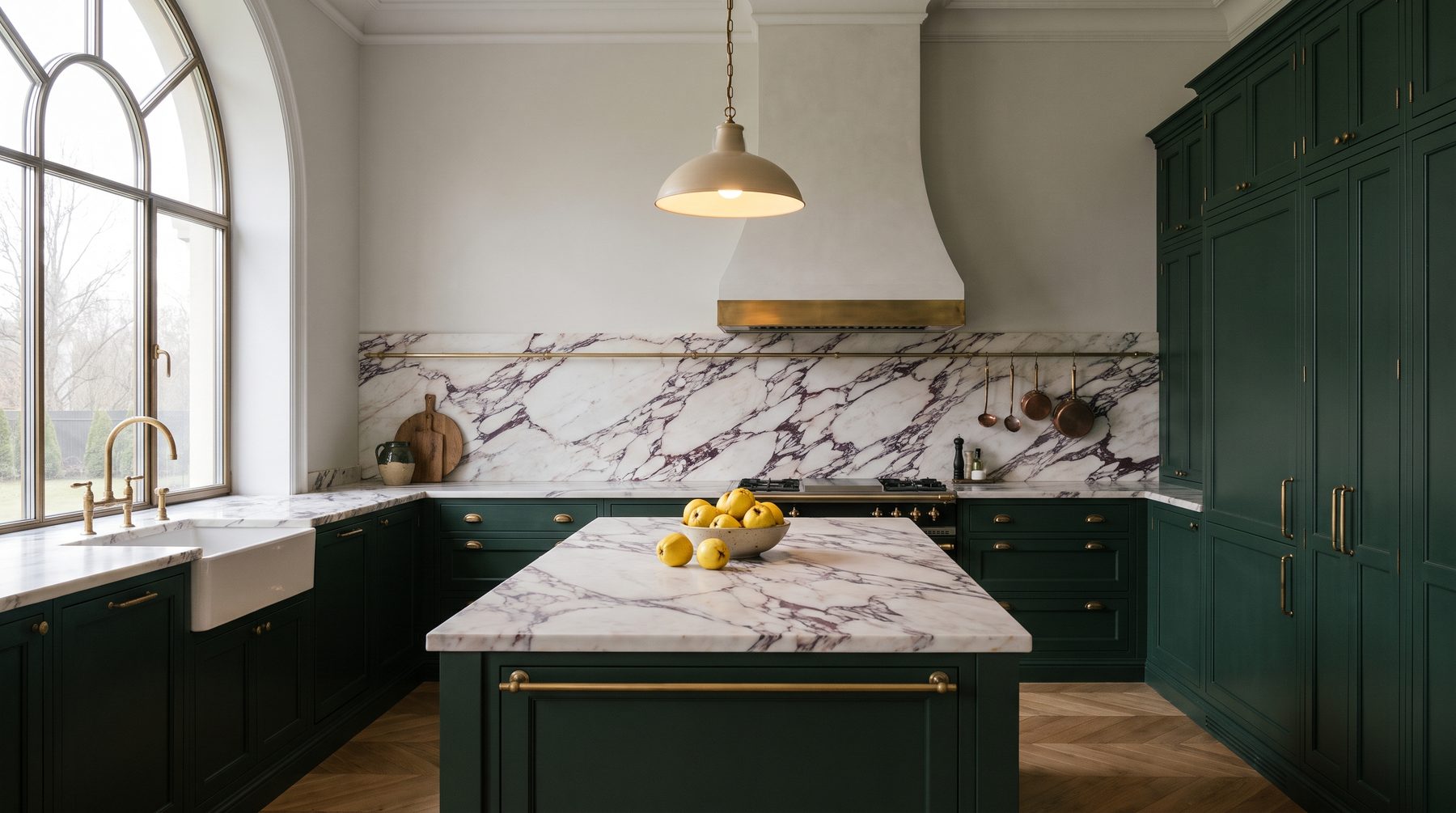
Unlacquered brass is bare metal with no protective coating, so it darkens: the mirror shine softens within weeks, the metal turns a warm honey tone within a few months, and the places you touch most become deeper and more matte. That is not a defect but the nature of the alloy. To care for it, use a soft cloth and mild soap, dry it straight away, and never use acids or abrasives.
Last spring a client called us six months after we had handed over his kitchen. He sounded worried: “Oleg, the taps are ruined. The cabinet pulls have spots. I think we were sold fakes.” I drove over. The bridge tap over the sink had turned the colour of old honey, the lever was darker than the body, and the drawer pulls looked thirty years old. Everything was exactly right. It was the brass we had specified, and the one he had chosen from our samples.
The mistake was ours. We showed him a brand-new sample and described patina in words. We should have shown him a sample that had spent a year on a windowsill in our studio. Now we always show both.
Why unlacquered brass darkens
Brass is an alloy of copper and zinc. Most architectural hardware contains roughly 57 to 70 percent copper; classic cartridge brass, C26000, is about 70 percent copper and 30 percent zinc. Brass used for machined tap bodies often contains a little lead to make it easier to cut. The more copper, the warmer and pinker the colour, and the faster the metal reacts with air.
Brass does not rust. What forms on the surface is a thin film of oxides and sulphides from oxygen, sulphur in the air, moisture and the oils on your hands. That film is the patina. It does not eat into the metal; if anything, it protects it a little. Underneath is the same brass, which can be polished back to a bright finish at any time.
Hardware makers describe a similar timeline: the mirror shine fades noticeably over the first weeks, the metal moves into honey and cognac tones by months three to six, and a mature patina takes a year or two. Kitchens and bathrooms speed it up; a pantry slows it down. A handle opened twenty times a day will be darker than its neighbour opened once a week. Two identical taps in two bathrooms will be different colours a year later. Accept this in advance rather than discover it.
Green is a different story. A green or bluish deposit appears where brass stays wet, especially with chlorides: at the base of a tap, in a shower with hard water, on an outdoor handle near the sea. That is not a noble patina but a signal to dry the metal and reconsider the location.
Lacquered, PVD or living brass
Lacquered brass is polished and sealed under a clear coat. It looks like the showroom for the first few years. But lacquer is a film, and on handles and levers touched every day, makers speak of cracks appearing after two or three years. Dark, irregular spots then grow under the damaged coating. Lacquer cannot be touched up: the piece has to be removed, stripped completely, polished and re-coated.
PVD brass is a thin, vacuum-deposited coating. It is hard, scratch-resistant and does not tarnish, which makes it a sensible choice for hotels, spas and anywhere nobody will care for the metal. But it is still a coating, and at constant contact points it can eventually wear through. It also never ages, which after ten years can feel more sterile than you expect.
Unlacquered brass has nothing to peel, because the surface and the core are the same material. A scratch can be polished out, a stain evened, the whole piece returned to shine or left to darken further. It is the only one of the three that can be restored rather than replaced twenty years from now.
There is a bonus. In 2008 the US Environmental Protection Agency registered copper alloys, including C26000 brass, as antimicrobial surfaces: in laboratory tests they killed more than 99.9 percent of bacteria within two hours. This only works on bare metal; lacquer cuts the bacteria off from the copper.
Where it works, and where it does not
Kitchens are the best place for it. Taps, rails, pulls, a brass band on the range hood: against painted cabinetry and a marble worktop, darkened brass makes a kitchen look loved for a century. Doors and windows are next. The metal darkens exactly where the hand rests, and after a couple of years the house starts telling you how it is lived in. Lighting is the gentlest start, because lamps are rarely touched and age slowly and evenly.
We are more careful in showers with hard water. Limescale plus constant moisture produce spots and green faster than a beautiful patina. Unless the water is softened and someone will wipe the fittings after every shower, choose PVD or nickel there, and keep living brass for the basin, which stays dry most of the day. Outdoors, expect dark brown within a season and green streaks on the stone below. For façades we usually prefer bronze; we compared the two metals in Bronze or brass.
How to care for unlacquered brass
First decide the one thing that matters: are you keeping the patina or keeping the shine? They are two different routines, and mixing them gives a blotchy result.
Checklist: keeping the patina
Dust with a dry microfibre cloth.
Wash every week or two with warm water and a drop of mild soap, then dry immediately, taps especially.
Avoid polishes, abrasive pads, limescale removers, glass sprays, vinegar, lemon, baking soda and salt.
Ignore fingerprints. On living brass they blend into the patina over time.
Checklist: keeping the shine
Polish with a brass paste and a soft cloth, following the direction of the brushing.
Frequency: every few weeks for pieces you touch, every few months for the rest.
Remember that every polish resets the clock: the metal starts ageing again from zero.
Checklist: fixing an uneven tone
Polish the whole piece and let it darken again evenly. Do not treat a single spot; work the entire surface up to a visible edge.
Test any new cleaner on a hidden area first. Many all-purpose kitchen sprays contain acids, and you only find out from a dull mark.
We hand our clients a short care sheet together with the keys. It sounds like a detail, but the people who clean the house decide what the brass will look like in three years.
FAQ
What is the best way to clean unlacquered brass without removing the patina?
Warm water with a little mild soap on a soft cloth, followed by drying straight away. Dust in between with dry microfibre. Do not use brass polish, vinegar, lemon, baking soda or limescale removers: they strip the patina in patches and the piece will age unevenly for years.
How long does it take unlacquered brass to patina?
The shine fades within the first weeks, a honey tone develops by months three to six, and a mature patina takes one to two years. Humidity and touch speed it up, so a kitchen tap ages faster than a living-room lamp.
Can I do it myself, or do I need a professional?
Routine cleaning and polishing are easy to do yourself. Call a metal restorer if lacquered brass is peeling and needs stripping, if green corrosion has pitted the surface, or if a built-in fitting has to come off the wall.
Should I polish one spot or the whole piece?
The whole piece. A spot polished on its own will stand out as a bright patch and then darken at a different rate. Work the entire surface up to a natural edge, such as a joint or the end of a handle.
Is unlacquered brass a good choice for a shower?
Only with soft water and the habit of wiping the fittings after use. With hard water it quickly develops limescale spots and green deposits. A practical compromise is PVD in the shower and living brass at the basin.

Author


Next step
Discuss your project
An hour at the studio with Oleg Reznikov: your site, your brief and relevant studio projects.