
Closing the Building Envelope Before First Snow: What Must Be Done by October
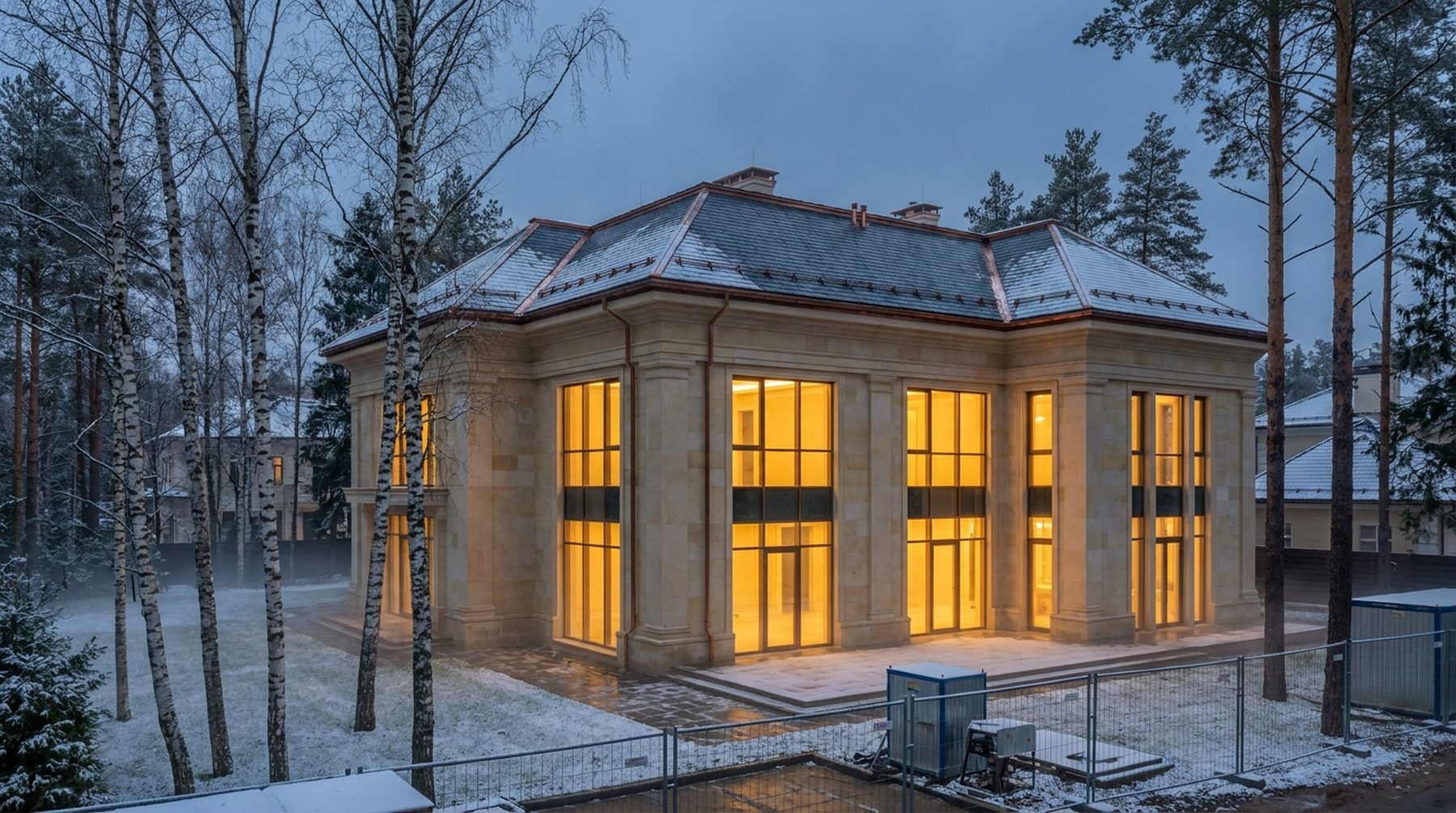
Last November I drove out to a site near Zvenigorod where we had been running design supervision since midsummer. An 1,100-square-metre house, cast concrete with brick cladding. The contractor was cheerful: the shell was up, the roof nearly done, “we’ll put the windows in come December, it’s all under control.” Wet snow was falling. I went up to the first floor and put a torch on the sill zone — dark streaks ran down the inside face of the brickwork, and a crust of ice a finger thick sat in the corner of the opening. Two months later that corner would have to be cut out and rebuilt. This is exactly why the building envelope deadline is harsher than any contract: the calendar does not slip, and October arrives in the Moscow region regardless of what the works programme says.
If you broke ground this spring, your winter is not decided in December. It is decided now, in July, while the schedule can still be rewritten.
What counts as a closed envelope, and what is self-deception
There are plenty of definitions in circulation, and most of them are convenient for the contractor. So let us agree on a strict one: the envelope is closed when the house is separated from the outdoors around its entire perimeter — a watertight roof with every abutment, valley and pipe penetration detailed; window and door openings filled; external doors hung; ventilation and flue ducts capped. Plus a paved apron, or at the very least an organised route for water away from the foundation.
Now for what is not an envelope, though it goes by that name in half the progress reports. A roof build-up with no soffits closed is not an envelope: snow drives into the roof void sideways, and I have watched it happen dozens of times. Openings sealed with polythene and tape are not an envelope: the first 15 m/s wind turns that sheet into a sail, and by morning it hangs in ribbons. Temporary OSB doors are not an envelope either.
The gap between “almost closed” and “closed” is not the last five per cent of the work. It is the difference between a house that spends winter drying out and a house that spends winter taking on water.
The building envelope deadline you cannot move
I always count backwards from the sustained crossing below zero. In the Moscow region that averages late October to early November — but the rain, and the daily swing either side of freezing, start earlier, from mid-October. It is the freeze-thaw cycling that destroys material, not the cold itself.
Hence the calendar we hand the client in July.
End of August — concrete finished
Concrete needs 28 days to reach its design strength, and those 28 days have to pass in above-zero temperatures. If the last slab is poured in late September, it goes into winter short of strength — and that is no longer a cosmetic problem.
Mid-September — roof watertight
Not “covered” but genuinely watertight: abutments, valleys, ventilation and flue outlets all detailed. The roof is the one element protecting everything else, and it is always first in the queue.
Early October — windows and external doors in
Why not November is the most contested point of all, and I will come to it below.
Mid-October — wet facade work complete
Render, pointing, anything that cures with water. After that there is nothing left to do outdoors.
End of October — envelope closed, heating on
From then on the house works for you: it spends the winter drying rather than soaking. We set out what this stage contains, and how it should be handed over, on our building envelope page.
Notice there is no November in that calendar. November is the reserve you keep for supply failures — and there will be some. If your plan is to close the envelope in November, you have no reserve at all.
The roof: where no compromise survives
On expensive houses the roof is almost always complicated: hips, dormers, parapets, concealed gutters. Every junction is a potential leak and every junction takes time. Natural tile over 600 square metres of roof is not a week’s work. It is a month and a half to two months once you count the rafters, the soffits and the rainwater system. Standing seam over complex geometry takes just as long.
But here is where it gets interesting. Even when the roof covering will not arrive in time, a temporary roof solves almost everything. A waterproofing membrane rolled out over the rafters and properly held down with counter-battens will honestly carry a winter. It costs well under a hundred thousand roubles on a large house and saves millions. People turn it down for one reason: “we’ll make it in time.”
You will not. In twenty years I cannot recall a season when a roofing delivery did not slip by at least a fortnight.
Windows: the argument we win every year
The contractor’s favourite line: “let’s glaze in spring, why let the windows sit through a building site and get scratched.” It sounds reasonable. It is wrong.
An installation joint to GOST 30971 has three layers: foam in the middle, a self-expanding weather tape outside, a vapour barrier tape inside. Foam performs reliably between +5 and +20 °C. Winter grades nominally survive down to −10 °C, but they are at their limit: the cell structure changes, and any error in preparing the opening costs you the airtightness of the joint. You will never see that joint — it sits behind the reveal. You will see it three years later, when condensation starts tracking down the plaster.
The second argument is the stronger one. Without windows you cannot switch on heat. Without heat there is no render, no screed, no wet trade at all through winter — every one of them needs at least +8 °C while being applied and +5 to +8 °C held until it has fully dried. So windows in December do not mean you saved the glazing from a winter on site. It means four months of interior finishing gone, and the move-in date pushed from autumn to the following spring. A few scratches on a frame are the cheaper problem, believe me.
At Petrovo-Dalneye we held the glazing date in early October, hard, though the client wavered. By February the house was being plastered at +18 °C inside while the sites next door stood under snow. The schedules diverged by six months.
What happens to a house that winters wet
Nobody puts this in a contract, so let me be straight about it. A house that goes into winter with an open envelope does not collapse — that is precisely what makes it treacherous. By spring it looks fine: walls standing, floors intact, nobody panicking. The trouble arrives later, in instalments.
First, water in the structure. Brickwork that took on moisture in autumn goes through dozens of freeze-thaw cycles over the winter. Each cycle spalls off a microscopic layer, and within a season the face starts dusting and flaking. On facing brick at 4,000 roubles a square metre that stings. Patching individual areas shows forever: brick from a different batch will not match in tone, and nobody is going to reface the whole elevation.
Second, drying time. A 250 mm concrete wall saturated with water gives it back over months. You cannot plaster that wall: the substrate moisture content must not exceed 8 per cent, and you will be reading 12 to 15 — so you will spend the summer drying the house with ventilation and dehumidifiers. Not a catastrophe; just another season lost, plus an electricity bill that surprises the client more than the delay itself.
Third, the damage that surfaces years on. Mineral wool soaked inside a roof build-up never recovers: it slumps and stops insulating, but you will discover that through your heating bills and through icicles on the eaves, long after the roof has been lined out. No one will open it up just to check.
This is where most people go wrong: they treat wintering an unfinished house as a matter of taste and morale. It is not. It is a question of how many years the house stands before the facade needs repair, and what you pay to heat it.
The classic wintering mistakes
The same errors repeat from site to site with remarkable consistency. These are the expensive ones.
Polythene instead of windows. It lasts until the first storm. After that the openings are open — and nobody notices, because the site is mothballed and there is no one to visit.
Exposed horizontal surfaces. The top course of walls, sill zones, parapets — anywhere a cap of snow can build up. Meltwater soaks into the masonry, freezes and tears it apart from within. Hollow brick and aerated blocks drink it in especially greedily. An unprotected unfinished house can lose up to 20 per cent of its design strength in a single season — that is not a scare figure, it is what turns up in a survey afterwards.
Uncapped flues and ventilation ducts. A direct channel for water into the body of the house, top to bottom, through every floor.
No drainage away from the foundation. Water stands in the backfill, frost-susceptible soil goes to work, and the house picks up uneven loading exactly where nobody calculated for it.
Wet trades “under a heater”. The most expensive delusion of all. A direct-fired diesel heater delivers not just warmth but combustion products and water vapour straight into the room. Plaster under it does not dry, it freezes the moment the heater goes off overnight — and off it goes, because nobody burns twelve litres of diesel an hour around the clock. The result is cracking, delamination and a redo in spring. Heating an occupied volume means electric heat or a boiler running continuously, not heroics with blowers.
If you are not going to make it: mothball it honestly
Sometimes you genuinely cannot make it — the design changed, the contractor walked, an approval dragged. In that case what you need is not an imitation envelope but a proper shutdown. It is a separate scope of work and it costs money.
A temporary membrane roof over the rafters. Every horizontal surface — wall tops, sill zones, parapets — covered with a waterproof apron that is mechanically fixed, not weighted down with bricks. Openings boarded with rigid sheet, not film. Ducts capped. Water led away from the foundation by a channel or a gutter. And somebody drives out once a month and looks, because a membrane can be peeled back by the first blizzard.
Between a badly closed envelope and a well mothballed shell, I will take the second every time. The first is an illusion of protection, and it makes everyone relax.
How we work
We build the programme backwards from winter, not forwards from the start date. At the very first meeting, while we are still sketching, the question comes up: which autumn are you closing the envelope? Everything else follows from the answer — what structure we choose, what we build the walls from, when we order windows and roofing with three- and four-month lead times.
Then come contractual milestones tied to the weather rather than to “stage completion”. Roof by 15 September. Windows by 5 October. Wet facade done by 15 October. We hold those dates through construction management and we check them on foot, on site, with a torch and a moisture meter — not by reading reports.
And the part that matters most: if in July it is clear the house will not make it, we say so in July. Not in September when it is too late, and not in November when all that is left is an excuse. Sometimes the right answer is to stop deliberately at foundation and shell, mothball it properly and enter the next season with a full summer ahead. That is not a defeat. It is a year faster than rescuing a house that wintered wet.
What to check on your own site this week
Take your programme and find three dates in it: concrete complete, roof watertight, glazing in. If even one of them lands in November, you have no reserve, and the conversation with your contractor needs to happen today rather than after the first snow. If the roof covering has not been ordered and it is already July, work out the lead time and add a fortnight for logistics. That arithmetic tends to open people’s eyes better than any argument.
And if you have doubts about your own schedule, show it to us. We will go through it date by date, tell you honestly where it is tight, and what can move without costing you quality. You can write to us straight on Telegram: a conversation like that usually takes twenty minutes and saves a season.

Author

Next step
Discuss your project
An hour at the studio with Oleg Reznikov: your site, your brief and relevant studio projects.