
Bespoke Furniture for a Country House: Brand or Your Own Joiner
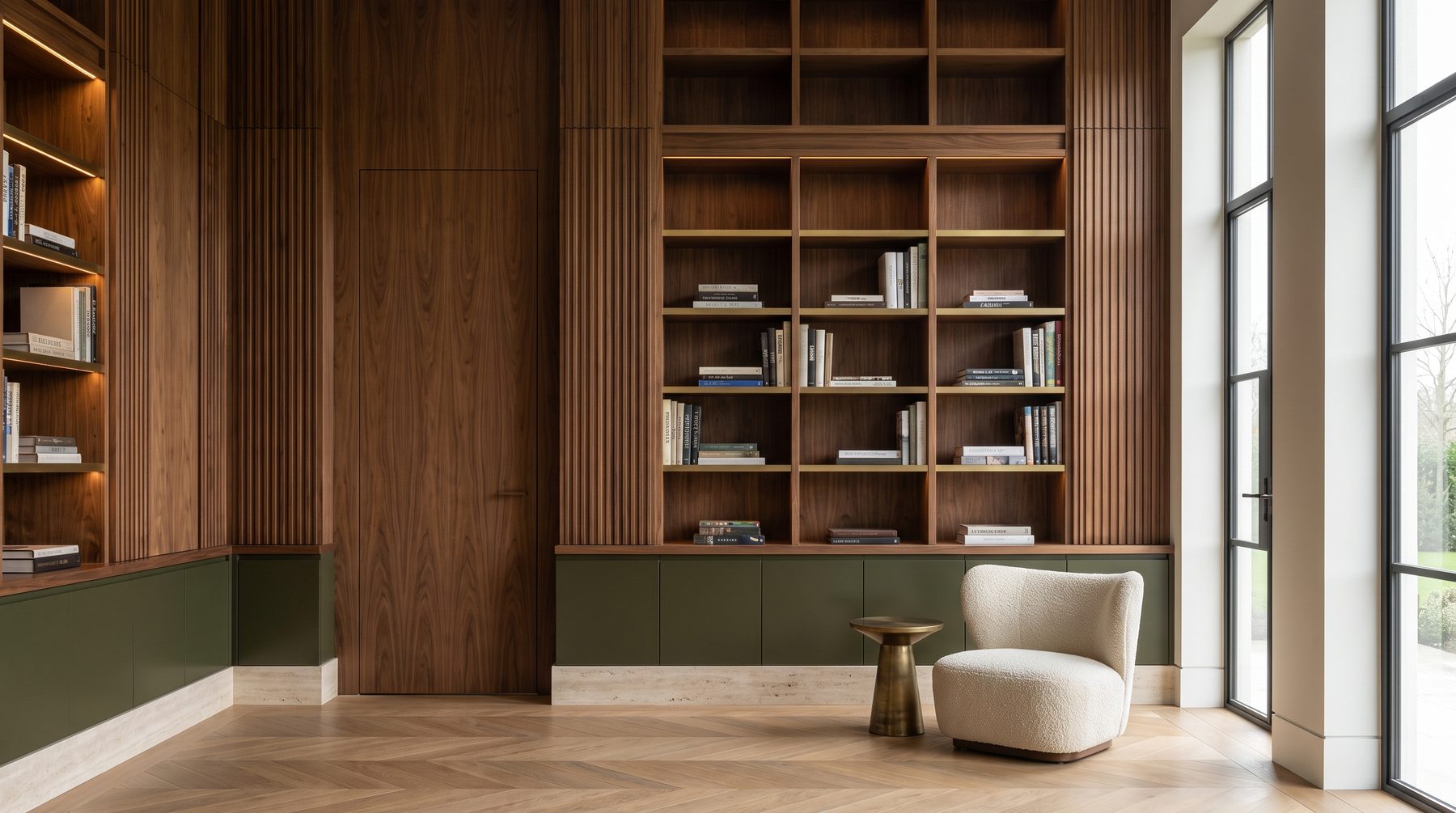
Bespoke furniture for a country house comes from one of two places: a named factory that sells you an engineered system together with its logistics and service, or a joinery workshop that builds to the drawings of your own project. The first route buys predictability and a label. The second buys accuracy against real walls. The dividing line is not the budget. It is who answers for the result ten years from now.
There is one thing in a large house that people notice last and remember longest. Not the facade. Not the marble in the entrance hall. A cabinet door that opens with a fingertip and closes without a sound. A reveal that is identical top and bottom, even though the wall behind it wanders by eight millimetres. That is the moment a building stops being a construction site and becomes somewhere to live.
And that is exactly where the client faces a choice nobody states out loud: ship the furniture from Italy, or build it twenty kilometres from the site.
What you are actually buying along with the name
A named brand does not sell you a cabinet. It sells you a system: module engineering refined across hundreds of thousands of pieces, hardware tested by opening cycles, a finish that behaves predictably fifteen years in, and — more valuable than any of it — the removal of decisions from your desk.
A factory catalogue is a set of rules. Heights, depths, module increments, permitted combinations of finishes. Inside those rules it is almost impossible to go wrong. The designer assembles the interior like a sentence from ready-made words, and the sentence comes out grammatical.
The other half of the price is service. Survey, supervised installation, a crew that sets a kitchen in two days and leaves behind aligned fronts and a signed handover. On a house where eight contractors work in parallel, that is not a small thing.
But this is where it gets interesting. A system works exactly as long as the house agrees to be standard. And a thousand-square-metre residence never is.
The joiner: furniture born on site
Bespoke joinery works the other way round. It brings no rules; it accepts them from the architecture. A 3.2-metre niche between two load-bearing walls. A panel that has to dodge a duct and still read as symmetrical. A library that follows the radius of a bay. A concealed door in the panelling where the veneer figure must continue straight across the leaf, as though no door existed.
Faced with that geometry, a factory either declines or covers the problem with a filler piece. A workshop builds one object for that one opening.
On quality: the gap between one joiner and another is wider than the gap between factory and workshop. A serious shop shows itself in three ways. There is a spray booth with dust and humidity control, not a paint corner next to the saw. There is a conditioning store where board and solid timber sit in the climate of the future house before they are cut. And there is a willingness to build from someone else’s drawings instead of “we’ll work out what’s best”.
The third point eliminates half the market. A workshop that asks you to send “a photo of what you want” will not deliver the level of interior the house is being built for.
Lead times: where the months actually go
The usual argument for local production is speed. It is true, but not for the reason people assume.
European furniture now reaches Russia along longer routes: consignments are re-documented at bonded warehouses in Turkish free zones, then travel by sea to Novorossiysk or overland through Kazakhstan and the UAE. The parallel-import regime has been extended and the channels have settled, but the arithmetic has changed. Those schemes typically run three to six months; direct supply through factory agents lands in two to four; shipping costs are up by a third and more.
A Russian workshop builds a complex package in eight to twelve weeks. There is a difference, but it is not dramatic.
The drama sits elsewhere. An imported order is confirmed once, and after the specification is confirmed nothing in it can change. A construction site, meanwhile, changes constantly: the ventilation contractor raises a duct, the electrician reroutes a busbar, the client decides the dressing room should be two metres longer. A factory order answers that with a new delivery date. A local joiner answers it by driving to site on Wednesday.
So we place furniture in the programme not at the end but at the point where the interior working drawings are complete: wall elevations, junction details, service points. A kitchen ordered before the elevations exist will almost certainly arrive for a wall that no longer does.
Money: the myth that your own furniture is cheaper
Joinery is widely believed to cost half what a brand does. On the houses we are discussing, that is simply untrue.
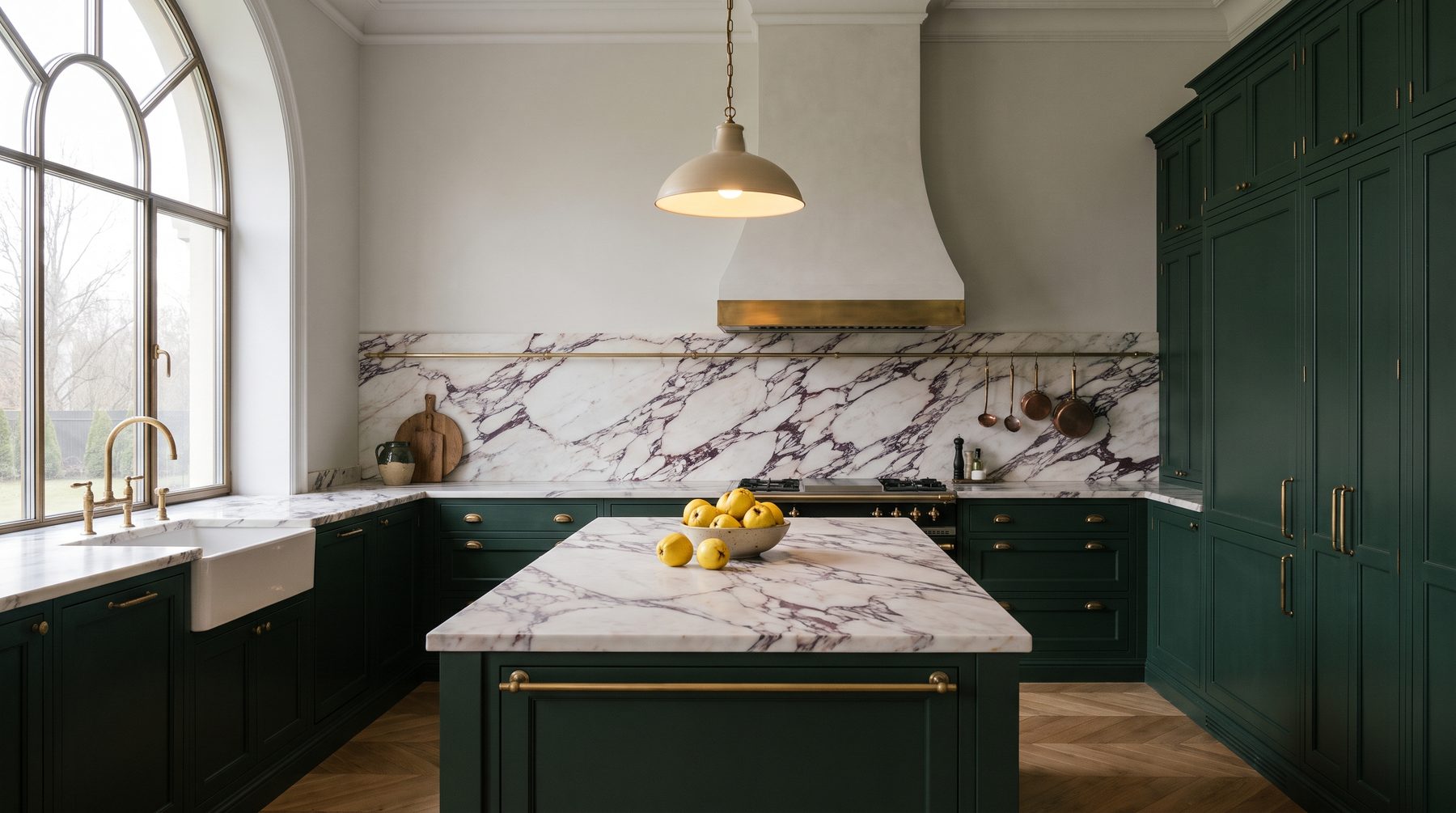
A premium bespoke kitchen from a strong Russian maker starts at roughly 50,000 roubles per linear metre of carcass, and that is the entry point for sprayed MDF with Blum or Hafele hardware. Fine veneers, curved fronts, stone-edged returns, integrated lighting and fitted drawer interiors multiply the figure. The full joinery package for a thousand-metre house — kitchen, scullery, three dressing rooms, library, bathrooms, panelling — sits comfortably in the same bracket as an Italian order.
The difference is not the total but the structure of it. With a brand you pay for proven technology and for the name. With a workshop you pay for hours and for material you choose yourself: a particular slab, veneer from a specific log, lacquer from a named manufacturer. Which is why we run joinery alongside every other line of material procurement: veneer and stone prices move faster than design does.
Savings appear in exactly one scenario: large, repetitive volume. Twenty identical wardrobes in a guest wing will be markedly cheaper from a workshop. One complex kitchen will not.
Serviceability: the test at year ten
This is where most people get it wrong. Furniture is chosen from a photograph and lived with through its service.
Furniture warranties in Russia typically run twelve to twenty-four months against manufacturing defects. After that, real life begins, and the two routes fail in fundamentally different ways.
A factory fails like this: the collection is discontinued, the finish is out of the palette, the nearest match is half a tone off. You cannot replace one front; you replace the whole run. The owner either lives with a patch or redoes the zone.
A workshop fails differently: the shop closes, the drawings are lost, nobody remembers the paint formula. So every joinery contract we write fixes two clauses: the client receives the shop drawings for the package, and a finish passport — colour code, coatings manufacturer, veneer batch number. It costs nothing. It saves you seven years later, when a dog runs its claws down a dressing-room front.
A word on solid timber. Wood answers to climate, and through the heating season, when indoor air drops towards twenty per cent relative humidity, a wide solid panel shrinks and splits along the glue line. Veneer on a stable substrate holds. We do not romanticise solid wood: for tall door leaves, large fronts and bathroom joinery we specify veneer over a stable core, and keep solid timber where it works structurally and ages beautifully. Humidification is designed in regardless, but for the people and the paintings rather than the cabinetry.
The mistakes clients make
First: choosing the brand before the architecture. A client arrives with an approved kitchen and asks us to fit it in. What ends up being fitted in is the house.
Second: giving all the joinery to one workshop for a discount. Kitchens, dressing rooms and bathroom furniture are three different technologies. A shop that excels at panelling is rarely strong in wet areas.
Third: ordering joinery from a concept package with no elevations and no junction details. The workshop then designs it alone, and on site a socket turns up inside the body of a cabinet.
Fourth, and most expensive: treating installation as a detail. A joinery package for a thousand-metre house takes three to four weeks to fit, and for all that time nobody else can work in the house. The installation window is agreed with the main contractor in advance, or the whole programme stalls.
Our approach: divide rather than choose
We almost never settle “brand or joiner” for a whole house. We split it.
The named factory gets what is genuinely about engineering and service: the kitchen run with its appliances, dressing-room systems with their internal fittings, upholstery, lighting. The joiner gets everything tied to the walls and obliged to agree with the architecture: panelling, libraries, concealed doors, niches, window seats, cabinetry for non-standard geometry.
On one house west of Moscow it worked out precisely that way. The island and the appliances came from an Italian factory, while the entire ground-floor perimeter — panelling, fireplace surround, the concealed door into the study — was built by a workshop outside the city to our elevations, with a single colour code and a single batch of walnut veneer across both zones. Nobody can find the seam between the imported and the local. That was the brief.
A second project was cleaner still. The client wanted “everything Italian”, but no catalogue system could close a library opening 3.4 metres high. We proposed the hybrid, and a year later he asked for the guest house to be done the same way. The logic is simple: where an interior is unique, it has to be made for its place. What that looks like when finished is visible across our completed interiors, where the vertical joinery is built for specific walls.
Good bespoke furniture for a country house happens when the decision about it is taken together with the plan, not after the finishes. Everything after that is discipline: specification, dates, inspection, and one person holding both the factory schedule and the workshop’s load in their head.
A house where it all lines up is not recognised by the label on the hinge. It is recognised because there is not one place in it where the furniture argues with the wall.
Frequently asked questions
Which costs less: a named brand or bespoke joinery?
On a premium project the two are comparable. A premium bespoke kitchen from a Russian maker starts at around 50,000 roubles per linear metre, and fine veneers, curved fronts and elaborate interior fittings multiply that figure. A workshop wins on large, repetitive volume — a run of identical wardrobes, for instance — and rarely wins on a single complex kitchen.
How long does Italian furniture take to arrive in 2026?
Direct supply through factory agents averages two to four months; routes through Turkey, Kazakhstan and the UAE run three to six. Shipping costs have risen by roughly a third or more. A Russian workshop builds a complex package in eight to twelve weeks, but its real advantage is not the lead time — it is the ability to absorb changes after work has started.
Solid wood or veneer for furniture in a country house?
Veneer over a stable core is the safer specification for tall door leaves, large fronts and wet areas: through the heating season indoor air dries out and a wide solid panel shrinks and splits along the glue line. Solid timber belongs where it carries load and ages well — dining tables, staircases, structural elements, hand-carved detail.
When should furniture be ordered during construction?
Once the interior working drawings with wall elevations and junction details are complete, and before finishes begin. Earlier, and you risk ordering into a wall the engineers will move. Later, and the package arrives after handover, leaving the owner months in a house with no kitchen and no dressing rooms. Allow four to five months before move-in.

Author

Next step
Discuss your project
An hour at the studio with Oleg Reznikov: your site, your brief and relevant studio projects.