
Indigo in the Living Room: The Color That Costs 12 Million
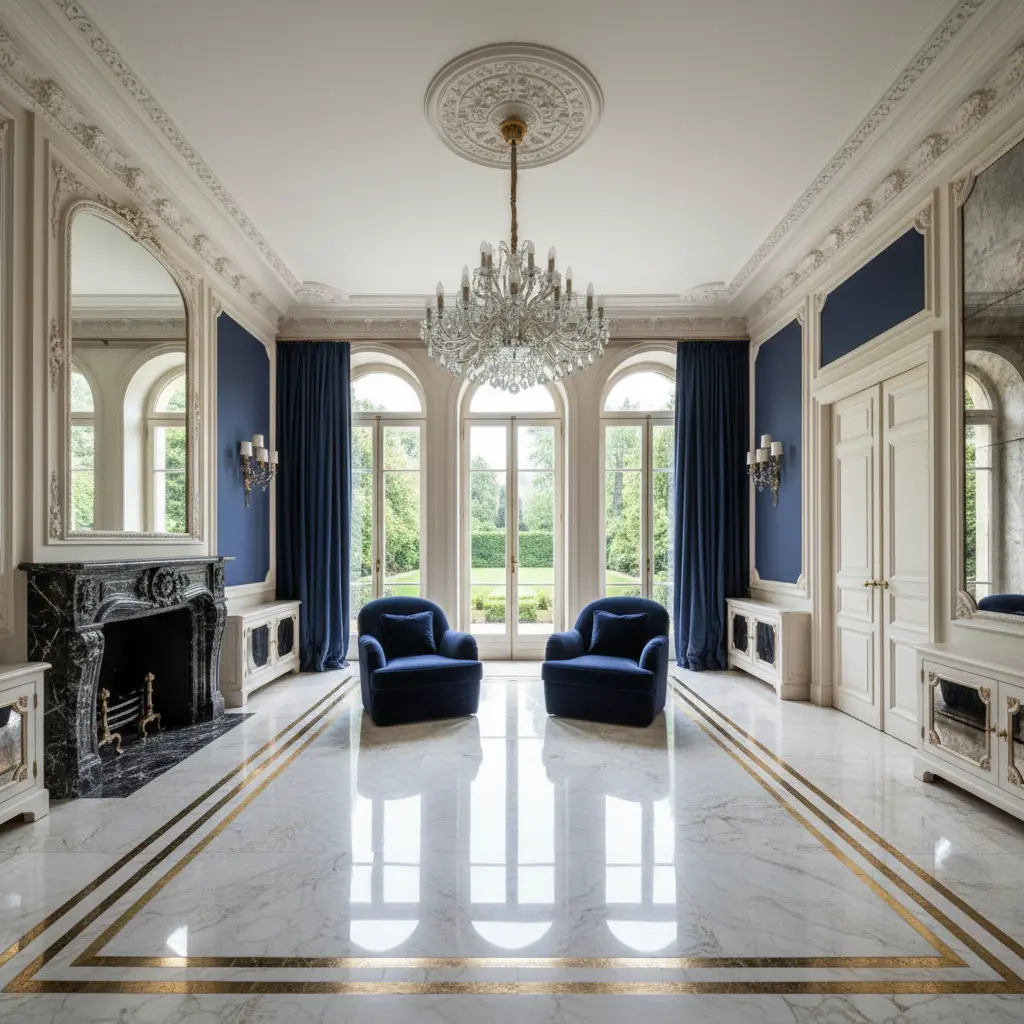
We had a project in Rublyovka — a 1,400-square-meter mansion, a budget I won’t disclose, but imagine a house with an elevator and a wine cellar for 3,000 bottles. The owner came to the final interior presentation, looked at the grand living room and said: “Oleg, something’s missing here.” Four months later we added one color. Indigo in a luxury mansion interior — in the upholstery of two armchairs, silk drapery, and wall paneling behind the fireplace. The cost of this “something missing” came to 12 million rubles. And the client was right to the last kopeck.
I want to explain why color isn’t a matter of taste. It’s a line item. And why indigo, which is now fashionable with every second designer, kills the interior in 90% of cases instead of elevating it.
If you’re planning a large home or are already at the finishing stage — read to the end. You’ll either save money or your sanity. Often both.
Why Indigo Became a Marker of Expensive Interiors
Indigo is not blue. It’s not about blue at all. It’s a pigment with 4,000 years of history that cost more than gold by weight in seventeenth-century Europe. Dutch masters painted it as backgrounds for aristocratic portraits. In Japanese Edo-era kimonos, indigo was a privilege of the highest classes.
That’s why today — even an untrained eye — reads this color as “expensive.” Not “beautiful.” Specifically as expensive.
But here’s where it gets interesting. The color we call indigo has about 40 recognized shades in the textile industry. The difference between Pantone 19-3933 and Pantone 19-3920 on a screen is three percent. In silk under daylight — it’s the difference between a one-million-ruble living room and a twelve-million-ruble one.
Case Study: How One Color Transformed a 1,400-Square-Meter Interior
Back to that mansion. What we did specifically.
First — we hired a colorist from Milan. Not “a designer who knows about color.” A colorist. It’s a separate profession; in Russia there are maybe six people who do this, no more. The cost of her work for the project — 1.8 million rubles. She came three times, studied the light at different times of day, checked how indigo behaves next to oak parquet, how it reacts to gold hardware, how it changes in candlelight in the evening.
Second — we rejected off-the-shelf fabrics entirely. Completely. We ordered custom dyeing from an atelier in Como. Silk dupioni, 280 g/m² density, hand-dyed with natural indigo (not a chemical substitute — this matters). 14 meters. Production time — 5 months. Price per meter — I won’t write it, but multiply the figure you’re picturing by itself and then double it.
Third — wall paneling. Stucco panels behind the fireplace, tinted indigo through 11 layers of translucent glaze over oak. Made in St. Petersburg by a master who had previously restored the Yusupov Palace. Four months of work.
When it all came together — the living room became a different space. Not “better.” Different. The same walls, the same fireplace, the same Baccarat chandelier worth 4 million — but the air in the room became denser. It’s hard to explain in words, and precisely why it’s worth 12 million.
Why Cheap Indigo Kills Expensive Interiors
Now to the unpleasant part. I’ve seen dozens of living rooms where owners tried to replicate “magazine designs.” They bought a blue velvet sofa in a showroom, hung blue curtains, placed a blue vase. Result — a dormitory with pretensions.
Here’s the thing. Cheap indigo is chemically dyed synthetics where the pigment sits on the surface of the fiber. In direct sunlight, within two years such fabric becomes dingy gray. Under light it looks “flat” — no depth, no play. The eye doesn’t love it, even if the owner doesn’t understand why.
Natural indigo penetrates the fiber. Each dyeing is an immersion in a vat of fermented dye, then oxidation in air, then immersion again. Eight to twenty-five cycles. The color acquires what the Japanese call “ai no fukasa” — the depth of blue. When you look at such fabric, you see not a flat surface, but depth. Like looking into lake water.
The price difference between synthetic and natural indigo is 15-20 times. For an average-sized sofa it’s the difference between 400,000 and 7 million rubles.
And you know what? In a cheap interior, cheap indigo works. In an expensive one — it kills it. Because the eye sees the falseness instantly, especially next to real materials — oak, marble, bronze.
Typical Client Mistakes with Color Accents
Over 20 years I’ve accumulated a collection of the same mishaps. Sharing them.
Mistake 1. “Let’s just paint the wall.” Most common. The client wants an “accent” and paints one wall in indigo with store-bought paint. A month later he doesn’t like it. Two months — he’s calling us to redo it. Paint and pigmented plaster are different things. Mineral plaster with natural pigment starts at 18,000 rubles per square meter of work. It’s not a whim — it’s the physics of light reflection.
Mistake 2. Too many accents. If indigo is in the armchair upholstery — it shouldn’t repeat in the curtains, cushions and carpet. Color works when it’s rare. Spread across the entire living room — it becomes a background. And indigo as a background is a Soviet sanatorium.
Mistake 3. Didn’t account for lighting. Indigo changes radically depending on light temperature. At 2700K it’s warm, noble. At 4000K — cold, almost clinical. I know of a case where a client spent 8 million on fabrics, then installed “modern” 5000K LEDs. The effect — like dinner in a morgue.
Mistake 4. Saved on a colorist, overpaid on fabric. This is a paradox. People are willing to pay for Italian silk but won’t pay a specialist to say which exact shade of indigo will suit their oak and their light. Result — expensive fabric in the wrong place, the wrong tone, doesn’t work.
Our Approach at the Studio: Color as Engineering
At Reznikov Studio we treat color in grand spaces the same way we treat load calculations on beams. It’s not a matter of inspiration. It’s a matter of precision.
What we do on projects of 1,000+ square meters:
First — spectrophotometry of materials. We take samples of flooring, stone, wood, metal — and measure their color temperature and reflectance. We get a digital model showing how colors interact.
Then — trials. Minimum 6 shades of indigo on real fabrics, in the actual space, under different lighting. No “pick from the Pantone fan.” Fans lie — because paper and silk reflect light differently.
Then — a 1:1 scale mockup. We stretch test fabric onto a frame, put it in the living room, leave it for a week. The client lives with this color. Looks at it morning, evening, with guests. Only after this — we order the final material.
It takes time. It costs money. It works.
How Much Does “Correct” Indigo Actually Cost
Let’s talk numbers, no fluff. A grand living room 60-80 square meters, mansion level:
— Colorist work: 800,000 – 2,500,000 rubles
— Natural silk or velvet with hand dyeing (8-15 meters): 3-7 million
— Wall paneling or textile panels with pigmentation: 2-5 million
— Drapery (if additional): 1.5-3 million
— Correct lighting for the chosen shade: 500,000 – 1.5 million
Total: 8 to 19 million for one accent color in one room.
Sounds insane. But that’s the difference that separates a 150-million interior from a 300-million one. Not the chandelier. Not the fireplace. The color.
When Indigo Doesn’t Work at All
I’ll say something unpopular. Indigo isn’t a universal color. I talk clients out of it more often than I recommend it.
It doesn’t work in north-facing living rooms without natural light — it becomes gloomy.
It doesn’t work with cold marble like Calacatta — it conflicts in temperature.
It doesn’t work in small spaces — it eats volume.
It doesn’t work if warm gold already dominates your décor — it creates mud.
Indigo loves oak, walnut, warm travertine, brass, black stone, wood-burning fireplaces and high ceilings. If you don’t have these — choose another color. Forest green, deep wine, graphite. They’re cheaper to execute and often work better.
In the End
Color in a large home is not a final touch or décor. It’s a structural element that changes how you perceive the entire space. Expensive interiors without correctly positioned color accents remain a catalog of materials. With an accent — they become a home you want to return to.
And yes, sometimes that accent costs 12 million. That’s a lot. But if the overall home budget is 200, 300, 500 million, economizing on color is like building a Bentley and putting Lada wheels on it. Technically the car will drive. But it won’t be a Bentley.
If you have a project in hand now and you’re unsure whether it’s worth getting into this color story — write me. I don’t sell services over the phone. But if the question is interesting, I’ll tell you honestly whether you need a colorist or a good decorator is enough. This will save you months and sometimes — millions.
Next step
Discuss your project
An hour at the studio with Oleg Reznikov: your site, your brief and relevant studio projects.