
The Color That Costs 8 Million: Indigo in a Grand Enfilade
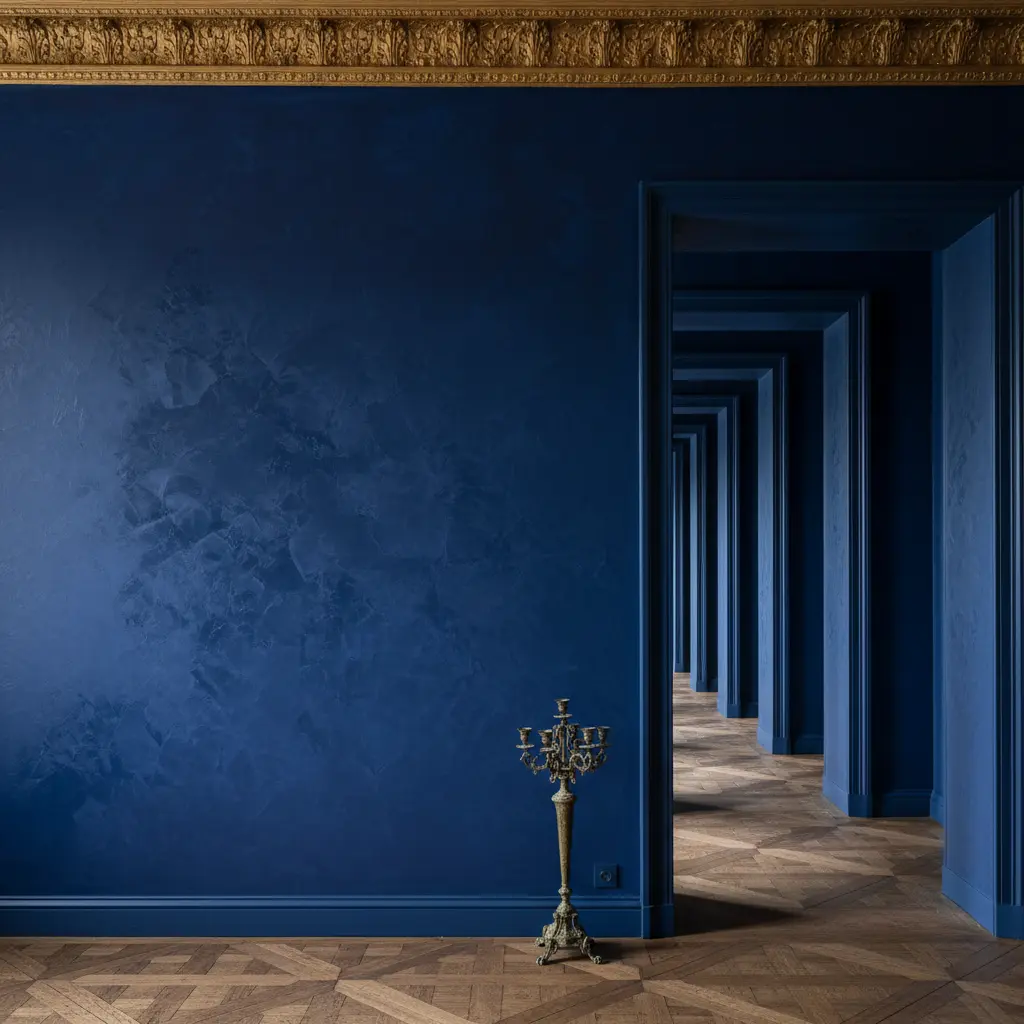
A client came to us with a magazine. Opened to a spread—a dark-blue enfilade in an estate near Paris, three rooms in a row, gilded cornices, herringbone parquet. Said a short phrase: “I want the same.” I didn’t know then that that very phrase would turn into a year and a half of work, six paint tryouts on site, a restructured lighting scheme, and a final interior estimate where just the coloring of the grand space—indigo color, grand enfilade, luxury segment—came to eight million rubles. Without furniture. Without decor. Just walls, ceilings, light, and work on them.
And you know what? The client never regretted it once. And since then I treat indigo like a surgical instrument: you can perform a miracle with it, or you can wound the project fatally.
In this article—why this color costs that kind of money, where clients go wrong, and how we at the studio calculate risks before agreeing to paint 300 square meters in the trickiest hue on the palette.
Why Indigo Isn’t Just “Dark Blue”
When a client says “let’s do blue,” I always clarify: which exactly. Because between cobalt, Berlin blue, ink blue, and indigo—there’s an abyss. Indigo is blue veering into violet, with a depth that only multi-layer pigments give. It has character: it eats light, but in exchange gives volume you can’t achieve any other way.
I often say: indigo behaves like velvet. In the morning it’s one thing, at six in the evening—another, by candlelight—a third. This isn’t a bug, it’s its essence. If the client isn’t ready for walls to “breathe” throughout the day, indigo isn’t their color. Take slate blue, sleep soundly.
But if ready—things get interesting.
Enfilade as a Stage: Why Indigo Works Here
A grand enfilade is a rare creature in modern projects. Three, four, sometimes five rooms connected along an axis, with door portals that open a perspective of 20–30 meters. In a regular living room, indigo could overwhelm. In an enfilade—it does the opposite, it creates the very depth that the eye reads as luxury.
Why? Because a dark color in perspective works like a theater backdrop. It pushes the far wall back, adds air between the portals, makes each following room a separate “picture.” In a light enfilade everything blends into one white corridor. In indigo—each room sounds.
We had a project in Barvikha, 340 square meters of grand space. The client initially wanted “everything in ivory, like Versace.” We made a visualization in two options: cream and indigo. She looked at the indigo for ten minutes without speaking. Then said: “I didn’t know my house was this big.”
That’s what they’re paying for.
How Much Indigo in a Grand Enfilade at Luxury Level Actually Costs
I’ll break it down by layers. Numbers from a real 2023 project, 300 m² grand space.
Paint. Not from a hardware store. We work with Farrow & Ball (Hague Blue, Drawing Room Blue), Little Greene (Hicks’ Blue), sometimes Argile or Ressource. A liter—from 8 to 14 thousand rubles. For 300 m² with prep and three coats around 60–80 liters needed. Already under a million.
Wall prep. Under dark color the wall must be perfect. Any wave, any joint trace on matte deep paint is visible like a scar. We do 5–7 layers of filler with intermediate sanding and mandatory primer in tone. That’s +1500–2500 rubles per square meter just for prep.
On-site color matching. Here magic starts. A ready-made color from a can never sits the way the specific room with specific light needs. A colorist comes to the site, does 4–6 paint jobs meter-by-meter, watches in different light for two days. That’s another 200–400 thousand.
Lighting. A separate section below—but upfront: on indigo walls you can’t save on light. Never.
Total for that grand space—8.2 million. And this is without decorative techniques like Venetian plaster or finish under lacquer.
Light Is Half the Success, and Here’s Where Most Get It Wrong
Indigo without proper light is a cave. With proper light—it’s a jewel.
We set up minimum four lighting scenarios for each enfilade room:
Daytime mode. Natural light plus dimmed cornice backlighting with warm temperature 2700K. Walls read as deep ink with violet undertone.
Evening reception. Wall sconces and center chandelier turn on. Temperature—2400K, not higher. In this light indigo goes almost black, with blue highlights on the molding. That’s the “Versailles” effect clients come for.
Intimate mode. Just sconces and a pair of floor lamps. Walls fade to shadow, the room stays an island of light around the seating. Indigo works on intimacy.
Technical. Full top light for cleaning and inspection. Used once a month.
All scenarios—on dimmers and scene control. Lamp CRI—minimum 95, otherwise blue starts to “green.” Critical. An 80 CRI lamp on indigo wall I’d recognize from the door: color becomes dirty, like the wall wasn’t cleaned well enough.
Typical Mistakes (Not Just Clients’)
In twenty years I’ve collected a collection.
Mistake One: choosing color from an Instagram picture. Color on screen is RGB, color on wall is pigment in medium. They never match. I’ve seen people fall in love with indigo in a photo and go into shock seeing it in person at their home in northern light.
Mistake Two: saving on prep. “Let’s do it over old plaster, it’s fine anyway.” It’s not fine. On dark matte paint every grain is visible. We once gave in—had to redo at our expense. Since then prep is a separate contract line, no options.
Mistake Three: one shade on all walls. In a three-room enfilade we often take three related shades with 5–8% difference. So each room has its own note, but the overall axis reads as unified. One indigo across all 300 square meters—that’s monotony, not depth.
Mistake Four: gloss. Deep blue asks for matte or maximum—satin. Glossy indigo on a grand wall looks like tiles in a Soviet clinic. Expensive tiles, but still a clinic.
Mistake Five: dark floor under dark walls. An enfilade with indigo walls and dark parquet turns into catacombs. Floor should be 3–4 shades lighter than walls. Golden oak, light herringbone, sometimes—marble inlay along the central axis. Contrast plays.
How We Work with Indigo at the Studio: Step by Step
In short—we don’t paint until we’ve checked everything.
First—insolation analysis. We measure natural light in each room three times a day. A north-facing enfilade and a south-facing one—two different projects, even if the color on paper is the same.
Then—test samples. Not A4 paper from the supplier, but gypsum boards meter-by-half-meter, primed and filled like real walls. These boards sit in the room minimum two days, we look at them morning, afternoon, evening, under artificial light.
Next—coordination with lighting designers. We have a permanent partner for scenario lighting, we calculate together what lamps, what temperature, what power you need specifically for the chosen shade. Sometimes light changes the shade. Sometimes shade requires rebuilding the whole light scheme.
Only then—the big painting. Three coats, inter-coat sanding, matte lacquer finish on touch zones.
It’s long. It’s expensive. It works.
Who Indigo Fits and Who It Doesn’t
I’ll be honest, not every client I’m ready to offer this color to. Indigo grand enfilade at luxury execution—that’s a story for people who understand they’re buying not paint, but atmosphere. Who will come in the evening after a long day, pour themselves a glass, sit in an armchair—and feel the house embrace them.
If the client wants “bright and festive”—that’s not indigo. That’s another project, another palette, another conversation.
And if he wants guests to catch their breath at the threshold of the first room—then we sit and calculate. First light, then color, then money.
And you know what I’ve noticed over these years? People who chose deep blue in the grand space never go back to beige. Color, like good whiskey, doesn’t let go.
If you’re facing such a choice now—write us. We’ll bring samples, look at your light, tell you what it costs you specifically. Without promises it’ll be cheap. With promise it’ll be exact.
Next step
Discuss your project
An hour at the studio with Oleg Reznikov: your site, your brief and relevant studio projects.