
The Grand Staircase: Sculpture That Costs as Much as a Floor
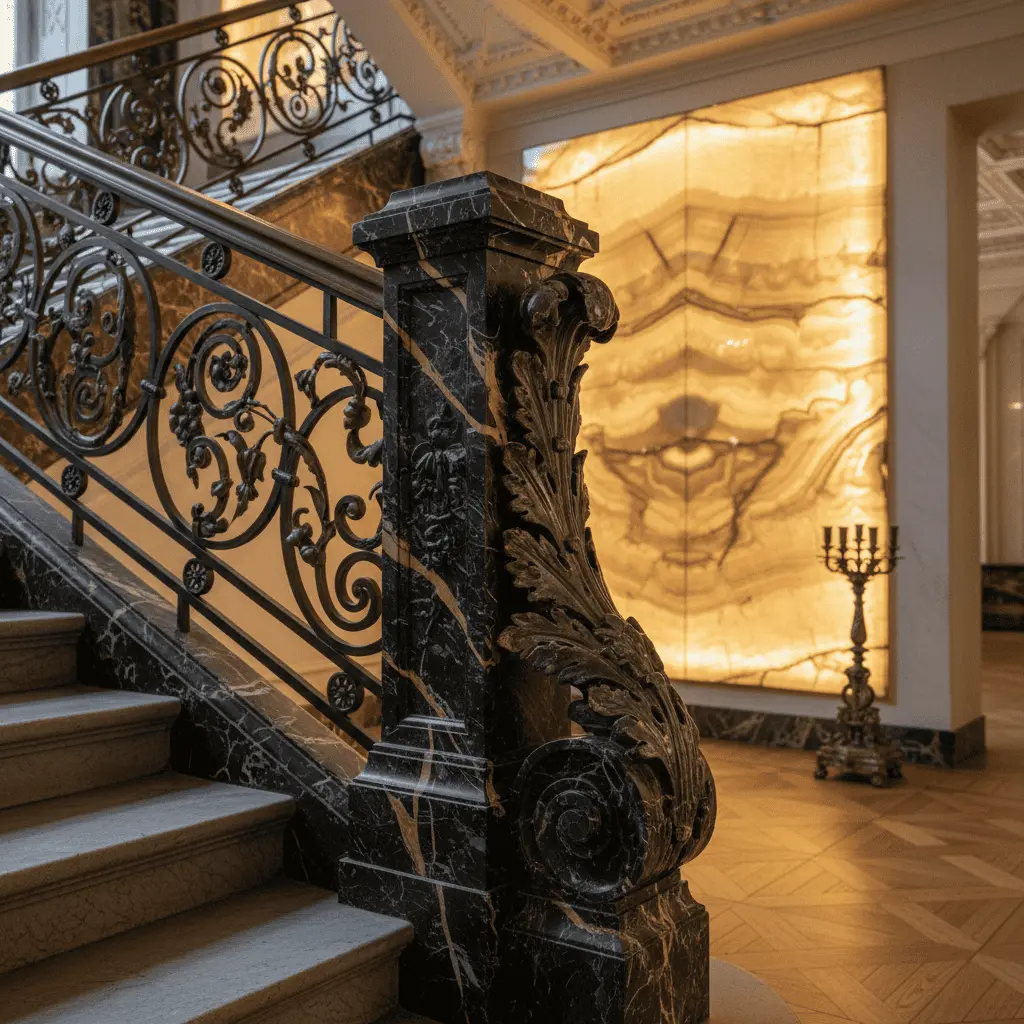
We had a project in the Moscow region — a 1,400 square meter mansion, a client who’s used to accounting for every ruble even at a 150-million finishing budget. And we’re working through the estimate, and he points at a line: “Oleg, why does the grand staircase — Portoro, bronze, onyx — cost like half the kitchens, bathrooms and dressing rooms combined? Let’s make it simpler, finish it in oak, and that’s enough.”
I understand him. On paper it really looks absurd: one object — and such money. But a month later, when we showed him the visualization of the foyer, he said it himself: “Okay, do it as you proposed.” And six months later, at the housewarming, he brought me to the staircase and quietly said: “This is the first thing everyone photographs. Literally everything.”
That’s what I want to talk about. Why a staircase in a large house is not a way to reach the second floor, but the emotional core of the entire interior. And why economizing on it is the most expensive economy you can imagine.
Why the staircase is not a construction, but a manifesto
When you enter a house over a thousand square meters, your eye doesn’t know where to grab hold. The space is too big, ceilings too high, perspective too open. The brain searches for a dominant. A point to push off from and read everything else.
In classical architecture, the fireplace played this role. In modern houses — almost always the staircase.
It works as an anchor. It sets the scale — next to it, a person understands they’re in a big house but doesn’t get lost in it. It determines geometry — the logic of the foyer is built around its lines. And most importantly — it sets the material and color vocabulary that the entire rest of the interior will speak in.
If the staircase has warm bronze in it — bronze will appear in light fixtures, in hardware, in mirror frames. If the steps are Portoro with its golden veins — this same stone or its echo will go into the master bath, into the bar countertop, into the fireplace portal. The staircase is the tuning fork. By it the orchestra adjusts.
Grand staircase in a mansion: materials that work
Over twenty years of practice, I can name three or four materials that genuinely transform a staircase into an event. Everything else is compromise.
Portoro — Liguria’s black gold
Italian marble of deep charcoal black with veining the color of melted gold. Mined in one single place on the Ligurian coast, always scarce. Price — from 8 to 15 thousand euros per cubic meter in slabs, not counting processing.
Why this one? Because it’s the only stone that works as jewelry at architectural scale. On five-meter-long steps, Portoro unfolds like painting — two mirrored plates with veining create a butterfly-wing effect. Impossible to repeat in other materials.
One downside: it’s demanding. Porous, afraid of acid, requires regular crystallization. But on a grand staircase, walked twice a day, this is not a problem.
Forged bronze — not “bronze-colored”
When a client says “bronze railings,” 90% of the time they mean painted metal. That’s not it. Real forged bronze is casting and hand finishing, it’s patina that lives and changes, it’s weight felt by the hand.
Railings of forged bronze for an 18-step staircase will run 4–7 million rubles depending on pattern complexity. Yes, a lot. But you get an object that in fifty years will look better than today. Bronze is one of the few materials that ages beautifully.
Backlit onyx — drama on the rise
Onyx is a translucent stone backlit from within. In a grand staircase it’s most often not used on steps, but on risers or in a wall panel running along the flight.
Picture it: evening, guests, soft lighting in the foyer, and along the staircase — honey glow of amber onyx. It works like a theater effect. By morning, in daylight, the stone looks like a calm marble mass. By evening, it comes alive.
Solid oak with heat treatment
For those who don’t want stone. Oak 40mm thick, heat-treated, hand-brushed — this is also premium material, just different aesthetics. Appropriate in houses of modernized classicism or Scandinavian chalet style. But — crucial point — oak on a grand staircase must be solid, not veneer. The difference is visible and felt underfoot.
Why this costs 15–30% of finishes
When I tell a client the staircase will consume up to a third of the finishing budget, the first reaction is disbelief. Let’s break it down.
An average 1,200 m² mansion — finishing budget 80–120 million rubles. A staircase with Portoro, forged bronze, and integrated lighting — 15–25 million. Do the math: 15–20% of budget goes to one object occupying maybe 20 square meters.
Madness? At first glance — yes. But look at it differently.
These 20 square meters everyone who enters the house sees. Everyone. No exceptions. But the master bath, which you’re ready to spend five million on — two people will see. The dressing room — one person.
The grand staircase is the most-viewed object in the house. Its payback in attention-per-square-meter is dozens of times higher than any other element.
Where most people make mistakes
Over decades of practice, I’ve collected a catalog of typical errors. They repeat with frightening regularity.
Mistake one: designing the staircase last. First comes the layout, then the interior, then “oh, where does the staircase go?” As a result, it’s squeezed into leftover space and either too steep or pinched between walls. The grand staircase is designed first. Always. The foyer is built around it, the house around the foyer.
Mistake two: economizing on flight width. “110 cm is enough for us.” No. A grand staircase is minimum 140 cm, preferably 160. Two people in evening wear should be able to pass each other comfortably. If a couple can’t descend arm-in-arm, it’s not a grand staircase, it’s a service exit.
Mistake three: lighting “by remainder principle.” Light in a staircase is half the effect. Embedded step lighting, accent light on railings, emphasis on onyx risers — all this is laid in structure, not added later. I’ve seen 10-million staircases ruined by hardware-store fixtures.
Mistake four: material discord. Client chooses Portoro for steps because “it’s beautiful,” then lays white travertine in the foyer. Two different houses in one space. The staircase material should dictate the foyer material, not fight it.
Mistake five: “we’ll redo it later.” A staircase is the one element in a house you can’t properly redo. You can only demolish it with all the surrounding finishing. Doing it “for now and we’ll replace it in five years” is a direct path to double expense.
How we work with stairs at Reznikov Studio
When a 1,000+ meter project comes to us, the staircase is the first thing we discuss with the client, before layout decisions. We ask three questions.
First: what emotion should someone feel entering this house? Ceremony? Lightness? Noble restraint? The answer dictates the geometry — straight, half-turn, curved, with an intermediate platform-podium.
Second: what material will be the “main voice” of the entire interior? If the client leans toward warmth — oak and bronze direction. If toward drama — Portoro and patinated steel. If toward light classicism — Statuario and polished brass.
Third: how should the staircase look in the evening? We always do a separate light visualization just for the evening scenario. Because grandeur is about evening, about reception, about event feeling.
Then a structural engineer joins. This is a crucial moment: a marble staircase requires load calculations different from standard. A Portoro step 40mm thick, 1,600mm long, weighs about 120 kilograms. Ten such steps on a beam — 1.5 tons of constant load plus dynamics. If the engineer treats this as “just a regular staircase,” cracks in the marble at joints appear in two to three years.
And only after that — aesthetics: forging pattern, stone cut pattern, hardware, final details.
Grand staircase in a mansion: materials and budgets in real examples
So it’s not abstract — three of our recent projects. Names withheld, of course.
Project A, 1,100 m² house, Novaya Riga. A half-turn staircase, Portoro on steps, forged bronze with light patina on railings, honey onyx risers with backlighting. Budget: 18.4 million rubles. Fabrication and installation timeline — 7 months.
Project B, 1,600 m² house, Moscow region. A curved floating staircase without visible support, Travertine Navona steps, tempered glass railings with bronze profile, LED in every step. Budget: 22 million. Timeline — 9 months, because the curved travertine was custom-cut in Italy to precise templates.
Project C, 1,300 m² house, Rublyovka. Classic straight staircase with intermediate landing, 50mm solid oak heat-treated, railings hand-forged with brass elements, molding along the string. Budget: 11 million. Here we consciously moved away from stone — the client wanted an English country house, and stone would have killed the atmosphere.
Range — from 11 to 22 million. And in each case it was the right decision for its specific house.
What remains when money stops being an argument
I often think about what distinguishes a house you want to return to from a house that’s just expensive construction. The difference is always in details that don’t obey the logic of return on investment.
The grand staircase is one of those details. It doesn’t make the house warmer. It doesn’t save energy. It doesn’t add usable area. It does one thing: every day it reminds the owner where they are and how they feel in that place.
Over twenty years I haven’t seen a single client regret spending more on the staircase than planned. And dozens who regretted economizing.
If you’re designing or building a large house and haven’t yet thought of the staircase as the main character of the interior — let’s talk. This is a conversation where crucial decisions are made early. And the earlier it happens, the less pain at the finishing stage.
Next step
Discuss your project
An hour at the studio with Oleg Reznikov: your site, your brief and relevant studio projects.