
Why New Russian Billionaires Are Tearing Out Glass and Bringing Back Columns
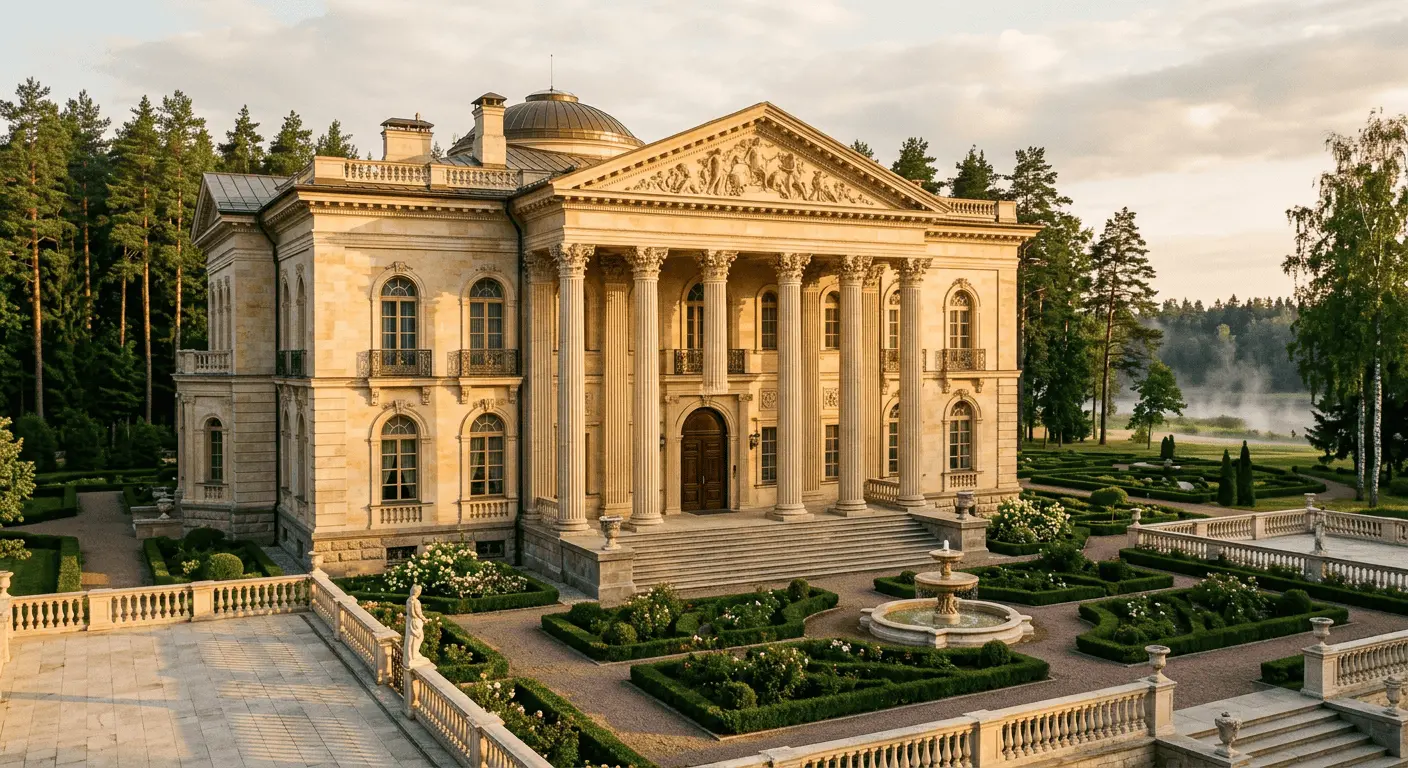
Last month a client came with an unusual request: take apart the glass facade of a 2014 house on Rublyovka and replace it with a limestone portico with columns. Budget—same as new mid-size construction. Reason—one phrase: “I don’t want to live in a refrigerator that the next owner will tear down in five years.”
This isn’t a one-off story. It’s a trend we’ve been watching for eighteen months, and it’s what defines what’s now called neoclassicism of elite mansions 2026. The premium market has turned—quietly, without loud manifestos, but systematically. The glass cubes that seemed like progress and status synonyms a decade ago are now trading at 30–40% discount. And classical mansions from the same year are appreciating.
In this article we’ll explain why this happened, who understood it first, which materials are coming back (and exactly why), and what mistakes clients make trying to jump onto the minimalism train as it’s leaving the station.
The Glass Cube as the Decade’s Most Expensive Miscalculation
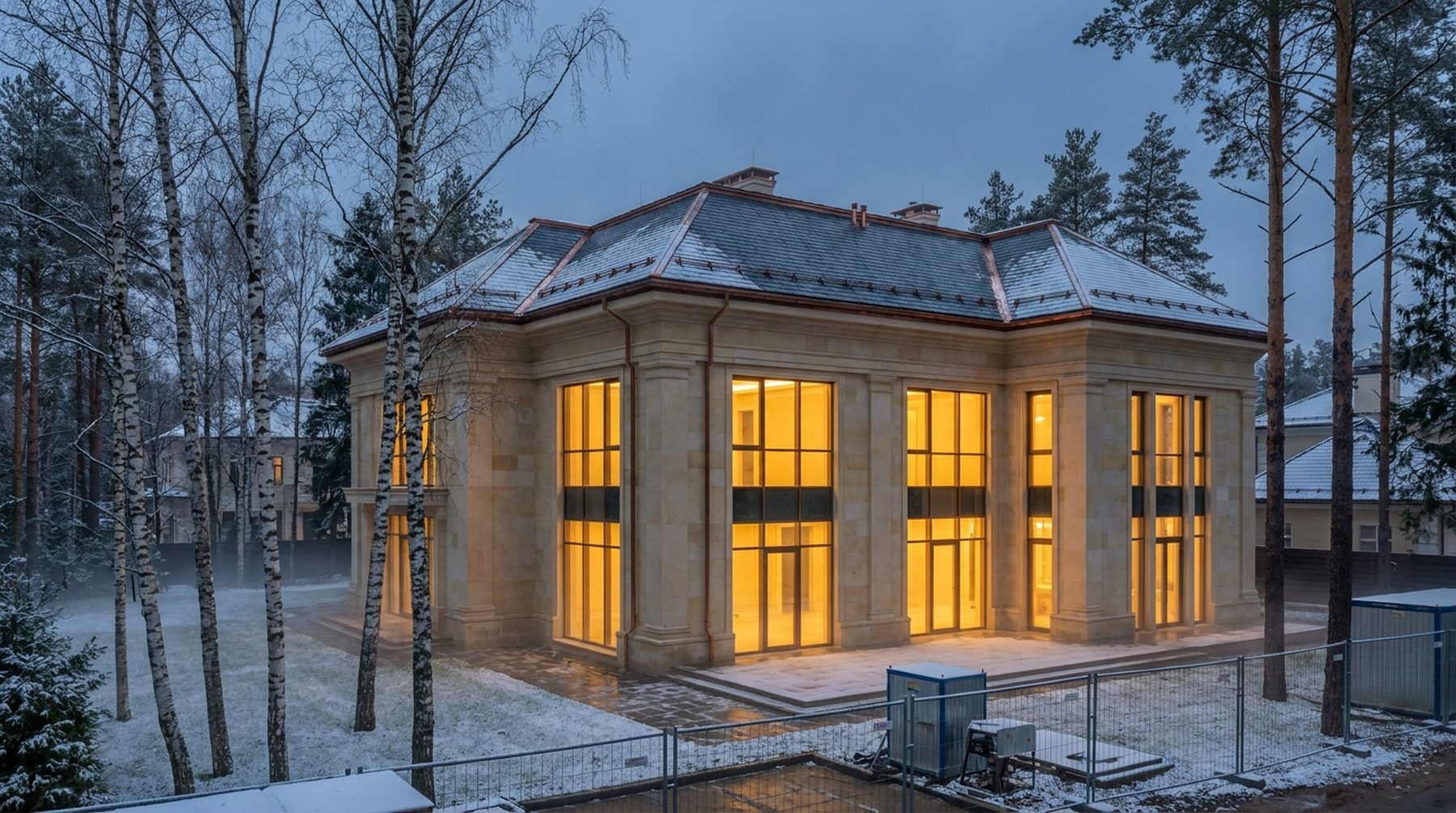
Let’s call things by their names. Fashion for “contemporary homes”—panoramic glazing, flat roofs, no decoration, concrete and steel—came to Russia as a direct copy from architectural magazines of the zeros. It was sold as “timeless.” Clean lines don’t age, they said.
They aged. And fastest.
In our practice we’ve seen at least a dozen homes from 2012–2016 that now can’t sell without serious discount. Facades bleached. Frameless glazing leaked—sealants live 10–15 years, and replacement costs like an airplane wing. Concrete cantilevers cracked from our temperature swings. Flat roofs—separate story, we could write one about those alone.
But main point—these homes stopped reading as status. They look like a mid-size bank’s office in Yekaterinburg. And an owner who paid 500 million ten years ago for the feeling of “I live in the future” now lives in the past. In past that doesn’t become vintage—it just becomes unfashionable.
What Changed in the Client’s Head
The shift didn’t happen in vacuum. We see three reasons, none about architecture per se.
First—capital generation shift. In the 2010s, premium clients were people who made money fast and wanted fast symbols. Now this niche is filled by their heirs, mature entrepreneurs age 45–55, for whom home is an asset. They think in horizons of 30–50 years. They ask: “How will this look when my grandson brings his wife here?”
Glass cube answers poorly.
Second—rethinking “contemporary.” Contemporary no longer means minimalism. Look what the world’s most expensive architectural bureaus are building—from Peter Pennoyer in New York to Robert Adam in London. Columns, symmetry, rustication, cornices. Classicism is back at the top not because the world went backward, but because the market understood: classicism is the language architecture speaks about eternity. Glass can’t.
Third—money. Banally, but important. A classical mansion from natural stone in 20 years costs more than it cost at build. A glass house—less. We’re talking Russian market now, and this is already statistics, not feeling.
Why Exactly Columns, Why Exactly Stone
We’re often asked: “Isn’t that too grand? Columns—isn’t that like Gazprom Arena on a budget, no?”
Answer: depends on who designs.
A column isn’t decoration. It’s a load-bearing element with two-thousand-year tradition of proportioning. When a column is designed right—ordinal ratios observed, entasis in place, capital linked to entablature—it reads as architecture. When you just add it because “client asked for columns”—you get what usually scares people off about “classicism.”
In our practice we work with Tuscan and Doric orders most—they’re calm, masculine, don’t overload the facade. Ionic and Corinthian for more ceremonial country projects, and only when justified by scale.
Stone is separate. Neoclassicism’s return is simultaneous return of natural materials: Jurassic limestone, travertine, dolomite, Russian white from Myachkovo. They cost 5–8 times more than plaster, but serve 150 years with no repair. Plaster facade on insulation needs major refresh every 12–15 years. Do the math yourself.
Neoclassicism of Elite Mansions 2026: What’s Actually Being Built
To avoid generalities, let’s go through what’s really being designed now in premium segment.
Volumes. Symmetrical main facade, portico with 4 or 6 columns (usually 4—six reads official). Two-story volume with mansard third level under hipped roof. Less often—full three-story volume, that drifts into estate typology.
Facade Materials. Natural stone—base and details (surrounds, cornices, balustrade), wall field—stone or quality mineral “stone-like” plaster. Roof—natural tile or copper standing seam. Never glossy metal shingles.
Window Glazing. Critical moment. Wooden windows with glazing bars—mandatory. Not plastic “wood-look,” not aluminum. Oak or larch, color—warm graphite, dark olive, deep burgundy. Frame size must be proportional to facade, not maximum-large like 2015.
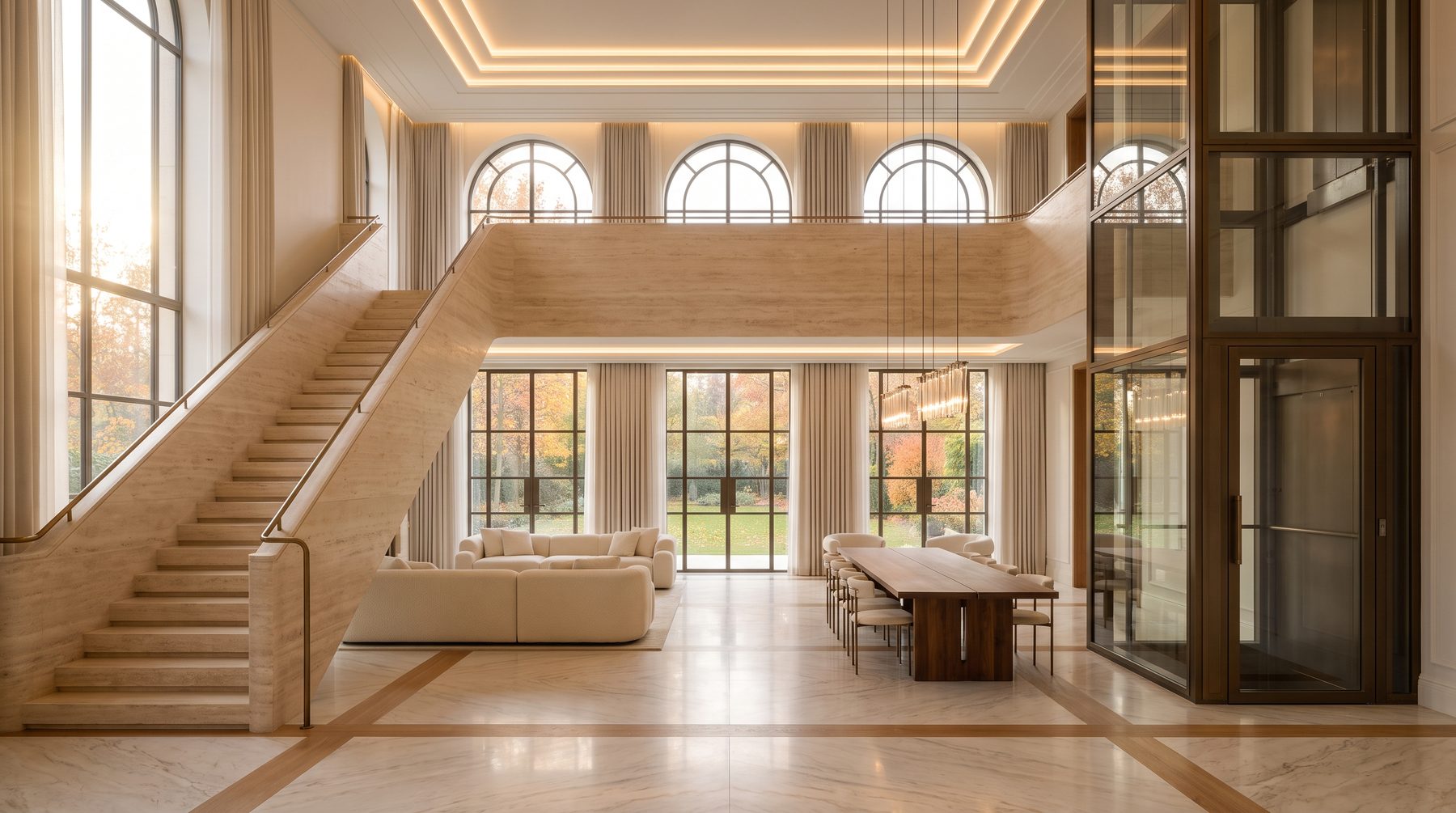
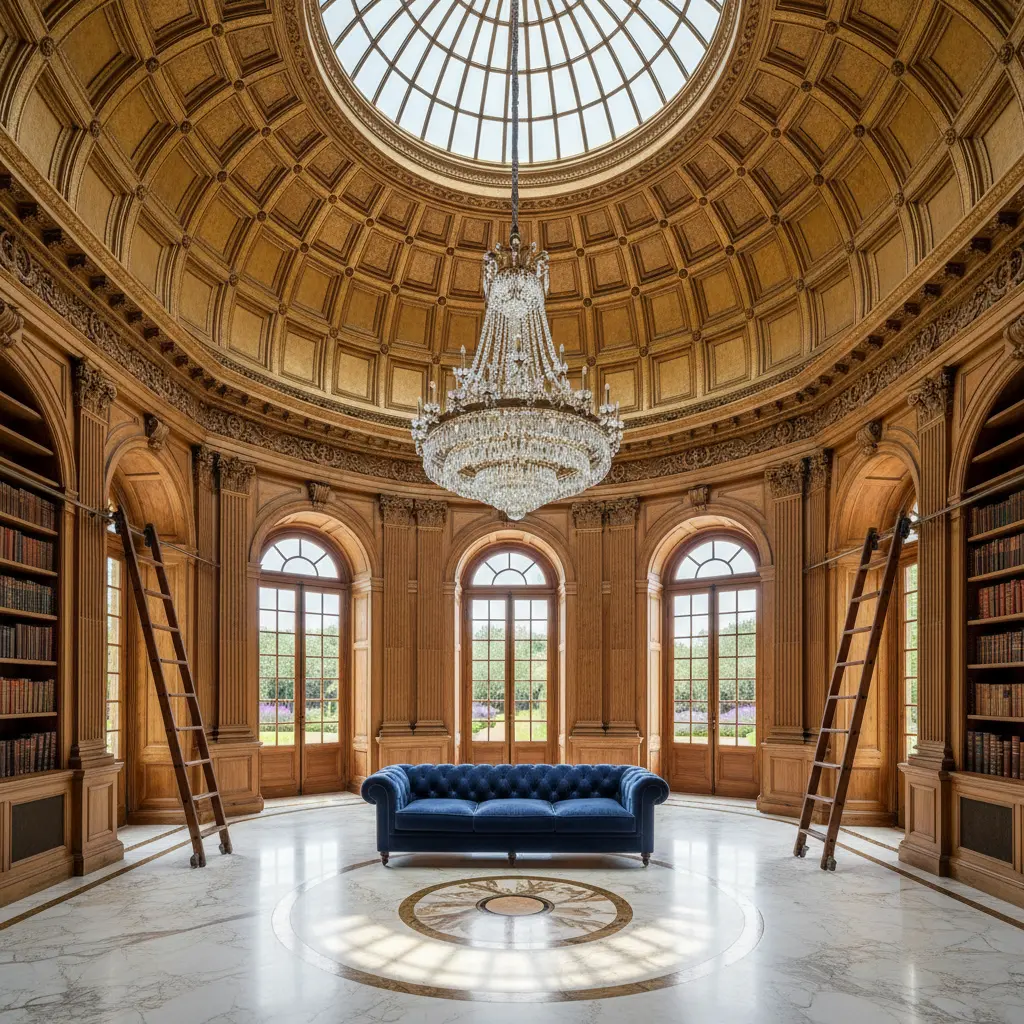
Interior. Separate topic, quick thesis: high ceilings (3.2–3.6 m ground floor), enfilade planning of main halls, fireplace—real, wood-burning, with chimney, not bioethanol fake. Parquet—solid oak, “herringbone” or “Versailles” pattern.
This is basic. Variations—from English Palladian villa to Russian estate in Zhukov style.
Typical Mistakes Trying to Build “Classical”
Last two years dozens of clients came with already-started projects needing fixes or total rebuild. Here’s what we see most.
Mistake one: “Quick classicism.” Client tells architect “add columns and portico, nice that way.” Architect draws what he remembers from textbook—and result looks like district ZAGS. Columns with no proper proportions, wrong windows, flat roof “because more modern.” This isn’t neoclassicism. This is a costume with sneakers.
Mistake two: Economizing on stone. “Let’s do stone-effect plaster, and columns from polyurethane—nobody’ll tell anyway.” They will. In three years. Polyurethane capitals yellow in sun, plaster cracks at corners. A 200-million-ruble house starts looking like 20-million-ruble stage set.
Mistake three: Style mixing inside. Classical facade—minimalist interior “to keep modern.” Schizophrenia. House must speak one language inside and out. Modern-classical or art deco work fine. But not IKEA with gloss facades, please.
Mistake four: Wrong scale. Sees photo of English mansion 1200 sq.m and wants “same thing” on 450 sq.m. Get toy house with outsized columns. Classicism works on right proportions—and crucially, right scale. Small neoclassical house is separate complex art, better go villa rustica or Russian country classicism, not palazzo.
Mistake five: No garden. Classical house without landscape—half a house. Symmetrical facade requires symmetrical planting before it. Alley, parterre, trimmed greenery. Chaotic “natural” groups before portico—aesthetic suicide. We always lead architecture and landscape in one project, or client comes asking two years later “why isn’t it quite right.”
How We Work With Neoclassicism
Briefly on our approach—so articles don’t look like lectures.
We start with typology. Before drawing a facade, we determine what type of classical building suits this lot, this scale, this family’s life. English villa, Palladian villa, Russian estate, French château, classical art deco—these are different architectural languages, can’t be mixed without understanding.
Then—order and proportions. We don’t use ready “classical element sets” from building catalogs. Each home gets custom order development, custom proportions, custom details. Takes longer, but only way to get something that doesn’t look like Lowe’s assembly.
Materials—only natural for structural and decorative elements. We discuss budget, offer simpler stone options, simpler profiles—but fake classicism from foam we don’t do. Professional reputation question.
Finally—always thinking 50-year horizon. How will it look in 10, 20, 30 years? How will materials age? What needs repair, what lives centuries? This is real premium architecture criterion—not how it looks at handover photo shoot, but how it lives further.
Did Minimalism Die Completely?
No. And we want to be honest here.
Good minimalism—real, thought-through detail, quality materials, proper landscape siting—lives and will live. A house in Mies van der Rohe style, if done like Mies and not Pinterest interpretation—is timeless architecture.
Problem isn’t minimalism as style. Problem that 95% of “contemporary” premium Russian homes 2010s—not Mies architecture. It’s Pinterest pictures translated into monolith without understanding proportions, details, materiality. When glass cube is done by John Pawson-level architect—masterpiece. When it’s done by “we saw pics on ArchDaily”—that’s what’s now selling at discount.
Neoclassicism came back not because glass is bad. Came back because classical language forgives more. In it harder to do complete disaster. Order holds facade, symmetry holds composition, natural stone holds image. More stable system—and market that got burned on modernism instinctively moves toward stability.
What’s Next
We don’t think neoclassicism is forever and everyone will build columns in 20 years. Architecture cycles. But right now—exactly now, 2025–2026—the window for creating truly long-lived home is in classical field. A home built today in neoclassicism with natural stone and right proportions in 30 years will cost more. A home built in trendy fake-hi-tech in 10 years will seek buyer at 40% discount.
This isn’t fashion. It’s revaluation of what status and capital actually mean in architecture.
If you’re choosing style for your future home now—come talk with us. Not to sell, to talk. We’ll show portfolio, show real budgets, show how homes we built 10 years ago live now. And honestly say whether you should even go classical—or your lifestyle and lot require something else. Not universal solution. But if it’s yours—you’ll feel it in minutes of conversation.
Read next
Next step
Discuss your project
An hour at the studio with Oleg Reznikov: your site, your brief and relevant studio projects.