
SPA Bathroom Without Travertine: What They Choose Instead
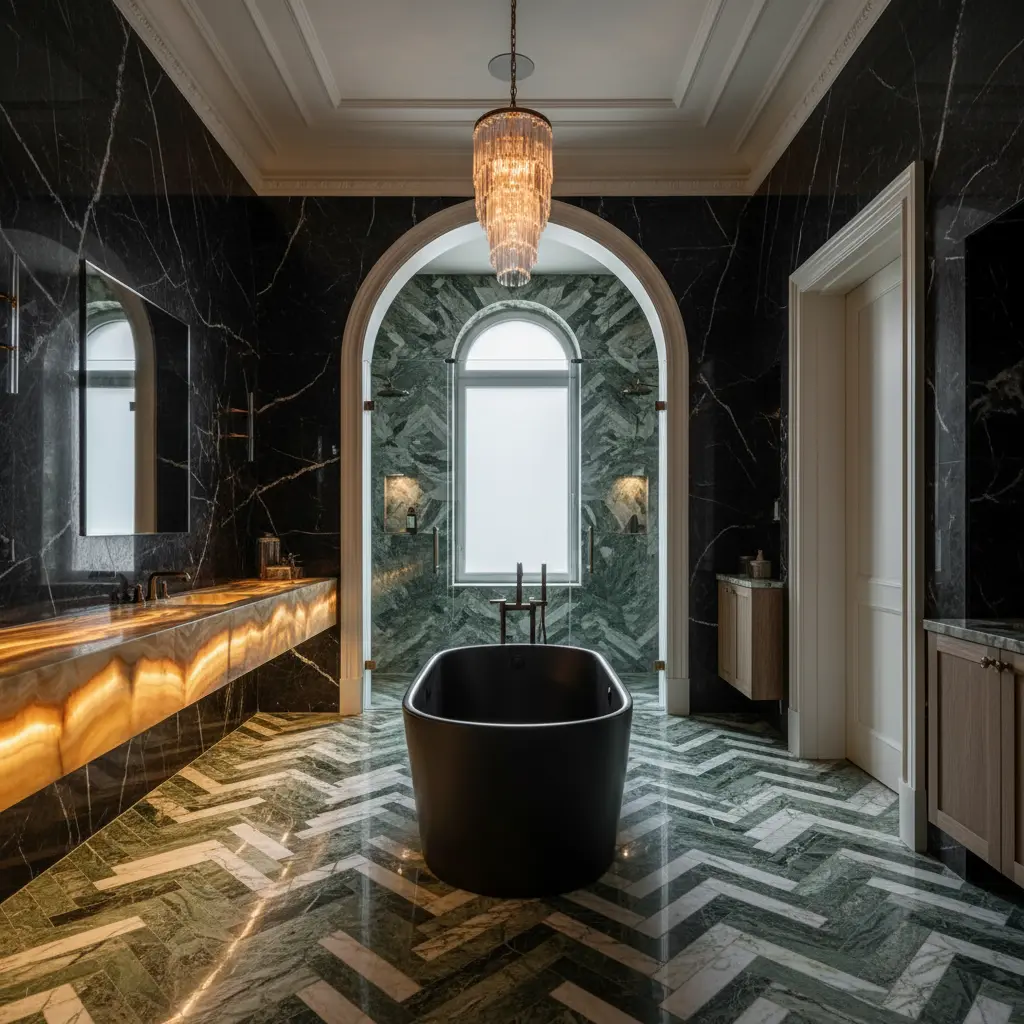
Last fall a client flew to Moscow after three weeks on the Côte d’Azur. Brought her phone with photos of a bathroom where she stayed—a villa near Monaco, friends lent it for a week. “Oleg, I don’t understand what this stone is. Black, like wet asphalt after rain, with streaks the color of mercury. I want the same.” That’s how I got my first black quartzite in the portfolio—and how I understood that a SPA bathroom materials premium 2026 would be dictated not by the stone we’ve gotten used to for five years.
Travertine is finished. Not physically—morally. When a material ends up in every third Pinterest interior, in showrooms of chain developers, in “premium” apartments for 250 thousand per meter—it stops being a status marker. It becomes background.
In this article I’ll tell what I saw in SPA bathrooms of Palm Beach and Monaco villas in the last year and a half, what three materials replaced travertine, and why it’s not just a matter of taste—it’s different engineering, different budget, and a completely different design approach.
Why Travertine No Longer Works as a Premium Signal
I love travertine. Really love it—soft, warm, with its own archaeology inside. But the problem isn’t the material, it’s its availability.
When in 2019 we laid Navona travertine in a master bathroom on Novaya Riga, the client waited four months for delivery and paid 18 thousand per square meter with sawing. Today that same travertine is in any big showroom near the Moscow ring road, in stock, 6-7 thousand. Democratization killed premium status.
And here’s what happened in parallel: Western colleagues—those working with really expensive clients—started moving into materials you won’t put in a 30-million-ruble house. Simply because the budget for one bathroom there starts at two million, and the client needs to see that.
Verde Alpi: Green Marble That Came Back After 40 Years
The first thing I noticed in Studio Sofield projects and at Vincent Van Duysen—the return of Verde Alpi. This is Italian green marble from quarries in the Aosta Valley, heavily used in the ’70s, then forgotten for decades, and now—everywhere.
Color—deep boggy green with white and emerald veining. In light looks almost black, in daylight—comes alive. We’re now working on a bathroom in a Rublyovka-Uspenskoe house where Verde Alpi goes as a continuous sheet from floor to ceiling with “book-match” sawing—when two slabs open like pages and the stone pattern mirrors.
What’s Important to Know About Verde Alpi
It’s serpentinite, not classic marble. It’s softer than it looks, and sensitive to acids—lemon, wine, even some cleaners leave matte spots. So in a bathroom it needs pampering—impregnation yearly minimum, and in the sink zone I always recommend the client live with it like with antique furniture. Not perfect—but alive.
Price of a 2×3 meter slab—from 280 thousand rubles. Without sawing, installation, fitting.
Black Quartzite—Material Worth Rebuilding Structures For
That same client with photos from Monaco ended up with a black Brazilian quartzite bathroom, Black Beauty. And here’s where it gets interesting.
Quartzite isn’t marble and it isn’t granite. It’s a metamorphic rock, density-wise closer to granite, but visual depth like the best marbles. Black quartzites with silver veining (Van Gogh, Titanium, Black Beauty)—hottest trend in projects from Miami to Saint-Tropez last two seasons.
But there’s a detail rarely mentioned. A 3.2×1.9 meter quartzite slab weighs around 700 kilograms. When we did that project, we had to reinforce the floor—the client lived on the second floor of a townhouse, and standard plate wouldn’t support mirror cladding of three walls.
This is why such materials don’t reach the mass segment. It’s not just price. It’s that you need to design the house from scratch for it, or invest an extra third of budget in reinforcement.
SPA Bathroom Premium 2026: Onyx Returns, but Different
The third material I now see in every second premium-segment reference from clients—is onyx. But not the glossy honey onyx with backlighting that was trendy in the 2010s and became associated with Dubai kitsch.
Now in work—raw onyx. With matte surface, with cracks left as-is without epoxy fill. Green, grey, smoky. Sometimes—with natural iron inclusions that on a matte surface look like rust on old bronze.
On one recent project we made a monolithic bathtub from such onyx—hewn from a single block, with visible tool marks inside the bowl. The client wanted to see: this is stone, not composite imitating stone.
Cost of such a tub—about 4 million rubles plus logistics. Made in Italy, eight-month wait.
Typical Mistakes I See Constantly
When clients come with photos of such bathrooms from foreign magazines and ask to “do the same,” the dangerous part begins. I’ll list where they stumble most.
Saving on sawing. Verde Alpi and black quartzite work only in large format—slabs from 2.5 meters. When a client tries to save and takes tiles 60×120, the main thing is lost: continuity of pattern. Ends up expensive and unimpressive.
Ignoring engineering. Stone this dense and heavy isn’t cosmetics. It’s structure. I always say: if the architect doesn’t embed reinforcement for quartzite cladding at the house project stage—that’s a bad architect. Rebuilding later is money down the drain.
Wrong backlighting. Dark stones need different light. Warm yellow 2700K lamp turns magnificent Verde Alpi into a swamp. You need cold neutral light 3500-4000K with high CRI—from 95.
Household chemistry. Clients spend millions on stone then hand the bathroom to a cleaner with Domestos. In six months acid agents eat through the polish. Such materials need different care protocol—and this must be discussed at contract signing.
How We Work with These Materials at the Studio
When a client comes asking for a SPA bathroom from unusual stone, I always start with one question: are you ready for this bathroom to live?
The thing is, Verde Alpi, quartzite, and onyx are materials with character. They change over time. Traces are left on them. This isn’t porcelain that looks the same ten years later. This is stone that ages.
We create a separate document for such projects—an operation passport. It describes: how to wash, what not to use, how often to refresh impregnation, what to do if perfume bottle falls. Sounds tedious, but this is what separates working with premium stone from working with ceramics.
And one more thing. We never work with such materials from a catalog photo. Always—a visit to the warehouse, always—picking a specific slab. Because two Verde Alpi slabs from the same quarry can differ so much you wouldn’t recognize them in one photo. Stone is individual. You can’t choose it remotely.
Will This Trend Come to Moscow Region
My forecast—yes, and faster than it seems. I observe this cyclically: what appears in projects of leading Palm Beach, Monaco, and Antwerp architects today comes to us in a year and a half. That’s what happened with microcement, with brushed brass, with open wooden beams.
Black quartzite and Verde Alpi are already in work at several Moscow bureaus—I know at least three studios ordering slabs directly from Brazil and Italy. By end of 2026 this will stop being rare in the premium segment.
Travertine won’t go anywhere. It will just move down a floor—to business-class projects, to apartments, to houses for 50-80 million. The premium segment will move to where it’s harder, more expensive, and more interesting.
—
If you’re planning a house or large apartment now and thinking about bathrooms—come to the studio, we’ll look at samples together, discuss what fits your project specifically. Stone isn’t decided by pictures. It’s decided by touch.

Next step
Discuss your project
An hour at the studio with Oleg Reznikov: your site, your brief and relevant studio projects.