
Portoro Marble: Why the Most Expensive Stone Dies in Wrong Hands
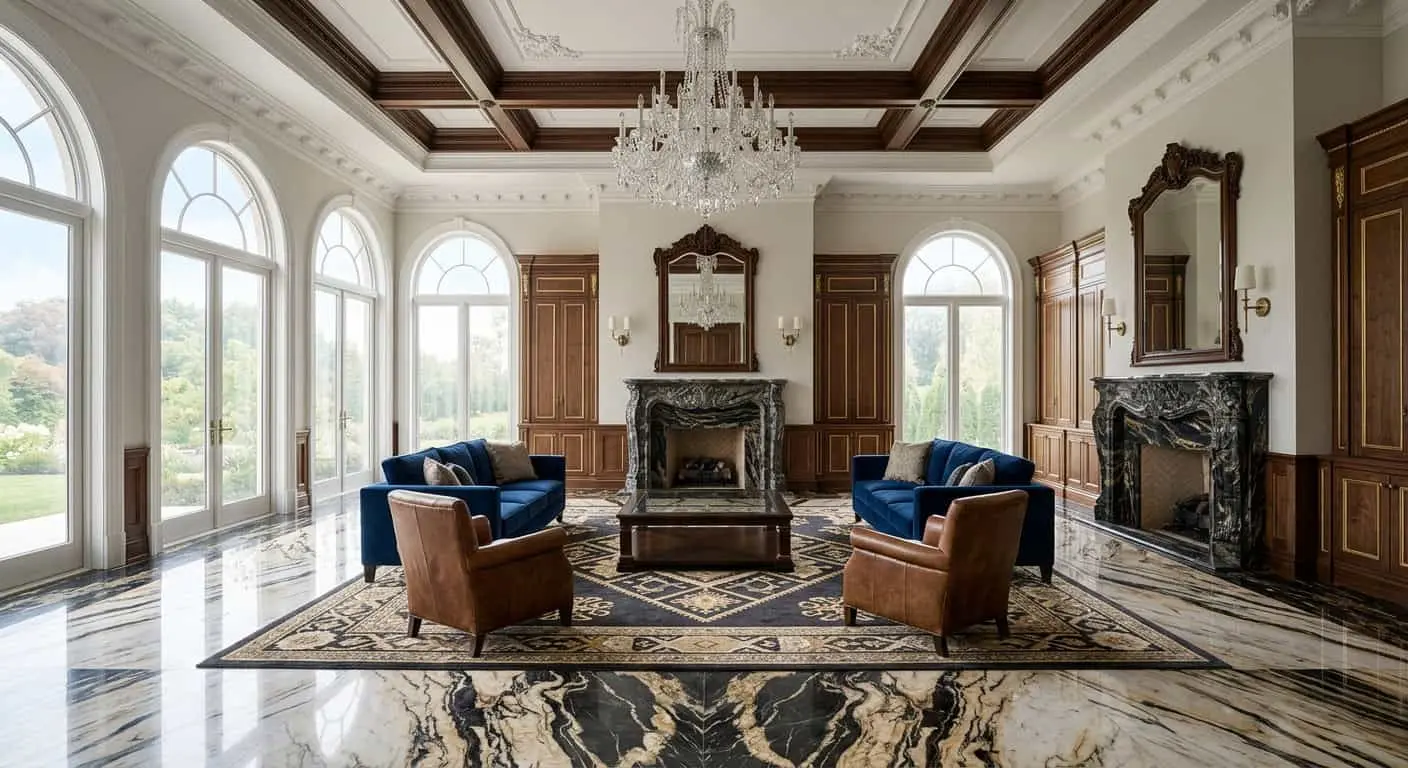
A client called me in a panic three months after moving in. “Oleg, I have a stain on my bathroom countertop. Size of a palm. Shampoo spilled.” I asked which stone. He said Portoro. And I knew this conversation would be long, because Portoro marble in a mansion interior is not a material, it’s a commitment, and most people learn this too late.
Portoro is black marble from the Ligurian coast of Italy, with golden veining that looks like someone melted the sun and poured it into the night. It’s one of the most expensive stones in the world. And one of the most temperamental. A square meter of slab costs like a used car, and in unskilled hands it dies in six months.
In this article, I’ll tell you where Portoro works at the level of a masterpiece, where it becomes an expensive catastrophe, and why we at the studio refuse it in half of projects — even when the client is ready to pay.
What Portoro really is
Let me start with the mundane but necessary. Portoro isn’t a single stone. Several varieties trade under that name: Portoro Macchia Larga (large golden swirls), Portoro Macchia Fine (thin veining), Portoro Extra — the densest with the cleanest pattern. Prices between them differ by two, sometimes three times.
It’s mined near Portovenere in Liguria. The quarry is small. Volumes are limited. Which is why the market has been flooded with “Portoro from China,” “Portoro from Vietnam” — visually similar black marbles with golden flecks. They cost ten times less. And behave completely differently.
True Italian Portoro is calcite with high bituminous content (hence the saturated black) and pyrite or ochre veining (the gold). High density, but porosity remains — as with all marble. And here things get interesting.
Why this stone is so temperamental
Black marble is unforgiving of mistakes. A wine stain on white Calacatta becomes visible in a week and you can still try to remove it. On Portoro, any chemical attack leaves a matte spot that reads on the glossy black surface like a white blotch on a tuxedo.
Here’s an incomplete list of what kills Portoro:
— Lemon juice, vinegar, wine — etch the polish in minutes
— Cosmetics: toners, perfumes, alcohol-based lotions — surprises for bathrooms
— Acid-based products, including many “gentle” stone sprays
— Hard water with limescale — leaves streaks visible at certain angles
— Hot pans — thermal shock can cause microcracks along the gold veining (it’s weaker than the base mass)
I watched Portoro on a kitchen countertop become a map of battle action in eight months. The owner — a serious person not prone to hysteria — said he’d never do it again.
Portoro marble in a mansion interior: where it works flawlessly
Now the good news. When Portoro is in its place, it’s one of the strongest materials that exists. It achieves what no other stone can: the feeling of absolute luxury without shouting. Black and gold — that’s not “rich,” it’s quietly powerful.
Fireplaces and portals
This is its native element. Nobody washes a fireplace with lemon juice. Nobody puts hot pans on it. Nobody presses a wet back against it from a shower. A Portoro portal framed by calm interiors in dark oak or dusty tones — a spot of visual force that holds an entire living room.
In one Rublyovka project we made a Portoro Extra portal with book-match layout — two slabs mirrored, and the golden veining forms a symmetrical pattern like spread wings. It’s been working eight years. Not a single spot. Not a single problem.
Accent walls in offices and foyers
A vertical surface away from water and chemicals — the ideal scenario. Portoro behind your back in an office, lit by warm light from above — and the entire room changes weight. Just remember: the lighting needs to be right, otherwise the gold becomes a dirty yellow.
Countertops in consoles and bar tops in reception zones
Key word — reception zones. A bar in the living room where you put champagne glasses once a week — yes. A working kitchen counter — no. Never. Even with the best seal.
Decorative elements: windowsills, bases, inlays
A small piece of Portoro in the right spot does more than an entire wall. We often use it as an inlay in a countertop of more durable material or in the floor — as a “rug” in the center of a foyer, surrounded by calm stone.
Where Portoro becomes an expensive error
I’ll speak directly, without diplomacy. If you want Portoro in these places — either refuse it, or be ready to replace it in two to three years.
Kitchen countertop. The most common catastrophe. Client sees Portoro in an Italian showroom, falls in love, orders. Six months later — a network of matte spots from lemon, tomato sauce, wine. No seal survives daily chemical assault. The seal buys you months, not years.
Floor in an entryway or bathroom. Sand, street dirt, winter deicing salts from your shoes — that’s abrasive and chemical at once. Plus constant humidity in the bathroom. Portoro dulls unevenly, paths form where you walk. After three years the floor looks like a checkerboard.
Bathroom countertop. Almost everything loses here: toothpaste with abrasives, alcohol-based cosmetics, perfume, makeup remover with acids. I’ve seen bathrooms where the owner arranged bottles in circles to hide the matte rings under each perfume bottle. Not a joke.
Shower floor. A combination: constant water + soap (alkali) + shampoo + cleaning products. Portoro in a shower lives a year. After that — cosmetic repair with repolishing, which few people in our country do properly.
Typical client mistakes
I’ve collected a good anthology over twenty years.
Mistake one: “I want Portoro everywhere because I already bought it.” A client orders slabs in bulk from Italy, brings them to Moscow — then tries to use them throughout the house, just to use up the material. I understand the logic: the stone is expensive, waste bothers you. But putting Portoro in the bathroom because you have leftover slab is like buying a Patek Philippe to use as an egg timer.
Mistake two: economizing on installation. Portoro is laid by the same guys who laid tile in the last apartment building. Result: chips on edges, incorrect pattern layout, 3mm seams instead of 1mm, poor sealing. The slab costs a million, the installer costs thirty thousand. Client saves on installation. Then is surprised.
Mistake three: ignoring the cut pattern. Portoro has very expressive pattern. Slabs from one block need to be laid with understanding: book-match (mirrored layout), end-match, or random. If you lay two neighboring slabs “however it comes out” — the pattern fights itself, and the entire effect of expensive stone disappears.
Mistake four: glossy polish everywhere. Gloss is beautiful, but it’s merciless: any etch is instantly visible. Sometimes honed (matte) or leathered (leather-like) finish is salvation. On floors, in bathrooms, even some countertops. The pattern reads more calmly, but the stone serves longer.
Mistake five: faith in sealers. “I was told the sealer protects everything.” No. The sealer slows down absorption. It gives you time to wipe up — a minute, two, five. It doesn’t make marble glass. And it wears away: reapply once every year-and-a-half. How many clients actually do this? Hardly any.
How we work with Portoro at the studio
Our approach at “Reznikov Studio” can be described in three rules.
First: we never sell stone, we sell a scenario. If a client comes with the request “I want Portoro in the kitchen” — we don’t say “okay, how many slabs.” We sit down and work through: how do you cook, how often, who does the dishes, are there kids. Eight times out of ten, after this conversation the client declines the idea themselves.
Second: we work only with verified Italian suppliers. We have three sources, all with direct quarry contracts. We personally inspect each slab — either me or my partner fly to the warehouse and look with our eyes. We never use Chinese Portoro, even if the client asks for “the same but cheaper.” It’s not the same material. It’s a different product that just looks similar for the first six months.
Third: we always offer alternatives. Nero Marquina with golden veins, Saint Laurent, Emperador Dark with brass inlay — there are dozens of options that give 80% of the visual effect at 30% of the cost and five times the durability. For countertops we often suggest engineered stone (Neolith, Dekton) with Portoro imitation — yes, it’s not marble, but in working zones it’s an honest choice.
And one more: if a client absolutely insists on real Portoro in a risky zone, we sign a document describing in detail what will happen to the stone in one, three, five years with this use scenario. It sounds formal, but it saves everyone’s nerves.
Care: what to do so Portoro lasts long
Briefly, by points, no filler.
— Wipe immediately. Not in an hour. Now.
— Only neutral products with pH 7. Never “universal cleaners.”
— Sealing every 12-18 months. Professional, not from a hardware store.
— Coasters under everything: bottles, glasses, flasks, makeup. Always.
— Every 3-5 years — professional repolishing by someone who knows black marble. In Moscow, there are maybe five such masters. No more.
If this sounds like caring for a living creature — you’ve understood it right. Portoro is a living being.
Final thought
Back to the client with the stain on his countertop from the opening. We replaced his kitchen countertop with engineered stone with a Portoro pattern. And real Portoro went to the fireplace portal in the living room. He now looks at this marble every evening and says the stone looks better than on the day of installation.
The moral is simple: the most expensive material requires not the biggest wallet, but the most precise understanding. Portoro is not a way to show money. It’s a way to show taste. And taste is revealed precisely in where you place this stone — and, more importantly, where you don’t.
If you’re currently choosing materials for your house and thinking about Portoro — write us. We’ll look at your situation specifically: layout, scenarios, budget. I’ll honestly tell you where it will work for decades and where it will let you down in six months. Sometimes the most valuable advice an architect can give is the advice not to buy what you’ve already decided to buy.

Next step
Discuss your project
An hour at the studio with Oleg Reznikov: your site, your brief and relevant studio projects.