
Why Heirs Demolish the Modernism of Their Fathers and Return to Classicism
Last spring we came for a site inspection in Rublyovka. Twenty-eight acres, on it — a glass parallelepiped from 2007, which once appeared in glossy journals. Cantilevers, floor-to-ceiling panoramic glazing, flat roof, black ceramic tile. The client — a 38-year-old man, the first owner’s son — said literally this: “Demolish it. Down to the foundation. I can’t live here”. We delicately clarified that the house was in excellent condition and worth around 380 million. He shrugged: “Exactly why — demolish faster, before I change my mind”.
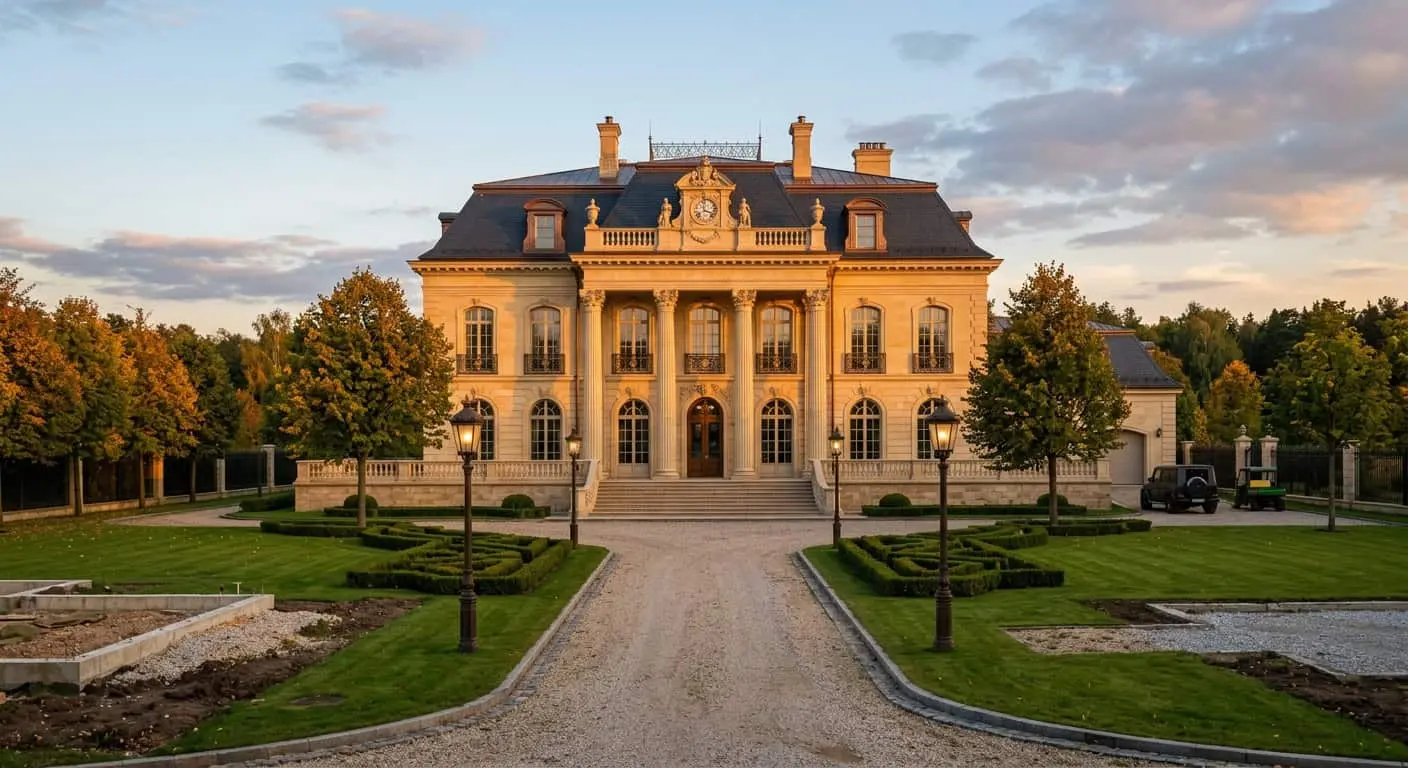
This isn’t a lone story. These are the trends in elite architecture 2026 in its most honest form — a generation of 35–45 year-olds, who’ve inherited parental capital and houses, systematically destroys the aesthetic of the noughties. In place of high-tech and “biotech” appear residences with colonnades, rustication, mansard roofs and natural limestone facades from the Jurassic. We’ve watched this from the inside for the last three years and are ready to explain what’s happening.
Because what’s happening isn’t just fashion. It’s a cultural pivot.
Modernism as the architecture of the newly rich
Let’s be blunt. The glass boxes built on Rublyovka and Novaya Riga in 2005–2012 were the architecture of people who’d just made a lot of money and didn’t quite know what to do with it. It’s the architecture of demonstration: “look, I can afford 9-meter spans and 6-meter cantilevers”.
There was nothing wrong with the taste in the direct sense. It was the taste of the first generation of capital. Such houses were built worldwide — from Los Angeles to Moscow — and everywhere they meant the same thing: “I’m new here”.
The problem is that the children of these people grew up. And they look at their father’s house with the same feeling an aristocrat looks at a gold toilet — with slight embarrassment for the parent.
Classicism, meanwhile, has always been the language of those who already have capital. The language of the second, third, tenth generation. And when a Russian capital heir wants to say: “I’m not a parvenu, I’m a dynasty”, he builds a house with colonnades. It’s grammar understood without translation.
Numbers that are hard to dismiss
We asked for analytics from three brokerage firms specializing in the 200+ million segment. The picture came out like this.
A classical mansion built in 2018 in the Zhukovka area, 1,200 sqm, limestone facade, mansard roof, symmetrical composition — over seven years rose in price from 520 to 730 million. That’s +40% in rubles, and even adjusting for inflation — solid plus.
A neighboring house, built in 2016 in “contemporary minimalism” style — concrete, glass, flat roof, 1,400 sqm — changed two owners and is currently listed 15% below the first sale price. The broker honestly tells clients: “either discount heavily or get ready to redo the facade”.
This is no accident. It’s a stable pattern of the last five years, and it’s exactly this shaping the trends in elite architecture 2026. Neoclassicism became a liquid asset. High-tech of the noughties — problematic.
Why? Because classicism is understood by any next buyer. Minimalism in the Zaha Hadid era is the architect’s personal statement, it either fits your aesthetics or it doesn’t. But a portico with Tuscan-order columns fits always.
Trends in Elite Architecture 2026: Exactly what heirs are building
We’re not talking about theatrical “Luzhkov-style” classicism with gilded lions at the gates. That’s exactly what the new generation flees as hard as they flee glass boxes. Their father’s house with columns and plasterwork provokes the exact same reaction in heirs as their father’s high-tech does.
What’s being built now:
Palladian tradition. Symmetrical compositions, portico with pediment, clear proportions, minimum decoration. The foundation is the form, not ornaments. Over the past year we’ve done four such projects, and all — for clients aged 37–44.
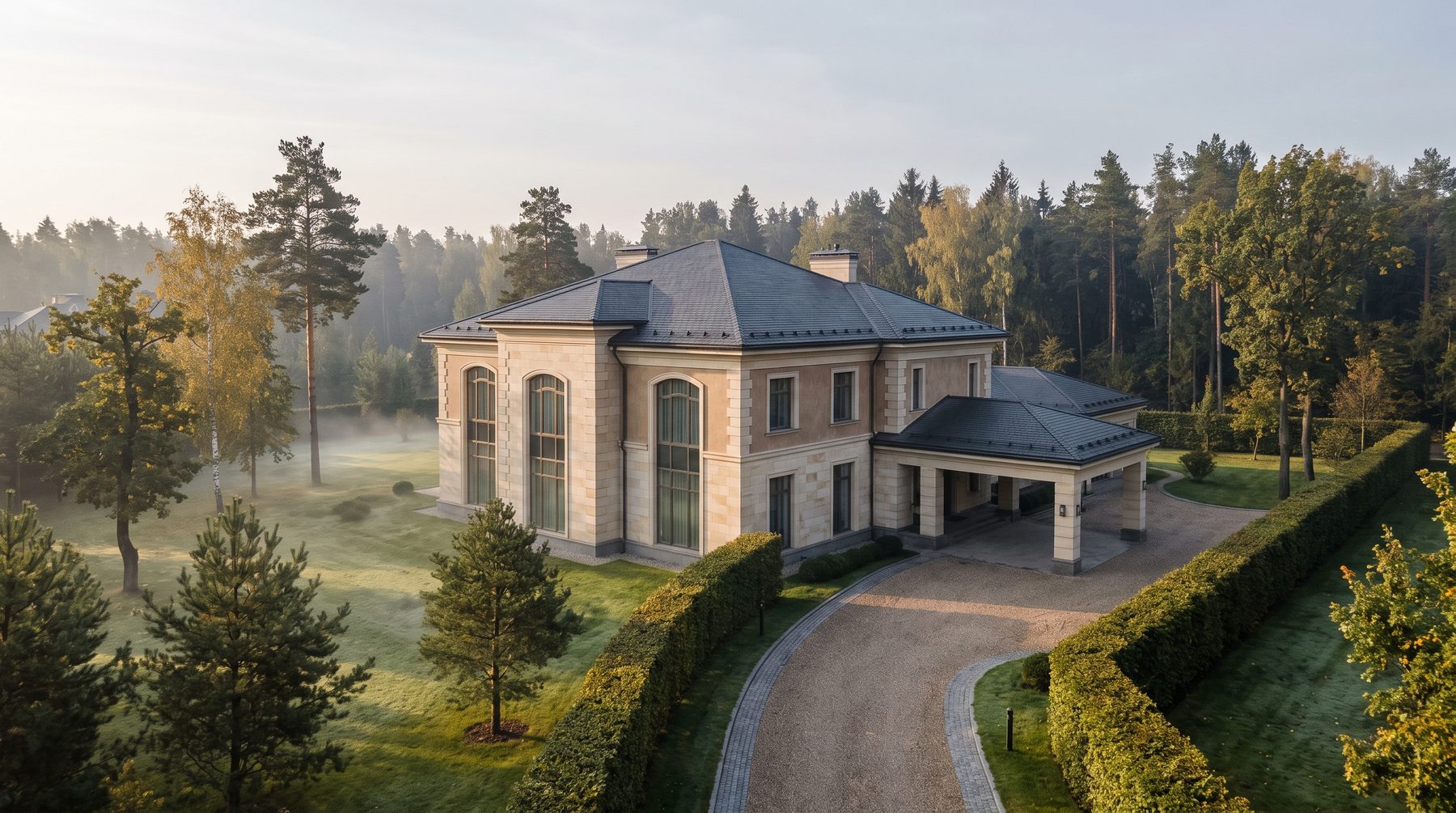
French neoclassicism. Mansards with tile, tall windows in small panes, facade from natural limestone Saint-Maximin or its Russian equivalents. No gilding. Gray-beige palette, patinated bronze in details.
English Regency and Georgian style. Hand-formed brick, flat facades, white casements, restraint to the point of asceticism. This is perhaps the most elegant thing we’re currently designing.
Russian country-estate classicism. Return to the tradition of Zhiliardy and Kazakov — without quoting, but with respect for proportions. Columns, mezzanine, enfilades inside. Interestingly, this request is growing fastest of all.
Why exactly now: a cultural diagnosis
Here’s where it gets interesting. The transition to classicism isn’t stylistic whimsy. It’s a reaction to three things at once.
First: fatigue with the temporary. A glass house looks outdated in ten years — glazing technology has moved on, silicone joints have darkened, frames look crude. A classical house looks better in ten years than on delivery day. Limestone patinates, brick gains character. A columned house in fifty years is a monument. A glass house in fifty years is a problem for the heirs.
Second: demand for rootedness. The generation now inheriting capital grew up in instability. They want to build something that will outlive them. Classical architecture visually promises eternity — rightly or not, but that’s how it reads.
Third: internal refusal of the fathers’ aesthetic. This is an almost psychoanalytic story. Children of the first capital generation build the opposite of what their parents built — not to prove something to the world, but to differentiate from the parental figure. Classicism in this sense is not just status. It’s a gesture of separation.
Typical mistakes in transitioning to classicism
Over the years we’ve seen many failed attempts at a “classical mansion”. Here’s where most people go wrong.
Mistake one: classicism as scenery. Take a modern house, glue polyurethane columns and plasterwork to the facade. It reads instantly — in how the column meets the plinth, how the cornice works, what proportions the windows have. Real classicism begins with plan and volume, not decoration. If a house was conceived as a box, no columns will save it.
Mistake two: mixing epochs and schools. Italian Palladian portico, French mansard, English bow windows and Russian casements on one facade. It’s not a house, it’s a catalog. Good classicism is choosing one tradition and working consistently within it.
Mistake three: saving on materials. A classical facade only makes sense in natural stone or quality hand-formed brick. Plaster-as-stone in five years will crack at temperature joints — and the whole expensive composition falls apart visually. In our practice, we refuse projects where the client wants classicism but isn’t ready for limestone or travertine on the facade. It’s a matter of principle.
Mistake four: transplanting hotel interiors. Lots of columns, lots of plasterwork, gold, marble on every surface. That’s the exact style the new generation is fleeing. The interior of a 2026 classical house is restrained, almost austere. Proportions and materials do the work, not the quantity of ornament.
Mistake five: scale out of place. A portico with 8-meter columns on a 600-square-meter house looks like a circus. Classicism requires precise scale-tuning — the architect must feel when to stop.
How we work with this request
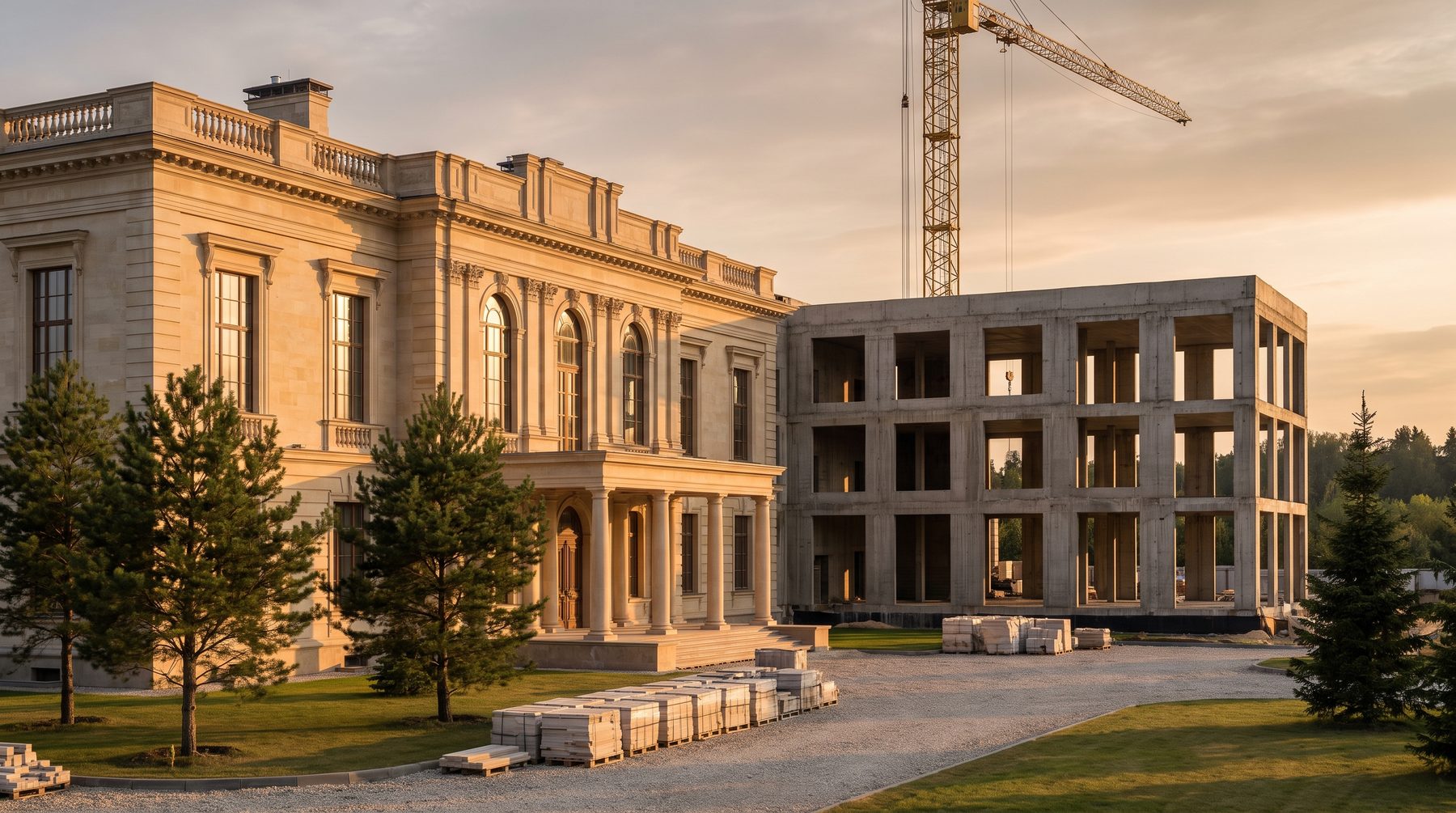
In our practice over the last two years, almost every other project is either tearing down the previous house and building a classical residence, or deep reconstruction with style change. And we’ve developed a certain approach.
We start not with a sketch but with a conversation about references. We ask the client to show ten photos of homes they like. And ten — they absolutely hate. From this set we understand which classical tradition exactly appeals to the person — often they can’t articulate it themselves. One client shows us photos of Chatsworth estate in England and Palladio’s Villa Rotonda. Another — Châteaux of the Loire and 18th-century Paris hotels. These are completely different projects.
Then we work with proportional systems. Classicism is mathematics. Golden ratio, modular grid, order as organizing principle. Without this foundation — no decoration saves it. We often make three-four variants of the facade composition, differing only in the proportions of openings, and show the client how the house’s character changes from centimeters.
We set materials from the start. Limestone from a specific quarry, with specific texture. Copper roofing or natural slate. Oak windows with brass fittings. Not “something in that spirit”, but specific article numbers. This is the only way to deliver what you promised on the sketch.
And we tell clients honestly when their request won’t work. If the plot is elongated and narrow — Palladian symmetry on it will look forced. If budget doesn’t allow natural stone — better to choose a different style where plaster is appropriate. Classicism doesn’t forgive compromises.
What this means for pricing on Rublyovka, Novaya Riga and Barvikha
The market’s already responding. Brokers we work with note: over the last 18 months, the price spread between a classical and contemporary house of the same class has grown to 25-35%. Before it was 5-10%.
Plots allowing demolition of existing high-tech started priced higher than plots with an occupied contemporary house — a paradox, but buyers factor demolition cost into price as a plus, not a minus. It’s a direct signal: a house on the plot is perceived as a burden.
Barvikha and Zhukovka are the epicenter of this shift. Novaya Riga is lagging by a couple years, but moving the same way. On Ilinskoye Highway we know five projects where glass mansions from the noughties are either already demolished or have demolition permits.
And here’s why it matters to those now only planning construction. If you’re building contemporary minimalism in 2026, understand this: in 15 years, that house will very likely be earmarked for demolition. Not because it’s bad. But because your children’s generation will probably want to live in a different aesthetic. Classical architecture passes this time-test.
Does this mean modernism is dead
No, of course not. There are brilliant contemporary projects — and we do them ourselves when justified. Small waterfront homes, forest residences, projects in unusual landscapes — there minimalism works and is appropriate. Contemporary architecture didn’t die, it just stopped being the universal language of elite housing.
Classicism returned as the default language for a status residence. Minimalism remained in a niche — as a language for specific tasks. That’s one of the main shifts shaping the trends in elite architecture 2026: not the victory of one style over another, but a rethinking of their roles.
A few words in closing
We don’t want this article read as a death sentence for contemporary architecture. And we’re not suggesting everyone urgently demolish their houses and build colonnades — that would be exactly the gesture of the parvenu that the new generation is fleeing from.
What we really want to say: if you’re now planning a house that should serve you for decades and pass to your children — think twice about its architectural language. Glass and concrete speak of the moment. Stone and proportion speak of time.
And if you’re that heir standing before your father’s glass house wondering what to do — call us. We already have experience with such conversations. And we know how to turn this moment from awkward inheritance into the beginning of your own story.
Architecture of dynasties doesn’t happen by chance. Someone has to start it.

Author
Next step
Discuss your project
An hour at the studio with Oleg Reznikov: your site, your brief and relevant studio projects.