
Building a 1,000 m² House: Where 200 Million Actually Goes
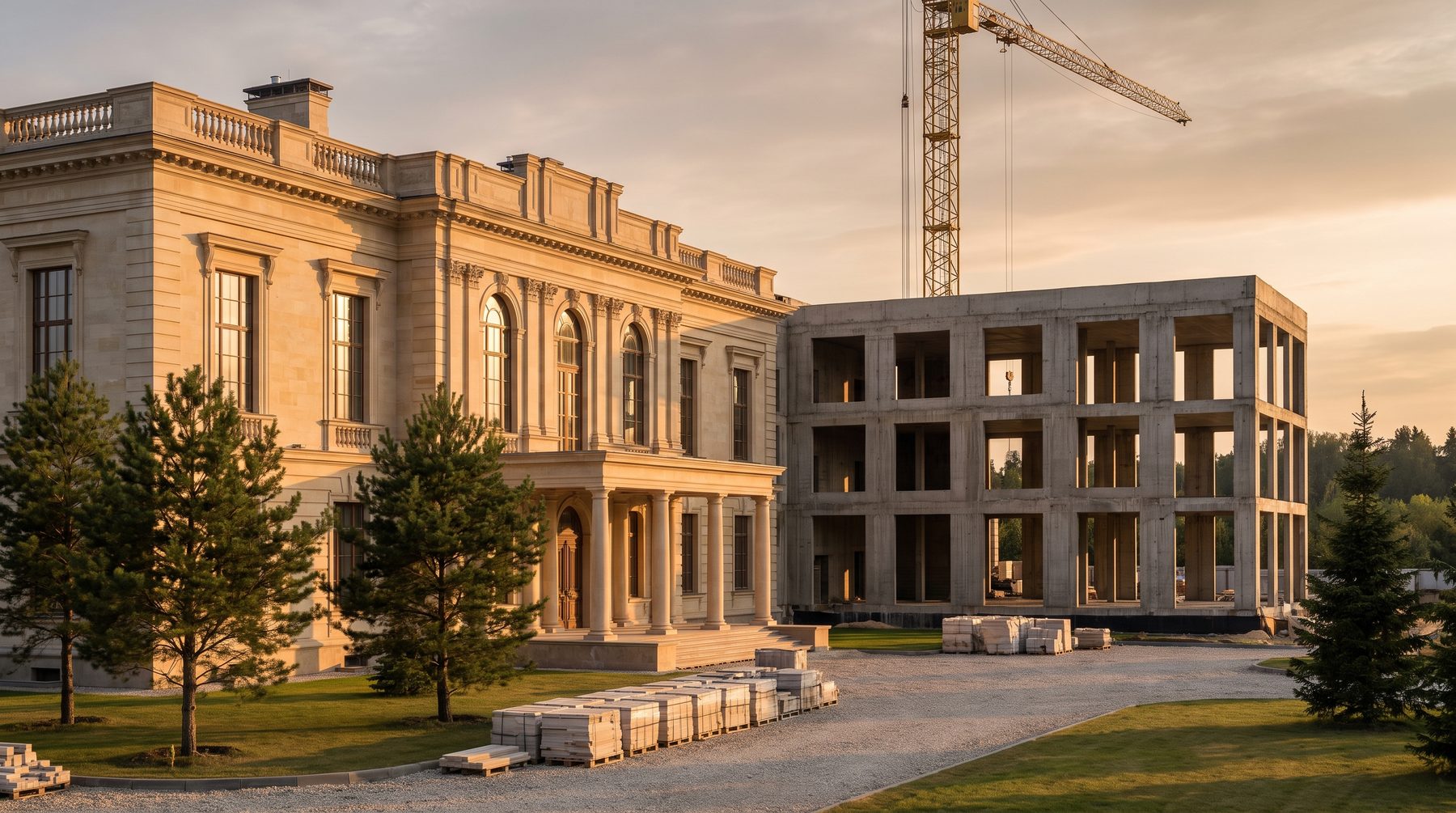
A realistic house construction budget breakdown for a 1,000 m² residence outside Moscow runs to 180–250 million roubles — and the money lands in places most clients never expect. Excavation, foundations and structure take roughly a third. Engineering systems take a quarter. Finishes and furnishing take another third. Architecture — the part everyone falls in love with — accounts for 3–5%.
It is a conversation I have every few months. A client puts a contractor’s estimate on the table: one page, eight lines, a number with a lot of zeros at the bottom. And asks me: “Oleg, is this expensive or normal?”
There is no honest way to answer. Not because the number is wrong, but because there is nothing behind it. Eight lines for a thousand-square-metre house is not an estimate. It is an intention.
Two years later the same client brings a different document — forty pages, prepared by his accountant — and the total has grown by eighty million. That is when the real conversation starts: where did it go?
The budget starts a year before the excavator arrives
The first thing to accept is that money starts leaving your account long before any machinery reaches the site. This is the single most underestimated part of the budget.
Geotechnical survey: 300,000 to 1.5 million roubles depending on the number and depth of boreholes. Topographic survey. A tree survey if the plot has mature specimens you intend to keep. Approvals with the estate: architectural review board, height limits, roof colour, permitted glazing ratio. Technical conditions for gas, power and water — and connection fees that, in some estates along Rublyovo-Uspenskoye highway, exceed the cost of the foundation.
Then design. Market benchmarks put design and survey work at 3–5% of the total budget. For a 200-million-rouble house that is 6–10 million for the full package: concept design, architectural drawings, structural engineering, four engineering disciplines, with interior design costed separately.
And it is precisely those 3–5% that clients try hardest to cut. The logic is understandable — paper isn’t walls. But here is where it gets interesting. Industry estimates put cost overruns caused by an underdeveloped design at 10–25% of the construction budget. On a 200-million-rouble house that is twenty to fifty million roubles. To save five.
Groundworks and structure: a third of the money, none of the glamour
Groundworks account for 10–20% of the budget, the superstructure for another 20–30%. Together that is roughly a third of all the money, and it is the most honest part of the project: almost impossible to fake, and almost nothing to show visitors.
At this scale the foundation is nearly always complicated. A thousand square metres rarely fits into a single rectangle — there is a lower ground floor with a pool and spa, a change in level, multiple datum heights, retaining walls. We had a project on Novaya Riga where the excavation and retaining walls cost more than the roof and the entire facade combined, simply because the house was set into a slope and half of the lower floor ended up below the water table. Waterproofing, perimeter drainage, a drainage blanket beneath the slab, granular backfill. Not a single rouble of it is visible in the finished house.
The superstructure of a 1,000 m² house is usually a reinforced concrete frame, sometimes with masonry infill. This is where the rebar sits — and structural steel in Russia has risen 6–9% since the start of 2026. Concrete, cement and brick added 8–12% on average in the first half of the year. An estimate priced in January is not an estimate by September. It is a historical document.
Roofing takes 8–12%. And roofing punishes false economy faster than anything else: copper or titanium zinc costs three times more than bituminous shingle and lasts four times longer. We covered this stage and its traps in our piece on foundations and structural works.
Engineering: a quarter of the budget that never appears in a photograph
Fifteen to twenty-five per cent of the estimate. On a large house it sits near the upper end, and with a pool and spa it routinely goes beyond.
Here is what that actually buys on a thousand-square-metre house. A plant room with two boilers and full redundancy, because losing heat in winter in a house like this is not an inconvenience, it is a burst-pipe catastrophe. Underfloor heating across the whole footprint, split into 40–60 circuits. Mechanical ventilation with heat recovery and humidification — without it, indoor humidity drops to 15–20% in winter, and one heating season is enough to crack parquet, boiserie and bespoke furniture. Cooling. Water treatment: a borehole in the Moscow region almost always delivers iron and hardness, and the treatment plant for a house this size is a dedicated room, not a box on the wall.
Then the electrical installation. On a large house that means 300–400 circuits, three or four distribution boards, a diesel generator with automatic transfer, UPS backup for critical systems. Low voltage: network, CCTV, security, door entry, multiroom audio. Automation — and if it is KNX rather than cloud-based relays, multiply the automation budget by three.
This is where most people get it wrong. Engineering is costed last, once the structure is already standing and the money has already been allocated. So it gets cut. Humidification goes. One boiler instead of two. Duct diameters are trimmed, the ventilation becomes audible, and the owner switches it off — which means throwing away every rouble already spent on it. How this should be resolved at design stage is set out in our section on building services and engineering.
Finishes and furnishing: where the estimate stops being an estimate
Finishes are quoted at 15–25% by market benchmarks. On premium projects that figure is almost always understated.
The reason is simple. In an average house, finishing means plaster, paint and engineered flooring, and it genuinely can be priced per square metre. In a 200-million-rouble house, finishing means sequence-matched veneer boiserie, book-matched marble slabs, patterned parquet, cornices modelled to drawing, three-metre doors with concealed frames and solid brass hardware. These are not square metres. They are joinery and stonework packages, each priced on its own.
I once saw an estimate where the line “bathroom finishes” came to 4 million roubles across seven bathrooms. The final figure was 31 million. Nobody was lying: at the time the estimate was written, nobody yet knew that the master bathroom would be open-pore travertine and the basins would be carved from solid blocks of stone.
Furnishing is a separate matter entirely. Furniture, lighting, textiles, sanitaryware, appliances, decoration. In our practice on houses of this class, furnishing runs at 25–40% of the cost of the finishing works, sometimes more. This is where the budget leaks most quietly, because it is spent not through one contract but through three hundred line items over eighteen months. We examined that mechanism in our article on interior procurement and furnishing.
Grounds: the 10–15% that appears in no contractor’s quote
A 1,000 m² house nearly always stands on half a hectare or more. That land has to be built too.
Regrading and imported topsoil. Storm drainage and land drainage across the whole plot. Paths and terraces — and if they are granite or clay paver, they cost about the same per square metre as the floors inside the house. Heated driveways and walkways. External lighting with its own control panel and scenes. Gates, fencing, a gatehouse. Landscaping: lawn, planting, semi-mature trees — a grown pine with a rootball costs as much as a decent car, and you will need more than one.
A guest house. A four-car garage. A garden pavilion with an outdoor kitchen. An outdoor pool, if the indoor one isn’t enough.
In practice, landscaping and external works run at 10–15% of the house budget — and they appear nowhere in the contractor’s original figure. Not one line. Because the contractor is pricing a house.
Five places where the money leaks
Pricing by square metre. “I was told premium is 200,000 per metre.” For a 300 m² house that roughly holds. For a thousand it does not: the share taken by engineering and complex structural solutions grows non-linearly, and a pool, a spa and a lift have nothing to do with floor area at all.
Carrying no contingency. The market norm is 15–20% for concealed works and design development. Clients budget zero, because a contingency feels like an admission that the estimate was done badly. It isn’t. It is an honest line item.
Fixing the price before the design exists. A lump-sum contract signed at concept stage is not budget protection. It is a promise the contractor will keep at the expense of things you won’t check: reinforcement diameters, concrete grade, insulation thickness.
Forgetting that time is a cost line. A 1,000 m² house takes three to five years. With materials rising 8–12% a year, the third-year budget is not the first-year budget. If the contract contains no indexation mechanism, one will appear in real life — in the form of a difficult conversation.
Saving on design and supervision. The most expensive decision available to you. Every unresolved junction gets resolved on site by the foreman. Quickly, cheaply for him, and expensively for you.
Our approach: an estimate is a drawing, not a final number
We cost a house three times. That is not bureaucracy — it is how we avoid lying to the client.
The first costing comes at concept stage: broad-brush, by phase, with an honest ±25% range. It exists for one purpose — to establish whether the house being imagined matches the money available. If it doesn’t, this is the best possible moment to change the brief. On paper, a room costs nothing.
The second comes after construction drawings and the selection of principal materials. The range tightens to ±10% and real quantities appear: cubic metres of concrete, tonnes of rebar, specific equipment models. This is also where the payment schedule gets tied to milestones rather than to the calendar.
The third happens during procurement, once actual products have been chosen. That is when the client sees the true cost of his house for the first time.
Running alongside all of this is construction management and supervision on site: checking quantities in the valuations, reconciling what the drawings specify against what has actually been bought and installed. Dull work. It routinely pays for itself within the first quarter.
A client once told me: “I thought I was paying for a house. It turns out I was paying for decisions.” That is exactly right. Two hundred million does not disappear into walls. It disappears into several hundred decisions, each of which can be made on paper for a thousand roubles or on site for a million.
If you are at the stage where you have a plot and a rough idea of the house, the most useful thing you can do is break the future budget down by phase before the first contract is signed. We do that analysis at the first meeting. Bring whatever numbers you already have and we will go through what they cover — and what they leave out.
Frequently asked questions
What does it cost to build a 1,000 m² house near Moscow in 2026?
The benchmark for a premium-level house is 180–250 million roubles excluding the land, or 180,000–250,000 roubles per square metre. The lower end reflects restrained architecture and sensible engineering; the upper end covers complex structure, spa, pool, natural stone and bespoke joinery. External works and landscaping add a further 10–15%.
How is the construction budget split between phases?
Indicative shares: design and surveys 3–5%, groundworks 10–20%, superstructure 20–30%, roofing 8–12%, engineering systems 15–25%, finishes 15–25%. No official methodology for this split exists, so treat the figures not as law but as a sanity check: if someone’s estimate departs sharply from these proportions, ask why.
How much contingency should be carried?
Market practice is 15–20% of the estimate for concealed works, design development and material price rises. On a house built over three to five years, a contingency below 15% will almost certainly be exhausted halfway through. It is not a fund for contractor error — it is a normal line in any long construction budget.
Can the construction cost be fixed in advance?
Fully — only after construction drawings and material selection, and even then subject to supplier price validity. A fixed price signed at concept stage usually means the contractor has priced his own risk into the number, or intends to economise on what you will never inspect. The realistic path is a broad budget at the start and an accurate one after the technical design.

Author
Next step
Discuss your project
An hour at the studio with Oleg Reznikov: your site, your brief and relevant studio projects.