
Open-Pore Travertine: Why the Perfect Stone Fell Out of Fashion
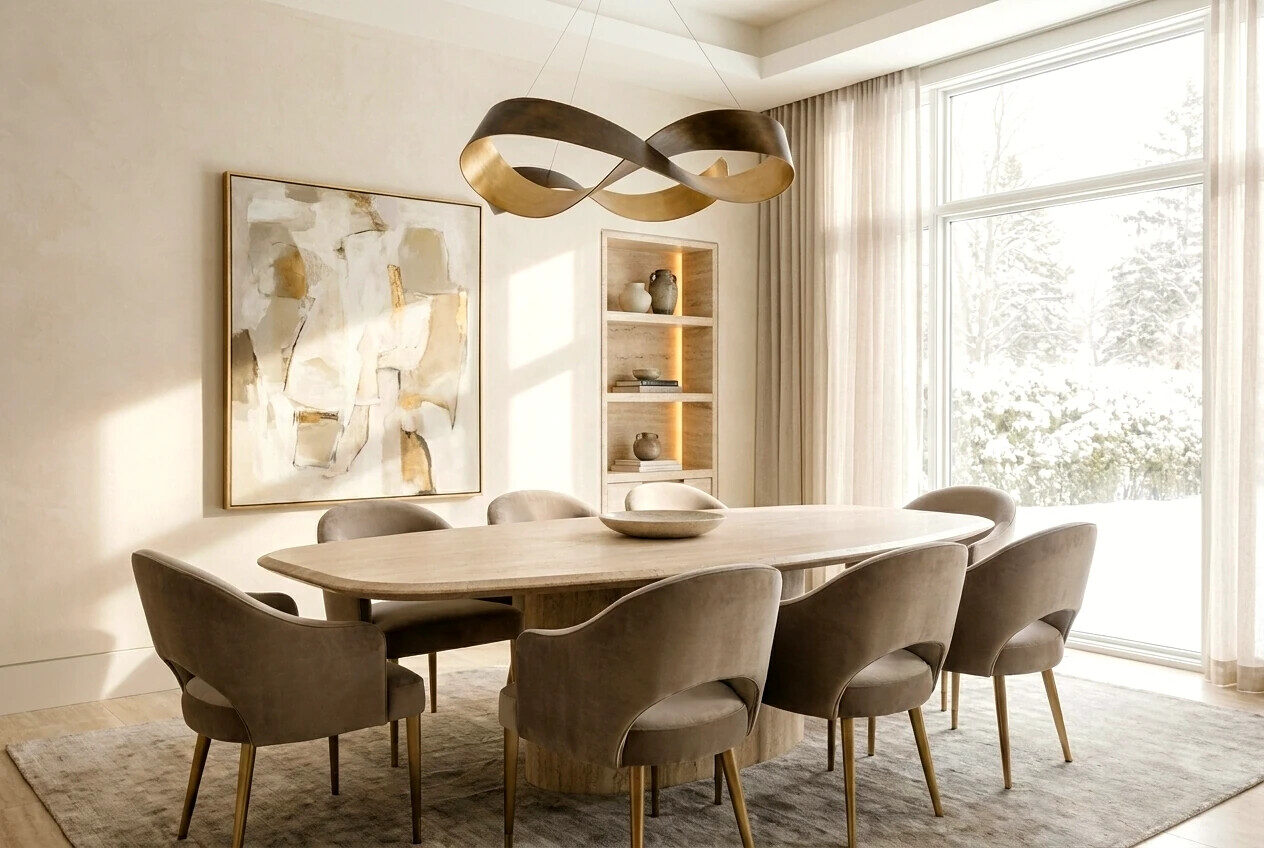
About three years ago a client brought me two chunks of stone from Rome in a plastic bag. One was polished to a mirror, a warm honey colour. The other was the same shade but riddled with tiny cavities, like frozen sponge. “The first one is expensive, from a boutique hotel,” he said. “The second was lying around at the restorers’, they were about to throw it out.” It was the other way round. The polished sample cost three times less.
Ever since, when a client sits down across from me and says “I want travertine, open pores, an interior like that hotel in Forte dei Marmi,” I know the conversation will be long and pleasant. Because the fashion has turned a full one hundred and eighty degrees, and what was considered a sign of unfinished work twenty years ago is today the most honest way to show that your home has real stone rather than an imitation of it.
Why open-pore travertine is back in fashion
For ten years we lived in the age of gloss. Everything had to shine: polished marble, lacquered kitchen fronts, mirror-finish slabs across a whole wall. The interior worked like a shop window — it reflected the light, reflected you, reflected the neighbour’s house through the glass. Beautiful, but cold. And, honestly, a little hysterical.
Now the pendulum has swung the other way. Designers call it “quiet luxury”; I’d put it more plainly — fatigue with showing off. Surfaces no longer reflect light, they absorb it. The milky “gallery white” is giving way to the warm tones of oat and bone. And travertine, with its open porous texture, turned out to be exactly the material that holds this register better than anything. It is matte, warm to the touch, and it has a character that cannot be faked with print.
Here is the thing to understand. Travertine’s pores used to be hidden — packed with filler and polished so the stone would look “like marble, only cheaper.” Today they are put on display instead. The cavity has stopped being a flaw and become the maker’s signature — proof that you are looking at a living mineral, not porcelain tile with a photo print.
What travertine actually is — and how it differs from marble
Travertine is a calcareous tufa. It forms where hot mineral water rises from underground: the water is saturated with calcium carbonate, it evaporates, and the calcite settles in layers. The gas bubbles that rose through this mass over thousands of years left those very pores. In effect you are holding a petrified spring. The classic travertines of Tivoli near Rome are quarried from the same pits that once supplied the Colosseum.
Travertine differs from marble fundamentally. Marble is the same calcium carbonate, but put through high pressure and temperature and compressed into a dense mass. Travertine never went through that pressure, which is why it is porous, easier to work, and noticeably cheaper to quarry and transport. Both are made of calcite — which means both fear acid, but more on that below.
On the market the stone is graded into three types, and it is graded precisely by its pores. Premium is dense, with a minimum of cavities and perfectly calibrated thickness. Standard has the same clean cut but visibly more pores. Commercial is the “wildest,” with uneven edges and floating thickness. The paradox of today is that the textured standard grade is often more interesting for a designer interior than the over-polished premium one.
Colour is a separate matter. Travertine offers a whole range of warm natural shades, and each has a name backed by a specific quarry. The milky, almost sugary Travertine White. The cool, smoky Silver with a greyish base — the only one in the palette that leans cold. The honeyed Classic Light, the most recognisable and “Roman.” The creamy Ivory with a dense linear grain that looks especially good in a vein cut. Worth knowing these names not for snobbery but to speak the same language as your supplier and avoid getting a warm honey batch instead of the “silver” you ordered.
Vein cut or cross cut: how the sawing changes the room
One and the same block of travertine yields two completely different materials — it all comes down to the angle at which it is sawn relative to the sedimentary layers.
Vein cut — sawn across the layers
The stone is cut perpendicular to the bedding planes, and even horizontal lines emerge on the face — that “striped” graphic so loved in contemporary architecture. Vein cut disciplines a space, stretches a wall, works like fine hatching. Run the lines vertically and the ceiling visually lifts — a trick that saves rooms with a low storey.
Cross cut — sawn along the layers
Here the stone is cut parallel to the layers, and the pattern opens up in clouds, swirls and “flowers” — the Italians call this cut fleuri, flowering. It is softer, more painterly, calmer. For a large blank living-room wall, or for a countertop you want to keep looking at, I almost always choose cross cut.
A mistake I see constantly: the client falls in love with a 30-by-30-centimetre sample and projects that impression onto a twenty-square-metre wall. But stone behaves differently at scale. So before purchase we always lay out the full actual slabs and photograph them — this step is part of interior procurement, and it is not something to skimp on.
Fill the pores or leave them open — where the line runs
Here is the key question that makes this whole conversation worth having. Open pores are beautiful and fashionable. But not everywhere.
Technically the stone can be left unfilled (pores open) or the pores can be closed — with epoxy filler tinted with travertine dust to match, or with cement grout, after which it is honed or polished. A filled surface becomes smooth, hygienic and almost impermeable. An unfilled one is textured, tactile, honest — and demanding of attention.
My rule is simple and divides the house by function. Dry vertical surfaces — walls, a headboard, a fireplace surround, a decorative niche — we leave with open pores. Here the texture works fully and there is nowhere for dirt or water to come from. Anything horizontal and in contact with daily life — countertops, windowsills, bathroom floors, the zone around a basin — we either fill and polish or honestly switch to another material.
Because “character” and “defect” are separated by a thin line. An open pore on a feature wall is character. The same pore on a kitchen countertop, clogged with coffee and olive oil after six months, is already a defect — and I’ll be the one answering for it, not you. I prefer to have that conversation before installation, not after.
Typical mistakes: where character turns into a problem
Over twenty years I’ve collected a catalogue of other people’s mistakes with this stone, and my own. Here are the ones that cost the most.
Travertine on a working kitchen. Calcite reacts with any acid — wine, vinegar, lemon juice, even a fizzy drink. The acid dissolves the top layer and leaves a matte “burn” mark on the polish that cannot be wiped off, only re-honed. On an active kitchen, open travertine lasts until the first spilled glass. If the heart insists on it, we take filled, polished stone and an honest understanding that the surface needs re-sealing every six months.
Skimping on the water repellent. Porous stone drinks everything — water, grease; red wine soaks in within minutes and goes deep. Only a quality water-repellent impregnation saves it, and you can’t apply it once and forget: in wet and high-traffic zones the protection is renewed every six to twelve months. It is not a one-off procedure but part of running the house, like changing the ventilation filters.
Open pores in the shower and on the bathroom floor. Cavities collect limescale, soap and grime, and cleaning them out is next to impossible. In wet zones I almost always suggest porcelain tile with a travertine texture: the stone’s pattern is preserved while the pores are “drawn,” not real. Snobbery is out of place here — it’s a question of how the house will look in five years, not on the photo shoot on handover day.
Betting on price alone. The spread is enormous. Natural travertine slabs start at roughly 5,300 roubles per square metre, tiles of the classic light grades at around 4,800, stone from the CIS can be found from 2,200. Porcelain “travertine-look” tile costs from 800 roubles. A cheap sample in the showroom and the same stone on your wall are often two different impressions: in budget batches the tone drifts, the edges crumble, the slabs don’t match into a pattern. Stone with character has to be paid for in attention during selection too.
Our approach: travertine as a material, not as hype
We’ve worked with this stone for a long time and treat it without reverence. It is beautiful, but it has physics, and physics can’t be fooled by fashion.
The first thing we do is zone the house by load and decide where the travertine is real and open, where it is filled, and where an honest imitation belongs. The second is to build the maintenance regime into the project from the start, so that a year later the client isn’t calling to ask “why is there a stain.” The third is to select the stone slab by slab in person and lay it out in a book-match where the pattern must mirror. All of this is part of finishing the house, and we don’t hand it over to a contractor blind.
We once had a country residence where the owner wanted travertine literally everywhere — from the living room to the kitchen island. We walked the house room by room. In the living room we ran an open-pore cross cut across the whole wall behind the fireplace — it’s still my favourite. In the bathrooms we laid porcelain you truly can’t tell from stone. And the kitchen island we made from quartzite in a warm travertine shade — it takes a knife, acid and heat alike. The client got the feeling she wanted and not a single evening ruined by a stain. How these decisions look in reality can be seen in our completed interiors.
And one more thing I always say at the first meeting. Travertine doesn’t forgive chance in selection. The same grade from different batches can vary in tone more than two neighbouring paint colours. So the stone for one room is taken from a single batch, and ideally from a single block — something to sort out at the stage of choosing materials, not when the wall is already half laid.
So is it worth it
It is — if you understand what you’re paying for. You’re not paying for gloss, and not for “the same as the neighbour’s.” You’re paying for living stone millions of years old, for a warm matte surface you want to touch, and for that very imperfect texture that makes an expensive interior calm rather than loud.
The perfect, over-polished stone has indeed gone out of fashion. Open-pore travertine has not. It simply needs to be understood now, not just wanted. If you’re choosing materials for a future home and don’t want to be disappointed a year on, let’s work through your brief together, room by room. Write to us or drop into our Telegram: I’ll show you on real projects where this stone works and where it’s smarter to find it a clever substitute.

Author

Next step
Discuss your project
An hour at the studio with Oleg Reznikov: your site, your brief and relevant studio projects.