
Designed for a Collection: Walls and Light Built for Fine Art
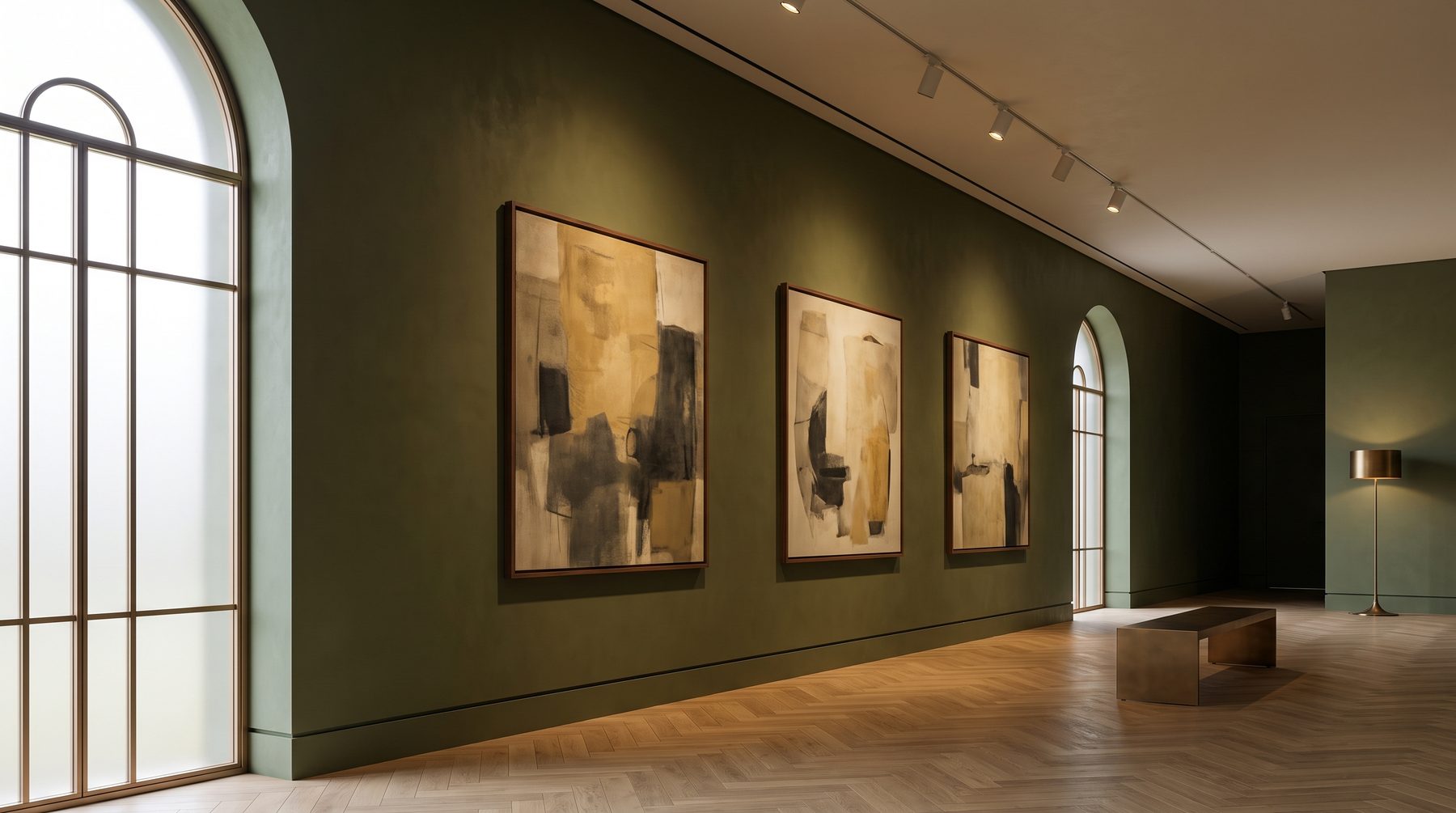
Art lighting in interiors follows museum numbers: roughly 150 lux on oil paintings and 50 lux on works on paper, a colour rendering index of 90 or higher, ultraviolet below 75 microwatts per lumen, and a beam striking the canvas at about 30 degrees. Everything else — wall load capacity, climate, blocking, sockets — has to be settled long before the first canvas arrives.
A house that lives with a collection and a house where paintings were simply hung are two different pieces of architecture. The difference does not show at the housewarming. It shows three years later: in one, the canvases breathe under even light and hold their colour; in the other, crimson lake drifts brown by sunset, the linen ripples in response to a dry January air handling unit, and frame shadows fall across the neighbouring work. Worst of all, by then it is nearly impossible to fix. The walls are closed, the lighting is installed, the chases are plastered over.
A collection always arrives at a house that was not expecting it
That is simply the order of things. A house is designed two or three years before anyone moves in; art is collected over a lifetime. Clients come to an architect with a list of rooms, not a list of artists. By the time a serious canvas appears in the hall, the partitions are up, the downlights sit on a 1200 mm grid, and the sockets were counted for a vacuum cleaner.
One conversation stays with me whenever hanging comes up. A client brought four large-format works back from London, each 2.2 metres on the long side, in heavy frames. The house was finished, the interior signed off. The only wall whose geometry could take that format turned out to be an external one, with two wardrobe recesses inside it and underfloor heating running right up to its base. We opened up the wall build-up, rerouted the heating circuit and redrew the ceiling lighting. All of it cost far more than the right wall would have cost had it been designed into the working drawings in the first place.
Here is where most people go wrong: a collection is treated as furnishing, like a sofa. But a painting is a structural, climatic and lighting problem at once. A sofa does not care what is behind it.
Art lighting in interiors: museum numbers that work at home too
Museums long ago quantified what a private house usually decides by eye. International guidance (CIE 157, ICOM-CC) sets not only illuminance but an annual light budget: around 150–200 lux and some 600,000 lux-hours a year for oil paintings; 50 lux and roughly 150,000 lux-hours for watercolour, works on paper, photographs and textiles. The logic is straightforward — pigment damage depends not on brightness alone but on brightness multiplied by time. A canvas may be lit brighter if it is lit less often.
Ultraviolet plays no part in that arithmetic; it should simply be absent. Conservators aim for 0–10 microwatts per lumen, with 75 as the outer limit. Modern LEDs emit virtually no UV, which is precisely why halogen left domestic displays along with its heat and its bleached pigments.
Then colour. For painting, choose sources with a colour rendering index of at least 90, and 95 or higher for serious works, with the deep red value checked separately. A warm 2700–3000 K reads ochres, glazes and gilded frames honestly. A neutral 3500–4000 K is more accurate for contemporary work, graphics and cool palettes. Never mix temperatures in one room: the eye instantly decides that one of the paintings looks dirty, when the fault lies entirely with the lamp.
And geometry. The beam is set at roughly 30 degrees from vertical. Any flatter and the light bounces off the glazing straight into the viewer’s eye; any steeper and the frame casts a shadow across the top of the canvas while the texture of the brushwork disappears. That yields a very practical rule for the house itself: the ceiling track or gimbal line sits 0.8–1.2 metres out from the wall depending on room height. You cannot draw that line after the ceiling has been approved.
Optical quality deserves its own paragraph. A cheap spot always throws a parasitic halo around its main pool of light; it washes the wall around the frame and destroys the very contrast the fitting was bought for. Proper display optics — ERCO, Reggiani, premium gimbals — give a clean beam edge and lenses matched to the format, from 15 to 40 degrees. The price gap between “just a spot” and a display luminaire is roughly threefold, and it is the one place in a lighting budget where we never advise saving. All of it belongs in the electrical design package, alongside circuit layouts and control scenes.
A wall that holds
A large canvas in its frame weighs 40–60 kilograms, and museum glass on a big format easily adds twenty more. Standard plasterboard on a stud will not carry that on a toggle fixing. You need either blocking — 18 mm plywood or a steel plate inside the partition — or a solid wall, or a rail system.
In our experience the rail wins almost every time. Gallery systems such as ArtiTeq or STAS carry around 30 kg per linear metre with three brackets to the metre, mount at the wall-to-ceiling junction, and let works be rehung without a single new hole. For a collection that grows and rotates, that matters: the display can change with the seasons while an expensive Venetian plaster or fabric wall stays untouched. The rail tucks neatly into a shadow gap and disappears — but that junction has to be designed together with the ceiling, not after it.
The same logic gives us recesses. A work set 8–10 centimetres into the wall, with concealed light around the perimeter of the niche, reads entirely differently from the same work on a flat plane. But a niche means a thicker partition, relocated switches and almost always a recalculation of acoustics. Those things live in the interior working drawings, on the wall elevations, where they cost nothing. On site they cost like a separate trade.
Climate: humidity matters more than temperature
Conservators put it bluntly: fluctuation harms canvas more than heat does. The comfortable corridor is 18–22 °C at 40–55% relative humidity; for oil and tempera the traditional figures are 17–19 °C at 50–60%. But the operative word is stability. Linen absorbs moisture and releases it, the ground layer moves differently from the paint layer, and microcracks appear at the boundary. At first you need a loupe to see them. A few years on, two metres will do.
In a house outside Moscow the collection’s true enemy is January. Twenty below outside, the air handling unit pushing dry air, indoor humidity down to 15–20% — drier than a desert. The only question is what cracks first: the solid oak floor, the joinery, or a nineteenth-century canvas. So a house with a collection gets mechanical ventilation with a humidification section and zone-by-zone humidity control. That is not a luxury but a condition of survival, and it is resolved in the building services design, not on the day the paintings go up.
Two prohibitions we repeat to everyone. Never hang painting above a working fireplace: you get both the temperature and a convective plume of combustion products. And never put a display wall against an external envelope without a ventilated cavity — sooner or later the dew point inside the build-up will find the back of the stretcher.
Glass, frames and the sun from the window
The most aggressive light source in a house is not a luminaire but a south-facing window. Direct sun on a canvas delivers tens of thousands of lux; such a wall burns through the annual museum budget in a matter of weeks. Hence a simple design rule: display walls run perpendicular to the glazing or face it, but never sit in the direct solar path, and the glazing itself gets shading — external awnings, motorised curtains, or a multifunctional unit that cuts ultraviolet.
Works on paper, watercolours and photographs keep their frame and glazing. The market offers exactly what is needed: anti-reflective museum glass such as Tru Vue Museum Glass and Optium acrylic, or Schott Mirogard Plus — under one per cent reflection and UV protection up to 99%. Industry framing guidance holds that glazing may only be called UV-protective if it blocks at least 97% between 300 and 380 nanometres; anything below that is marketing. On large formats acrylic is also four times lighter than glass, which brings us back to the question of what the wall can carry.
Five mistakes we see in every second house
Display light on the general scene. The paintings switch on with the chandelier and burn for six hours every evening, overshooting the annual light budget several times over. Display lighting needs its own circuit, its own scene and, ideally, a presence sensor.
The picture light on the frame. A classic frame-mounted fitting heats the top edge of the canvas and lights it unevenly: blown out at the top, sunk at the bottom. For serious works it is a solution from the last century.
Hanging to the centre of the wall. The museum rule puts the centre of the composition at about 150–155 cm from the floor, not at the geometric centre of an empty stretch of wall. In a room with 3.6-metre ceilings those two points can be half a metre apart, and the painting floats away.
No spare sockets. Every new luminaire, vitrine or lit sculpture needs power. In display areas we specify at least twice the number of circuits required on handover day.
The collection kept secret. Clients do not tell the architect they own art because “it is personal”. The house then gets designed around the furniture rather than around what the family actually values.
Our approach: the collection is a design package
We start with an inventory. Not valuation or provenance — that is for the galleries — but dry data: format, weight, medium, glazing, light sensitivity. Then comes the hanging plan: point locations on the floor plans, marked wall elevations, a blocking schedule, a display lighting layout with angles and colour temperatures, and a separate sheet of control scenes. Even when the specific works have not been bought yet, we reserve walls by format — “up to 2.5 metres”, “up to 60 kilograms” — and that is enough to guarantee that nothing has to be demolished five years later.
In one of our projects, built around a dark palette and deep timber, display logic shaped the whole plan: a gallery corridor with a rail system linked the public part of the house to the private one and became the main route of the evening. It is clearly visible in Notturno, where lighting for art set the rhythm of the entire interior rather than the other way round.
A house designed around a collection changes how a family behaves. It gives them a reason to slow down and stop. Architecture rarely knows how to hold a pause — here the pause becomes part of the plan. If you collect painting, or are only beginning to think about it, the cheapest moment to discuss walls, light and climate is now, before the first chase is cut. Write to us or message our Telegram: we will go through your situation properly, with plans and formats on the table.
Frequently asked questions
How much light should a painting get in a private house
Aim for 150–200 lux at the surface of an oil painting and no more than 50 lux for watercolour, works on paper and photographs. The annual exposure matters more than momentary brightness: about 600,000 lux-hours a year for oils and 150,000 for paper. In practice, put display lighting on its own circuit and resist leaving it on all evening.
What colour temperature and CRI should art lighting have
Choose a colour rendering index of at least 90, and 95 or higher for valuable works. Warm light at 2700–3000 K reads classical painting, ochres and gilded frames most truthfully, while a neutral 3500–4000 K suits contemporary art and graphics. Do not mix temperatures within one room: a neighbouring canvas will instantly look faded, though the fault is purely in the source.
Can an expensive painting hang on plasterboard
Yes, if the wall was prepared. A framed canvas weighs 40–60 kilograms and a standard board fixing will not hold it. You need blocking — 18 mm plywood or a steel plate within the partition — or a gallery rail system carrying roughly 30 kilograms per linear metre. That decision belongs to the working drawings stage, not to moving-in week.
What humidity keeps a canvas from cracking
Hold 40–55% relative humidity at 18–22 °C with the smallest possible swing. Winter is the danger: with frost outside and mechanical ventilation running, indoor humidity falls to 15–20% and the canvas and ground layer start pulling in opposite directions. This is why a house with a collection is designed with humidification and zone humidity control from the outset.

Author

Next step
Discuss your project
An hour at the studio with Oleg Reznikov: your site, your brief and relevant studio projects.