
Curtains Cost More Than the Furniture: Textiles Decide the Interior
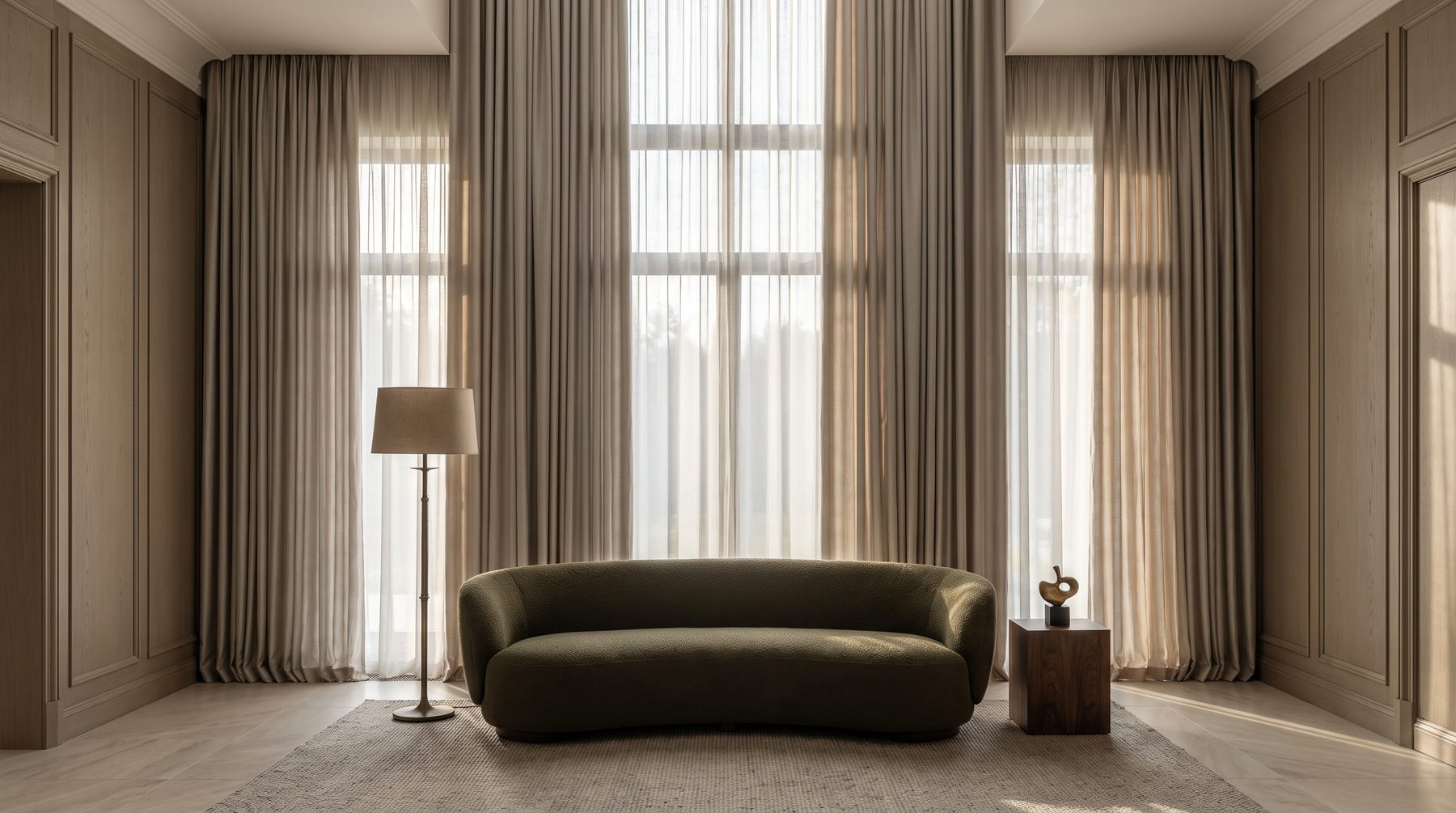
Textiles in a country house account for 5–10% of the furnishing budget and roughly half of the impression a room makes. Drapery for a full-height window, with European fabric, lining, hand-made pleats and a motorised track, costs as much as a good sofa. It should be ordered during the working drawings stage, not at the end of the fit-out: the ceiling pocket, the socket and the control cable all have to be designed in.
We once worked on a house in Barvikha. Eleven hundred square metres, three years of work, and a client who read drawings better than half the contractors on site. Everything approved, furniture on its way, finishes signed off. Then we sat down over the furnishing budget, reached the line marked “textiles”, and he read the number out loud. Twice. Then he looked at me and said: “Oleg, this is a mistake. It’s cloth.”
It was not a mistake. Twelve windows in the formal enfilade, openings 3.6 metres high, fabric from Milan, lining, interlining, hand-sewn French pleats, concealed motorised tracks. The figure was comparable to all the upholstered furniture on the ground floor. And that was the calm version, with no embroidery and no silk.
One window, more than a bedroom: how the running metre is actually counted
Clients almost always price curtains “per window”: one window, two panels, one price. Workrooms count differently, and that is where the gap opens.
Fabric is measured not by the width of the window but by the width multiplied by a fullness ratio. For heavy pleated drapery that ratio is 2 to 2.5. The arithmetic is blunt: a three-metre window needs not three metres of fabric but six to seven and a half. Add hem allowances top and bottom, then pattern matching if the fabric has a repeat. On a large-scale jacquard, matching eats another 10–15% of the length, because every drop has to be cut with an offset.
Then the making-up. Moscow price lists for 2026 start at 350–450 roubles per running metre for straightforward work; a panel on standard heading tape runs to around 660 roubles per metre plus about 200 for the tape itself. Eyelets cost more, around 1,080. But the decisive multiplier hides in the small print: anything made from “premium” or “exclusive” fabric is calculated with a factor of 1.7. Silk, heavy velvet and metallic-thread cloth demand a different level of skill and different machinery, and the workroom prices that honestly.
Now assemble it. A three-metre window, 3.6 metres high, needs roughly eight metres of fabric once hems and repeat are counted. If the cloth lists at 120 euros a metre at a European mill, the material alone approaches a million roubles once currency and freight are in. Lining and interlining add another 25–40% of length at their own price. Making-up with the premium factor adds tens of thousands. The concealed motorised track is a separate line, often a six-figure one.
And that is one window. A formal enfilade usually has eight to twelve.
Why textiles are ordered first, not last
Here is where most people get it wrong. Fabric is chosen at the very end, once the walls are painted, the floor is laid and the furniture is in place. The logic seems sound: big things first, details later. It is wrong twice over.
First, lead times. There are no direct shipments from Europe to Russia now. Fabric travels through intermediate warehouses in third countries: Türkiye, Kazakhstan, Serbia, the UAE. Logistics operators in 2026 say openly that what used to take a few weeks now stretches towards four months, with every extra hub adding its own days. On top of that, the cloth first has to be found in stock at the mill (a popular reference can be committed a season ahead), then ordered, then waited for, then made up, and making up twelve windows is another three to four weeks of workroom time.
Which means six months pass between “I like that one” and “it hangs on the window”. Start after the fit-out is signed off and the house stands with bare glass for half a year. We have watched it happen, and it is a bleak sight: the client has moved in, the panoramic glazing reflects everything after dark, privacy is zero, temporary roller blinds from a builders’ merchant go up, and they stay for a year.
The second reason matters more. Fabric sets the palette, not the other way round. Drapery is the largest block of colour in a room after the walls and floor, and it is the only one with texture, movement and backlight. Choose the sofa first and the search narrows to three references, one of them discontinued, one out of stock, one you dislike. Choose the fabric first and everything else follows, because the world holds far more upholstery cloths than drapery fabrics in the right colour, weight and width. That is why in our furnishing and procurement process textile samples are signed off in the first third of the project, alongside stone and timber, not in the last.
The ceiling pocket: centimetres that settle everything
There is one detail that tells me within five seconds whether a house had an architect or was assembled as it went. It is the top of the window.
When the track is screwed to the ceiling in plain sight, with a strip of cove light glowing above it, that is building without a design. When the drapery emerges from the ceiling as if the fabric grew out of the plane, with no track visible at all, that was set on the working drawings eighteen months before the fabric arrived.
A concealed track pocket demands specific things, all of them decided long before the fit-out:
Depth. One row of drapery usually needs 150–200 mm; two rows (drapery plus sheer or blackout) need 250–300 mm. That depth comes out of the plasterboard ceiling, which means the ceiling drops in that zone, which has to be reconciled with the room height and with the ventilation ducting that normally runs in exactly the same place along the wall.
Power. The track motor needs a supply inside the pocket: a concealed 230 V socket with access for servicing. Somfy Glydea, one of the most common drives in the premium segment, operates at around 30 dB, quieter than a whisper, but it still needs feeding. Silent Gliss builds systems specifically for concealed pockets. Specifying that socket in the interior working drawings costs nothing. Chasing a finished ceiling in a house with the parquet already down costs nerves and a fortnight.
Control cabling. If the tracks are folded into home-automation scenarios, and in a thousand-square-metre house they always are, a control cable has to reach the automation panel. It does not travel through the air.
Structural backing. Heavy interlined drapery on a 3.6-metre window weighs tens of kilograms. Plasterboard will not hold it. A timber or steel backing is needed in the ceiling, and it goes in when the framing does.
All four points fit on a single drawing. Skip the drawing and you get a visible track and a cable running down the wall.
Five mistakes that make an expensive window look cheap
Saving on the lining. An unlined panel sags, lets light through and fades twice as fast. Lining costs a fraction of the face fabric and delivers weight, opacity and protection. Interlining, the soft layer between face and lining, gives the heavy sculptural fold that people are really paying for in European interiors. Without it, expensive silk hangs like a net curtain.
Short drapery. Fabric that stops two centimetres above the floor gives the budget away instantly. Correct is either just kissing the floor with a 5 mm allowance, or breaking on it with a 20–50 mm puddle. The second option costs more in length and demands a perfectly level floor, which is exactly why it is skipped.
A track narrower than the reveal. Drapery has to stack fully clear of the glass, which means the track runs 300–400 mm beyond the opening on each side, and the wall behind the stack carries no switches and no pictures. Again a drawing, not an on-site decision.
Sheers as an afterthought. During the day you are looking at the sheer; the drapery is open. Yet sheers typically get a tenth of the attention and a twentieth of the budget. A good linen mesh or a semi-transparent silk changes a daytime room more than the drapery does.
One fabric for the whole house. The client tires of choosing and says “use that one everywhere”. In a bedroom it works; in a study it reads like a hotel room. We usually hold one palette and three or four cloths of different weight, chosen by what the room does.
In two summers the panel will be a different colour
Suppliers dislike this subject, but it has to be said. Natural fibres fade. Linen, cotton and above all silk lose depth within one or two seasons of strong sun if they are unprotected. Silk on a south-west window should never hang unlined: it does not merely lose colour, it turns brittle and starts splitting along the folds.
What a properly run project does about it:
Lining is compulsory on every south- and west-facing window. Not advisable, compulsory. It takes the hit, and in five years it is the lining that gets replaced, not the face cloth that cost several hundred thousand.
For heavily insolated openings we specify blends or treated fabrics, and pure silk is moved to north-facing rooms and bedrooms. Synthetics in premium textiles stopped being a dirty word long ago: a modern viscose-polyester jacquard is indistinguishable by hand and by drape from a natural cloth, and it beats one comfortably on lightfastness.
Architectural shading. Roof overhangs, external awnings, solar-control glass with a selective coating. All cheaper than replacing textiles every five years, and all decided at facade stage.
Spare fabric. We always order 10–15% extra from the same roll, meaning the same dye lot, and ask the client to store it in the house. Three years later the same reference from the same lot is unobtainable; recutting one ruined panel from the reserve takes a week.
How we work: textiles as a chapter of the project, not a purchase
In the studio, textiles are run as a separate chapter, on a par with electrics and stone. It looks like this.
At concept stage we fix the palette and the character: heavy drapery or light, hand-made pleats or tape, whether the same family of cloth will appear on walls and furniture. The order of the budget is established here too, so that nobody reads a number out loud a year later.
At working-drawing stage the sheets appear: pockets, backings, sockets, control cabling, window elevations with exact levels. The control type and the scenario switch position are agreed here as well.
At procurement we approve physical samples, not catalogue photographs. A piece of cloth at least 300 by 300 mm, viewed in the actual house, in two conditions: daylight and evening with the working lighting on. Fabric under a 2700 K lamp and fabric under a north window are two different colours, and half of all complaints are born right there.
Then making up and installation under design supervision, because the final drop is set on site, after the finished floor is down, never off the drawing. Half a centimetre is visible from the doorway. In our Notturno project the living-room drapery was hemmed twice: after the first installation the heavy cloth had dropped eight millimetres in a week, and it showed.
We keep our own vetted supplier base across all ten procurement categories, and textiles are the most temperamental of them on lead time. Which is precisely why we start there.
What to budget
An honest benchmark for a house of 800–1,200 m² with a formal wing: textiles, tracks and installation together take 5–10% of the furnishing budget. In absolute terms that is a seven-figure rouble sum for such a project, and it moves into eight figures once silk and hand-made pleats appear on every window.
It sounds like a lot right up to the moment you see the finished room. Textiles are the only material in a house that moves, filters light and changes the room through the day. Stone is static, timber is static, but drapery looks different in the morning, at noon and at dusk. That is why the level of an interior is read off it in a second.
That client in Barvikha signed the budget, incidentally. A year later, when we came back for something else, he walked us through the ground floor and stopped precisely at the living-room window. “This,” he said, “is the one thing I overpaid for and don’t regret.”
Frequently asked questions
What do textiles cost in a 1,000 m² house?
Budget 5–10% of the furnishing spend, which for a premium project means a seven-figure rouble sum and upwards. The main items are fabric (60–70% of the total), making-up with the 1.7 premium factor, lining with interlining, concealed motorised tracks and installation. A single 3.6-metre panoramic window in European cloth easily costs as much as a good sofa.
How far ahead of moving in should curtains be ordered?
Six to eight months. European fabric now reaches Russia via third countries and can take up to four months instead of the former few weeks. Add sample selection and approval, three to four weeks of making-up for a whole house, and measuring on site once the floor is finished. Start after the fit-out is signed off and the house stands with bare windows for six months.
Is a ceiling pocket necessary, and how deep?
It is, if you want the fabric to emerge from the ceiling with no visible track. Allow 150–200 mm for a single row of drapery and 250–300 mm for two rows (drapery plus sheer or blackout). The pocket also carries the motor socket, the control cable and structural backing for the weight of the cloth. All of it belongs on the working drawings, not on site.
Which fabrics do not fade in sunlight?
None are entirely fade-proof, but the spread is enormous. Unprotected linen, cotton and silk go dull within one or two seasons. Modern viscose-polyester jacquards are indistinguishable from naturals by drape and hand, and they outperform them substantially on lightfastness. Lining is compulsory on south and west windows, and pure silk is better placed on the north side.
If you are at design stage with a year to go before the fit-out, this is the moment to talk about windows. Write to us or reach us on Telegram: we will look at the plans and tell you where pockets are needed and where an exposed track will do. It is a half-hour conversation that saves half a year.

Author

Next step
Discuss your project
An hour at the studio with Oleg Reznikov: your site, your brief and relevant studio projects.