
The Chair in an Edition of Twenty: When Furniture Became Collectible
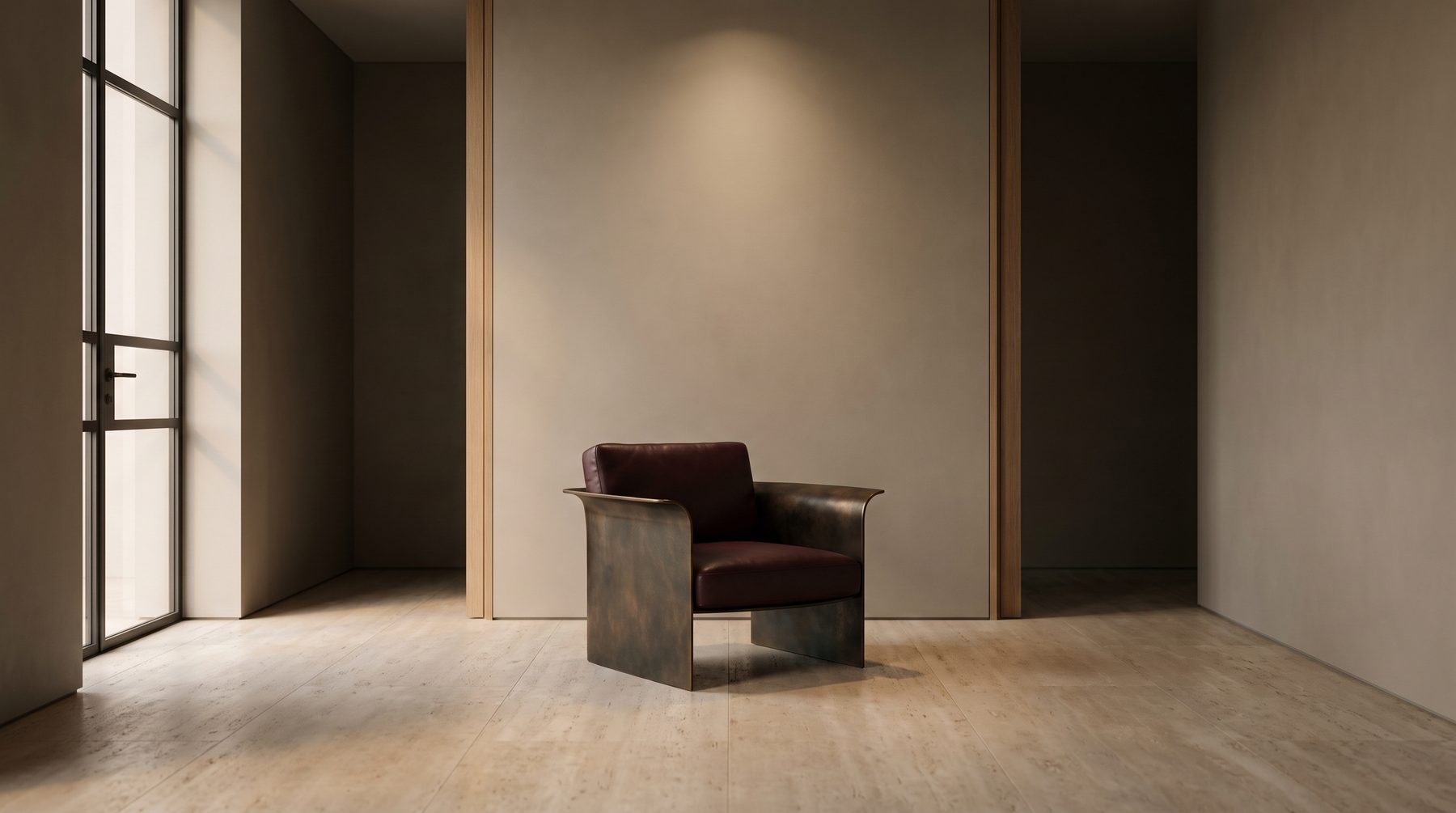
Collectible design furniture means pieces made in editions of twenty or fewer — sometimes a single example — carrying a number, the maker’s signature and a certificate. Galleries sell them, not showrooms. People buy them the way they buy art: for authorship, rarity and the ability to appreciate. In a house, such a piece carries the whole room — and quietly works as an asset.
Furniture stopped being furniture
Twenty years ago a client building a large private house asked about the brand. Today the same client asks about the author and the edition number. This is not a whim or another turn of fashion. It is a change in the logic of ownership itself.
An object made in an edition of twenty behaves differently from something out of a catalogue. You cannot order it tomorrow. Your neighbour cannot repeat it. It ages the way a painting ages: adding rather than losing.
We have travelled from “expensive means Italian” to “expensive means singular”. That, more than anything else, is what has happened to the private interior over the past five years. The house stopped being a display of purchasing power and became a display of choice.
The numbers that changed the conversation
For a long time collectible design lived as the hobby of a few hundred people worldwide. Now it has a market with real statistics, and those statistics explain why a conversation about a chair has become a conversation about money.
The global collectible design market was valued at 18.7 billion dollars for 2025, with forecasts pointing to 31.2 billion by 2034 — roughly 5.8% a year. The wider contemporary design segment across auctions and galleries is counted more aggressively still: from 40 billion in 2025 to 65–70 billion by 2030, or 8–10% annually.
More telling than any forecast is what happens in the room. The June design sales in New York at Christie’s, Sotheby’s and Phillips together produced 65 million dollars, a 64% jump on the previous year. In the first half of 2025 eight designers set personal auction records, from Frank Lloyd Wright to Michele Oka Doner. Limited pieces by established names appreciate, by gallery estimates, 15–25% a year during their first five years, while scarcity is still becoming obvious.
Here is where it gets interesting. In April 2026 the 64th Salone del Mobile launched Salone Raritas — a dedicated collectible design platform inside the world’s most important furniture fair, twenty-five exhibitors curated by Annalisa Rosso in a space designed by Formafantasma. The industry has formally admitted that it has grown a wing which trades not in production capacity but in rarity.
Why twenty, and not two hundred
The edition size is not a marketing figure. It is a technical consequence of how the object is made.
Gallery editions typically run to eight, twelve or twenty pieces, sometimes plus two artist’s proofs and a prototype. Behind those numbers sits a hand operation that cannot be put on a line: sand-cast bronze, a profile bent by hand, a patina a craftsman builds over a week, a slab of rare stone that will physically yield ten tabletops and no more. The twenty-first example is impossible not out of greed, but because the material ran out and the author does not repeat himself.
Every piece carries a number, a signature, a certificate of authenticity and edition documentation. Without that paperwork the object loses a serious share of its value on the secondary market — the buyer is paying for provable provenance as much as for form.
Galleries handle the trade: Carpenters Workshop Gallery in London, Paris and New York; Friedman Benda with its experimental roster; Southern Guild with African makers. And here is what is invisible from the outside: the best pieces in the smallest editions never reach auction at all. They move through collectors’ waiting lists long before the first paddle goes up. Which is why waiting a year or eighteen months for a commissioned piece is a normal timeline, not a supply failure.
Myths and the usual mistakes
Myth one: it is an investment that always goes up. What goes up are names with a record of public sales and serious gallery backing. A young author with no secondary market may remain simply an expensive chair. Advisers suggest holding 5–10% of a portfolio in collectible assets — that is the share of a passion, not a substitute for a deposit. Buy what you are willing to live with even if the price never moves.
Mistake two: hunting for the piece once the interior is finished. The most common and the most expensive. An object in an edition of twenty cannot be matched “to the sofa” a fortnight before you move in. Either you look for it years ahead, or you settle for whatever is in stock — and what is in stock is rarely the best of it.
Mistake three: ignoring dimensions, weight and the route in. A four-hundred-kilogram marble table arrives at a house whose cantilevered stair and floor slab were calculated without it. Door openings, the lift, the turn on a landing, the load capacity of the slab — all of that is checked before the purchase, not after. Twice we have dealt with a piece that physically would not enter the house and had to come in through a window opening with the glazing partly dismantled.
Mistake four: insuring at purchase price. Insure at replacement value. If a piece has gained a third in five years, a five-year-old policy covers two-thirds of your loss at best.
Mistake five: five such pieces in one room. They start arguing with each other. A collectible object is a soloist by nature, and its principal demand on a room is silence around it. If you want three accents, spread them across different rooms and different scenarios of use.
How a collectible piece actually lives in a house
This is where the market ends and our work begins. An object priced like an executive car makes demands on the house — and they are engineering demands.
Light. Sources with a colour rendering index of CRI 90 or above, 2700–3000K, and no direct ultraviolet falling on textile, leather or oiled wood. Upholstery bleached over two summers destroys value faster than any wear. Accent light is aimed at the piece deliberately, at the electrical design stage, not with a floor lamp bought at the last minute.
Background. The wall behind the soloist must keep quiet. A dense matte tone, smooth plaster, timber in a calm figure — and no pattern competing with the silhouette. That is why in projects where we know about the future piece in advance, the wall behind it is designed separately from the rest of the finishes.
Floor and climate. Heavy feet on stone need soft metal or felt pads, or within a year a matte ring appears beneath the object. Humidity at 40–55% all year round: nobody stabilises the wood and veneer in collectible pieces for a Russian winter with radiators drying the air.
Logistics and handover. Specialist rigging, separate transit insurance, and acceptance recorded on paper with photographs taken before the crate is opened. All of this belongs to the procurement stage — the one clients underestimate most often and where the most money is lost.
An honest word about daily life. If the house holds two children under seven and a large dog, a hand-finished leather lounge object in the living room is a poor idea. Not because it is forbidden, but because within a year you will resent either the object or the children. In those cases we move the accent into the study, the library or the bedroom, where the traffic of daily life does not cross the soloist.
Our approach
We work from a simple premise: the place for a collectible object is designed the way a fireplace or a staircase is designed. In advance.
In practice that means a floor socket beneath a future table or a lit object. A steel plate cast into the wall for a cantilevered piece. A niche with five to seven centimetres of tolerance on each side, because the real object never quite matches the catalogue dimensions. A route in, marked on the plan. A line in the budget for rigging and insurance.
On one project the client arrived with a table already bought — an edition of eight, a single slab of volcanic stone, close to half a tonne. The dining room sat on the first floor. We recalculated the slab, strengthened that bay while the structure was still on paper, and left a technical opening in the glazed façade through which the table was eventually craned in. Had that conversation happened six months later, the table would have stayed on the ground floor, where nobody needed it.
The second case is more honest. A client wanted a suspended object over a nine-metre stairwell. We talked him out of it: servicing a piece like that means bringing a lift platform into the house once a year, and changing a lamp becomes a half-day operation with specialists. Instead we placed an object on the first-floor landing, where it reads from three positions and a hand can reach it. Sometimes the best thing an architect can do for an expensive object is to stop it being bought.
And one last thing. A collectible piece does not rescue a weak interior. It finishes it off — because next to it everything else starts looking exactly like what it is. Architecture, order, light and materials first. The soloist joins a finished orchestra; it does not replace one.
If you are looking at your first such piece and are not sure where it belongs in your house, write to us. A conversation at the design stage costs less than strengthening a floor slab after the fact.
Frequently asked questions
How is collectible design different from a premium brand
By edition size, by who sells it and by the paperwork. A premium factory produces serially and sells through showrooms; a collectible piece appears in an edition of twenty or fewer, moves through a gallery, and carries a number, the author’s signature and edition documentation. The first is expensive furniture. The second is an object with its own secondary market, where price depends on the name and on intact provenance.
Do these pieces really appreciate
Pieces by established authors with a record of public sales do: gallery estimates put it at 15–25% a year over the first five years, while scarcity becomes obvious to the market. Young names without a secondary market carry no such guarantee. Advisers recommend keeping no more than 5–10% of a portfolio in collectible assets and buying only what you would happily live with regardless of price.
How long is the wait for a commissioned piece
Six months to eighteen months is normal rather than late. The best pieces in small editions are allocated through gallery waiting lists before any public showing, and production involves hand operations: casting, patination, selecting the right cut of stone. Plan the purchase alongside the interior design, not during the final finishing stage.
What should the house design allow for in advance
Slab capacity under heavy objects, a route in that accounts for openings and turns, a floor socket and fixings for lighting, a niche with five to seven centimetres of tolerance, accent light at CRI 90+ with no ultraviolet, and humidity held at 40–55% year round. Plus a separate budget line for rigging and transit insurance.

Author


Next step
Discuss your project
An hour at the studio with Oleg Reznikov: your site, your brief and relevant studio projects.