
Backlit Onyx: Why This Is Not Luxury, But a Mistake
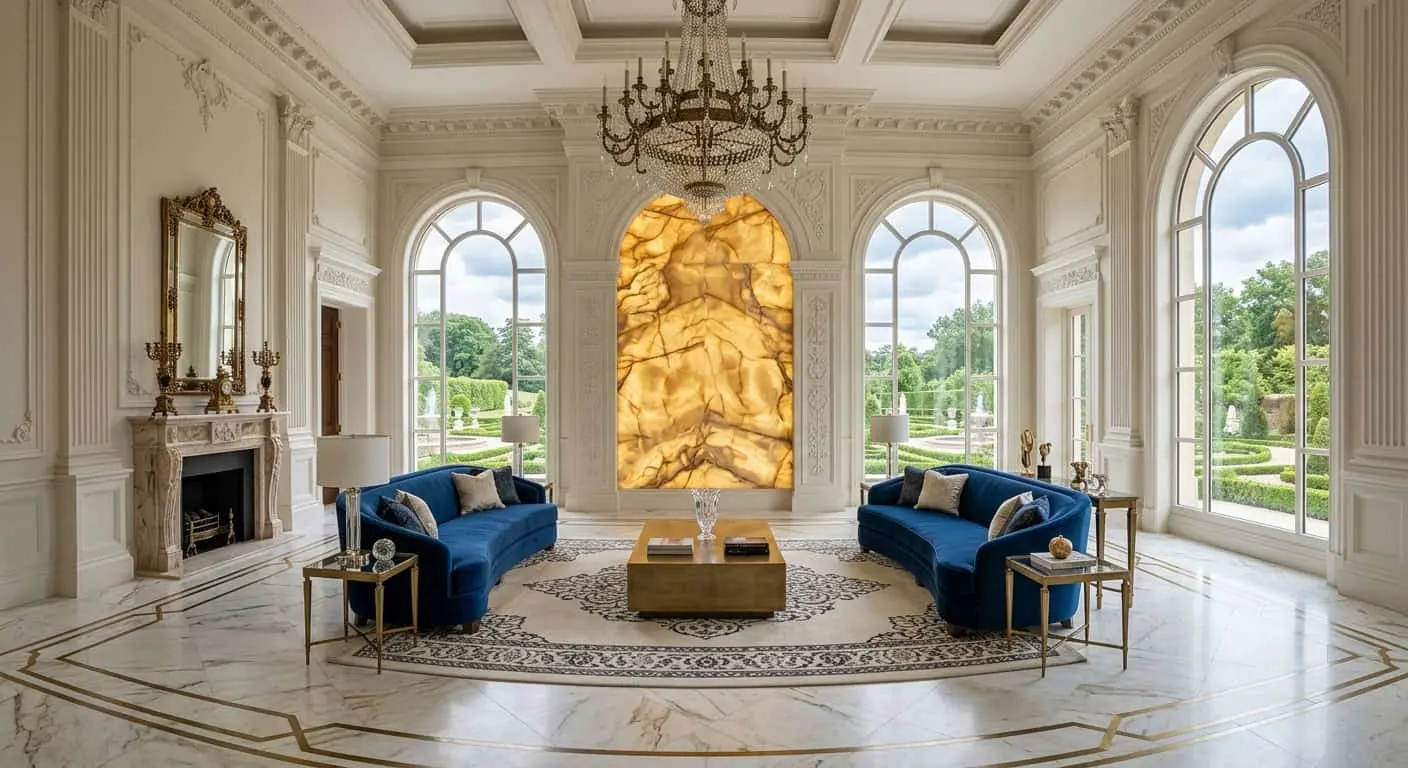
We had a project three years ago. A country house, 1,800 square meters, the client was a serious person, one of those accustomed to getting the best. At our first meeting, he placed a tablet with renderings from the previous bureau in front of me and said: “Oleg, I like this — onyx, backlighting, a mansion interior should immediately say that someone important lives here.” On the screen glowed a honey-colored wall in the foyer — the very one I’d seen at least a hundred times by that point. In a casino in Batumi. In a hotel lobby in Sochi. In a restaurant on Rublyovka. In the bathroom of a billionaire developer.
I said nothing for about ten seconds. Then I said: “If you want your house to look like a four-star hotel lobby, we can do it. But let me first explain why none of my clients with taste want this.”
He wasn’t offended. He was thoughtful. And it was this conversation — about how backlit onyx transformed from a status symbol into a symbol of mediocrity — that I want to retell now. Because the topic is painful. And almost no one among my colleagues talks about it out loud.
How onyx became a cliche: a brief history of one mistake
In the early 2000s, a backlit onyx panel truly was a wow-effect. Stone was brought to Russia by the piece, backlighting cost a lot, adhesive bonding technologies with acrylic were barely developed. If you saw such a wall, it meant you were in a very specific place. And it worked.
Then what always happens with expensive techniques happened. The mass market mastered them.
Chinese factories began stamping thin onyx slabs on a honeycomb base. LED panels dropped in price tenfold. Any foreman with three years of experience learned to assemble “that very wall” in a week. By 2015, backlit onyx stopped being a status symbol and became a symbol of a finishes budget around two to three million rubles per square meter of interior. That is — average.
And by 2020, it became outright bad taste.
Why backlit onyx cheapens an interior
I’ll be blunt. When I enter a foyer and see a honey-glowing wall, I immediately understand several things about the client and their architect.
First: they wanted it to be “expensive-looking.” Not beautiful. Not thoughtful. Expensive-looking — meaning by the principle of “obviously costs money.” This is basic thinking for someone just entering a new wealth bracket. People with established taste don’t think this way.
Second: the architect couldn’t offer anything of their own. Onyx with backlighting is a ready-made solution from a catalog. AI produces it in three seconds. An architect’s job is precisely to avoid templates, not replicate them.
Third: the interior has no unified idea. Because a backlit onyx panel is always solo. It screams. It demands all attention. And the rest of the interior around it usually either tries to compete with it (and loses), or becomes a quiet background for the star wall. Both scenarios are a failure.
And you know what’s most frustrating? The stone itself is not to blame.
What’s wrong exactly with the backlighting
Natural onyx is a material with character. It has depth, veining, translucency, temperature. It lives in reflected light, in side light, in grazing light. It plays with shadow.
When you backlight it with a uniform LED panel, you do exactly one thing: you kill the stone.
You turn it into a stained-glass window. Into backlit glass with a pattern. All the depth, all the tactile nature, all the geology — collapse into a flat picture. Onyx stops being stone. It becomes a lightbox with stone texture.
I’ve often caught myself thinking that cheap onyx imitation on acrylic with backlighting looks almost the same as a real slab worth twelve thousand euros. Precisely because backlighting equalizes. It erases the difference between material and the image of material.
Why pay for real stone then?
Onyx with backlighting in a mansion interior: where taste’s boundary lies
Let me explain with specifics. Two situations.
Situation one. A two-story house foyer. A wall 4×6 meters of backlit honey onyx. It glows evenly, uniformly, like an advertisement banner. In front of it — a designer sofa, bronze spider lamp, expensive rug. Everything together costs conditional twenty million rubles. It looks worth three.
Situation two. The same foyer. The same wall. But the onyx is not backlit. It’s clad with open-grain plating, matte polished, illuminated from above by narrow grazing light that reveals the relief of the veining. Beside it — a solid wall in warm plaster. Below — a heavy handcrafted oak console. The stone is silent. But when you approach it, you understand it’s stone. Real. With a hundred-million-year history.
The second wall costs the same. But it looks like the full twenty. And works for years — doesn’t bore you, doesn’t become outdated, doesn’t require LED replacement every five years.
The difference is architectural thinking. The first option — a decorator made an “accent.” The second — an architect worked with the material according to its nature.
Typical client mistakes with onyx
Over the years, I’ve collected a personal list. I show it to clients at the first meeting — saves everyone time and nerves.
Mistake one: choosing by rendering. Onyx is impossible to evaluate from a picture. At all. Every slab is unique — veining, color, pattern density. The client sees a beautiful visualization, says “I want that” — then arrives at the warehouse and sees the real block looks different. Always. You need to choose physically, with a flashlight, looking at the cut in different light.
Mistake two: onyx everywhere. Bathroom in onyx, foyer in onyx, wine cellar in onyx, kitchen backsplash in onyx. Stone that should be an accent once in the house becomes wallpaper. Loses all value.
Mistake three: incompatible partners. Onyx next to painted MDF. Onyx next to ceramic tile imitating marble. Onyx alongside glossy wenge. The material demands worthy surroundings — solid wood, natural plaster, bronze, aged brass, proper timber. If your budget doesn’t account for all this, skip onyx entirely.
Mistake four: that very backlighting from behind. Everything about it was already said above.
Mistake five: economizing on installation. I’ve seen slabs worth fifteen thousand euros installed crooked, with visible seams, with poorly matched pattern seams. It hurts. It’s like buying a Rothko and hanging it on duct tape.
How serious interior studios work with onyx
This is where things get interesting. In studios doing truly expensive interiors — not “expensive-looking,” but genuinely expensive — they treat onyx completely differently.
As a fragment, not a wall. A countertop in the guest bathroom. An insert in a kitchen island facade. The front plane of a fireplace. A small detail that works tactilely, upon close viewing, in reflected daylight.
Paired with matte finishing. Polished onyx is too loud. We often use leather-like texture — a semi-matte finish that preserves the stone’s depth but dampens glare. The pattern reads, but there’s no vulgarity.
With architectural, not decorative light. A narrow beam from above. Side grazing. Sometimes nothing — just daylight from the window. Stone should breathe with natural light, as any stone should.
In silence. Around onyx, there’s always a pause. A solid wall. A smooth floor. A calm ceiling. If you surround stone with ten other active materials, it becomes noise.
In one or two places in the house. No more. Onyx is like rare wine. Drinking it by the bottle is a crime. It should appear where its appearance is an event.
Our studio approach: when we agree to onyx at all
To be honest, our team doesn’t offer this material to every client. Not because it’s bad. But because it’s not suitable for everyone.
We ask several questions.
Is the client ready to choose a specific slab personally, at the warehouse? If not — not our case. Photos from the factory or warehouse aren’t enough. You need to touch the stone.
Is he ready to refuse backlighting from behind? This is the key question. If someone insists — we usually politely advise them to contact another studio. This isn’t snobbery; it’s professional hygiene. I won’t sign off on work I’ll be embarrassed about in five years.
Is he ready to give onyx one role in the house? One. Not five.
Does he understand that stone is alive — that it will change over time, that micromarks will appear, that this is part of its value, not a defect?
If the answer to all four is yes, we work. And then the very magic emerges for which this material is worth money at all.
Alternatives nobody talks about
If you really want translucent stone in an interior, there are more interesting things than onyx.
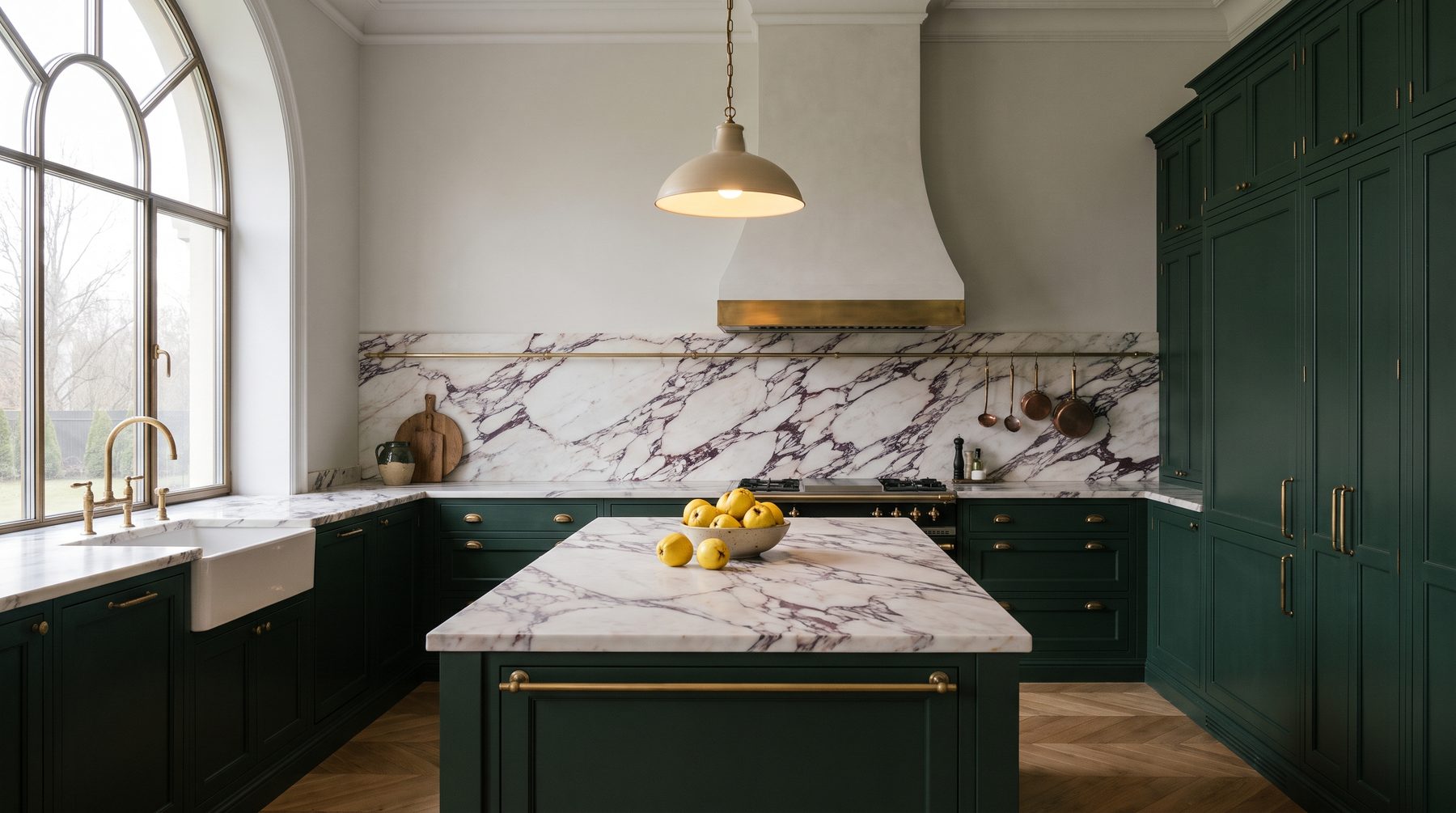
Calacatta Viola marble. Makubas quartzite. Travertine with open pores. Certain agate varieties — but that’s already exotica for jewelry tasks, not walls. Each of these materials carries its own history, geology, drama. And none has become as much of a cliche as backlit onyx.
And sometimes the strongest solution is to skip translucent stone altogether. Take dense green marble, make a monolithic fireplace wall from it — and it will be more powerful than any lightboxes.
In conclusion
Returning to that client with the tablet. We didn’t build him a backlit wall. We created a solid plane of warm mineral plaster in the foyer, and onyx went to the billiard room countertop — one slab, leather-like polish, upper architectural light. When he brought partners there for the first evening, they stood at that countertop for an hour. Touching it. Studying it. One of them, a serious collector, said: “I’ve finally seen onyx the way you want to understand it, not photograph it.”
That’s the right way to work with material. Not to photograph it. To understand it.
If you’re now at the stage of choosing materials for your house — and someone is persistently offering you “that very wall” — stop. Ask your architect three questions: why exactly onyx, why exactly here, and why with backlighting. If the answers sound like “it’s premium” and “it’s impressive” — your problem isn’t the stone. Your problem is the architect.
And if you want to discuss it substantively, come by. We love those conversations most of all.

Author

Next step
Discuss your project
An hour at the studio with Oleg Reznikov: your site, your brief and relevant studio projects.