
Burl Veneer: The Wood That Costs More Than Marble
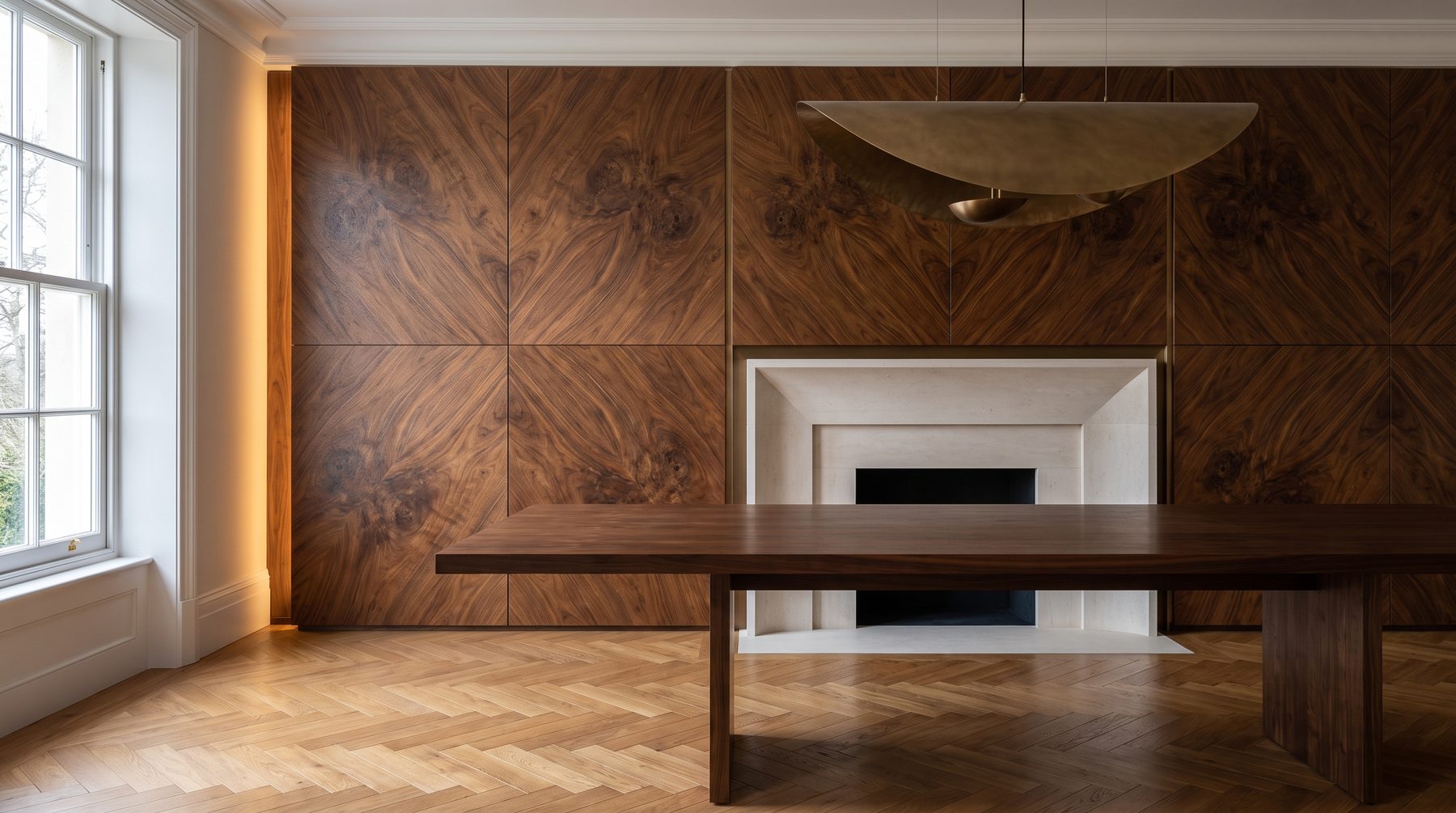
Burl veneer in an interior is a thin slice of natural wood, usually 0.6 mm, applied to panels, doors, joinery and furniture. Its most expensive form is burl: a cut through a growth on the trunk where the grain twists into a dense swirl. A square metre of burl costs more than a square metre of marble. And nearly always, it earns it.
A few years ago we were finishing a dining room in a house outside Moscow. The client came back from Milan with a sample the size of his palm: walnut burl, matte oil. He set it on the table next to the two marble slabs we had spent a week approving and asked, “This is more expensive than stone, isn’t it?”
It was. Roughly double, per finished square metre. And it was the best money spent in that project.
What burl is, and why it outprices marble
A burl is, technically, a tumour. It sounds unlovely and looks magnificent. The growth forms where a tree has been injured or infected by a fungus or virus: the tree starts frantically laying down dormant buds, and the wood grows not in annual rings but in a vortex. Every eye on the cut surface is a bud that tried to sprout and never did.
Hence the figure: eyes, curls, fine ripple. It cannot be repeated even within a single tree. The next slice off the same growth is already a different picture.
Then comes the arithmetic of scarcity. Burl grows on one tree in hundreds, is harvested in lumps rather than logs, and is sliced into leaves that are, by joinery standards, tiny. Karelian birch, for instance, yields leaves 50 to 150 cm long. An ordinary European walnut arrives at 250 to 300 cm. Building a three-metre wall out of the former stops being a question of taste and becomes a question of logistics.
Prices on the Russian market in 2026: Karelian birch burl runs from about 4,500 roubles per square metre of veneer at some suppliers and around 5,900 at others, and that is the leaf alone, before substrate, pressing, finishing and the cabinetmaker’s hours. Multiply by three or four for the finished panel on the wall. Exotics such as amboyna (the burl of Pterocarpus, the tree traded as narra), thuya, vavona or American walnut burl sit well above that.
Marble, for all its reputation, comes out of quarries. Burl does not.
Natural leaf or reconstituted: the first real decision
This is where most projects go wrong before anything is even ordered.
There is natural sliced veneer, the actual wood taken off a log or a growth. And there is reconstituted, or fine-line, veneer: the Italian houses Alpi and Tabu learned to dye rotary-cut veneer from fast-growing species, glue it into a block and re-slice it into leaves with a designed figure. The technology is honest and genuinely useful, giving stable colour, batch-to-batch repeatability, large formats and no exotic species in the supply chain.
But burl cannot be reproduced this way. Straight-grained walnut or oak in fine-line is convincing. “Burl” in fine-line reads like printed wallpaper: the pattern repeats on a fixed pitch, the eye catches the repeat within seconds, and all the expense evaporates.
Our position is simple. Reconstituted veneer is an excellent answer for large, calm planes: dressing rooms, corridors, ceiling coffers, built-in wardrobes. Burl is bought natural only, for one specific place, and only by the flitch.
The flitch is the key word. Veneer is sold in flitches: consecutive leaves off one log or one burl, stacked in the order they were cut. Within a flitch, colour and figure are related. Between two flitches there will always be a difference, and on dark species even a layman sees it. If a house calls for 60 m² of burl panelling, you buy the whole flitch, with 25 to 30 per cent spare for waste, because burl is full of holes and some leaves are lost to splits and bark inclusions.
Ordering the same thing again six months later is not an option. Not even close.
The layout is half the cost and all the point
Buying burl is a third of the job. Laying it out is the other two thirds.
There are a few basic matching schemes. Book-match opens consecutive leaves like the pages of a book, mirrored, producing a symmetrical butterfly. Slip-match slides the leaves sideways without flipping them, so the figure repeats and the joints read softer. Diamond and four-way bring four leaves together toward a centre, giving a diamond or a cross; this is the classic Art Deco layout, and burl was more or less born for it.
Burl almost always wants a four-way match radiating from the centre of the composition. Then the engineering begins: where exactly that centre falls, whether it lands on the axis of the window or the fireplace, how the joints sit relative to sockets, switches and door casings, and what separates the wood from the material next to it.
That last point matters most. Burl and stone must never meet flush. Both materials are alive, both carry tolerances, and within a year you will have an uneven hairline gap running the whole length. Separate them with a 6 to 10 mm shadow gap or a bronze reveal. A shadow reads as intent; a gap reads as a defect.
In our studio the veneer layout drawing is its own sheet in the interior working drawings: wall elevations with numbered leaves, grain direction, symmetry axes and joint positions. The cabinetmaker receives not “a burl panel” but a drawing that says which leaf goes where. The difference in the result is the difference between a bespoke suit and one off the rack.
Five ways to ruin expensive wood
Collected over twenty years of practice. I have seen all five in person, three of them in other people’s finished interiors that we were called in to fix.
Burl everywhere. The commonest and costliest mistake. Burl is an accent, not a finish. A healthy share is 5 to 15 per cent of the visible surfaces in a room: one wall, a fireplace surround, bar fronts, island end panels, the inside of a study cabinet. Line all four walls with it and the drawing room stops being a room and becomes a jewellery box. A month later it is hard to sit in, because the eye has nowhere to rest.
Burl in wet and hot zones. Kitchen fronts beside the sink and hob, a vanity top, a shower wall. Veneer survives splashes exactly until the first spill left un-wiped at a joint; after that the edge drinks moisture and lifts. Wood in a bathroom is possible, but away from direct water contact and always with edges capped in metal or stone.
Twelve coats of piano lacquer. High-gloss polyurethane over burl is a message from the nineteen-nineties, the interior of an executive saloon. Living burl asks for a semi-matte finish: hard wax oil, or a matte lacquer at 10 to 20 gloss units. The figure then reads deeper instead of reflecting the ceiling.
Ordering from a photograph. The client brings an image, the cabinetmaker nods and takes whatever the supplier has in stock. The burl in the photo and the burl on the wall turn out to be different trees. The rule is simple: approve a physical flitch with a number first, sign the specification second.
Meeting stone without detailing. I have already made the case for the shadow gap, but it bears repeating: eighty per cent of the visual failure of expensive materials happens not in the materials but where they meet.
Light, humidity and year five
Wood changes. That is not a defect, it is a property, and it has to be designed for.
Ultraviolet works differently by species. Walnut lightens over time and drifts toward a warm ginger; cherry and mahogany do the opposite and deepen. Beside a south-facing panoramic window, the difference between the lit and shaded halves of a wall becomes visible within a season or two. There are three remedies: a finish with a UV filter, film on the glazing, and, on a project that justifies it, a considered curtain scenario in the interior specification. Furniture near a window is worth rotating once a year so that the ageing stays even.
Humidity matters more than light. The comfortable range for people and for wood is the same, 40 to 60 per cent. In a Moscow house in winter, with radiators running and no humidification, it drops to 20 or 25. The veneer dries out, the substrate moves, and hairline cracks appear along the glue joints. This is precisely why every project of ours with a serious volume of joinery carries a humidifier in the air handling unit. It is not a luxury; it is insurance on several million roubles of finishes.
Also: no underfloor heating beneath veneered plinths, a minimum of 30 cm from the firebox casing, and never place a burl study cabinet hard against a radiator. Wood forgives a great deal, but not a dry hot draught at point-blank range.
How burl actually enters our projects
The sequence we have refined into a predictable result.
Place first. At concept stage we decide which three or four surfaces in the house carry the attention, and only those are candidates for burl. All the other wood is quiet, straight-grained, often reconstituted.
Then the flitch. We go to the supplier and look at the stacks in person, in daylight and at 3000K, because warm evening light pulls a ginger note out of burl that daylight hides. The chosen flitch is reserved and paid for before the cabinetmaker starts. We keep our sourcing directions in the materials section of the site, which also shows what is genuinely available this season and what carries a four-month lead time.
Next, a control panel. One square metre in the final finish, on the exact substrate that will be used. We look at it on site, on the wall, under the working lighting scenario, and approve it in writing. That is cheaper than relaying sixty metres.
Only then come the layout drawing, the joinery, the installation, and the handover inspection under design supervision, where we check axis alignment, reveals and any wandering joints.
What it looks like assembled can be seen in the Notturno interior, a residence in dark Art Deco where wood carries the whole volume and works with brass and stone rather than arguing with them.
Is it worth it
Marble registers instantly and makes its impression at the threshold. Burl works differently: a guest sits down, lets their eye travel along the wall, and a minute later stands up to touch it. It is the only material in my practice that people walk up to.
That client outside Moscow, incidentally, later had a hall console made from what was left of the flitch. The 30 per cent spare had survived. In the end he liked the console better than the dining room.
If you are thinking about wood of this order in your own house, come with a floor plan and photographs of the site and we will work out together where it belongs and where it would simply be wasted. The conversation commits you to nothing and usually saves several expensive mistakes.
Frequently asked questions
How does burl differ from root veneer
Burl is cut from a growth on the trunk or a branch; root veneer is cut from the base of the trunk and the roots. Burl figure is finer and full of eyes, while root gives broader wavy swirls. Both count as complex figures, both arrive in small leaves, and both require a numbered layout drawing. Supplier price lists usually group them together as burl and root.
What does burl veneer cost in 2026
Karelian birch burl veneer in Moscow runs from roughly 4,500 to 5,900 roubles per square metre of leaf. A finished wall panel, including substrate, pressing, finishing and installation, costs three to four times that. Rare species such as amboyna or thuya are multiples higher, and availability depends on the individual shipment.
Will veneer fade beside a panoramic window
The colour will certainly change; the only questions are how fast and how evenly. Walnut beside a south window lightens noticeably within a season or two, while dark species deepen. A UV-filtering finish, solar film on the glazing and curtains built into the daytime scenario all help. The process cannot be stopped, but it can be made uniform across the plane.
Can burl be used in a bathroom
Yes, but only outside the zone of direct water contact: a vanity set away from the basin, a door, a wall panel by the entrance. Edges must be capped in metal or stone, the finish has to be moisture resistant, and the room needs working extraction. In the shower and around the tub, wood has no business at all.

Author


Next step
Discuss your project
An hour at the studio with Oleg Reznikov: your site, your brief and relevant studio projects.