
Materials That Age Well: Designing for Patina
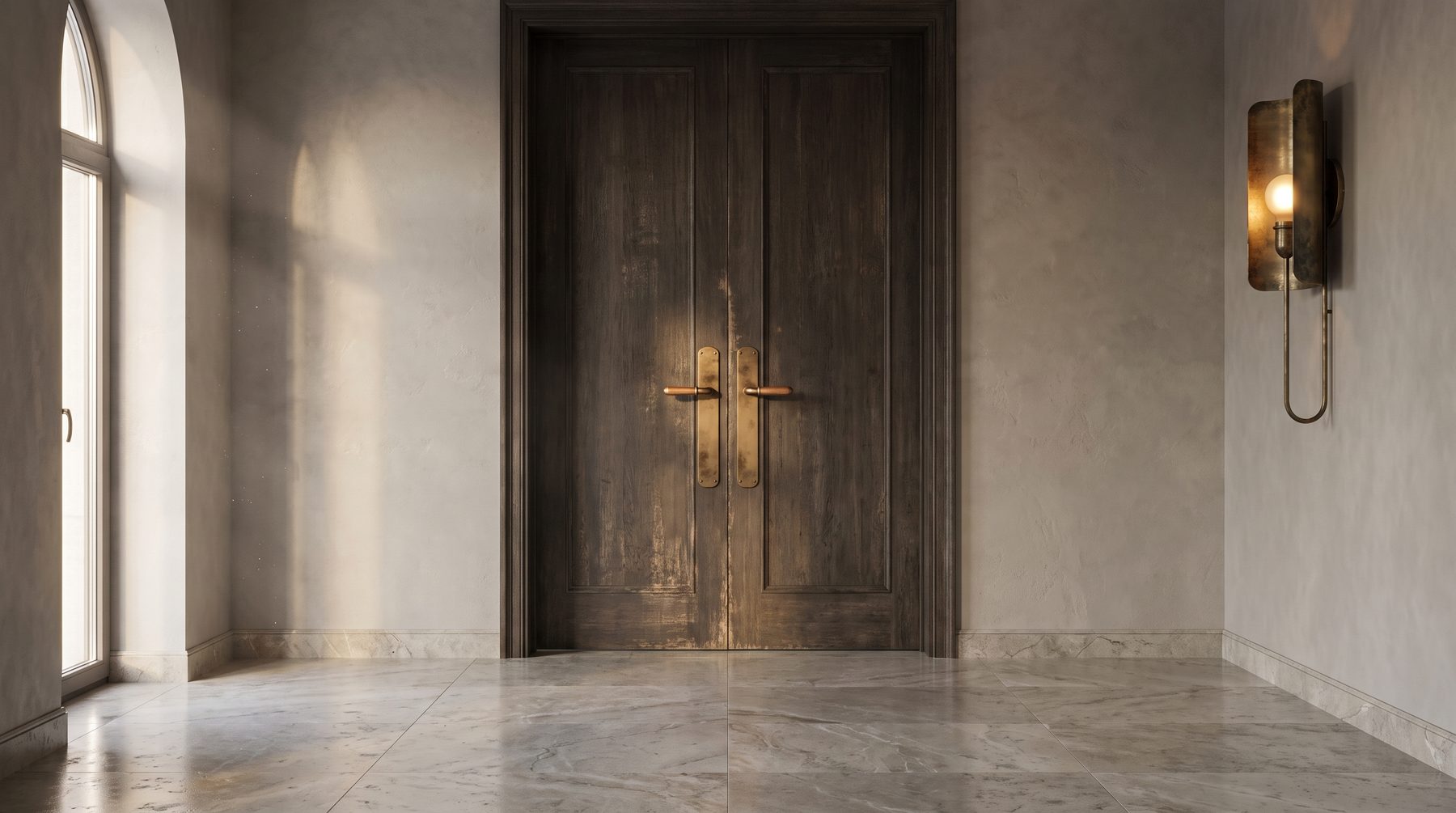
Patina in interiors is not a flaw and not dirt — it is a material property you plan for. Unlacquered brass darkens under the hand, copper turns green, oiled oak lightens along the walking lines. In the houses we design, ageing is written into the specification. Otherwise the owner demands a redo eighteen months in.
One phone call still stays with me word for word. A client moved into his house on Novaya Riga in May and called back in November: “All my door handles have gone black, this is a defect, we are changing the supplier.” We drove out. The handles were not defective. They were beautiful — dark gold across the plate, bright and almost rose-toned exactly where a palm rests on the lever. Precisely what the client had paid roughly double for, eight months earlier, instead of ordinary chrome.
The problem was not the metal. The problem was that nobody had explained to the family that they had bought a process, not a product.
Why some materials appreciate with time and others only wear out
Mentally sort every finish in a house into two baskets.
In the first: materials that imitate. Painted MDF pretending to be timber, porcelain pretending to be marble, lacquered “gold” hardware, PVC film on kitchen fronts. They have exactly one day of peak beauty — handover day. After that it is downhill: a chipped edge, scuffed film, lacquer worn off the fridge handle, and none of it can be repaired locally. Only replaced.
In the second: materials that live. Unlacquered brass, copper, zinc, weathering steel, limestone, oiled oak, lime plaster, full-grain leather. For them handover day is the poorest day of all. From there the surface gains depth: it darkens, develops an uneven tone, starts catching morning and evening light differently.
The global finish market has turned decisively in this direction. Polished shine is giving way in high-end housing to what catalogues call a living finish. Unlacquered brass, aged bronze and oxidised copper have become the default language of expensive interiors for one reason: their character cannot be faked industrially. Every handle looks different after three years, depending on who touched it and how.
But this is where it gets interesting. A beautifully ageing material is always an agreement with the client, never a gift. And the agreement has to be signed before the order, not after.
Unlacquered brass: the flagship of living patina
Brass is copper alloyed with zinc. Copper oxidises in air, so freshly polished brass first moves into warm dark gold, then brown, then slightly green where there is moisture nearby. Here is the detail catalogues leave out: patina grows unevenly, and fastest where the metal is touched most. Skin acids strip the fresh oxide, so the working part of a lever stays brighter than the plate for years. That contrast is exactly what reads as expensive.
Where we specify it without hesitation: door hardware in principal rooms, window latches and espagnolettes, joinery edges and pulls, fireplace surrounds, light fittings, the kitchen island rail, master bathroom taps when the owners understand what they are signing up for.
Where we do not: guest bathrooms and children’s rooms. Those surfaces are handled by other people and cleaned with aggressive chemistry. One pass with a chlorine-based product leaves a pale stain on living brass that then takes months to grow out. For those zones there is brushed brass with a PVD coating: visually near-identical, permanently unchanged. Distributing these two materials across the house is an architect’s job, not a procurement decision.
The care instruction we write into the building manual is deliberately boring: leave it alone. If the owner ever wants the shine back, it comes back locally with a metal paste or plain lemon juice and salt, in ten minutes, without specialists. But the rarer the better — every polish resets three years of biography.
Copper, zinc and weathering steel: patina that works outdoors
On a facade or a roof, ageing stops being aesthetics and becomes engineering, and the cost of a mistake changes accordingly.
Copper. Natural greening takes decades and its speed depends on climate and air chemistry. Around Moscow a copper roof sits in a chocolate-brown stage for a very long time, and the classic verdigris arrives for the next owners. So in expensive houses we usually specify pre-patinated copper — Aurubis Nordic Green and Nordic Blue, for instance, where the colour is achieved at the factory through oxidation and heat treatment and is visible the day the roof goes on. Factory patina does not block the natural one: it keeps building on top and, over decades, tunes the shade to the local climate. One practical note for the build programme — lead times for this material run around six to eight weeks, and that has to sit inside the schedule for the weathertight envelope, not be remembered in September.
Zinc-titanium. Same logic. Natural zinc takes roughly a year after installation to reach an even light grey matte, and during that year the facade looks patchy and unfinished. Pre-weathered products such as Quartz-Zinc deliver that grey immediately, then continue to patinate naturally and darken slightly. For a house that is handed over and photographed at once, the difference matters.
Weathering steel. Corten rusts exactly once: a dense oxide film seals the surface and then holds that terracotta colour for decades. The patina stabilises within two to three years, the layer reaching 50–100 microns over a period of up to five, and the material never needs painting or protection.
Here is where most people get it wrong. For the first couple of years corten sheds heavily in the rain, and rust-coloured water stains everything below it: pale limestone plinths, light concrete aprons, driveway paving. We have seen a plot where the owner replaced two hundred square metres of expensive paving because of three corten retaining walls installed without a single thought about drainage. It is solved on the drawing: drip edges, a cut-off at the lower rim, a gravel strip under the panel, corten and pale stone kept on separate planes.
Stone and timber: how interior surfaces age
Limestone. Jura limestone is the German benchmark stone, equally at home on a ventilated facade and inside the house. It ages more gracefully than any marble: it does not crack, it smooths, and stair treads gradually acquire a soapy sheen down the middle where people walk. One rule we never break: do not polish it. Brushed or antiqued finishes last decades; polished limestone loses its looks in two seasons. Price ranges in Moscow are honestly wide — plain cladding limestone starts around a thousand roubles per square metre, while selected travertine and Jura stone reach eight to nine thousand and beyond, and the difference is in the block the slab was cut from, not in the marketing.
Oiled oak. The most underrated item in this whole subject, and it is about money rather than beauty. Molecular-bond oils — Rubio Monocoat and its equivalents — go on in a single coat, cover roughly 30–50 m² per litre and, crucially, repair locally: a scratch in a traffic zone is re-oiled in place, in one evening. A lacquered floor cannot do that. Any serious damage to lacquer means sanding the entire room back.
Do the arithmetic on a thousand square metres. A local repair on an oiled floor is one craftsman for two days and a family that carries on living there. Re-sanding the same area of lacquered parquet is weeks of dust, furniture in storage and a temporary move. Over ten years, the difference in cost of ownership outweighs the difference in finish price several times over.
Plasters. Lime-based finishes and tadelakt follow the same law: they do not peel, they fade in tone and develop soft gradients. Painted plasterboard in these houses survives until the first time the furniture is moved.
Five ways to turn patina into grime
Materials only age well inside the right scenario. The failures we see most often:
Mixing the living and the dead in one room. Unlacquered brass beside chrome and “gold” PVD in the same bathroom: a year later the brass has gone dark, its neighbours are still clinically new, and the whole zone reads as a renovation done in two stages.
Handing living surfaces to a cleaning company without instructions. Professional cleaning polishes everything to a shine by default. One pass with polish removes three years of patina from every handle on the floor. This is the most common and the most painful scenario.
Putting corten above pale stone. Covered above. Always more expensive than it looks.
Confusing patina with damage. Polished marble on a kitchen island does not patinate under lemon and wine — it etches. That is micro-relief and dull patches, and they do not grow back out. Some materials age; others simply spoil. The two must never be filed together.
Not showing the client the future. The most expensive mistake of all. Someone approves a sample in its factory-fresh state and discovers a different house a year later.
Our approach: patina is designed, not awaited
Twenty years of practice have produced a simple protocol, and it is about procedure rather than taste.
First, at the finishes stage we sort every material in the house into three groups: those that must age, those that must stay unchanged, and consumables that are honestly replaced every five to seven years. Each specification line carries a note on how that material behaves over time. It is part of the finishing works package, not a pleasant extra.
Second, we show the future before the order. Accelerated ageing on brass samples takes a couple of days; oak sample boards sit by a window so we can demonstrate what happens to the tone. The client sees three states — today, in a year, in five years — and signs off on all three. After that procedure, November phone calls about blackened handles stop happening.
Third, we compile the schedule ourselves instead of delegating it to the contractor. Living materials demand an exact manufacturer and an exact article number: on a delivery note the difference between unlacquered and PVD brass is one word, and in the house it is ten years of a different life. How we run that is described in our materials and procurement section.
Fourth, the house is handed over with an operating manual: what to clean with what, what to leave alone, what never to let near polish. One sheet of paper that saves several million roubles’ worth of finishes.
At the residence in Sady Mayendorf we carried this logic from roof to door handle: patinated copper outside, limestone on the plinth and terraces, unlacquered brass through the principal enfilade, PVD in the guest zones. Years on, the house does not look “as good as new” — it looks better than new. Those are different things, and the second one costs more.
If you are choosing finishes now and cannot tell which of your materials will age and which will simply wear out, bring the plans and the specification — we will go through it line by line in consultation. It is a conversation that costs far less before the order than after move-in.
Frequently asked questions
What is a living finish, and can the process be stopped?
A living finish is the natural oxide layer that forms on unlacquered brass, copper, bronze and zinc through contact with air and hands. It can only be stopped with a coating: lacquer, wax or industrial PVD. But the coating also kills the effect — the surface stays permanently in its day-of-purchase state. The better answer is zoning: living metals in principal rooms, stable coatings wherever an unchanging look is required.
Will unlacquered brass survive a bathroom?
It will survive, but it darkens faster than in dry rooms and unevenly — most strongly around the spout. In a master bathroom used by two adults, that is normal and looks good. For guest bathrooms and children’s rooms, choose brushed brass with a PVD coating: visually almost identical, and indifferent to household chemicals and other people’s hands.
How long does green patina take on a copper roof?
In the climate around Moscow natural greening takes decades, and the roof stays brown for the first several years. If the green is wanted immediately, the answer is factory pre-patinated copper — the shade is there from installation day, while natural patina continues to build on top. Lead times for such material usually run six to eight weeks and must be booked into the roofing programme in advance.
How do you care for an oiled oak floor?
Dry cleaning, and damp cleaning with a well-wrung cloth and a soap concentrate made for oiled floors — no abrasives, no general-purpose products. Every year or two, high-traffic zones are refreshed with maintenance oil, spot by spot. Scratches are repaired locally, without sanding the whole room, and on large areas that is precisely where oil beats lacquer.

Author

Next step
Discuss your project
An hour at the studio with Oleg Reznikov: your site, your brief and relevant studio projects.