
Onyx with backlighting: material that lives only in darkness
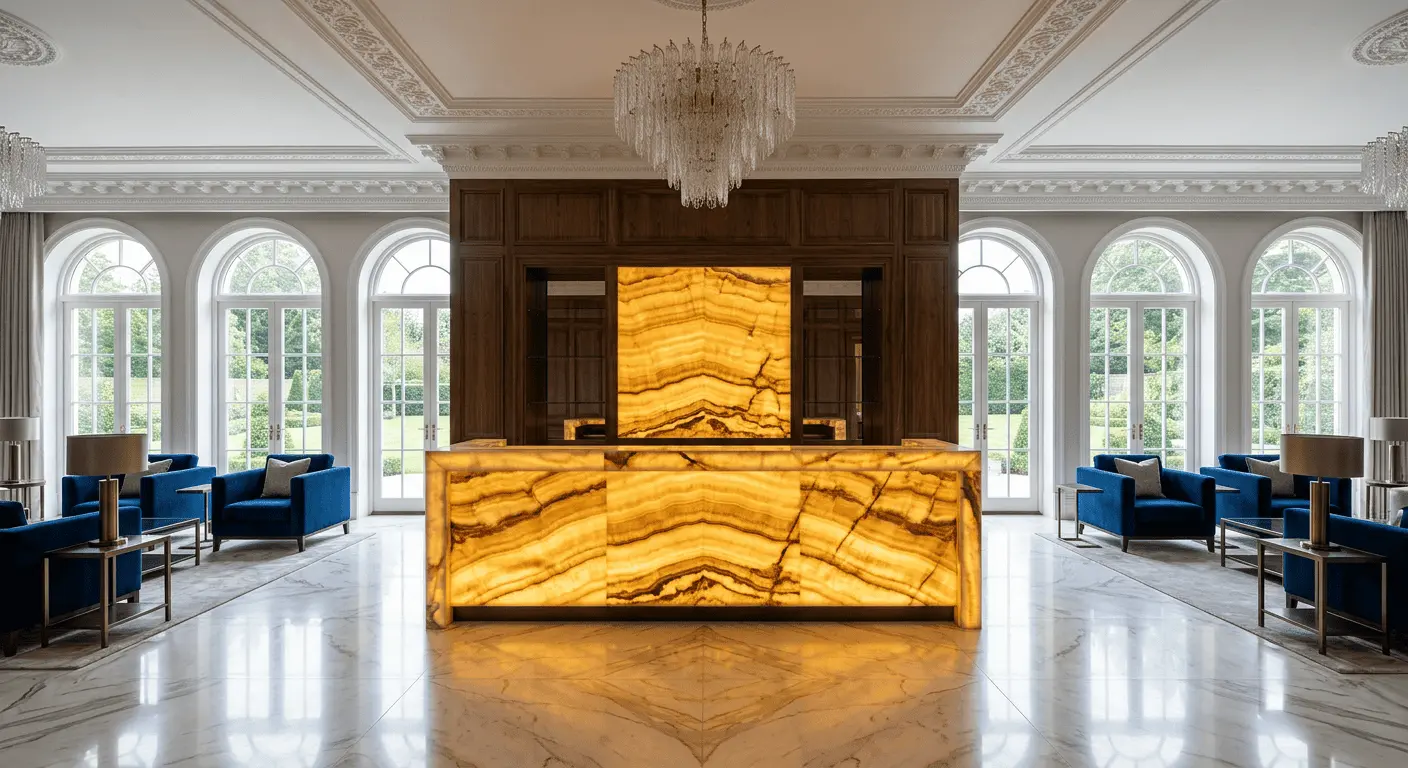
I remember that moment still. A mansion on Novaya Riga, handover, evening. The owner walks into the living room, I flip the switch — and her honey-onyx bar glows from inside like someone captured sunset and poured it into stone. She’s silent for ten seconds. Then: “Oleg, why didn’t you show me this during the day?” I answer: “Because it doesn’t exist in the day.”
That’s the whole material in one phrase. Onyx with backlighting in a premium interior — this is not marketing copywriting, this is technical requirement. Without light, onyx is just an expensive rock with nice pattern. With light — it’s a light object, a work that functions like a painting with its own energy source. And if you didn’t design the backlighting before the plates left the factory — consider you bought a diamond and didn’t set it.
In this article I’ll tell what we at the studio learned about onyx over recent years: where it works, where it fails, what it actually costs, and why 80% of onyx bars in private homes look like cheap fakes — at several million rubles.
Why onyx is not a stone, but an optical device
Technically, onyx is a semi-transparent calcite with iron, manganese, copper impurities. Hence the palette: honey, caramel, green nephrite, pink, milky with veins. But that’s not what matters.
What matters is that a 20mm onyx slab transmits light. Literally. Place your hand behind — you see its silhouette on the face. No other natural stone does this. Marble — no. Travertine — no. Quartzite — only specific types and weakly.
And here’s where it gets interesting. Under external light — daylight, from a chandelier, from a spot — you see the stone’s surface. Pattern, gloss, texture. Under internal backlighting — you see the stone itself, straight through. Veins, inclusions, depth measured in centimeters. It’s two completely different objects in one material.
Onyx is the only stone that changes character from a light switch flip. Design it without understanding this — like buying a grand piano and not tuning it.
Three honest uses of onyx in a mansion
Over years we’ve concluded onyx thrives in three scenarios. Everything else is either showing off or mistake.
Bar counter
The most grateful story. Front panel backlit with LED strip — this is the center of gravity in any living room after sunset. Fails never.
Real budget from the latest project (counter 2.8m, Italian “Miele” onyx, 20mm slab):
— stone with pattern selection and book-match cutting: about 680,000 ₽
— frame-construction with matte diffuser: 120,000 ₽
— backlighting (professional strip CRI 95+, power supply, dimmer): 85,000 ₽
— installation and joint grinding: 140,000 ₽
Total just over a million. For an object guests photograph first.
Partition
Technically complex but visually — strongest move. Glowing onyx wall between living and entry, between bedroom and bath, between office and library. Works like a stained window, only nature draws the narrative.
Nuance here: partition needs two-sided viewing. So backlighting must hide in the edge or between two slabs (we often do “sandwich”: two 20mm slabs with 40mm gap, inside — perimeter strip). Single-sided backlighting works as spots — patchy.
Budget for 2.5 x 2.4m partition: 1.8 to 2.6 million all-inclusive.
Bathroom
Most controversial scenario. Clients often want full onyx bath — floor to ceiling. I advise against. Onyx in water and on floor behaves poorly: porous, absorbs, darkens. Plus slippery.
But wall behind the tub, backlit from behind — yes. Or a niche with backlighting behind the sink. Or front panel of a hydromassage tub (we did this on Rublyovka — with internal strip on remote, owner activates only before sleep).
Why without proper backlighting it’s just expensive stone
One story. Consultants came after someone else’s project — finished counter, good onyx, green. But dead. No effect.
We broke it down. Problem was three things at once:
Strip CRI 80. That’s color rendering index. Cheap strip gives cold corpse light that kills warm onyx tones. Need CRI 95+, better 97. Price difference — about 800 rubles per meter. Effect difference — colossal.
Strip glued straight to stone. Point sources every 15mm make “zebra” — light and dark stripes. Need diffuser: matte acrylic or special diffuser, minimum 30-40mm offset.
Warm white 3000K on cold gray onyx. Light color matches the stone, not “the usual.” Honey and caramel — 2700-3000K. White with gray veins — 3500-4000K. Green — separate story, often RGBW tuned per slab.
Fixed it — stone came alive. But retrofit was 40% of original install cost. Because everything was already built.
Typical client mistakes (and architects too)
Accumulated plenty.
Buy stone before designing light. Main mistake. Client goes to showroom, falls for a slab, buys it. Then comes to us. That slab might be too dense — light won’t pass. Or too sparse — backlighting will “eat” the pattern. Stone selection and backlighting design are one operation, not two.
Save on cutting. Onyx must be cut “book-match” (when neighbor slabs mirror each other like pages) or “four-match” — creating symmetry. Costs 20-30% more, but without it you get random patchwork. On a backlit counter it’s brutal.
Forget dimmer. Onyx at full backlighting brightness is kitsch. It glows softly, at 40-60% power. Without dimmer you get shopping-mall lightbox.
Put onyx where it’s unnecessary. Entryway without evening scenario. Kitchen backsplash behind the stove (just gets smeared with grease in a year). Staircase. Money nowhere.
How we design onyx at the studio
We have internal rule: light first — stone second.
First we select the spot, calculate lighting scenarios, sketch backlighting scheme — where the strip goes, what offset, what diffuser, what temperature, what power per meter. Only then we take the client to the warehouse to pick a slab — with a light. Literally. I carry a powerful LED 97 CRI fixture and hold it behind candidate slabs. We watch how it glows inside. Not “how it looks under showroom top light,” but how it will look at home at 10pm.
This changes everything. Two slabs from one batch can give completely different backlighting effect. One — deep, warm, readable veins. The other — murky, gray, flat. Top light makes them identical.
Next — mockup. For big projects we assemble test piece on-site: stone bit, temporary strip, diffuser. Client looks in real conditions, real time of day. After this there’s no “oh, I thought it would be different.”
Onyx as atmosphere investment
Let’s be honest. Onyx isn’t the most practical material. It costs 1.5–2x more than marble. Needs restoration every 5–7 years. Fears acids, wine, lemon. For a bar counter this means regular polishing and sealing.
But we’re not selling stone. We’re selling scene. The moment when guests walk into the living room after dinner, light dims, the counter glows from inside, and conversation automatically gets quieter. This can’t be bought with tile. Can’t be replaced with “onyx-look” ceramic — I’ve seen attempts, looks like silicone breasts: fine from distance, shameful up close.
Backlit onyx in premium interior is the only material that creates theater. Not décor. Not finishing. Theater, with act “day” and act “evening.”
How much does entry into this cost
Short answer — nothing under a million for realistic results in a private home. Small niche with backlighting — from 350–450 thousand. Full counter — from a million. Partition — from two. Complex bathroom solution — from 1.5.
Expensive? Yes. But onyx is not the place where savings bring joy. Either do it right or don’t do it. Mid-options look worse than honest drywall with good light.
Closing thought
If you’re thinking about onyx — don’t start with stone hunting. Start with question “where’s the evening focal point in my home?” If that point exists — onyx can live there. If not — it’s not your material, no offense.
Want to discuss your project — write. I’ll show slabs from recent batches, tell what’s currently in Italian and Iranian warehouses (Iranian often more interesting by pattern — separate conversation). And most important — we’ll look at your home and understand if this spectacle is needed. Sometimes the most honest architect advice is “you don’t need this.” Happens too.
Next step
Discuss your project
An hour at the studio with Oleg Reznikov: your site, your brief and relevant studio projects.