
The Invisible Butler: Smart Home You Don’t Notice
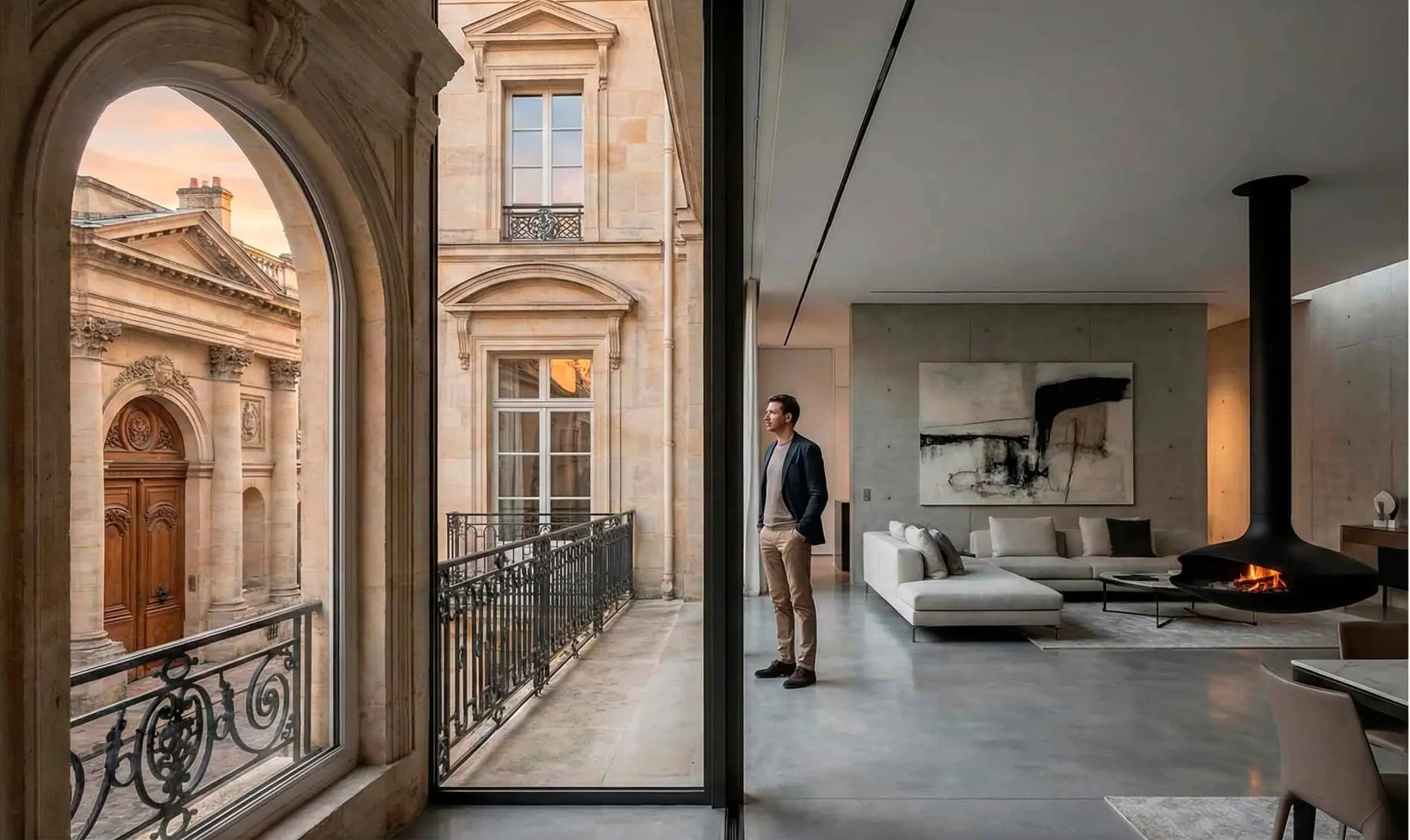
A year ago we handed over a residence outside Moscow. The owner, a man who’d traveled half the world and lived in hotels written about in Monocle, walked through the house, stopped in the living room, and asked: “So where exactly is all this automation of yours?”
It was the best compliment in the studio’s history.
Because a premium smart home isn’t control panels on walls, illuminated icons, and a voice assistant butting into conversations. It’s absence. The absence of switches in sight, the absence of need to push anything, the absence of feeling that you’re inside technology. A good smart home is like a good butler in an English estate: you don’t see them, but the water glass is already on the table, the curtains closed at sunset, and the bathroom floor is exactly the temperature you like in October.
If guests entering say “oh, you have a smart home!”—the home is dumb. Let’s talk about that.
Why “Smart” Doesn’t Equal “Visible”
In the public mind, smart home is still associated with gadgets. A bright panel at the entrance, an app on your phone, lighting that changes color to music, and a smart speaker that “understands” five commands out of ten.
That’s not a smart home. That’s toys.
Real automation works on a different principle: it learns your life scenarios and executes them without commands. You wake at 7:15—the bathroom has a warm floor and soft light because at 7:14 it was ramped down gently. You approach the front door with bags—it opens automatically because the system recognized your car on approach and camera confirmed your silhouette. You sit in the library armchair—lighting shifts to the floor lamp and wall sconces, the ceiling light goes off. Nobody pressed anything.
In the project I mentioned above, we programmed 140 scenarios. The owner knows about thirty. The other 110 work in the background: climate in the wine cellar, supplemental light for orchids in the winter garden, guest bedroom prep two hours before the driver returns from the airport with the mother-in-law. The system knows mother-in-law’s schedule better than the owner does.
KNX, Crestron, Lutron—and Why This Isn’t Marketing
When we tell a client that basic automation engineering starts from 8–12 million rubles for a 600–800 square meter house, the first reaction is “why not just get something simpler, Chinese, for 500 thousand?”
We explain calmly.
KNX—an open European standard more than thirty years old. Airports, museums, and residences where people whose names you know run it operate on it. It won’t be “hacked” by neighbor kids, won’t fall apart in three years because the manufacturer left the market, and scales—today 80 devices, in five years 300, and nothing needs rebuilding.
Crestron—American ecosystem, the flagship for AV integration, multi-room, complex home theaters and control systems where everything—from curtains to a 9-million-ruble Sony projector—lives in one interface. Crestron is when you want your home to work like a yacht, not like an apartment in a new building.
Lutron—a separate religion in the world of light. Their dimmers and curtain systems work with such smoothness that you don’t notice how the room changed mood. Lutron has shades of dimming that Chinese analogs can’t reproduce in principle—not because they don’t want to, but because they can’t. Physics.
This isn’t snobbery. It’s engineering. In our practice we’ve seen three homes where they tried to economize on automation, mixing Xiaomi, Tuya, and some no-names. Two of the three needed complete rebuilding in 2–3 years. One caught fire. Not metaphorically.
What “Invisible” Means Physically
Concretely. What must disappear from sight in a residence claiming A+ level?
Switches. Don’t exist in the classic sense. There are scenario buttons—flat, unlabeled, minimalist, placed strategically: by the bed, at the entrance, in the study. Three or four per house. Everything else operates through presence sensors, scenarios, and geolocation.
Wall thermostats. Archaic. Temperature is managed through unified interface (usually hidden panel in technical zone or app), and invisible sensors in each room read real-time for the system.
Wires. Not a single visible one. That means thinking about electrics at the architectural stage, not when plasterers have already left. We had a case: a client came after another studio, where smart home was remembered a month before handover. Had to cut walls already faced in Turkish travertine. The travertine, naturally, became waste.
Remotes. If there’s a single TV remote or AC remote in the house—the system was designed poorly. Everything runs from one logic: either voice (and not “Alexa,” but professional solutions like Josh.ai), or from one hidden touch panel, or fully automatic.
Routers, servers, switches. In a separate server room with ventilation and backup power. Not on a shelf in a closet next to the vacuum.
Typical Mistakes We See Most Often
Since we’re on the subject—let’s go through what clients do wrong. This part is always more useful than theory.
Mistake one: “Finish first, then smart home.” No. Automation is designed at the architectural concept stage, parallel with electrics and climate. Otherwise you get Frankenstein where a presence sensor is crooked in a perfectly made walnut cornice.
Mistake two: economizing on the integrator. An integrator isn’t an electrician with courses. It’s a separate profession, and a good KNX engineer in Moscow earns like a senior developer in a bank. If someone offers to “set up the whole house for 500 thousand”—run. It’ll be set up once, then either stops working or you’ll never be able to change anything because documentation doesn’t exist.
Mistake three: too many scenarios from the start. Clients often want “everything automated from day one.” Doesn’t work that way. The first 2–3 months living in the house—calibration. You don’t know yourself when you actually wake up, which chair you prefer, what light you need for reading versus talking with your wife. Scenarios are written based on actual life, not fantasy at design time.
Mistake four: voice assistants as main interface. This still works poorly for Russian even in expensive solutions. And for Cyrillic names and commands—disaster. We recommend voice as supplementary, not primary. Primary is automation without commands.
Mistake five: trusting cloud solutions. If your home stops working when your provider has internet downtime—that’s not premium. All critical scenarios (light, climate, security, curtains) must work locally, on your own server, independent of the outside world. Cloud is only for remote access and backups.
How We Do It in the Studio
Our approach is built around one principle: automation is architecture’s extension, not its overlay.
That means when we draw a floor plan, an automation engineer works in parallel. They know where the bed will be, where the sofa, where the owner will put the coffee machine, what hour the cleaner arrives. From this information comes logic—and from logic, wiring, equipment selection, and scenario mapping.
We always produce three documents:
First—physical points map: where sensors go, where controllers, where the server room, which cable runs.
Second—scenario map: a 100–150 row table describing what happens in the house at 6:00, 7:30, 12:00, 18:45, 23:00, weekends, vacation, when the owner is away a week, when friends with kids visit. This document outlives integrator changes and contractors. In 10 years any engineer can open it and understand how the house works.
Third—degradation mode. How the system behaves when something breaks. Internet down? Local scenarios run. Main server down? Light and climate run from backup controller. Everything down? Three hidden mechanical buttons in the house give light in main zones. A home should never leave its owner in darkness.
What This Actually Costs
Without numbers the conversation is meaningless, so—here are reference points for late 2024.
— Basic automation in a 500–700 m² residence (light, climate, curtains, security) on KNX + Lutron: from 12 to 20 million rubles turnkey with project, equipment, installation and commissioning.
— Full premium-class smart home with multi-room, home theater, AV integration on Crestron, scenarios, server, redundancy: 25–50 million rubles for 800–1200 m².
— Exclusive solutions with Josh.ai, art integration (gallery lighting management, museum climate), pools, wine cellars, complex landscape automation: from 60 million and up.
That sounds like a lot. But let’s count differently: a good custom kitchen in such a residence costs 8–15 million. One bathroom with Salvatori tile and Vola fixtures—4–6 million. Automation is an engineering system managing the whole house for 20–30 years. Economizing on it is like putting a Lada engine in a Rolls-Royce.
Plus there’s maintenance. A serious system needs a service contract—another 300–600 thousand per year. For that money you get an engineer visiting quarterly to update firmware, check redundant channels, and you can call him anytime. Without this, even the most expensive system becomes a headache in 5 years.
Why Chinese Solutions Don’t Work Here
Separate conversation because the question always comes up.
Chinese ecosystems (Xiaomi Aqara, Tuya, Yeelight, etc.)—excellent. For a studio apartment, for a dacha, for a startup office. They solve “turn lights on from phone” for reasonable money.
In an A+ level residence they don’t work for several reasons.
First—reliability. These systems run on Zigbee/Wi-Fi with cloud architecture. When you have 200+ devices, radio spectrum is clogged, routers lose connection, and a server in Shenzhen sometimes decides to log you out of your account.
Second—aesthetics. Chinese switches and sensors physically look like Chinese switches and sensors. Plastic, glow, logos. Against a natural marble wall this looks like sneakers with a tuxedo.
Third—longevity. You’re building a house for 30 years. A Chinese brand on the market today could close in 5, change protocol, or stop supporting your model. KNX has worked since 1990. It will work in 2050.
Fourth—data security. A home for a person at this level is sensitive data: schedule, cameras, biometrics, voice commands. Sending all this to the cloud with unknown jurisdiction isn’t smart. Professional systems store data locally on your server room, only sending out what you authorize.
A Home That Knows You
Back to where I started. Real automation isn’t technology. It’s psychology. The answer to: do you want to live in a house that demands your attention, or a house that cares about you?
We in the studio are sure: the second. Always. Home should be environment, not interface. Tool, not conversation partner. Space that adapts to you, not forces you to learn how to use it.
A good smart home is silence. It’s when you don’t remember the system exists because it just works. It’s when guests say “how cozy” not “how tech.” It’s when ten years later everything still runs because it was done right the first time.
If you’re starting out—designing a house, thinking about engineering, reading about brands—write us. We’re always ready to discuss a project on the shore, before plaster is applied. Because a smart home doesn’t start with equipment. It starts with right architectural thinking.
And the butler, if you get it right, you’ll never see. That’s his job.

Next step
Discuss your project
An hour at the studio with Oleg Reznikov: your site, your brief and relevant studio projects.