
What They’re Building on the Côte d’Azur in 2026: The End of the Glass Villa Era
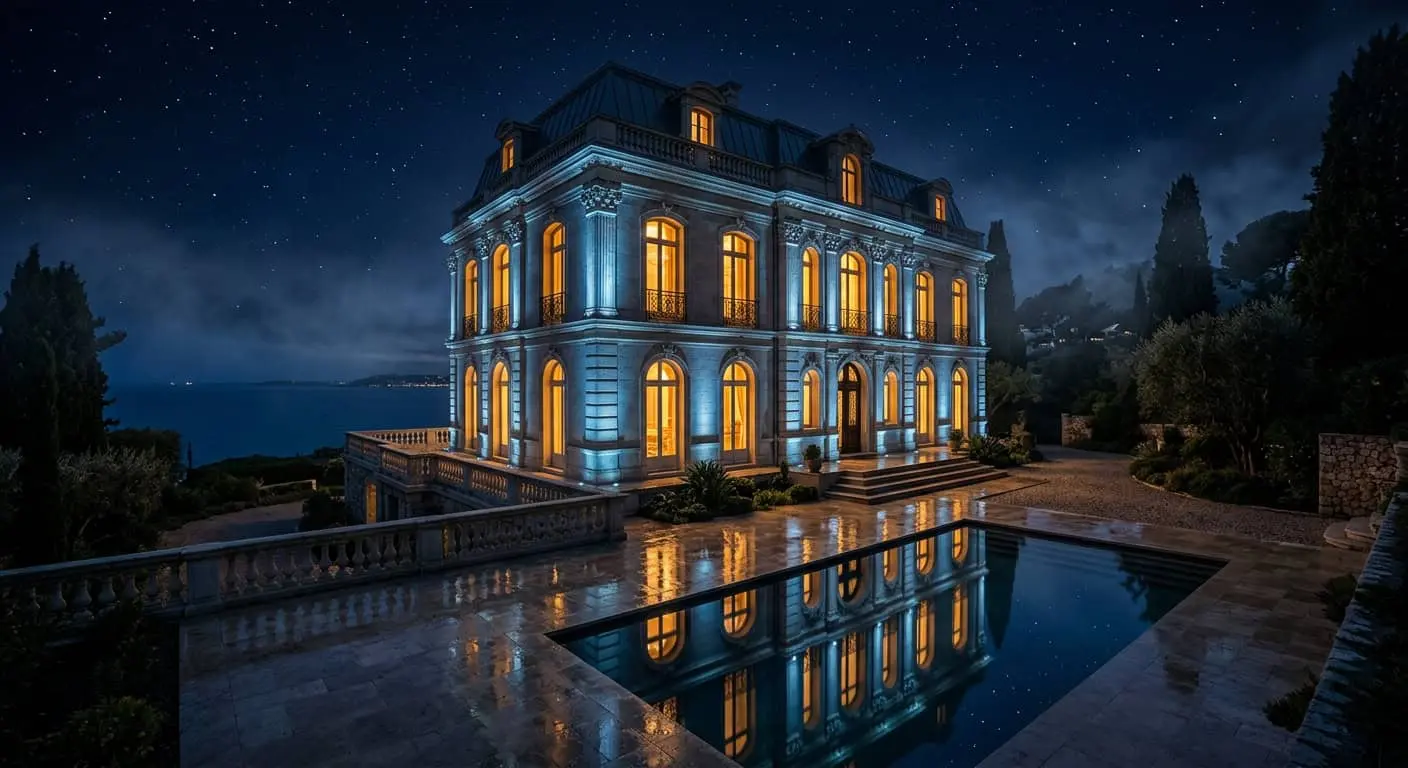
Last April we went to see a property near Saint-Tropez — a villa owned by one of our clients who bought it four years ago for 18 million euros. Glass to the floor, flat roof, concrete cantilever over the sea, infinity pool. Everything that for ten years straight was considered the peak of taste. Today he’s trying to sell it, and the agent is frank: minus 20% from the purchase price, and that’s if lucky. This is how we want to start talking about elite real estate trends Europe 2026 — with a concrete object that in four years managed to age morally and financially.
On the Riviera and in Tuscany there’s a turnaround that Moscow hasn’t fully grasped yet. Wealthy Europeans — those who form demand in the upper segment — are massively moving away from glass minimalism toward stone, plaster, arches, and columns. Not from nostalgia. From calculation.
In this article we’ll break down why this happened, what it means for a Russian client with a budget from 100 million rubles, and why neoclassicism — which we inertially call “conservative choice” — turned out to be the most aggressive investment strategy of the decade.
Why glass stopped selling
A glass villa ten years was a universal marker of status. Everyone wanted it — from Moscow bankers to Arab princes. European architecture bureaus cranked them out by hundreds: flat roof, white plaster volume, floor-to-ceiling glazing, minimal decor. The formula worked.
Now it’s broken. Here’s why.
First, too many glass villas were built. Between Cannes and Menton there are several thousand. All similar. When a buyer with 20 million euros sees the fifth “modern villa with sea view” in a row, he stops understanding what exactly he’s paying for. Uniqueness disappeared.
Second, glass and concrete age badly. This is physics, not aesthetics. In 8–10 years cracks appear on plaster, glass gets cloudy from salt air, steel frames rust inside, flat roofs leak. Repair costs half of construction. A stone residence from the XIX century next door stands two hundred years without major renovation — and any buyer sees this.
Third — and this is the main point — the cultural code changed. New money wants to look like old money. And old money never lived in glass.
Elite real estate trends Europe 2026: what sells instead of glass
If you look at deals over the last 18 months in the 15 million euro+ segment — the picture is unambiguous. Growing in value:
— Stone belle époque villas from the late XIX — early XX century. Those very ones, with rusticated base, window casings, balustrades, tile roofs.
— New residences built “in the old style” — with thick stone walls, high ceilings, enfilade planning, historically accurate plaster.
— Tuscan farmhouses (casali) with restoration — terracotta tiles, beams, simple geometry, thick walls.
Elite real estate trends Europe 2026 — this is returning to the concept of “a house that will outlive its owner”. Not “object”, not “residence-manifesto”, not “architectural statement”. A house. With role, with character, with age — real or convincingly made.
Numbers speak for themselves. Per Knight Frank and local agent reports on the Côte d’Azur, stone villas in belle époque style in 2023–2025 added 22–28% in price. Glass villas same class — lost 8–15%. Liquidity difference — twice.
Why this isn’t just fashion
We at the studio have seen dozens of cycles. Modernism replaced art deco, minimalism replaced postmodernism, every fifteen years something gets declared “new language of architecture”. But what’s happening now is different — it comes not from architects but from buyers.
Architectural media still publish glass boxes. Professional prizes still go to minimalists. But the real market — people with money voting by bank transfer — already turned around. This is rare, and it’s exactly what makes the trend stable.
When market outpaces professional fashion, it means one thing: fundamental value shift occurred. People who paid 25 million for glass saw their house look like an office center from the 2000s in five years. And made conclusions.
What this means for Russian client
Now — the main point. Why elite real estate trends Europe 2026 directly concern someone building a house on Rublyovka, Novaya Riga, or near Saint Petersburg.
Russian private architecture market always lags European by 5–7 years. Hi-tech was built here when Europe already stopped loving it. Glass minimalism — same story: peak in Europe was 2015–2018, ours — 2020–2023. And now we’re at an interesting point: European client already left glass, Russian client just invested into it.
To our studio over the last year and a half comes a new client type. Man 40–50 years old, budget 150–300 million, already looked at 3–4 finished projects in glass and concrete. And saying the same phrase: “I don’t want my house in ten years to look like an outdated showroom”. These are early swallows of the same turnaround that’s in full swing on the Riviera.
Neoclassicism — in correct execution, without vulgarity and kitsch — isn’t a conservative choice. It’s investment backed by the European market right now, in real time, with real money. Elite real estate trends Europe 2026 tell the Russian client one thing: stone, order, proportion — this isn’t past. This is liquid future.
Typical mistakes we see every month
The turnaround to classicism is good, but it bred its own layer of mistakes. Let’s go through them honestly.
Mistake one: “neoclassicism” from foam concrete with foam-polystyrene cornices. Client comes with Palazzo Strozzi references, but budget is for plastered facade with polyurethane decor. In two seasons everything chips, cracks, yellows. Neoclassicism lives by mass, stone texture, real proportions. It doesn’t work on foam — looks like theater set.
Mistake two: columns for columns’ sake. Man watched the Riviera and demands six columns before the entrance. We ask — why? Because “rich”. A column is a structural element with function, proportion, order. When it’s stuck to the wall for beauty — that reads immediately. Especially if the order is mixed up, capital wrong, base wrong.
Mistake three: mixing everything together. Owner wants “classic facade but modern interiors and a kitchen like Zaha Hadid’s”. Out comes a centaur-house that neither classical lovers nor modernists like. Integrity — this isn’t dogma, it’s what the next buyer pays for.
Mistake four: economizing on stone. Real belle époque — this is limestone, travertine, sandstone. Cladding thickness — 40–60 mm, not 20. Grout — live, not like bathroom tile. When client says “let’s use ceramic under stone 20 mm, no one will notice” — everyone notices. Immediately.
Mistake five: copying without understanding. Bring a photo of a villa in Cap-Ferrat and ask to “do the same”. But that villa stands on a cliff, proportions calibrated for specific topography, specific sun, specific horizon. Put it on a flat plain — it looks like cake on a table. Classicism requires adaptation to place, it’s not wallpaper.
How we work with this request
In our practice over the last two years, about seventy percent of projects — it’s exactly stone, plaster, order, classical volumes in modern interpretation. Not “Russian estate” with carved casings, not “palazzo” head-on. European neoclassicism adapted for central Russia.
We start not with the facade. We start with volume proportions — floor heights, length-to-height ratio, window rhythm. Window in classical house — it’s vertical, not square and not horizontal band. Ceiling — minimum 3.3 meters on first floor, better 3.6. Without this any “classicism” becomes a 2000s cottage with pilasters.
Facade material — natural limestone or high-quality plaster on system that doesn’t crack ten years. Decor — either carved from stone or cast from architectural concrete, no foam. Roof — natural tile or patinated copper standing seam, no flat roofs in our neoclassical projects on principle.
Inside — enfilade of main rooms, tall doors (2.4 meter minimum), stone floors in grand zone, wood in private. No glass partitions between living room and kitchen — this came from that same glass trend now going away.
Such house costs 15–25% more than glass one. But in ten years it will cost 60–80% more. Math is simple.
Elite real estate trends Europe 2026 and question of taste
Separate topic — the question we’re regularly asked: “Won’t this look old-fashioned? Won’t I be living like my grandfather?”
No. Here’s why.
Contemporary European neoclassicism — it’s not XIX-century reconstruction. It’s classical architecture language rethought through modern tasks. Panoramic windows exist, but vertical, in right proportions, with real mullions. Open spaces exist, but not by destroying rooms, but by height and enfilade. Technology exists — radiant floors, ventilation, automation — but it’s hidden.
House of the XXI century built in classical logic — it doesn’t look “like grandfather’s”. It looks like a house that has ancestors. That’s different.
And frankly — in our segment (we work with budgets from 80 million+) visual “novelty” stopped being value maybe five years ago. People with money don’t want to shock, they want to live. And live long, in environment that won’t bore in a season.
In the end
Elite real estate trends Europe 2026 — it’s not that “now columns are in fashion”. It’s that the upper-market has recalculated the cost of different architectural strategies and concluded: durability matters more than novelty, material matters more than form, proportion matters more than effect.
For Russian client this is a window. While the main mass still builds glass parallelepipeds, the entry window for correct investment is open. In five years, when the same turnaround happens here (and we almost don’t doubt it will), houses built now in stone and proportion will cost noticeably more. Not because they’re “in fashion”. But because there simply won’t be many of them.
If you’re now at the stage of choosing between “modern” and “classical” solution for your future house — we’d be happy to talk. Not to sell the project, but to figure out what exactly suits you. Sometimes after that conversation the client goes to a glass villa — and we wish good luck. But more often they stay. Because numbers and common sense usually are on one side.

Author

Next step
Discuss your project
An hour at the studio with Oleg Reznikov: your site, your brief and relevant studio projects.