
Columns for 40 Million: Why Real Neoclassicism Doesn’t Tolerate Shortcuts
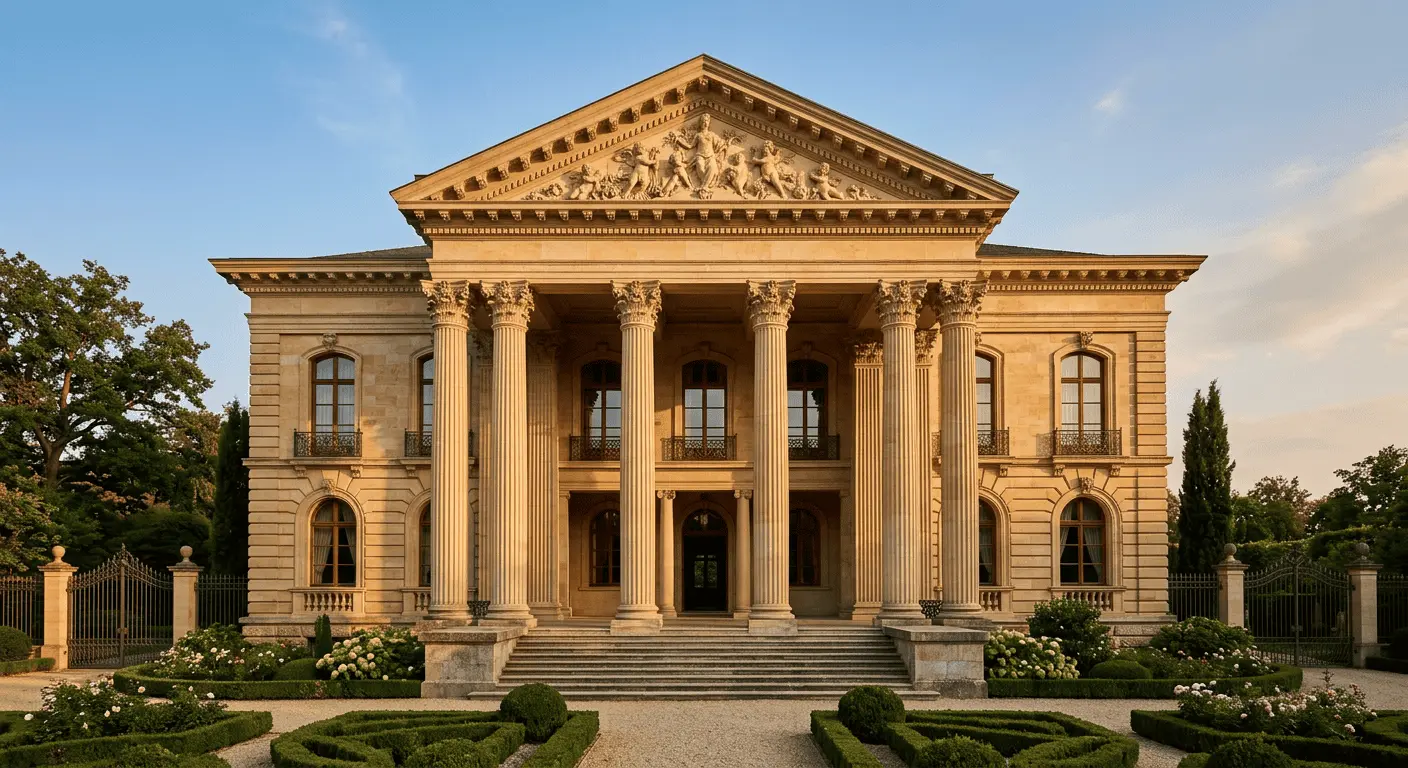
We often get calls with the same question: “We want neoclassical mansion facade like [neighbor’s name], but fit in eight million.” We usually answer honestly—for eight million you won’t get neoclassicism. You’ll get theater set that lasts until first serious winter and first guest who knows architecture.
Then usually a pause. Because client already saw cottage for eight million “in classical style”—with columns, with plasterwork, with portico. Externally—all there. Why do we say it’s not quite right?
This article breaks down what authentic neoclassical mansion facade actually costs, why the gap between 8 and 40 million isn’t brand markup but difference between architecture and parody, and which seven signs give away fake in three seconds. If building house fifty years, not one season for Instagram—you need this.
Two Facades, Two Worlds: Where the Border Actually Is
Imagine two homes on same Rublyovka street. Both—”with columns.” Both—”classical style.” Both—white, symmetrical, center portico.
One cost owner eight million for facade work. Second—forty.
From road at 60 km/h—difference unclear. Stop. Approach ten meters. Then interesting begins.
First house: columns thicker than should be—architect clearly didn’t know module. Capitals cast polyurethane, painted “marble,” already cracking after two seasons—facade paint gives microbreaks. Cornice—plastic, glued with foam. Pedestal “rustication”—drawn, not cut. Travertine walls—actually plaster with “stone effect.”
Second house: proportions read immediately—even if you can’t explain why. Columns from solid travertine, capitals hand-carved by Italian craftsman, entablature per canon, pedestal true rustication from blocks, aging beautifully year by year.
First is Cherkizovsky tailoring shop knockoff of Brioni. Second is Brioni. And yes, it shows.
Why Neoclassical Mansion Facade Is Math, Not Decoration
Main misconception we meet: people think classicism is “columns, plasterwork, symmetry.” Checklist of elements.
No. Classicism is proportions. It’s system of relations Palladio locked in XVI century, Vitruvius—earlier. Column diameter determines entablature height. Entablature height determines facade module. Intercolumniation (distance between) strictly tied to order—Doric, Ionic, Corinthian. Everything connects to everything.
When “classical” facade gets column height three meters at forty-cm diameter—get pencil. Classical Ionic order demands 1:9. Meaning at forty-cm diameter, height should be 3.6 meters. Plus base, plus capital.
We at studio saw project where architect put Corinthian capitals (most complex, with acanthus leaves) on Doric columns (simplest, baseless). Like wearing bow tie with tracksuit. For someone who reads order, it physically hurts watching.
That’s why real neoclassical mansion facade expensive: behind each centimeter sits calculation. And canon can’t be imitated—only observed.
What These Forty Million Break Down To
Let’s lay it out honestly. Clients love numbers.
Travertine from Tivoli. Not Turkish, not Iranian, not “travertine-like stone from Dagestan.” Real Roman from Tivoli quarries—the same as Colosseum and St. Peter’s. Price—180 to 350 euros per square meter in slabs. For 600 sq.m facade area—15-20 million rubles just material. Plus delivery, cutting per size, grinding.
Columns. One monolithic travertine column, 4 meters high—1.2–1.8 million each. Plus hand-carved capital—400-800 thousand more. Classical portico needs minimum four columns. Do the math.
Carving and plasterwork. Real plasterwork—from gypsum or marble, cast to historic forms or hand-carved. Not polyurethane from building megastore. Acanthus leaf on Corinthian capital carved by craftsman 2-3 weeks. Not fast, not cheap.
Pedestal rustication. Stone cut to blocks, each processed “under texture” or smooth—per concept. Then laid with mortar joints. This isn’t plaster with grooves.
Installation. Neoclassical facade needs not plasterers, but high-qualification stonemasons. Crew able to work travertine and set columns plumb within 1mm—rare specialists. Paid accordingly.
Sum up—get those 35-45 million. No architect premium, no studio markup. Just honest cost for honest work.
Seven Signs of Fake Classicism Visible in Three Seconds
When we arrive at client’s lot who “almost everything’s done and want to finish interior”—often see facade that hurts to look at. Here’s how in seconds we know it’s counterfeit.
1. Wrong Module Proportion
Classical column strict: diameter to height ratio—Doric 1:7, Ionic 1:9, Corinthian 1:10. If column looks “stocky” or “lanky”—module’s violated. Eye reads it instantly, mind hasn’t explained yet.
2. Plastic Plasterwork
Polyurethane plasterwork visible by unnatural gloss, too-sharp edges, how it catches light. Real gypsum or stone has depth, shadow falls differently. Polyurethane always looks like toy.
3. Capitals from Foam
Polyurethane capital painted “marble”—death sentence for facade. After two winters it’ll crack, after five—start crumbling.
4. Facade Paint Instead of Stone
“Travertine effect,” “liquid marble,” “decorative plaster stone”—all marketing for “paint.” Stone breathes, ages, gets patina. Paint fades and peels.
5. Order Violation
Mixing elements from different orders on one facade—Doric base, Ionic shaft, Corinthian capital. More common than seems. Especially in “author projects” from architects studying classicism via Pinterest.
6. Chinese “Marble”
Marble or travertine slabs questionable origin—usually China, Iran, Turkey low-grade. Visually similar first glance. But stone pattern unnatural, color flat, in five years starts “blooming”—white salt spots appear on surface.
7. Symmetry Without Axis
Classicism isn’t “columns left and right.” It’s strict symmetry axis organizing whole facade: entrance, windows, pediment, chimney, even path to house. When portico “sort of centered” but front door offset, second-floor windows don’t align with first—that’s not classicism. That’s chaos in classical clothes.
Why Economizing on Neoclassical Mansion Facade Is Worst Possible Economy
We have rule repeat to clients: on classicism you can’t economize selectively. Either you do everything per canon, or don’t do classicism—pick something else. Modern minimalism, Scandinavian, chalet—there economizing reads as conscious choice. Classicism—doesn’t forgive.
Why? Because classicism—language. Like any language, requires literacy. Person speaking with errors immediately shows language isn’t native. Facade with violated proportions immediately says: owner wanted to look important but didn’t figure out how.
From practice: client built “classical” facade for twelve million, three years later came asking to redo. His own words: “every time I pull up I’m embarrassed.” Couldn’t explain why. But felt. We audited and found six of seven signs above. Redoing cost 34 million. Total—46. If he’d come for right solution initially—forty.
Economizing in classicism—always double count. Best case.
How We Approach It: First Canon, Then Client
When request for neoclassical mansion facade comes, we start not with sketches. We start conversation about lifestyle. Classicism—not style. It’s statement. It’s house saying: “I’m here long-term, I know my worth, I respect history.”
If person building for five years to then sell—neoclassicism won’t pay. It’s overspend. Classicism reveals over time: in twenty years travertine nobly patinates, patina settles on bronze door handles, garden grows to proper height. That’s architecture for thinking in generations.
Then we work proportions. Modular grid, symmetry axis, window rhythm, floor heights. Only when facade math aligns—we select materials. Not reverse.
And we honestly warn: if facade budget under 25-30 million—we’ll offer not neoclassicism, but something else. Rationalism, modernized classicism without order, just good contemporary. Because we don’t want to sign work that in three years feels shameful.
Typical Client Mistakes We Meet
“I want like on Pinterest photo.” Problem: photo usually either XVIII century building or 200-million newbuild. Comparing your 10-million budget to those—path to disappointment.
“Let’s shrink columns fit budget.” Can’t. Column either holds proportions or doesn’t. Shrunken column—not economy, it’s error.
“Can we use composite capitals, they look real.” Look. Only on render and first two years. Then—see above.
“Neighbor built same house for 12 million, why yours 40?” Because right now you’re looking at neighbor’s facade “wow, columns.” In five years you’ll look with eyes “why’s everything cracked.” We offer not first glance, but twentieth.
“Let’s do basic first, redo later.” In classicism remake costs more than right work initially. First have to demolish error.
Neoclassical Mansion Facade—It’s Investment, Not Expense
We often say: properly made classical home doesn’t lose value. It grows. In thirty years authentic travertine facade with hand carving will cost more—because such homes fewer, craftsmen almost gone.
Eight-million house in ten years worth two million as lot minus demolition. Forty-million—worth as architecture. Simple arithmetic on 20-30 year horizon.
One more thing rarely mentioned. Classical home raises standards. Children growing in space with right proportions, real stone, alive architecture—automatically distinguish real from fake life-long. Automatically. That’s also investment.
In Conclusion
If you read this far—likely building for decades, not next season. Who counts not just construction but self-reflection in this house in twenty years.
Neoclassical mansion facade—not for everyone. Complex, expensive, takes patience. But if ready to speak classical language—speak correctly. Don’t mangle it for economy. Don’t build “almost classicism”—always reads. From Rublyovka, from Novaya Riga, from any street in any town.
We at Reznikov Studio take classicism only when know we’ll do it right. If you have project, doubts, or just want understand—write us. We’ll honestly say what’s worth doing, what—definitely not. Even if means declining commission.
Because architecture—responsibility. Classicism—responsibility squared.

Author
Read next
Next step
Discuss your project
An hour at the studio with Oleg Reznikov: your site, your brief and relevant studio projects.