
Ornament Is Back: A Smooth Facade No Longer Signals Taste
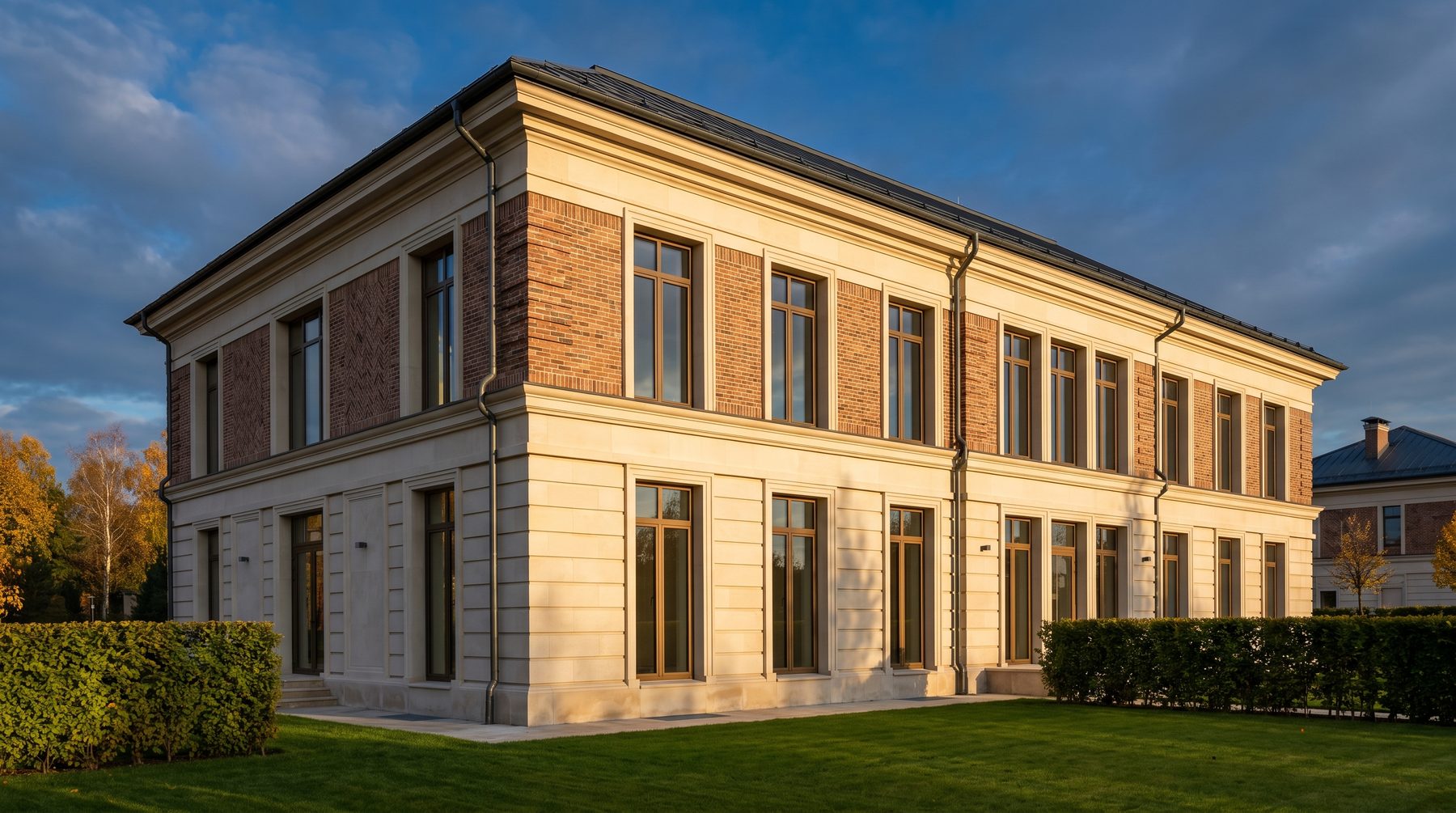
Facade ornament has become a mark of architectural nerve again, not of bad taste. The world has gone back to relief: patterned brickwork, deep mouldings, sculpted masonry. A smooth white box no longer reads as expensive by default. The question is no longer whether to give a facade texture, but with what — and at what level of thinking.
For fifteen years architecture lived by subtraction. Remove the cornice. Remove the surround. Remove anything that casts a shadow. A flat plane was called honesty, and any relief was treated as the weakness of an author who could not handle volume and hid the failure behind stucco.
That era is over. And it did not end in Russia.
While Moscow was scrubbing its facades clean, the world started modelling again
Look at the numbers rather than the mood. In the ninth annual 1stDibs survey of design professionals, answered by 468 designers worldwide, the most requested styles for 2026 are maximalism (39%) and eclecticism (38%). Not minimalism. Not quiet luxury. Clients came back for character, and interiors felt it first — facades followed.
The architectural press says the same thing in the language of brick. All season Dezeen has been running roundups of buildings with sculpted masonry: curving brick balcony bands, courses of textured bonding, rows of perforated brick that ventilate the structure and print dappled light onto the wall at the same time. The Brick Award 2026 went to work the jury described with words unthinkable a decade ago: a sense of wonder and beauty. Brick, once merely a skin, is ornament again.
Houzz, in its forecast for the year, singles out the return of Art Deco — not the gilded, theatrical kind, but the geometric one: rib, step, rhythm. This is not a revival of catalogue stucco. It is the revival of the idea that a wall is allowed not to be flat.
But here is where it gets interesting. At exactly the same moment, the Russian premium market is moving the other way.
Facade ornament: how it became a shameful word in Russia
According to country-house market reviews, demand for houses with clean geometry and minimal facades has grown by roughly 40% against 2022, while pseudo-classicism is losing value fast. There is a very clear reason for this, and it has nothing to do with aesthetics.
The reason is trauma. The early 2000s built several thousand houses around Moscow on which decoration was glued on. Literally: polystyrene cornices on adhesive, polyurethane capitals, urns, balustrades, three orders on a single elevation. Five winters later it all darkened along the joints, cracked and peeled away. An entire generation of wealthy clients drew one simple rule from that era: the less that projects from a facade, the less will fall off it later.
The rule works. But it protects against poor execution rather than leading to good architecture. The result is settlements where forty houses in a row look like the same white parallelepiped with floor-to-ceiling glazing, and the only thing telling them apart is square metres.
This is where most people go wrong. Abandoning ornament was mistaken for a style, when it was really an insurance policy.
What facade ornament is made of today: three materials and one trap
There is no point discussing relief in terms of liking or disliking. It is discussed in terms of material, weight and service life. All of it is calculable.
Glass-fibre reinforced concrete
Today’s default material for professional facade elements. Frost resistance is rated around F300 — three hundred freeze-thaw cycles, a margin measured in decades of Russian winters. At a wall thickness of 12–15 mm a square metre weighs 27–35 kg; at 20 mm, about 48 kg. That matters: such weight demands an engineered fixing into the load-bearing layer rather than adhesive, but it lasts fifty years and more without losing geometry or its anchors.
Costs vary enormously and depend on the complexity of the form, not on the area of the elevation. Simple linear elements — string courses, sill bands — start at roughly 3,000 roubles per linear metre. Three-dimensional pieces of complex shape, urns and capitals made to a bespoke model run into hundreds of thousands of roubles apiece. A batch of identical elements gets dramatically cheaper, because one mould produces dozens of castings.
Natural stone
Limestone, sandstone, travertine in a rusticated plinth and window surrounds. The most honest option and the most demanding one: the stone has to be chosen for water absorption, protected with drips, and kept out of any zone where meltwater from the roof will run across it. A mistake here is the most expensive of all, because putting it right means demolition.
Polyurethane and polystyrene
The trap. Light, cheap, installed in a day, and in its first year it photographs no worse than stone. Then physics arrives: polymer and wall expand at different rates, the joints open, and the facade needs refreshing roughly every five years. Acceptable for a shopfront. Not for a house built for a generation.
The rule is simple: if an element projects further than the palm of your hand and is read from twenty metres away, it should be mineral. That is why we settle material questions long before the finishing stage, when the walls already stand — they belong with the structural design.
Where ornament turns into kitsch
The return of relief is a permission, not an indulgence. The distance between architecture and kitsch is measured by a handful of things, and all of them are technical.
Scale. Classical ornament was calculated for a twenty-metre building seen across a square. Transferred to a two-storey house at its original size, it turns a home into a scale model. Contemporary neoclassicism enlarges and simplifies: one moulding instead of three, but a deep one.
Number of sources. A facade assembled from three different catalogues reads as collage, even when every element is good on its own. One language across the whole volume is what separates an architect’s work from a buyer’s.
Shadow. Ornament exists as light and shade, not as drawing. A projection under 40–50 mm on a north elevation on an overcast day cannot be read at all, and the client quite reasonably asks what they paid for. Relief either has depth or it does not exist.
Logic. A cornice must terminate something, rustication must hold a corner, a pilaster must mark a structural axis. The moment ornament stops agreeing with the logic of the volume it becomes a sticker, and that reads instantly, even to someone with no architectural training.
We once had a conversation with a client who arrived with a photograph of a Venetian palazzo and asked for the same thing, only modern. We did not argue. We took that palazzo apart into its components: horizontal division, the proportion of window to pier, the depth of the reveal, the way the corner works. The house we eventually built contains not a single quotation. Yet the feeling the facade gives is exactly the one he had travelled to Venice for.
Bonding instead of stucco: relief that does not age
The most interesting direction today is not applied decoration but relief in the wall itself. Here, for the first time in years, the global trend and the Russian climate agree.
Patterned brick bonding, headers projecting every other course, diagonal fields, stretchers set at varying depths, perforated panels on parapets and terrace balustrades — all of it brings a facade to life without a single glued-on piece. There is nothing to fail: the ornament is made of the same material as the wall and ages with it. The cost sits less in material than in the bricklayer’s skill and in time: complex bonding runs two to three times slower than standard work, and that has to be written into the programme honestly.
The same principle works in render: not appliqué but profiled bands, rustication, a change of texture between plinth and main field. And in stone: different finishes of one and the same quarry — sawn, bush-hammered, split — give a rhythm that will never date, because it is not tied to fashion.
In one of our projects outside Moscow we dropped applied ornament entirely and built the facade on three things: a deep window reveal, a rusticated limestone plinth and a change of brick texture at first-floor level. In photographs the house looks restrained. In life, at four o’clock on an October afternoon, it holds shadow in a way that stops people in the street. A similar logic runs through the residence at Sady Mayendorf, where the modelling of the volume and the treatment of the stone do the work of ornament.
Our approach: relief is born in the sketch, not in the finishes
We take a definite side in this argument. A smooth facade is neither a sign of taste nor a sign of its absence. It is one possible decision, and it should be chosen rather than inherited from fear.
In practice that means three things. First, the modelling of the facade is set in the concept design, while we are still drawing the volume, not later when finishes are picked. Wall thickness, cornice projection, reveal depth — these are structural, and they are resolved with the engineers. Second, every projecting element gets a fixing detail in the working documentation, with cast-in anchors and a wind load calculation, not a note saying “to suit site conditions”. Third, the number of different elements is deliberately limited. A good facade usually rests on two or three devices, repeated well.
All of this belongs to a separate stage of facade design, where modelling, materials and details are decided. Choosing actual suppliers of stone, brick and facade systems then runs through our procurement directions — where the client sees real samples rather than a render.
The world has lifted its ban on ornament. That is good news and, at the same time, a test: you can no longer hide behind minimalism and call an empty facade restraint. A decision has to be made.
If you are at concept stage and cannot tell which way to go — clean geometry or relief — come and talk it through. This is the conversation that costs far less before the project than after the build.
Frequently asked questions
What is the best material for facade ornament near Moscow?
For the climate of central Russia, glass-fibre reinforced concrete is the sound choice: frost resistance of about F300, a service life of fifty years and more, and a weight of 27–35 kg per square metre at 12–15 mm thickness that calls for engineered fixing into the load-bearing layer. Natural stone belongs in the plinth and surrounds. Polyurethane and polystyrene are wrong for a permanent house: the joints open and the facade needs redoing roughly every five years.
What does facade ornament cost on a 1,000 m² house?
The price is calculated from the complexity and repetition of the elements, not from the area of the elevation. Simple linear GFRC pieces start at around 3,000 roubles per linear metre, while complex three-dimensional forms made to a bespoke model reach hundreds of thousands per piece. A batch of identical elements becomes far cheaper, because a single mould yields dozens of castings.
Will a textured facade look dated in ten years?
Quotations date; devices do not. An applied classical order taken from a catalogue will age, because it is tied to one stylistic movement. Relief produced by the construction itself — patterned bonding, rustication, reveal depth, a change of stone finish — does not date, because it works with light rather than with style.
Can ornament be added to a house that is already built?
Technically yes, but the outcome depends on the wall. Heavy mineral elements cannot simply be fixed to a rainscreen or an insulated render system: they need anchors in the load-bearing layer, which means opening up the build-up. So the honest answer is that decoration added after the fact almost always reads as added. If the house is not yet in finishing, the decision has to be made now.

Author

Next step
Discuss your project
An hour at the studio with Oleg Reznikov: your site, your brief and relevant studio projects.