
Home Sauna Design: What to Calculate Before You Choose the Wood
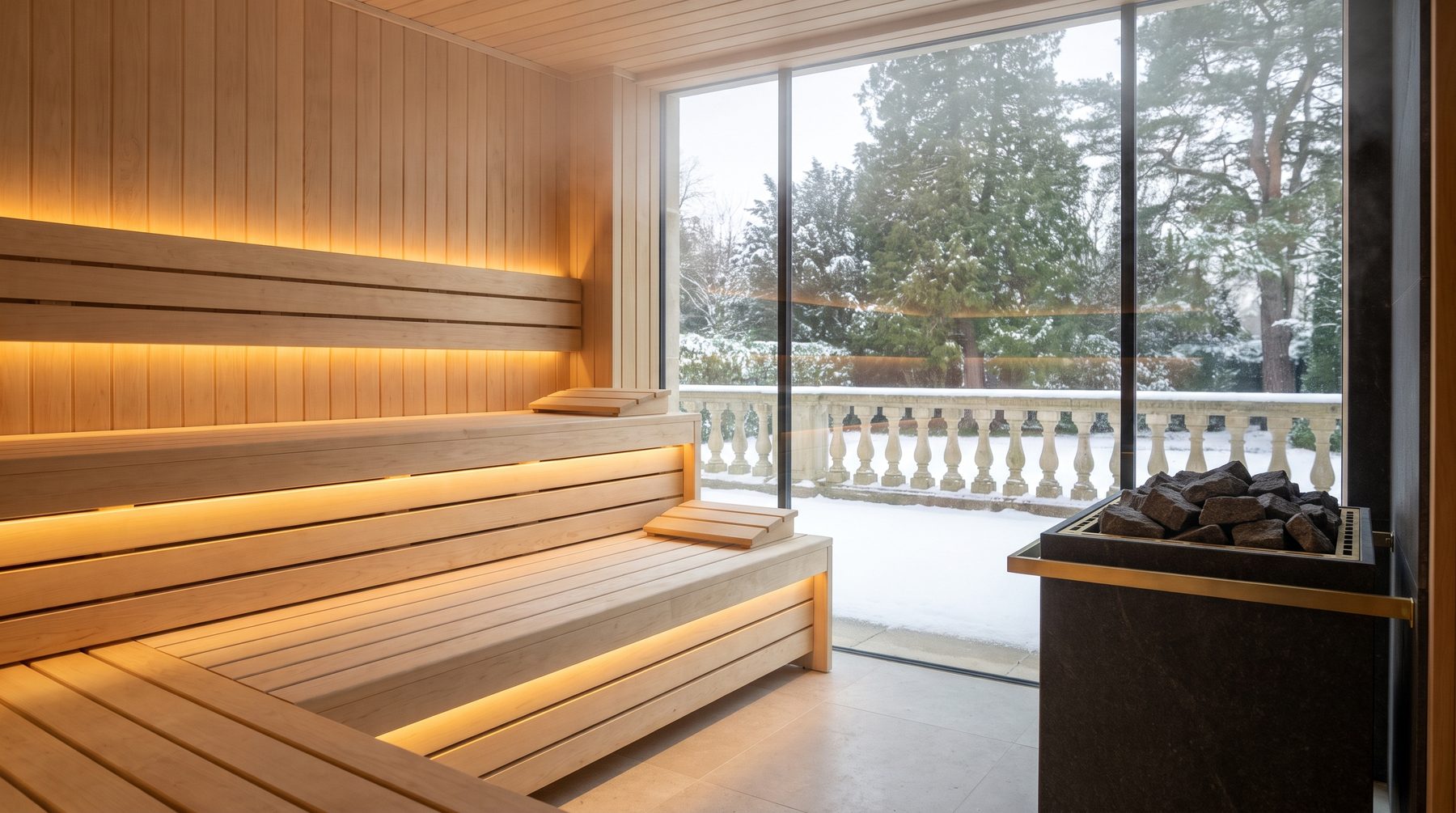
A home sauna design usually begins with a beautiful sketch: a glass wall, dark timber, light glowing under the benches. A month after the family moves in, the owner asks why the cabin feels stuffy and the changing room walls are wet. The answer is rarely the wood or the heater. It is the air, which nobody gave a path. A good home sauna rests on three things: how air enters the cabin, how heat is kept, and where the power for the heater comes from. Everything else, from the species of wood to the light fittings, comes second.
Plan the air before the wood
We once met a client who had already bought linden boards, a heater and a glass door before we saw the floor plan. The cabin sat in the middle of the lower level, between a plant room and a cinema, with no outside wall. Without an outside wall there is no simple way to take the exhaust out. We had to move a wall and rework part of the services. The wood stayed the same; three weeks and a good deal of money went on something a pencil could have solved at the plan stage.
Heater manufacturers such as Harvia recommend about six air changes per hour for an electric heater. With mechanical exhaust, the supply vent goes above the heater. With gravity ventilation, it goes below or beside the heater, and the exhaust sits near the floor, as far from the heater as possible. The incoming air must never blow on the heater’s temperature sensor, or the control will misread the room.
Size the heater with the glass in mind
The common rule is roughly 1 kW of heater power per cubic metre of cabin volume. That works for a timber-lined room with insulated walls. Glass changes the sum: Harvia counts each square metre of glass or other uninsulated surface as adding 1.2 m³ to the volume. A glass wall of 7.5 m² adds nine cubic metres, and a heater sized for a 6 m³ cabin suddenly needs to be almost twice as powerful.
On electrics, heaters of 3 and 4.5 kW usually run on a single phase. Anything stronger needs a three-phase supply, a dedicated circuit and a breaker matched to the heater. In a large house the supply is normally there; the problem is a distribution board that is already full.
Common mistakes in a home sauna
The first is building the cabin as big as the plan allows. A bigger room means a heater at its limit, high bills and still not enough heat. A smaller cabin plus a good lounge next to it works better. The second is glass nobody calculated: we like glass, but we do not like uncalculated glass. The third is waterproofing everywhere. A sauna is dry, but the shower, plunge pool and changing room around it are not, so we waterproof the shower zone and the threshold, not the whole floor. The fourth is picking wood from a catalogue. Linden, alder, cedar and abachi stay comfortable to the touch; pine and spruce can bleed resin when hot. Thermally modified wood is valued for stable shape and moisture resistance, but we ask for samples and test them before approving them.
Where to put a sauna in the house
Choose the spot by three tests: an outside wall for air, a wet-zone neighbour for the shower and plunge pool, and distance from bedrooms. In large houses we usually place the sauna on the lower level next to the pool, or in a separate wing with a door to the terrace. Keep the ceiling at about 2.1 to 2.3 metres: the taller the room, the more air you heat and the colder the lower bench.
How to care for a sauna
Good design makes care easy. Leave the door open after use so the cabin dries fully. Wipe the benches with a damp cloth and let them dry; do not varnish the benches or backrests, because varnish gets hot and sticky. Lift the slats now and then to dry the wall behind them, and check that the vents are free of dust. Design the cabin so that benches come out and every vent is within reach, otherwise a simple clean-up becomes a rebuild.
FAQ
How powerful should a home sauna heater be?
As a guide, about 1 kW per cubic metre of cabin volume. Each square metre of glass adds roughly as much load as 1.2 m³ of volume, so cabins with glass walls need extra power. Always check the manufacturer’s calculator for the final figure.
Do I need three-phase power for a home sauna?
Heaters of 3 and 4.5 kW can usually run on a single phase. Larger heaters need three-phase power, a dedicated line and a correctly rated breaker. Check spare capacity in the distribution board early.
How should a home sauna be ventilated?
Aim for about six air changes per hour with an electric heater. With mechanical exhaust, put the supply above the heater; with gravity ventilation, below or next to it, with the exhaust near the floor, far from the heater. Keep the incoming air away from the temperature sensor.
Which wood is best for a sauna?
Linden, alder, cedar and abachi are common choices because they stay comfortable to touch. Avoid resinous pine and spruce. For thermally modified wood, buy from a reliable producer and test a sample first.
Can a sauna have a glass wall?
Yes, but the heater must be sized for it. Glass loses heat, so calculate it at the design stage rather than after the heater is bought.

Author
Next step
Discuss your project
An hour at the studio with Oleg Reznikov: your site, your brief and relevant studio projects.