
Venetian Smalti Mosaic: A Wall That Changes Colour With the Light
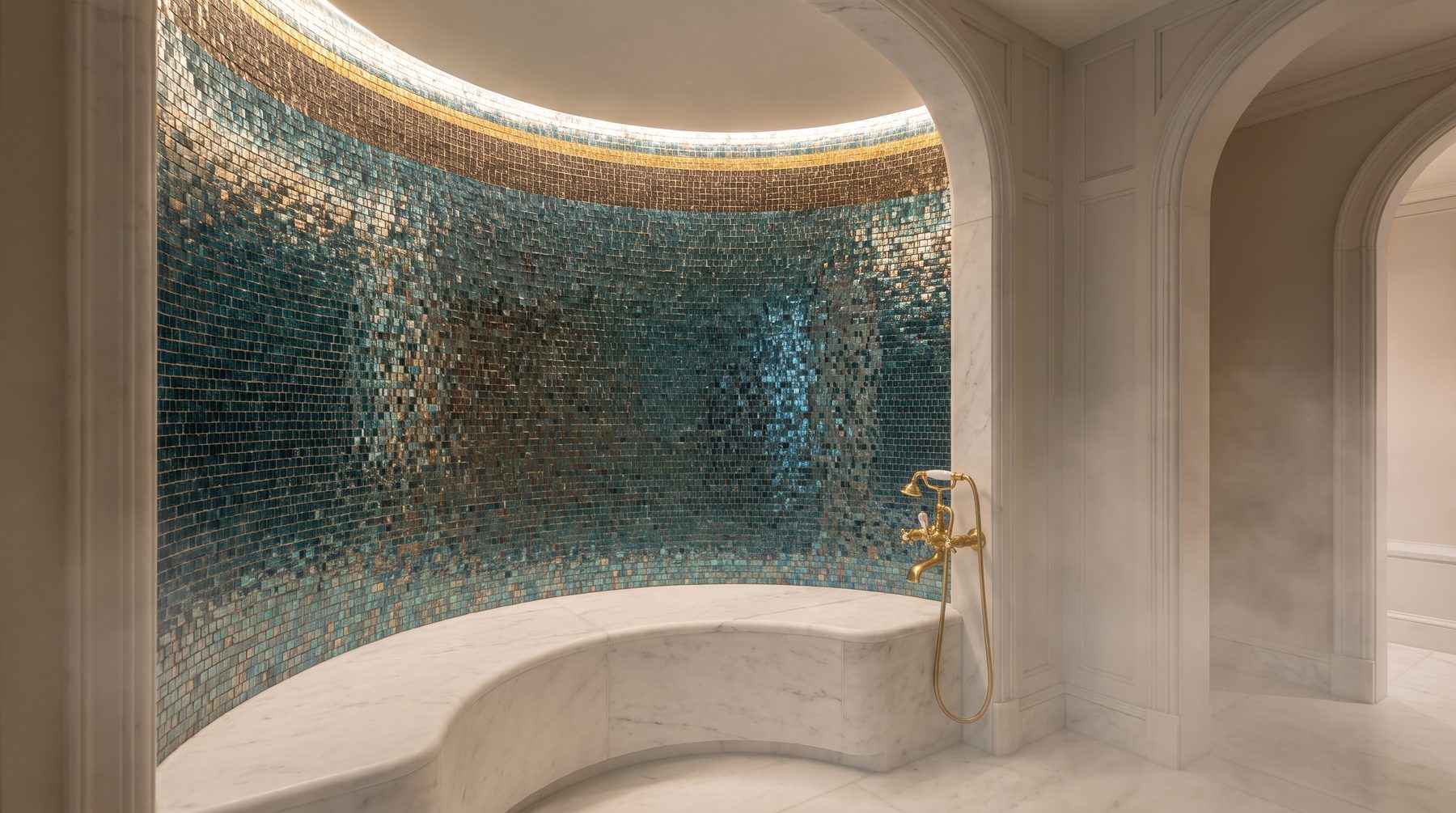
Smalti mosaic in an interior behaves like no other wall finish: the same surface reads deep sea blue in the morning, turquoise at noon and bronze by candlelight. Nothing is lit or filtered to achieve it. Every hand-cut piece of Venetian smalti catches light at its own angle, so the wall moves with the room. Below we explain how smalti differs from machine-cut glass and from marble mosaic, where it works in a private house, how to clean it, and which mistakes in the substrate and grout turn an expensive wall into a liability.
A wall that stopped being a surface
Finishes used to aim for flat, quiet and identical at any hour. Today clients ask for the opposite: a material that answers to light instead of absorbing it. Mosaic is the oldest and most honest answer. Byzantine masters set tesserae at slight angles on purpose, so candlelight would gather into a single glow across a dome.
Venetian smalti is still made with the same techniques. The Orsoni furnace in Cannaregio was founded in 1888. Glass is melted with colouring agents, cooled and cut by hand into tesserae, and the workshop itself credits that hand-cut edge for the shimmer that machine-cut tile cannot reproduce. Its public palette lists roughly three hundred base colours, plus a separate line of 24-carat gold. The same furnace worked on the restoration of St Mark’s Basilica and remains a working workshop rather than a museum.
For a private house this means one simple thing: smalti is not a tile and not an imitation. It has its own physics of light, and the room has to be designed around it.
Smalti, glass mosaic and marble mosaic: three different characters
Smalti. Opaque coloured glass with an uneven, hand-cut surface. The glint is alive and the colour has the depth of enamel. It is practically non-porous and unaffected by UV or frost, so it suits a hammam as well as an exterior niche. The price of that texture is that dirt and mineral film settle into the relief.
Glass mosaic. Factory chips on a mesh sheet: even, uniform, bright. The reflection is flat and predictable. It is a practical choice for a large pool or shower surface and is easier to clean than smalti because it is smooth, but it will not have the liveliness of smalti.
Marble and stone mosaic. A different logic: muted natural colour, pattern that comes from the stone rather than from light. Stone is porous and needs sealing and caution with acids. Beautiful in a fireplace surround or a bedroom, but it asks for discipline in wet areas.
Where smalti mosaic works in a house
We use it in a limited number of places, by design. Dense mosaic on every wall turns a house into an aquarium.
Hammam and steam room. The classic. Smalti does not absorb water, and gold and dark tones pick up concealed lighting beautifully. Fireplace niche. A small area with a large effect; the mosaic changes with the fire. Accent wall in a bathroom. One wall behind the tub or in the shower, with calm stone elsewhere. Plunge pool or pool. Smalti defines the colour of the water but demands flawless waterproofing.
Where not to use it: floors with heavy foot traffic, unless the product is specifically rated as floor mosaic.
Common mistakes
The material is rarely the problem. The substrate and grout are.
Skimping on waterproofing. Adhesive system manufacturers such as Mapei describe two-layer waterproofing with reinforcing mesh for wet areas. Mosaic itself does not let water through; the joints and the substrate behind it do.
Cement grout in a wet zone. It is porous, absorbs moisture and dirt and turns grey against bright smalti. Epoxy adhesive and epoxy grout are the standard for wet or submerged areas.
Epoxy left to cure on the face. Epoxy grout that hardens on the surface can only be removed with a dedicated gel remover, so the installer must clean it off before it sets.
Unfilled joints. An empty joint is a future mould problem. The wrong installer. Smalti is not tile; a crew with a wet saw will deliver a flat, lifeless result.
How to care for smalti mosaic: a practical checklist
Dust first with a soft dry cloth, so grit does not scratch the glass during wet cleaning. Then warm water and a microfibre cloth, with a pH-neutral soap-based cleaner if needed, free of ammonia, bleach and peroxide. Avoid abrasive pastes, scouring pads and steel wool. Acidic and alkaline cleaners can stain or etch glass and grout, according to glass-tile manufacturers. Test any new product on an inconspicuous spot.
For grout, brush regularly with a soft brush and mild detergent; in a shower, a baking-soda solution or steam every two to three months is a sensible rhythm. Cement grout should be sealed; epoxy grout does not need it. Smalti itself, like glass, is normally not sealed because it is non-porous. Good extraction in a shower or hammam protects the joints and the lighting far more than any product.
Colour and light: how to choose the shade
A sample in your hand and a three-metre wall live by different rules. North light pulls blue and green; warm evening light turns gold nearly copper. We review samples where they will hang, in morning, daylight and under the project’s evening lamps. Mixing two or three close shades in one wall keeps it from going flat, and gold works best as a band or frieze, not as a whole room.
Our approach
Mosaic cannot be picked from a catalogue at the last stage, after the sanitaryware is bought. We choose it by asking how the room looks through the day, set the layout to the room’s modules so a joint never lands on a niche edge, and order extra material, because smalti comes in batches and shades can differ slightly. The studio’s position is firm: mosaic is never rushed. The substrate is allowed to dry, a trial area is reviewed in real light, and only then does the main installation begin.
FAQ
What is the best way to clean smalti mosaic?
Warm water and microfibre, with a mild pH-neutral soap-based cleaner if needed. Avoid ammonia, bleach, peroxide, abrasive pastes and scouring pads, and test any new product on a small area first.
Does smalti need sealing?
Smalti itself, like glass mosaic, is normally not sealed because it is non-porous. Cement grout joints benefit from sealing; epoxy grout does not need it.
Why does the grout between mosaic tiles darken?
Cement grout is porous and absorbs moisture and dirt. Regular brushing with mild detergent, steam and good ventilation help; epoxy grout resists this far better in wet areas.
Can smalti be used in a hammam or shower?
Yes. It does not absorb water and is unaffected by UV and frost. It needs two-layer waterproofing with reinforcing mesh, epoxy adhesive and grout, a flat substrate and an experienced mosaic installer.
Is smalti suitable for floors?
Wall smalti is not designed for heavy foot traffic. For floors choose mosaic rated specifically as floor mosaic.

Author


Next step
Discuss your project
An hour at the studio with Oleg Reznikov: your site, your brief and relevant studio projects.