
Stained Glass in a Modern Home: Where Colour Works
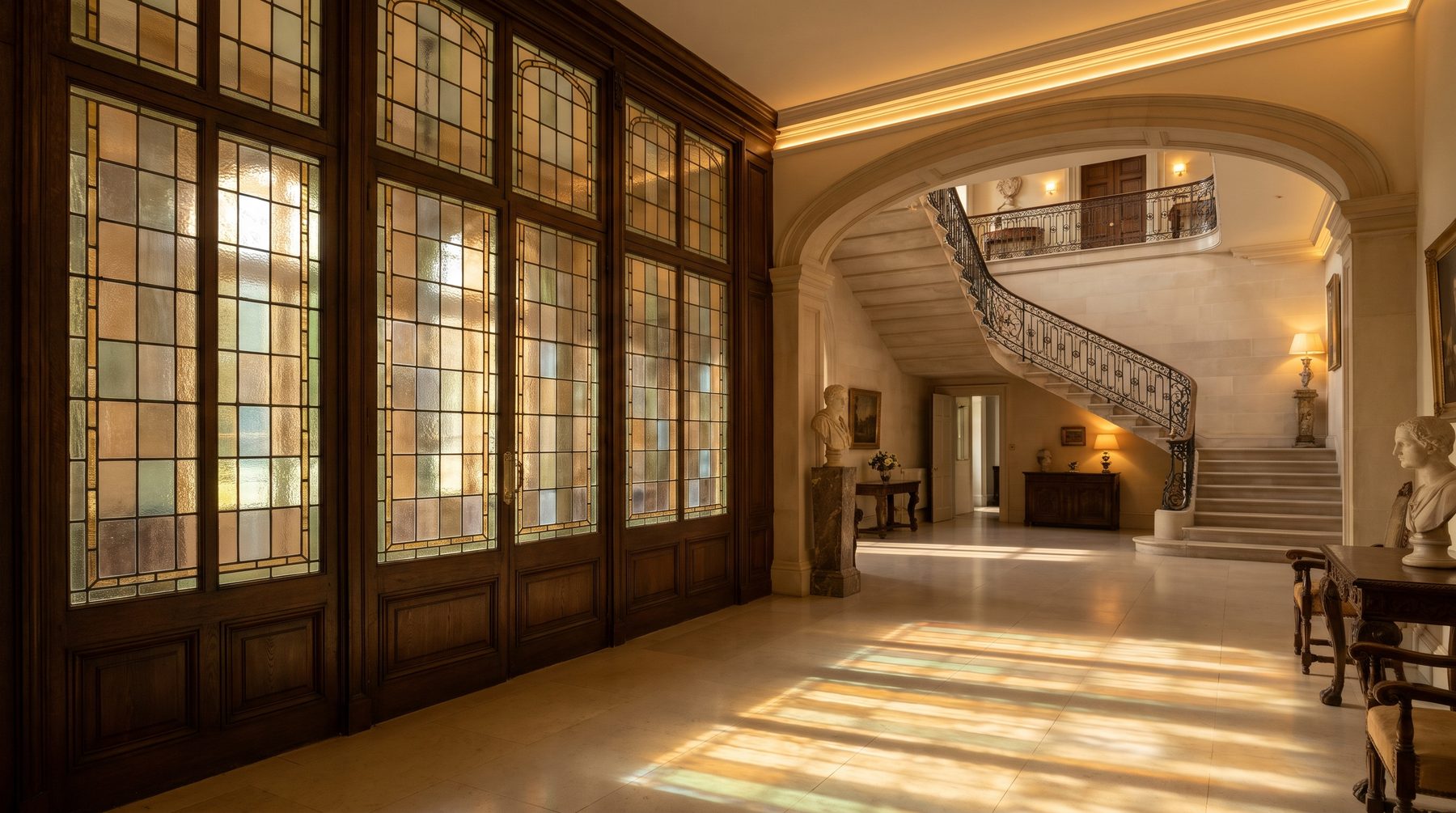
Stained glass in a modern home is back, but not the way you remember it: no leaded saints, no rose-and-tulip panel in a 1990s front door. Today it is a coloured screen between a hall and a staircase, a sliding door that lets light through and hides a study, a glass dome over a dining table. Here is where it works, where it turns into a chapel, and what has to be decided at design stage rather than after the finishes.
A few years ago we showed a client a hall scheme, and he stopped me on the slide with coloured glass: “Oleg, just not a church.” A week later he brought a photograph of a stained glass door from a Viennese townhouse and asked if we could do the same without the mosaic across half the wall. We could. But it had to be planned before the openings were cut.
Why stained glass is back in the conversation
Design press keeps saying the same thing. Livingetc asked back in 2022 whether coloured glass could draw us away from the Crittall-door look, and House Digest calls stained glass one of the old-school glass ideas returning in 2026, in light fittings, screens and entrances. Designers quote a simple argument: colour in glass gives a room character without painting a wall or committing to a big pattern.
The craft side agrees. A profile of Judson Studios, the oldest family-owned stained glass company in America, reports that about a third of its work now comes from private homes and commercial projects. Owner David Judson says he has never worked with interior designers as much as he does now, and that clients are leaning towards pale tints and earthy tones, not ruby and cobalt: colours that sit quietly next to limestone and oak.
Where stained glass works: screens, doors, light
The safest use is a stained glass partition. It separates an entrance from a living room, or a stair from a corridor, without cutting the space: light passes, silhouettes soften, colour moves through the day with the sun. Where privacy matters (a study, a dressing room, a spa) it does the job a solid wall would normally do.
Second, sliding or pocket doors. Judson calls coloured glass a “problem solver”: it adds colour, creates a screen between zones and filters light while keeping the plan open. Third, pendants and ceiling domes. Over a dining room or stair void, a glass dome gives at night what the window gives by day. The colour temperature of the light matters more than the pattern: warm 2700 K LEDs keep amber amber, while cool 4000 K turns any panel into a pharmacy sign.
Fourth, the entrance: sidelights and a fanlight over the door. This is the most “churchy” spot, so the design should be the most restrained: geometry, repeat, a gradient of two or three tints.
Technique: lead, copper foil, fusing
Traditional leaded glass joins pieces of coloured glass with lead strips. It looks graphic and suits a crisp line. The copper-foil technique, introduced by Louis Comfort Tiffany in the 1880s, wraps the glass edges in foil and solders them: thinner lines, and the ability to build three-dimensional shapes such as shades and domes. Glass fusing, melting layers of glass together in a kiln, gives smooth colour transitions with no soldered lines. According to Judson, fused work suits abstract, painterly designs, which are exactly what a contemporary interior wants.
On price, we will not invent Russian price lists. Judson reports a range of $400 to $1,500 per square foot for residential work and 10 to 12 weeks after design approval; the spread comes from complexity, the type of glass (machine-made or mouth-blown) and installation. These are American figures, but the order of magnitude is clear: this is a bespoke piece, priced like furniture or a chandelier, not like a finishing material.
Light, glass, safety: what to check before ordering
Orientation matters more for stained glass than for any other material. On a south side, coloured glass throws patches across the floor; on a north side, without artificial backlight, it reads dull and darker than the sample, so we pick lighter tints or opal glass. For doors and stairs, use toughened or laminated glass and replace open lead with fused monoliths. In an external wall, set the panel inside an insulated unit or behind a normal window with an air gap, otherwise it becomes a cold bridge with condensation. Choose a studio that supports the piece after installation, and keep the original drawings and glass codes.
Common mistakes
Adding stained glass at the very end: by then openings, door frames and partition loads are fixed. Judson notes that most residential frames are not built for stained glass, which is why the studio installs its own work. Colour without context: ruby glass next to warm limestone and oak panelling reads as a circus. Catalogue designs: grapes and birds age a house faster than cheap tile. And forgetting the evening: without backlight, a window turns into a black patch after dark.
How to care for stained glass
Use a soft cloth and a neutral cleaner, with no ammonia or abrasives. A panel set in an insulated unit is cleaned like any window. An open leaded panel deserves a check of joints and solder every few years. Keep a record of the glass codes so a single broken piece can be replaced without disassembling the whole panel.
Our approach: stained glass in a neoclassical house
Neoclassicism, with its symmetry and heavy openings, carries coloured glass surprisingly well if one rule holds: colour lives inside strict geometry. The panel sits in a door panel or an arch, repeats the module of the wall panelling and stays within the architrave. We plan it at the concept stage and treat it as a bespoke item in the procurement schedule. One piece per house beats three: choose the key sightline, usually the axis from the front door inward, and give the colour to that.
FAQ
Does stained glass suit a modern home, or only a classical one?
Both, if the design is geometric or abstract and the palette is quiet. Modern interiors favour fused glass with soft transitions of colour; classical houses gain from leaded grids that echo the panelling. Pictorial scenes suit neither.
Can stained glass go in a sliding door?
Yes, if the hardware is rated for the weight. The panel is laminated or built into an insulated unit and hung on reinforced runners. Decide this before the tracks are installed.
How long does a custom stained glass panel take?
Judson Studios reports 10 to 12 weeks after design approval. Expect at least two months from sketch to installation.
How do you clean stained glass?
A soft cloth and a neutral cleaner, without ammonia or abrasives. Panels in insulated units are cleaned like normal windows; open leaded panels need their joints checked every few years.
Architect Oleg Reznikov and his studio design interiors and houses of this kind. If you are considering coloured glass for your own home, write to us and we will go through the plans together.

Author
Next step
Discuss your project
An hour at the studio with Oleg Reznikov: your site, your brief and relevant studio projects.