
The Garden That Grows Up With the House: Why Landscape Is Designed for Twenty Years
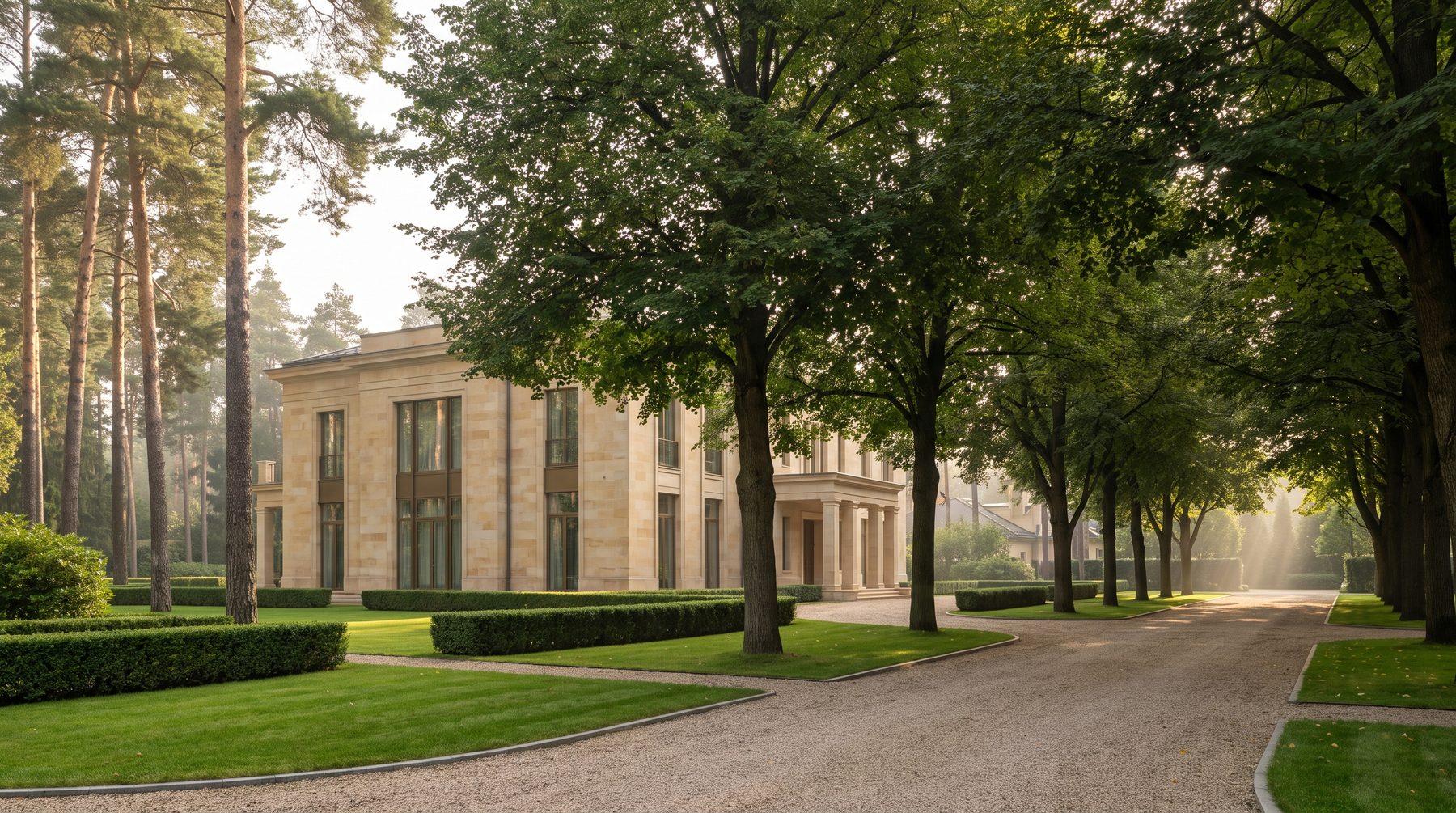
A house can be built in three years. A garden cannot. It is the one part of an estate where money does not convert directly into time, and that is precisely why the garden keeps losing its place in the queue: foundation first, then the facade, then the interiors, and the land around the house — “once we’re finished”. By the time the house is ready, the grounds are compacted clay, cut by trenches and stacked with leftover blocks. And then the rush begins: turn a construction site into a park in a single season.
There is a simple rule we repeat at every first meeting: in a landscape design project for an estate, trees are planned before the paths, the lighting and the garden structures. Before the facade stone is chosen. Sometimes before the building footprint is finally fixed.
Because a house is an object. A garden is a process stretched across two or three decades, and no chequebook accelerates it. You can only start on time.
Three Years for the House, Thirty for the Garden
Twenty years of construction practice have trained the wealthy client to believe that speed solves everything. Modular technologies, parallel processes, ready-made interior packages. A 1,200-square-metre country house can realistically be commissioned in 30 to 36 months, and that is no longer a feat but an industry standard.
With plants the logic collapses. An oak adds 50–60 centimetres a year and only reaches its adult form at twenty to thirty. A linden grows at roughly the same pace. Scots pine climbs actively between the ages of five and twenty, yet in the first four years after planting it puts on a mere 10–50 centimetres in total — it is busy with roots, not with the crown. Fast growers — poplar, birch, larch, willow — gain about a metre a year, but they pay for that speed with longevity: they are the first to age, the first to break under wet snow, the first to need replacing.
Hence an uncomfortable conclusion. Plant a sapling in 2026 and the shade you wanted it for arrives closer to 2040. The owner will see the garden fully grown at an age when the children are already bringing grandchildren. This is why serious landscape is the only part of an estate designed not for the client, but for the next generation of the family.
But this is where it gets interesting. The moment you accept a twenty-year horizon, the entire logic of decision-making changes: not “what shall we plant to look good by July”, but “what structure of this land will survive a change of generations, tastes and functions”.
Landscape Design Starts Before the Foundation
The most expensive mistake on a site is not made at planting. It is made the moment the first excavator arrives without a plan for the land.
The topsoil is stripped and lost. Heavy machinery compacts the ground to a density roots physically cannot penetrate. Spoil from the pit lands exactly where the grove was meant to be. Drainage is engineered for the house rather than for the grounds, and two years later water collects precisely where the conifers were planted — and pine does not survive standing water.
That is why grading, drainage, storage zones and machinery routes belong to construction preparation, not to the landscape stage. By that same point the utility routes must be resolved: irrigation mains, exterior lighting cables, connection points for fountains and the pool. Laying engineering systems after the large trees are in means digging between roots by hand, or cutting them.
A full landscape package includes the master plan of the grounds, a planting plan with a schedule of species (variety, height, trunk diameter and age of every specimen), a setting-out drawing, and layouts for paving, grading, drainage, irrigation and lighting. A minimal master plan in the Moscow region starts at around 28,000 roubles; a comprehensive project for large grounds begins at one and a half million and rises from there. Against the budget of a mansion this is a rounding error. Against the cost of the mistake it prevents, it is insurance.
The Arithmetic of a Grown Tree
There is a way to buy time — semi-mature transplanted trees. An adult specimen with a prepared root ball is delivered and planted fully formed: not in fifteen years, but this December.
The method works, though not the way people imagine. A few numbers worth knowing before you talk to a contractor.
Survival rates are best for trees under eight metres. Anything taller establishes worse and costs more: the root ball gains mass faster than the crown, the machinery required is heavier, the risk of loss is higher. Gigantism on a private estate is punished by statistics.
Planting happens in winter, from December to March. A frozen root ball survives transport intact, and a dormant tree tolerates the move far better. Summer planting of a mature specimen is almost always a compromise dictated by deadlines — and almost always a shortening of the tree’s life.
Aftercare runs two to three seasons. Scheduled irrigation, shading, guying, pest treatment, monitoring of the root zone. A tree counts as established not when it stands upright, but when it puts on normal growth in its third year.
Prices span two orders of magnitude. The planting work alone starts at about 3,000 roubles per tree and reaches 7,500 and beyond depending on the size of the ball and machine access. A coniferous semi-mature specimen as planting material starts near 14,000 roubles, while shaped pieces — garden bonsai pines, one-off topiary forms — pass 600,000 roubles per tree. The spread is explained not by species but by the years a nursery invested in root pruning and shaping.
That is what you actually pay for: not timber, but someone else’s patience. A nursery that has transplanted a tree every two or three years for a decade to build a compact root ball is selling you ten years of its own labour. It is a fair trade, and it is always more expensive than it first appears.
Three Myths That Cost Real Money
Myth one: “We’ll plant a grown forest and get a finished park.” You will not. A transplanted mature tree does not grow for the first two or three years — it rebuilds a root system that lost most of its volume when it was lifted. While the young sapling beside it puts on height, the mature specimen stands still. Within twelve to fifteen years the difference between them becomes indistinguishable. A transplanted tree buys not a permanent advantage but the first decade of life in the house — which, incidentally, is a perfectly good reason to buy it.
Myth two: “Conifers are forever, they need nothing.” Conifers are acutely sensitive to groundwater levels, to salt from de-icing agents near the entrance gates, and to spring sun scorch. We have seen estates where a row of blue spruce along the drive turned into rust-coloured skeletons within five years, simply because the road was cleared with salt each winter.
Myth three: “Landscape means planting.” Planting is the last of seven stages. Before it come survey, drainage, grading, utilities, surfaces and retaining structures. A garden that begins with buying plants always gets rebuilt — the only question is whether in year two or year five.
Mistakes That Surface a Decade Later
The good news about landscape mistakes is that they are invisible at first. The bad news is exactly the same.
The distance from an external wall to a tree trunk should be no less than five metres. To utilities — water, sewage, gas, power cable, irrigation lines — no closer than two metres, and for aggressive rooters such as beech or ash, no closer than four. The roots of fast-growing species spread eight to ten metres within a few years and can dry out the ground beneath a foundation enough to trigger uneven settlement. This is not an internet horror story: root damage to a structure is a decade-long process, but it starts the year the tree goes in.
Here is where most people get it wrong. A birch or a willow is planted where it looks good today: by the terrace, by the pool, outside the study window. Eight years later the willow lifts the terrace paving, the birch fills the storm drains with leaves and seed, and its roots find the drainage pipe and grow into it. Removal costs more than the planting did — and always comes with the same conversation: “nobody told us”.
Lighting deserves its own paragraph. Exterior schemes are designed for today’s crown size, and ten years on the uplight that dramatically grazed a young pine sits inside a dense canopy, warming branches. In our projects the exterior lighting nodes are set with spare offset and the ability to be repositioned — it costs almost nothing during construction management and is impossible to add later.
Our Approach: Landscape Design in Three Layers
We divide the grounds of an estate into three layers with different life cycles. We did not invent this — every old European estate works this way; there it simply happened by itself, over two hundred years.
Layer one: the frame that does not change
The large trees that define the silhouette of the land, the main axes, the boundaries, the perimeter grove, the allée to the house. This layer is designed for thirty to fifty years and is effectively not up for revision. Only long-lived species belong here: oak, linden, pine, Norway maple. This is where buying semi-mature trees makes sense — the frame has to read from the first year, otherwise the house stands in a field.
Layer two: the structure that matures in 10–15 years
Hedges, bosquets, shrub groups, the orchard, the parterre. This layer creates the “rooms” of the grounds and governs privacy. It tolerates adjustment: a hedge can be re-shaped, a group thinned. Here it is worth planting young material — cheaper, better establishment, and within a decade it catches up.
Layer three: the seasonal one, replaced every 3–5 years
Perennials, grasses, flower beds, container compositions at the entrance. The layer of mood and fashion. It is meant to change — and it is a good sign when the lady of the house wants to redo it: it means the garden is alive rather than a museum piece.
This division resolves the central conflict of landscape work — between the wish to see a result today and the obligation to a tree that will outlive everyone involved in the project. The first layer answers for permanence, the third for pleasure this season.
On one of our estates near Moscow the client initially wanted 2.4 hectares closed in a single season, “like Meiendorf”. We persuaded him into a different scheme: mature trees only along the entrance allée and at three view points from the house windows — 22 trees instead of the hundred and fifty first discussed — with the rest of the grove planted as young stock. The saving came to roughly 60% of the landscape budget, and by the fourth year the difference between the zones was no longer readable from the terrace. The same logic runs through our Meiendorf Gardens project: what works is not the number of trunks, but the precision of their placement.
A Garden as an Asset, Not an Expense
Internationally, mature trees stopped being decoration long ago and are counted as part of an asset’s value: established trees on a property can add up to 15% to what it is worth, and spending on their care returns almost in full at resale. The 2026 trend in luxury landscape is phrased almost as an investment strategy: the question has shifted from “how much more can we add” to “what will create an environment that outlives us”.
Hence the return of slow-growing species, the interest in structural planting that performs across all four seasons, and the retreat from spectacle that demands constant servicing.
The Russian market is arriving at the same place from another direction. The second generation of owners of estates outside Moscow — those inheriting the house from their parents — are the first to judge a property not by its area but by the age of its garden. A house can be rebuilt, interiors can be replaced, equipment will be obsolete within a decade, as will any finish material. A thirty-year-old lime allée cannot be reproduced at any price. It is either there or it is not.
That is the real meaning of a garden growing up alongside a house. Not a horticultural metaphor, but a property fact: the only element of an estate that does not depreciate with the years but appreciates.
What If the House Is Already Built
This is the situation we meet most often: the house is finished, the grounds are trampled, and the client wants a garden immediately.
The sequence that works looks like this. First, an honest assessment of the soil — compaction, groundwater level, composition. Then restoration of drainage and topsoil, which as a rule takes a full season with not a single plant going in. Only then the frame: mature trees in winter, at the correct distances from the house and the utilities. And only in the third season the thing it was all for — beds, parterre, lighting.
A year of “empty” grounds is psychologically hard to endure. The alternative is to sink several million into dead soil and watch it yellow three years later.
If you are at the stage where the house is still on the drawing board, you hold a rare opportunity: to set the garden before the construction machinery decides the topography for you. It is the cheapest and most underrated move in the entire project. Come and talk about the grounds before the pit is dug — we will take the site apart layer by layer and show you how it will look in year five, year ten and year twenty.

Author
Next step
Discuss your project
An hour at the studio with Oleg Reznikov: your site, your brief and relevant studio projects.