
An Instant Garden: The Truth About Planting Mature Trees
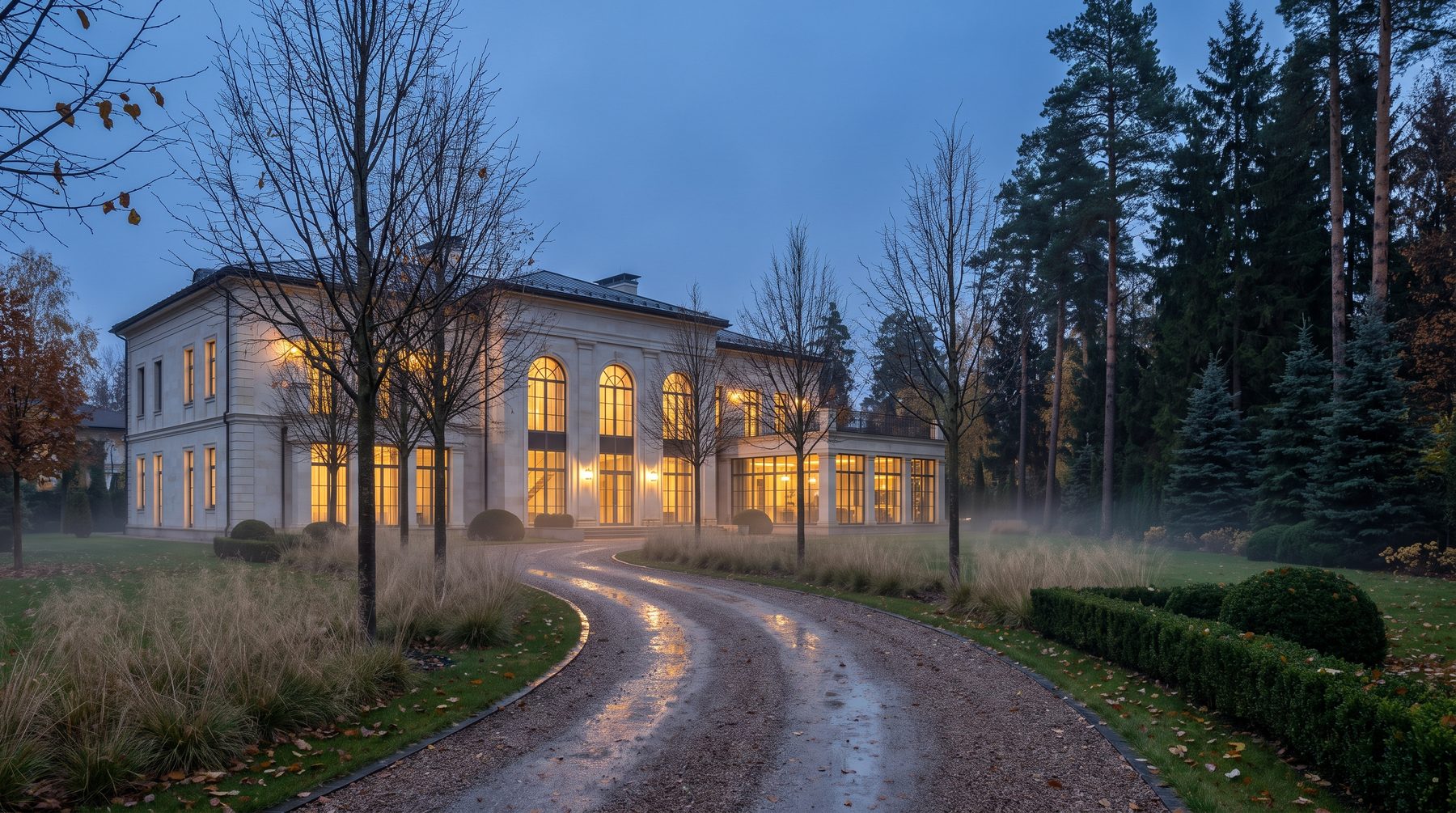
Planting mature trees in autumn is not the purchase of a finished garden — it is the start of a season that runs until March. Full-grown trees can only be moved while dormant, with a root ball weighing a tonne and a half or more. Done properly, survival rates reach 90–95%; move the same tree in summer and it drops to 50–70%.
A house can be built in three years. An interior can be assembled in eighteen months. A garden cannot be grown for any amount of money: it grows at its own pace, and that pace is entirely indifferent to the client’s budget. Which is precisely why mature trees have become the most honest currency in country living — they are the one thing that cannot be accelerated, only transported.
The only product that sells time
When a client first sees the site after grading, they see a field. Level, drained, with retaining walls and a hardstanding for the entrance — and completely bare. The house is finished, the facade is done, and around it lies a lunar landscape. At this point the same question comes up almost every time: “Can we have big trees straight away?”
You can. That is exactly what you are paying for.
A mature specimen tree is more than a tall plant. Formally the category starts at three metres; in practice, on private estates we are talking about conifers of six to nine metres and deciduous trees with trunk girths of 20–35 centimetres. A pine like that spent fifteen or twenty years in a nursery. You are not buying timber or a crown — you are buying two decades that somebody else lived through for you.
And here is where it gets interesting. This is the only line in a landscape budget where paying more for size is justified biologically rather than emotionally. Paving will still be paving in ten years. A pine will be a different tree.
Why the planting season opens only after leaf fall
Transplanting a grown tree is a controlled injury. However carefully the machinery works, part of the root system stays behind in the nursery soil, and the first casualties are the fine feeder roots through which the tree drinks. While the crown is still active and transpiring and the roots are out of action, the tree dehydrates within days.
Hence the only viable window: dormancy. It opens in October, once the leaves are down and sap flow has stopped, and holds until March. Inside that corridor the tree experiences the move as sleep rather than as surgery without anaesthetic.
Autumn and winter play different roles inside that window, and it is worth understanding this before you sign off a schedule.
October to November: containers and mid-size specimens
The early part of the season suits container-grown stock and trees of moderate calibre. The ground is still warm and unfrozen, roots have time to establish before the cold, and machinery can reach the planting positions without sinking. Container-grown plants at this point deliver survival rates close to 100% — their root systems are never disturbed at all.
December to March: the season for genuinely large trees
The largest specimens travel only over frozen ground. The reason is prosaic: above freezing, a root ball of the required size simply falls apart during lifting, whereas a frozen one holds together like a monolith. Frozen soil also carries the loader crane and the mobile crane that in summer would leave half-metre ruts across the site.
So “a grown garden in a single autumn” is a marketing simplification. The honest version: a garden is established in one season, and that season begins in autumn and ends in March.
The root ball: why a tree weighs as much as a car
Everything that happens on site during a mature tree planting is dictated by one parameter — the root ball. The industry rule of thumb is straightforward: roughly 10 centimetres of ball diameter for every centimetre of trunk diameter, with sources quoting a range of eight to twelve. A tree with a 30-centimetre trunk girth ends up with a ball around a metre across and 60–80 centimetres deep. In private practice, balls run from 0.8 to 2 metres in diameter.
That volume of soil weighs a tonne and a half and upwards. A five-metre pine weighs about as much as two refrigerators; its root ball weighs as much as a small car. Everything else follows from that: a loader crane on site, a mobile crane for anything above six metres, an access road capable of carrying the machinery, and a clear corridor to the planting position with no low cables and no freshly laid paving.
The ball is wrapped in hessian and wire mesh — and that wrapping is not removed when the tree goes into the pit. It holds the soil around the roots at the moment of lowering, and within a year or two the roots break it down themselves. The tree is then secured with underground anchors in the pit and guy wires above ground: even an established transplant holds the soil less firmly than a tree that grew in place, and one good November storm is enough to bring it down.
Nursery or forest: where mature trees actually come from
This is where most people get it wrong, and get it wrong expensively.
A nursery tree is grown from the outset with the future move in mind: its roots are undercut periodically, the plant is lifted and replanted several times, and the root system develops compact and densely branched, fitting entirely inside the ball. Planted in winter, such a tree establishes at 90–95%.
A forest specimen lived differently. For thirty years it sent structural roots several metres sideways with almost no fine branching. Lifting it whole is impossible — only a fraction of the roots make it into the ball and the rest is cut off by the excavator blade. Survival for these trees runs at 60–80%, and that is with good execution. On top of that, a forest tree grew inside a closed stand where its neighbours sheltered it from wind and sun; moved onto an open site, it frequently scorches during the first February thaw.
The price gap between a nursery tree and “we’ll bring one in from the forestry, half the cost” is precisely the sum you pay for probability. In one case you are buying 95%; in the other, 60%.
What a grown tree really costs
The nursery price list accounts for roughly half of the real figure. Benchmarks for the 2026 season around Moscow look like this.
A four-metre spruce: 25,000–45,000 roubles for the tree itself, 12,000–18,000 for delivery, 15,000–25,000 for turnkey planting, 8,000–12,000 for a one-year guarantee. Total: 60,000–100,000 roubles. A five-metre pine comes to 80,000–140,000. A six-metre lime runs 120,000–230,000 roubles for a single tree. A loader crane adds 12,000–25,000, and anything above six metres needs a separate mobile crane.
Now multiply by quantity. A conifer screen along the boundary of a one-hectare plot is not three trees but eighteen to twenty-five. An avenue along the drive adds another dozen limes or maples. The real budget for an instant garden on a large estate comfortably passes ten to fifteen million roubles — before lawn, shrubs, irrigation and lighting.
The guarantee deserves its own line. Companies offering one or two years of establishment cover include not only replacement but mandatory aftercare: scheduled watering, root-stimulant treatment, remedial pruning. Without that aftercare the guarantee usually lapses, and fairly so — most transplanted trees die not on planting day but the following summer, once everyone has forgotten about them.
Five myths that cost clients real money
“The bigger the tree, the better the result.” The opposite. The older the plant, the worse it tolerates the move and the longer it sits in shock. A twelve-metre spruce may put on no growth for three years and look worse than a seven-metre one planted beside it on the same day.
“Plant it and it takes care of itself.” The first year after the move is the most dangerous of the tree’s life. It needs watering calibrated to the volume of the root ball rather than five minutes with a hose, mulching around the trunk, shading of the needles against February sun, and feeding aimed at roots rather than crown.
“Winter planting is cheaper.” Winter planting is safer. It is never cheaper: frozen ground, machinery, warming the pit and insulating the ball all add to the budget rather than subtract from it.
“We’ll do the garden after construction.” The most common and most expensive mistake. By the time the house is finished the site is wrapped in paths, the services are laid, and access to the far end of the garden is blocked by a pavilion. There is nowhere left to bring a twenty-tonne crane.
“Everyone guarantees establishment.” Guarantees apply to a plant from the contractor’s own nursery, planted by their own crew, under a maintenance contract. Nobody will guarantee a tree the client bought independently — and that is honesty, not greed.
Our approach: the garden is drawn alongside the house
We fix the positions of mature trees at masterplan stage, before any machinery arrives for the excavation. The reason is engineering rather than aesthetic: a future tree position is a zone where underground services cannot run, where soil must not be compacted under machinery, and where topsoil has to be preserved. During construction preparation we record those footprints in the site organisation plan together with the temporary roads — the same roads the tree crane will later use.
The second layer is engineering services. Irrigation, drainage and buried lighting cables go in before planting, not after: digging a trench a metre from a fresh root ball means cutting the very roots whose establishment you paid for. In the building services package we route irrigation, storm drainage and exterior lighting around the planting positions rather than the other way round.
One example from practice. On a 1.2-hectare site on Novaya Riga, the client wanted the neighbouring house screened out within a single season. We planted twenty-three spruces of six to seven metres in February, over frozen ground — the machinery came in along a temporary road that had been part of the construction organisation drawings from the start. Of the twenty-three trees, one failed and was replaced under guarantee the following winter. By the third summer the screen had closed and the neighbouring house had vanished.
And a counter-example. Another estate, trees bought by the client directly from a forestry operation and planted in April once the buds had already broken — “the ground has thawed, so we can”. Of fourteen pines, six were alive by August. The initial saving was around four hundred thousand roubles; replanting cost roughly two and a half million.
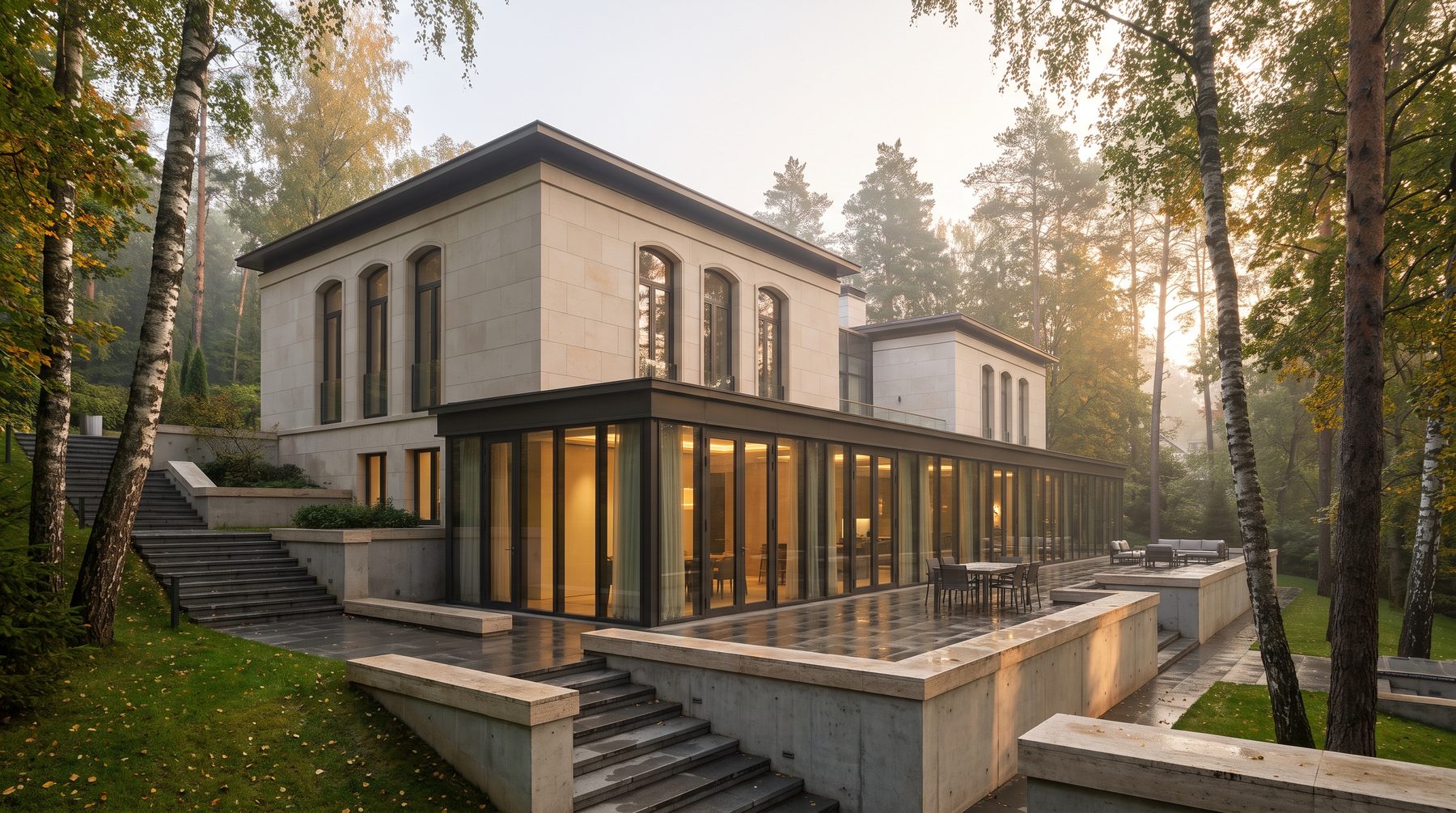
What it looks like when the garden is designed alongside the house can be seen on our projects — for instance the residence at Sady Mayendorf and the house at Petrovo-Dalneye, where mature planting reads as part of the architecture rather than scenery delivered at the last minute.
What remains after the first season
A grown tree that has survived a move does not behave like a young sapling. For the first two years it puts on almost no growth — all its energy goes downwards, into rebuilding the root system. The crown may thin slightly and the needles dull. This is not disease; it is the price of moving through time.
In the third year the tree returns to its normal rhythm. And that is when the garden stops being a project and becomes a place. The shade that falls across the terrace in July. The sound of wind in canopies that were not there before. The sense that the house has stood here for a long while.
That, in the end, is what people pay for: not the trees, but the absence of that new-build feeling.
If you are planning construction and know the garden will have to be established in the coming season, the conversation is better started now, in August — tree layout, machinery access and irrigation routing are resolved on paper in a few weeks, not in December with a crane already at the gate. Write to us and we will look at your site together.
Frequently asked questions
When is the best time to plant mature trees?
The optimal window runs from October to March, while the tree is dormant. Container-grown stock and mid-size specimens go in during October and November over warm ground. The largest trees above six metres are moved only over frozen soil, between December and March: a frozen root ball does not disintegrate during lifting and the machinery does not tear up the site.
What survival rate can I expect from a transplanted tree?
Winter planting of nursery-grown stock to correct technique gives 90–95% establishment. Container-grown plants approach 100%. Forest trees lifted without prior root preparation establish at 60–80%, and summer transplanting of any mature tree drops the figure to 50–70%. Season and root preparation matter more than species.
How much does it cost to plant a grown tree turnkey?
Around Moscow in the 2026 season a four-metre spruce costs 60,000–100,000 roubles including delivery, planting and a one-year guarantee. A five-metre pine runs 80,000–140,000 and a six-metre lime 120,000–230,000 roubles. Machinery is billed separately: 12,000–25,000 for a loader crane, with a mobile crane required above six metres.
Why do transplanted trees die a year after planting?
Almost always because of aftercare rather than the planting itself. A transplanted tree loses its fine feeder roots and cannot source water independently through the first season. Without regular watering matched to the root ball volume, mulching and protection of the foliage from spring sun, it burns through its reserves and dies the following summer — usually after the guarantee has expired.

Author

Next step
Discuss your project
An hour at the studio with Oleg Reznikov: your site, your brief and relevant studio projects.