
Rublyovka or Novaya Riga: Where to Build Your House
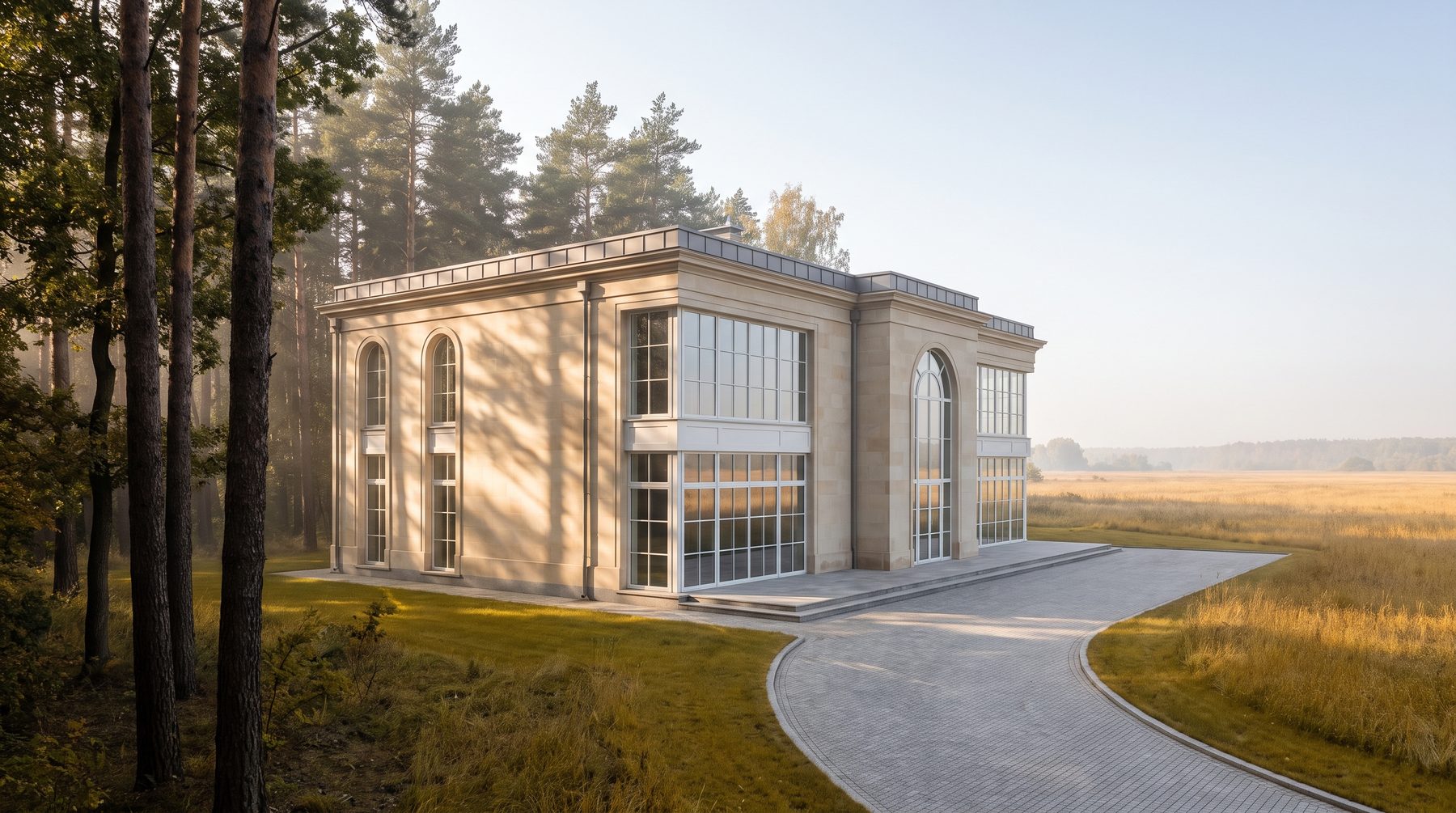
Rublyovka or Novaya Riga is not a choice between two highways. It is a choice between two ways of living outside Moscow. Rublyovka sells an environment that already exists: forest, terrain, water, established neighbours — and, almost always, a plot with a house due for demolition. Novaya Riga sells freedom and speed: level land, a wide road, and the right to build without inheriting somebody else’s thirty years.
We watch the same scene play out every season. A client arrives with the decision already made: “we are only looking at Rublyovka”, or “we are definitely going to Novaya Riga”. The decision took two weekends, a friend’s advice and a drive-time estimate from the office. And then it turns out that the house this person describes in words cannot be built on the chosen plot. Not because it is forbidden — because the landscape, the regulations and the logistics dictate a different architecture.
The direction is the first design decision of the project. Not an estate agent’s decision, but an architect’s. And it is almost always made before the architect is invited.
Two landscapes, not two addresses
Rublyovo-Uspenskoye is old estate country. Pine and oak woods, the bends of the Moscow River, real changes in level, plots carved out of the forest back in Soviet times. Most settlements here stand in the shade of mature trees or along the water. The land was cut irregularly, following the clearings and the slopes rather than a grid.
Novaya Riga is a different breed of land: former farmland, wide horizons, flat plateaus and the ten-kilometre view you almost never get on Rublyovka. Its settlements were built in the 2000s and later, from a clean sheet, in large blocks. Hence the canals, the artificial lakes, the parks — the environment here was not inherited, it was designed. Millennium Park, at the 19th kilometre of Novaya Riga, is the clearest example of that logic: eleven man-made canals, roughly ten kilometres of tree-lined avenues, five parks. Here the landscape is a product, not a given.
But this is where it gets interesting. A mature forest cannot be bought, only inherited. An open field, on the other hand, can be planted — it simply takes twenty years, or a great deal of money. Each direction sells you time in a different currency: Rublyovka sells time that has already passed, Novaya Riga sells a future you will pay for yourself.
The road: forty minutes you will repeat ten thousand times
The transport logic of the two directions is the exact opposite. Rublyovo-Uspenskoye is a narrow historic road — two or three lanes, traffic lights, checkpoints, limited capacity and almost no room to widen: there is private land and forest on both sides. In exchange, the first settlements begin immediately beyond the city ring, at the fifth to tenth kilometre.
Novaya Riga is the M-9 Baltia motorway, one of the widest and most modern signal-free routes in the Moscow region, and toll-free along its regional stretch. It continues to grow: under the federal programme for the M-9, the section from Volokolamsk towards Rzhev is being widened from two lanes to four, with a forty-kilometre stretch opened at the end of 2025. Speeds are higher here — but the premium settlements sit further out, between the 19th and 35th kilometre.
This is where most people get it wrong. They compare kilometres and free-flow travel times, but they will be living this route on Friday evening and Monday morning. On Rublyovka the jam is short, inevitable and daily: it is structural, written into the geometry of the road. On Novaya Riga traffic moves more freely, but the leg is longer, and a single accident at the edge of the city turns forty minutes into an hour and a half.
The practical advice we give everyone: drive the route from the plot to your actual office or school four times — Monday at 8:15, Friday at 18:30, Sunday evening, and once during snowfall. That is the only honest test. Everything else is marketing arithmetic.
The plot: forest and terrain versus field and horizon
For an architect the difference comes down to one sentence: on Rublyovka we almost always work with constraints, on Novaya Riga with a blank sheet.
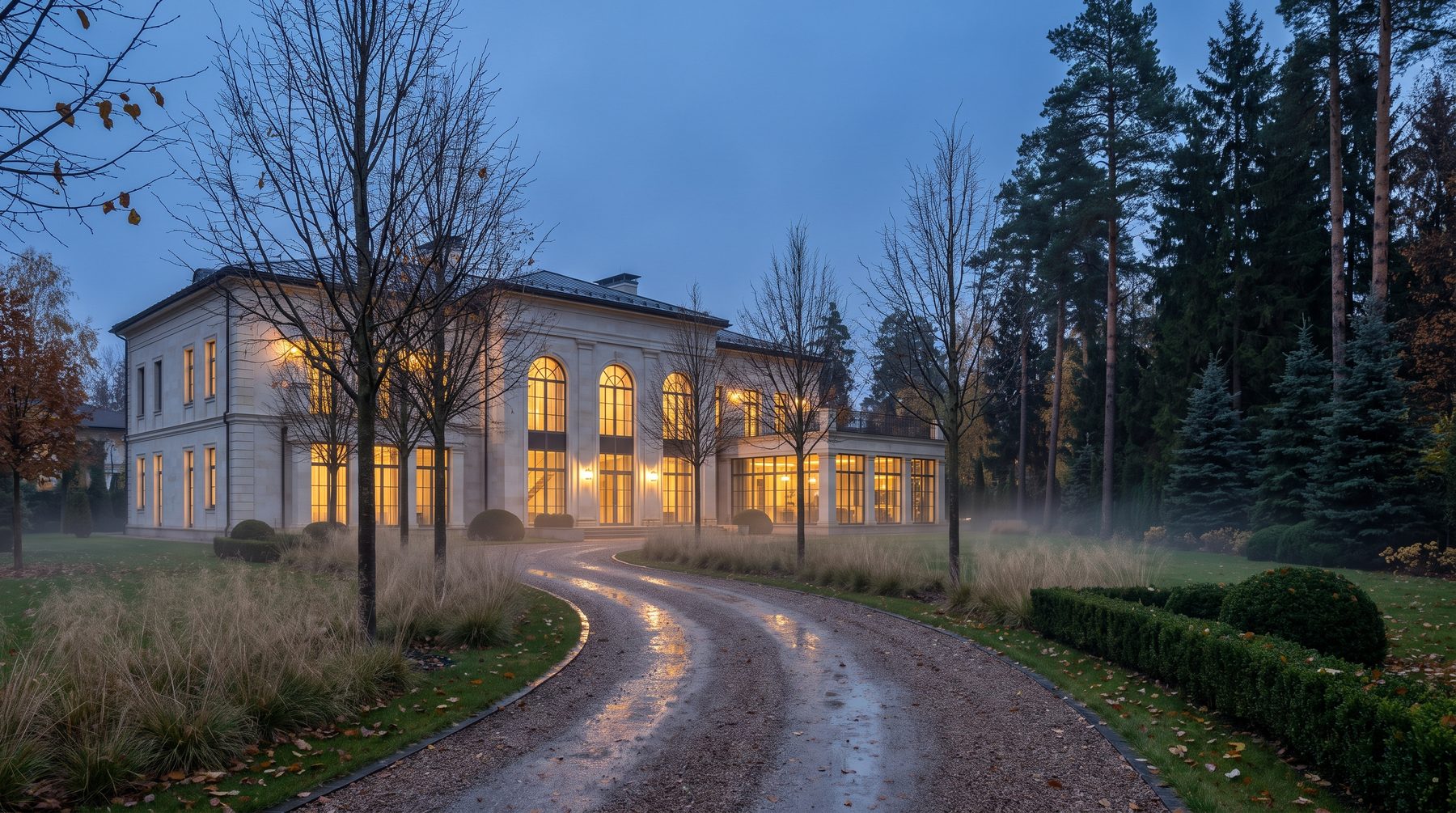
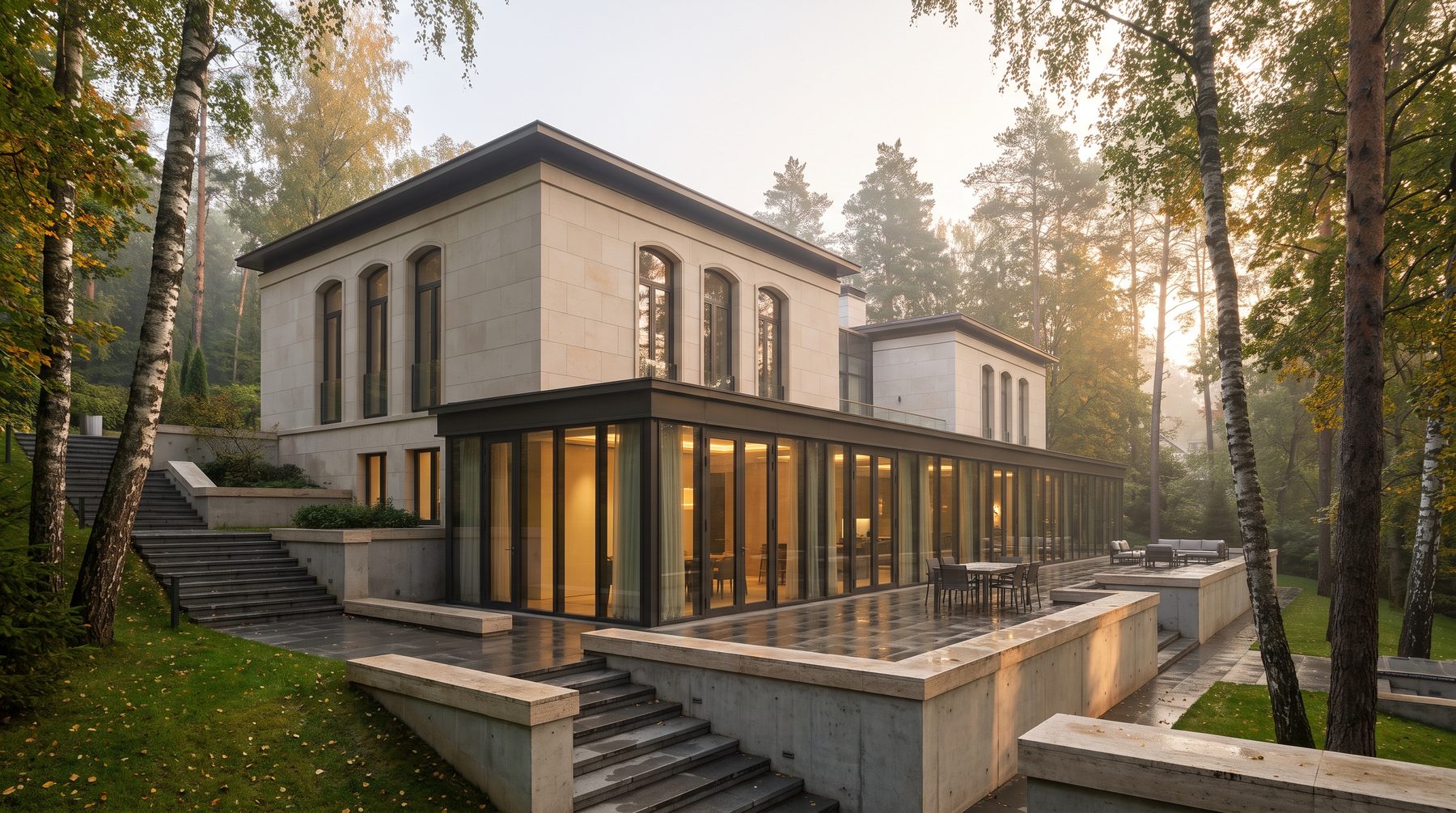
A Rublyovka plot is typically 20 to 50 sotkas of irregular shape, with mature pines that must not be touched, a change in level, a neighbour’s fence five metres away and established points of access. The building footprint is assembled metre by metre: work around the root systems, avoid facing the neighbour’s terrace, pull the main windows towards the gap between the trees. The house ends up complex in plan, often opening inwards and closing itself off from the street. That is exactly how our project in Sady Mayendorf works — privacy there matters more than symmetry, and the views are collected point by point rather than as a panorama.
A Novaya Riga plot is often 30 to 100 sotkas of regular geometry on a level plateau, without a single tree above head height. Complete freedom: you can orient the house by the sun, open the living room south behind full-height glazing, build a long single-storey volume around a courtyard. The price of that freedom is the absence of shelter. Wind, hard summer sun, no privacy at all until the planting grows in — and the knowledge that in two years a house may appear on the neighbouring plot and cancel your main view.
One more difference the land sellers rarely mention: within the same settlement, a wooded plot consistently costs one and a half to two times more than an open one. The market priced that in long ago, because a mature forest cannot be reproduced with money in any reasonable time.
Settlement regulations: who really approves your facade
Legally, a residential plot gives you broad rights. In practice your house is approved by the settlement’s architectural board, and on the two directions those boards work very differently.
The newer Novaya Riga settlements were sold as a single product, and their architectural codes are strict: style, facade materials, permitted height, setbacks, sometimes even roof type and fence colour. There are settlements where approving the concept takes longer than drawing it. That is not necessarily bad — the code is precisely what protects you from a neighbour’s pink castle with turrets. But you have to design to somebody else’s code from day one; reworking a concept after the board says no is expensive and demoralising.
On Rublyovka the situation is reversed. Many settlements grew over decades with no unified code, so a 1998 brick mansion, a timber dacha and a contemporary limestone house stand side by side. More freedom, less predictability. Here the real constraint is not the regulation but the physics of the site: protection zones, old utilities, trees, established levels. We always build in a separate stage for this — construction preparation: geology, topographic survey, checking encumbrances and working out what can genuinely be built within the footprint.
Rublyovka has one further storyline: the house due for demolition. A large share of what is offered here is a plot with a building from 1995–2005, sold as “a house”, but hopelessly obsolete in its engineering, layouts and energy performance. The market has accepted this: a full reconstruction of such a building to current standards often costs more than building new. The buyer is paying for the land and the location; the old house is a cost item, not an asset. Demolition and removal belong in the budget at the moment of purchase.
Money: on Rublyovka you buy land, on Novaya Riga you buy a house
The market puts the land price gap between the two directions at 20–30% in Rublyovka’s favour, and in the top settlements it is a multiple. The order of magnitude on Rublyovo-Uspenskoye is roughly 580,000 to 2,000,000 roubles per sotka, depending on the settlement, the forest and the proximity to water. A finished house of about 400 m² on 20 sotkas is valued at 250–350 million roubles on Novaya Riga, and 350–500 million for an equivalent on Rublyovka. The difference is almost entirely the land.
That leads to a practical conclusion that reshapes the project budget. At the same total budget, Rublyovka takes more of it for the plot and leaves less for the house. On Novaya Riga the proportion is reversed: cheaper land means resources left for architecture, engineering and finishes. We regularly see both distortions — an expensive plot with a compromised house, and a beautiful house standing in an empty field with no landscape at all.
There is a market backdrop as well. The supply of genuinely well-conceived new elite settlements is limited: in 2023–2024 the Moscow region saw two or three new elite projects a year, while 2025 brought around eleven. Almost all of them are on Novaya Riga and adjacent directions, because Rublyovka has physically run out of free land for a new settlement. Hence the different dynamics: Rublyovka appreciates as a scarce resource, Novaya Riga as a developing product.
And one trend of the season applies to both: the average floor area clients ask for is falling, while the budget for materials, engineering and energy performance is not. Heat recovery, heat pumps and a properly managed thermal envelope have stopped being optional. People are building fewer square metres, but building them better.
Typical mistakes — and what people regret later
The first mistake is buying the plot before talking to an architect. Several times a year we talk clients out of a deal: the footprint will not hold the brief, a gas pipeline protection zone cuts the plot in half, or the settlement code forbids the flat roof the client has already fallen in love with.
The second mistake is believing in the view. A panorama from a flat Novaya Riga plot is protected by nothing. If there is an empty plot between you and the field, assume you have no view. On Rublyovka the view is more often protected by forest or water — but the price of that protection is already inside the price of the land.
The third mistake is underestimating utilities. On Novaya Riga services are usually brought in centrally by the developer, with capacity defined and documented. On Rublyovka the connection can turn into a separate project with its own budget and timeline: old settlements were never designed for a house with a pool, a spa and full climate control across 1,000 m². Electrical capacity and the connection point must be checked before the deal, not after.
The fourth mistake is choosing by the prestige of the address while living a different scenario. If the family drives into the city four times a week and the children go to school in the west, geography decides everything. If the house is a base for weekends and remote work, an extra fifteen kilometres mean nothing, and space means a great deal.
Our approach: the way of life first, the highway second
We always ask clients to start not with a map but with a description of one week. Who leaves, for where, at what time. How often guests come and how many. Whether the study needs its own entrance. Whether there are horses, a boat, a car collection, a greenhouse. Whether the house is year-round or a summer place. From that list the direction follows almost automatically — and the decision stops being an argument about prestige.
Our practice is split across both directions, and we will say it honestly: there is no universal answer. Rublyovka suits those who value an established setting, the shade of mature woods, water nearby and a short leg into the city; there we work like jewellers, fitting the house into an existing landscape and an existing neighbourhood. Novaya Riga suits those who want space, light, a contemporary plan and the chance to design not only the house but the whole territory around it; there we more often build horizontal volumes, internal courtyards and a full landscape design. Our projects in Petrovo-Dalneye and Sady Mayendorf grew out of the first logic; the Novaya Riga houses out of the second.
The right order of operations looks like this. First the way of life and the brief for the house. Then two or three candidate plots across both directions. Then a rapid check on each: geology, regulations, utilities, footprint, sunlight, neighbours. And only then the purchase. That check takes one or two weeks and costs incomparably less than reworking a concept or reselling the wrong piece of land.
If you are choosing between the two directions right now and you have cadastral numbers in hand, show them to us before you sign the deposit. We will look at what can genuinely be built on that land and tell you plainly if the plot is not right for your house. Write through the form on the site or on Telegram — an hour of conversation at this stage saves months at the next one.
Frequently asked questions
Which is more expensive, Rublyovka or Novaya Riga?
Rublyovka is more expensive: land there costs on average 20–30% more, and in the top wooded settlements the gap is a multiple. As a benchmark, Rublyovo-Uspenskoye runs from roughly 580,000 to 2,000,000 roubles per sotka. A house of about 400 m² on 20 sotkas is valued at 250–350 million roubles on Novaya Riga, against 350–500 million for an equivalent on Rublyovka.
Which is better for building from scratch?
Novaya Riga is simpler for new construction: level terrain, regular plot geometry, centralised settlement utilities and straightforward access for heavy machinery. On Rublyovka new construction almost always starts with demolishing an old house, working in tight conditions and protecting mature trees — slower and costlier, but it gives you a finished environment around the house from day one.
How strict are the settlement architectural codes?
In the newer Novaya Riga settlements they are strict: style, facade materials, height, setbacks, sometimes roof and fencing are all prescribed, and the concept goes before an architectural board. Rublyovka more often has no unified code, which means more freedom but far less predictability about what your neighbour will build. Obtain and read the code before the purchase.
Is a plot with an old house worth buying?
As a rule, treat such an offer as a plot rather than a house. A full reconstruction of a late-1990s or early-2000s building to current standards of engineering, layout and energy performance often costs more than building new. The cost of demolition and removal should be written into the purchase budget from the start.

Author
Next step
Discuss your project
An hour at the studio with Oleg Reznikov: your site, your brief and relevant studio projects.