
Wine Cellar for 25 Million: Investment or Decoration
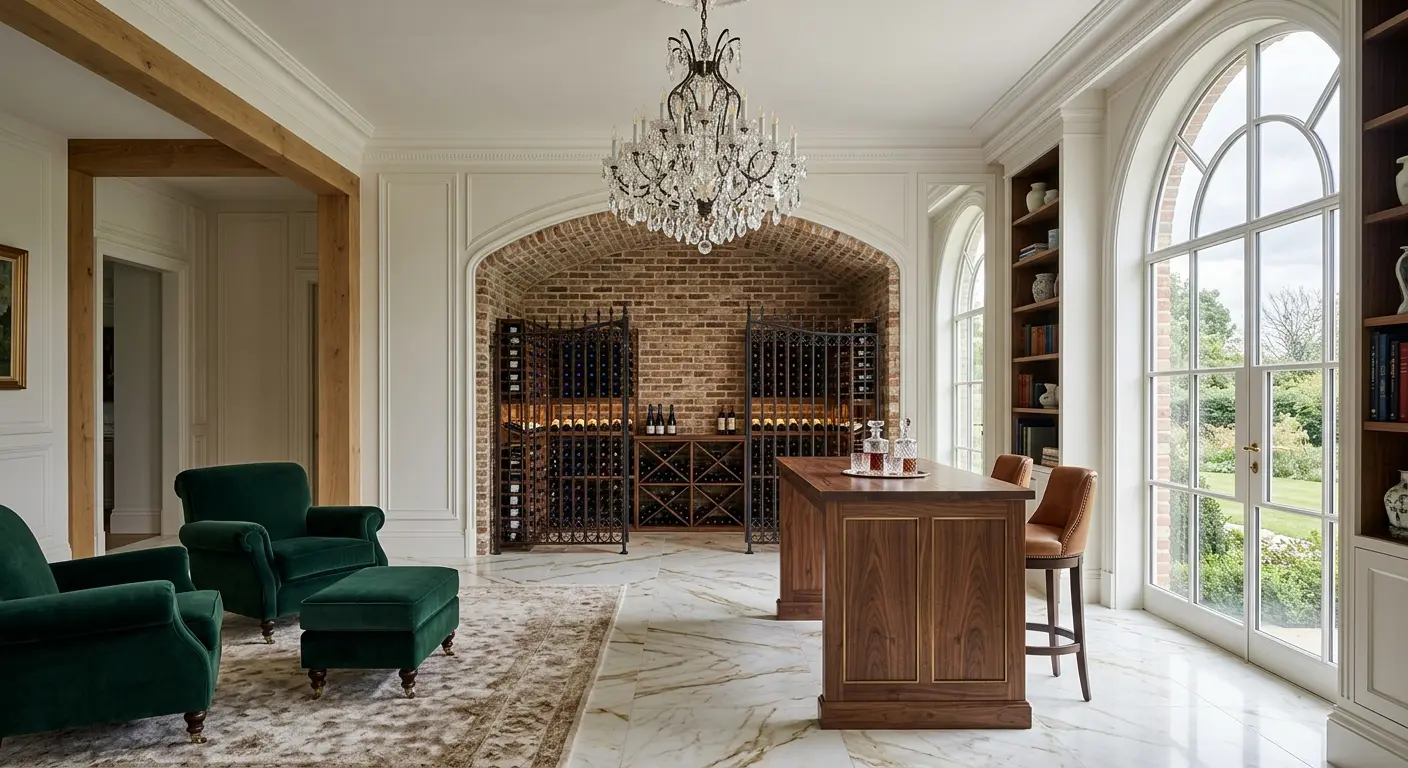
A few years ago I walked into a Moscow-region mansion where the owner proudly showed me into the wine cellar, 18 square meters. Oak racks for 1,200 bottles, wrought iron, brick vault, solid-wood tasting table. Budget — around 22 million. On the racks stood 47 bottles. Thirty of them — cognac gift sets that shouldn’t be stored in a cellar at all. This is the main story we’ll break down: wine cellar as investment in a mansion — or the most expensive decoration a rich person can afford.
By our internal observation — through studio we’ve done roughly forty wine-zone projects over ten years — approximately 80% of such spaces don’t fulfill any stated function. Don’t store wine properly. Don’t get used for tastings. Don’t grow in value as assets. Cost millions, occupy 15–25 square meters of useful space, and work like a very expensive illuminated cabinet.
Next — three objects, three budgets, three approaches. And honest conversation about when cellar truly makes sense and when you’re paying for someone else’s vision of what a “real mansion” looks like.
Where Fashion Came From and Why It Won’t Leave
Wine cellar in Russian country house — imported code. Not from Bordeaux and Tuscany where the function comes — from them came the image. Something between medieval castle basement, Hemingway’s study, and Silence of the Lambs. Client who built colonnaded house ten years ago now builds house with wine cellar. Status marker, not wine passion.
Nothing shameful here. Architecture always played with status symbols — marble fireplaces to home theaters. Problem isn’t wanting cellar. Problem is 9 of 10 clients never ask themselves one question: what will I do with it in three years.
In three years wine collecting either becomes a system — buying, accounting, degustation dinners monthly, sommelier contact, — or interest fades. Second case: space becomes a monument to impulse.
Wine Cellar as Investment in a Mansion: Where Myth Ends
Let’s break it down. The argument “cellar raises house value” works poorly in Russian reality. Secondary premium real estate market assesses by location, square footage, structural quality, project reputation. Wine cellar — niche element. Either matches new buyer’s interests or needs redoing.
I’ve seen properties where new owner dismantled cellar year one — doesn’t drink. Seen it redone for different format — buyer collects only Burgundy, racks designed for Bordeaux bottle size. Investment logic here is fragile.
Real investment is the wine in cellar, not the cellar itself. Bordeaux Grand Cru 2010 properly stored delivers 7–12% annual returns in currency. That’s Liv-ex data, not fantasy. But needs system: buying through verified channels (en primeur, auctions), accounting, insurance, understanding what you do. Without it cellar — consumption, not accumulation.
Three Objects: 15, 25, and 40 Million
Project One: 15M, Everything Works
850 sq.m. house in Istra district. Client — restaurateur, genuinely knows wine, maintains around 800 bottles in active rotation. Cellar 12 sq.m. in cellar level with natural ground insulation. Fondis split-system at 14°C, 70% humidity, vibration-isolated shelves, LED lighting only with minimal UV.
Finishing — lime plaster, terracotta floor, oak racks without ornament. No ironwork, no fake stone vaults. Tasting zone separate — in library. Cellar stays storage, as it should.
15M budget went to climate (2.8M), proper waterproofing and vapor barrier (critical, discussed below), racks for specific bottle formats, reinforced door with thermal break. This is money working for function.
Project Two: 25M, Half Decoration
Mansion on Novaya Riga, 1,400 sq.m. Cellar 22 sq.m., real brick vault, tasting table for 6, vintage décor. Budget 25M: ~9M finishing and decor, 5M racks for 2,000 bottles, 4M climate and engineering, rest doors, lighting, furniture.
Problem: client stores 300 bottles, half gifts from partners he doesn’t drink and won’t. Space beautiful. Used 4–5 times yearly. Climate works 90% empty volume, technically fine but economically absurd.
Typical “golden middle” scenario: real investment, partial use.
Project Three: 40M, Pure Decoration
Two-level cellar, 35 sq.m., granite floors, custom wrought iron, antique chandeliers, Provençal antique tasting table, solid-oak door 100mm. Climate at museum level — three independent circuits, backup power, app monitoring.
Bottles in cellar at handover — 18. Year later — about 60. This space exists as scenography for receptions. And you know what — there’s honesty in that if client admits it. He’s not pretending to collect. He’s making interior event. Just 40 million for an event happening eight times yearly — that’s decision needing conscious choice.
Where Money Disappears: Typical Errors
Ignoring waterproofing. Most expensive mistake. Client pays for oak racks and misses that vapor-barrier perimeter must be solid. Two years later moisture from walls pushes humidity to 85%, mold appears on labels, collection loses liquidity. Fixing — demolish finish and racks, redo from zero. Seen such projects — it’s drama.
Wrong location in house. Wine cellar on first floor near south wall — design error. Climate works overtime, electricity bills double, compressor lifespan — two-three years instead of ten. Right place — north, cellar level, away from heat and vibration.
Generic racks, not format-specific. Bordeaux, Burgundy, Champagne, Riesling, Port bottles have different sizes. Universal 75×75mm cells — compromise that doesn’t work for serious collection. Professional racks design for anticipated collection structure. Different work, different money.
Tasting zone inside storage. Each door open — microclimate hit. Each person — heat and humidity source. Pro approach — tasting separate, cellar storage-only. 70% of projects mix this; technically wrong.
Lighting that degrades wine. Any UV damages wine. Halogens, normal LEDs with high blue index, natural light through glass door — all enemies. Need LED with specific spectrum and door sensors.
Our Questions First: Studio Approach
When someone requests “need wine cellar,” we don’t sketch racks. We ask three questions.
First: how many bottles now and what’s annual turnover. No collection — we suggest starting with wine cabinet 200–400 bottles (800K to 3M budget) and see if format fits you over a year-two. Only then — cellar.
Second: what’s the goal — storage, investment, show. Determines everything. Investment — compact, technical, protected, no décor. Show — scenography matters more than volume. Mixing honestly — possible, but need proportions clear.
Third: ready for operating costs. Cellar isn’t one-time. It’s 150–400K yearly on electricity, climate maintenance, insurance, consumables. In 7–10 years — compressor replacement. Budget this into life in the house.
We tell clients honest truth: if any answer’s vague — let’s hold off. We’ll do the infrastructure (right waterproofing, outlets, structure) — and you can fill it in three years when you know if you need this. This recommendation costs us project budget. But saves clients from dead space.
Wine Cellar as Quality-of-Life Investment: Only Honest Formulation
Strip away illusions about home value rise and financial return — one thing remains. Cellar makes sense when wine is part of your life. When you come back from Piedmont with three cases, when you know your merchants, when Friday dinner with friends means opening something special.
In that logic 15 million for right cellar — reasonable money. It works every week. It’s in life’s fabric. Culturally justified, not financially.
And 40 million for empty space for rare receptions — buying status. You have right. Just name things by name — in conversation with architect, yourself, spouse. Then choice becomes conscious, not imposed.
What’s Ahead
In ten years, I think wine cellars in Russian mansions split into two clear categories. First — functional, compact, technical. Part of house infrastructure like boiler room, just different contents. Second — art objects, designed as part of reception scenario, with clear role and no pretensions to collecting.
The middle — big decorated cellars with couple dozen bottles — will disappear. Generation building main houses now increasingly asks “why” instead of “how it’s done.” That changes architecture deeper than it seems.
If you’re designing now thinking about wine zone — let’s talk before the oak-rack estimate appears. Sometimes the most valuable architect advice is “don’t do it.” Sometimes — “do it, but differently.” We’ll share what we’ve seen ten years, help not repeat others’ 25 million in nowhere.

Author


Next step
Discuss your project
An hour at the studio with Oleg Reznikov: your site, your brief and relevant studio projects.