
Calacatta or Portoro: Which Marble Will Outlast Fashion
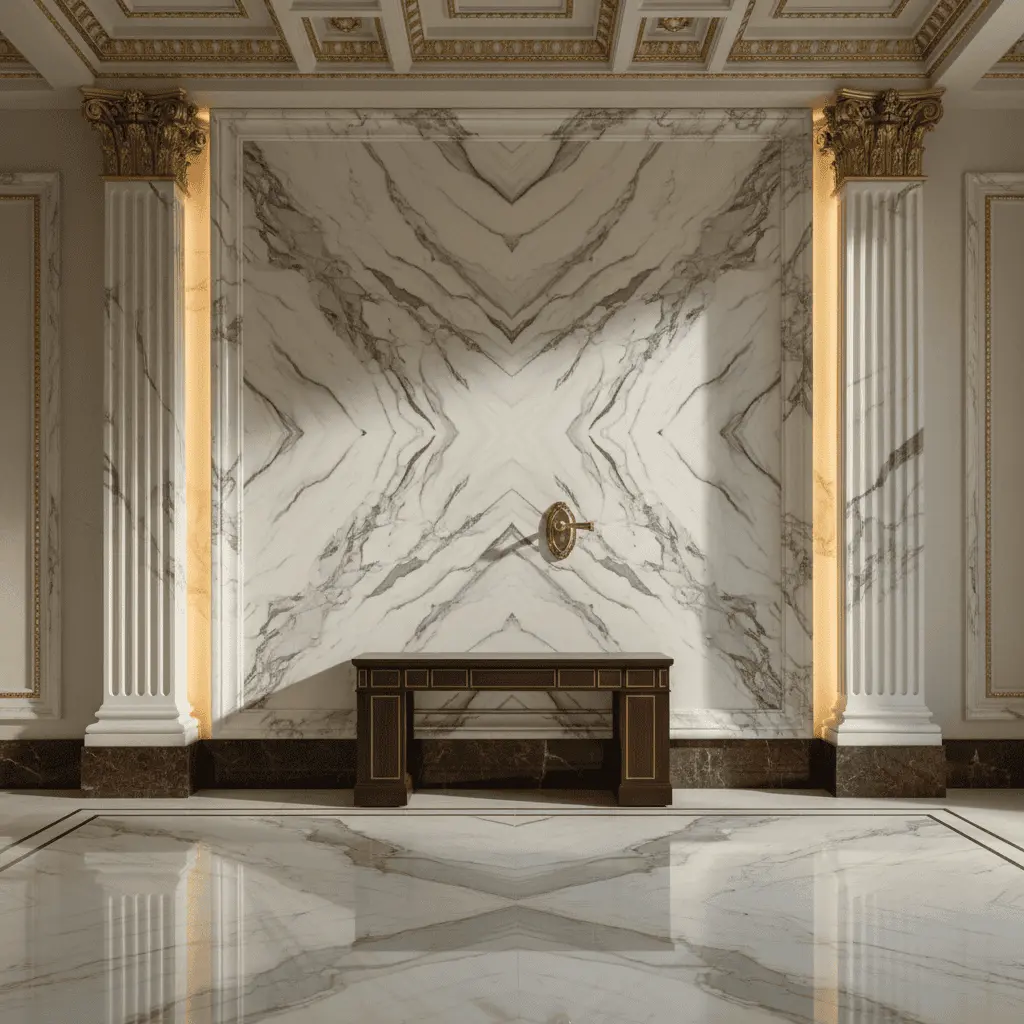
One of our clients — a man with impeccable taste in watches and cars — called me in the summer of 2019. Tired voice. “Oleg, remember we did the facade? So I hate it.” He was talking about Portoro on the main volume of a mansion near Istra — black marble with golden veining, which three years earlier seemed to him the peak of premium gesture. And turned out — a verdict. Because marble for a premium mansion facade is not about “looking expensive,” it’s about whether the house will look like your house in ten years or a set piece from the 2018 season.
I’m writing this for those now choosing between Calacatta and Portoro. Or thinking they’re choosing — when in fact they’ve already leaned toward one because “that’s what serious projects do.” That “all serious” is what we’ll discuss. Without Italian quarry brochures.
Let’s break down two breeds like adults: how they behave on a facade in 5, 10, 15 years. What Moscow climate does to them. And why “classic” sometimes turns out to be a fashion trap, just better disguised.
Why facade stone is a twenty-year bet
You can repaint an interior. Replace bathroom tile in two weeks. Redo a kitchen.
A facade — you can’t.
That is, technically you can, but when we’re talking about cladding an 800–1,200 m² mansion with 20mm plates on concealed fastening — we’re talking a budget of 25 to 60 million just for material and installation. That’s not renovation. That’s open-heart surgery on the house. And if you’re doing it, you should be sure that in fifteen years when fashion shifts, the house won’t look like grandmother’s coat with shoulder pads.
That’s why I always say: when choosing facade stone, forget the word “beautiful.” Think “neutral.” Stone that in ten years doesn’t scream about when it was installed — that’s true premium.
Calacatta: the white idol and its character
Calacatta is a general name for several Carrara-region quarries. The spread is huge: from quiet Calacatta Michelangelo with soft gray veining to aggressive Calacatta Viola with purple-burgundy graphics. For facades, only the first category makes sense — calm, architectural varieties.
What happens to it outside?
The white base yellows over time. Not catastrophically — 2-3 tones over a decade with north exposure, faster on south. This is natural, it’s patina, it’s not a defect. And done right, Calacatta ages noble, like the Parthenon’s white marble. Gray veining stays readable, pattern doesn’t lose architectural logic.
But there’s a nuance the dealers won’t mention. Calcite marble is susceptible to acidic precipitation. In Moscow, where winter brings de-icing agents and summer brings industrial dust, the open base of Calacatta starts to “run” in the top 2-3mm over 7-8 years. Polish goes away, matte patches appear. It’s fixed by on-site grinding, but that’s separate maintenance expenses every 10-12 years.
When Calacatta works
— North and east facades of large volumes
— Combination with warm wood (iroko, teak), travertine, copper
— Architecture where stone is background, not soloist
— Plates from 1200×2400mm, thin joints
Such Calacatta will outlast any fashion. It exists outside fashion from the start.
Portoro: golden trap
Now our hero, who prompted the client’s call.
Portoro is black marble from the Ligurian coast, mined in very limited volumes (real Portoro Extra is literally hundreds of tons yearly on the world market). Golden-ochre veining on deep-black background. Dramatic, theatrical, strong stone.
And therein lies its problem.
Portoro on a facade is a statement. Very loud. From 2015-2019, it became the business card of a certain “new luxury” wave: black matte cars, brass in interiors, wenge-brushed cabinet facades. That was an era. The era ended around 2021, and now Portoro on a facade reads as a specific install year.
Add the technical side. Black stone heats to 70-75°C in the sun. With sharp swings (from -28 to +35 in the Moscow region), microcracking starts in the matrix along the gold veins — exactly where structure is uneven. After 5-7 years, hairline fractures appear on plates, and the polished surface loses depth. Black becomes graphite-gray. Gold becomes dull.
I’m not against Portoro. I’m against Portoro outside. In interiors, on a fireplace, on an island countertop — it’s a timeless treasure. On a facade — a bet that 8 times out of 10 doesn’t pay off visually.
Premium marble for a mansion facade: what actually ages well
If I were to distill twenty years into a short list of stones we recommend for exterior cladding without reservations:
Travertino Romano Classico — Roman travertine, the very thing the Colosseum is built from. Aging 2,000 years and counting. Warm palette that in any era reads as “architecture,” not “finishing.”
Calacatta Michelangelo / Calacatta Borghini — with correct orientation and proper hydrophobic treatment.
Pietra Serena and Pietra di Vicenza — technically not marble, but in the same category of noble limestones. Absolutely timeless.
Bianco Perlino — quiet, intelligent, microgranular structure. Almost unaffected by fashion because it was never in it.
What we stop specifying on facades five years ago: Portoro, Calacatta Viola, Rosso Levanto, Verde Alpi, any strongly graphic breeds. All are interior darlings. All are traps outside.
Typical owner mistakes when choosing facade marble
Twenty years has given me a collection. Here’s the top.
Mistake one: choosing by small sample in the showroom. A 30×30 cm plate in warm dealer lighting and a 400 m² facade in north wind are different universes. We always order full-size layouts minimum 2×3 meters and view them in four lighting scenarios: morning, noon, dusk, artificial night lighting.
Mistake two: “I want like at [name]’s.” Five years ago everyone wanted “like [X]” and got identical black facades that are now morally outdated in sync. A reference is a conversation tool, not a specification.
Mistake three: economizing on plate thickness. Facades get 20mm, 30mm in the best case. Some try gluing 10mm “slabs” with mesh. In three winters — delamination. Always. Without exception.
Mistake four: ignoring sealing and care. A marble facade is alive. Every 3-4 years — update hydrophobic coating. Every 10 years — possible local grinding. If you don’t budget this, stone starts giving up in 6-7 years.
Mistake five: trusting “Italian certificate.” A certificate confirms stone origin, not the specific plate. Two blocks from one quarry can differ in density by 15%. We test each batch separately — lab testing for water absorption and frost resistance.
How we choose facade stone for a mansion at the studio
When a client says “I want a marble facade” — our first question isn’t about variety. It’s: “In twenty years, do you want the house to look like now, just older? Or do you accept it will look like an era?”
These are two different projects.
First variant — quiet limestones, calm travertines, neutral calcite marbles. “Timeless architecture” always means muted palette and large detail scale.
Second — Portoro is acceptable, Calacatta Viola, green Verde Guatemala. But then we honestly discuss: this facade in 10 years will probably want redoing. We’re budgeting that redo now.
Third path, increasingly recommended — combination. Main volume from timeless stone (travertine, perlino, light calacatta). Accent zones — portals, fireplace stack, base — from characteristic breed. If the accent ages out, you can replace it locally without touching the main cladding.
That’s exactly what we did in a Rublyovka project three years ago: main volume Bianco Perlino, main portal Portoro. The client wanted to change the portal to Nero Marquina two years later. Swapped it in three weeks without touching the base cladding. That’s the mature approach to stone work.
So what to choose — Calacatta or Portoro
My answer after twenty years of practice: for main facade volume, Calacatta from calm varieties will outlast Portoro with a big margin. Not because it’s a better material. Because it’s quieter. Premium — it’s always quiet, not loud.
Portoro — leave it for interior accents. There it’s immortal. On the facade — it’s a hostage to a specific decade.
And honestly — the best choice for big-house cladding often isn’t in this pair at all. It’s in Roman travertine, in Bianco Perlino, in rough Pietra Serena. In materials that aren’t trying to be fashionable because they’re older than fashion.
If you’re currently designing a house or redoing the facade — come see us, we’ll look at samples in real scale, discuss orientation, operations, twenty-year budget. Better to spend a month choosing stone than ten years living with a mistake across three hundred square meters.
And the call from the Istra client? We redid his main facade for him. Travertine Navona, large format, warm palette. Three years on — no regret calls. Which means it worked.
Read next

Next step
Discuss your project
An hour at the studio with Oleg Reznikov: your site, your brief and relevant studio projects.