
7 Billionaire Mistakes: Why Rich Clients Build the Wrong Thing
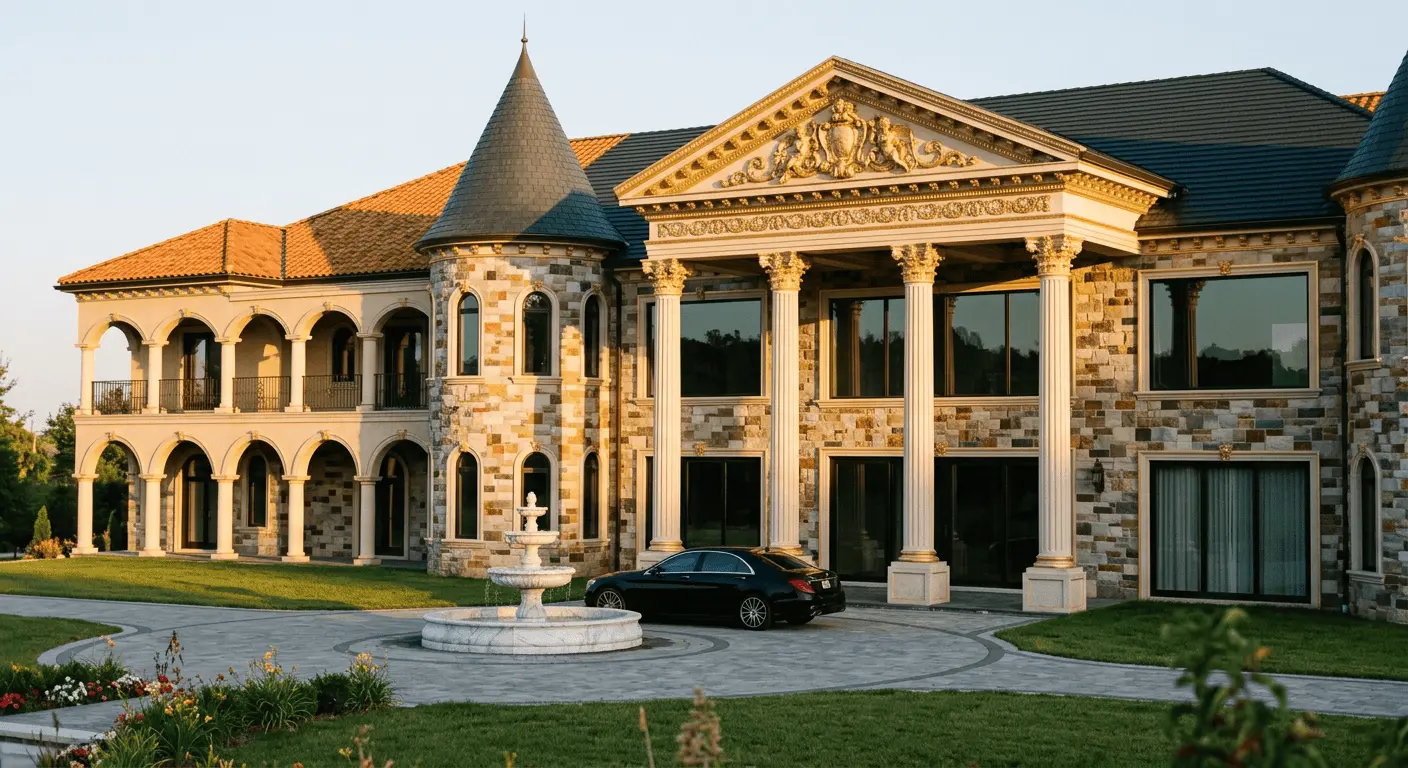
A 48-year-old man walks in. A holding company owner, three languages, house in London, apartment in Monaco, just back from Architecture Biennale in Venice. Lays a folder on the table: Château in France, villa in Sardinia, palazzo in Como. “I want that. Only bigger and better.”
Five minutes into the conversation it’s clear: he’s never been inside any of them. He saw the facades. At 90 km/h. Through tinted Mercedes glass. And now genuinely believes he understands architecture.
This is perhaps the most common and most expensive mistake in building a mansion—the confidence that lots of travel automatically equals being well-informed. It doesn’t. Over ten years of practice we’ve learned: money without taste isn’t a neutral state. It’s a catalyst. Money doesn’t just fail to help—it actively amplifies any bad idea and makes its realization inevitable.
Below are seven mistakes we observe again and again. Case studies—names we omit, naturally.
Mistake One: “I Want It Like…”
The most frequent opening line at first meetings. Then—a famous person’s name, a Dubai hotel, or a screenshot from Architectural Digest a decade old.
The problem isn’t that you can’t be inspired by others’ homes. You should be. The problem is “I want it like Rothenberg’s” isn’t a brief. It’s emotion. Behind it usually stands not a desire to live in such a space, but a desire to own the status that space symbolizes.
We always ask one question: “Were you actually inside?” Nine times out of ten—no. A person wants to copy something they’ve never experienced. Like ordering dinner from a photo, not knowing how it smells or tastes.
Architecture is a life scenario. Rothenberg’s house was written for Rothenberg. Settle someone else there with different habits, different day rhythm, different family composition—you won’t get grandeur. You get discomfort at a scale of 2,000 square meters.
Mistake Two: Economizing on Foundation for Marble
Real case. Seventy-hectare lot, difficult soil—sand with peat lenses. Geology clearly showed: needed monolithic slab with thickening under load-bearing walls, plus perimeter drainage. The foundation cost was serious.
The client said: “Let’s do it cheaper. With the saved money I’ll buy Calacatta Oro marble for the hall and staircase.”
Four years later we were called to look at cracks. The marble lay beautifully. The house was moving.
There’s an iron rule we repeat at every meeting: money in a mansion must be invested in reverse order of perception. First—what’s unseen: soil, foundation, engineering, load-bearing structures, masonry quality, roof junction details. Then—what’s seen: finishes, decor, light.
A person economizing on the unseen for the seen isn’t building a house. They’re building stage scenery.
Mistake Three: “I Know How”—The Manager Syndrome
People who made big money trust their judgment. It worked in business—so it should work here too. The logic makes sense. The logic is wrong.
Architecture is a separate discipline with its own knowledge density. The fact that you spent twenty years building oil trading or a clinic network doesn’t automatically make you an expert in insolation, acoustics, thermal bridges, and lighting design. It’s not an insult. It’s a fact.
We had a client who personally chose the house’s position on the lot. “Here’s the most beautiful panorama.” True. Except the panorama faced northwest. As a result the main living spaces never saw direct sun year-round, and summer evenings got blinding sunset right into the living room. Too late to fix—walls were already up.
If you hired an architect—hire them. Don’t turn them into someone executing your decisions. Why pay, then?
Mistake Four: A House as Monument to Self
Double-height entry halls six meters tall. Columns that bear nothing. Grand staircases where nobody walks because they take the elevator. Fireplace in the bedroom they don’t use. Billiards room visited once a year.
A rich house is often built not to live in but to demonstrate the ability to live like this. Those are different tasks, and the architecture differs.
We’ve noticed a pattern: the more confident a person is, the less they need to prove with space. The quietest, most refined homes we’ve done were for people with nothing left to prove. The loudest were for those still talking to ghosts.
That doesn’t mean big is bad. Big is normal if there’s a scenario for every square meter. If a ballroom gets used once every four years for an anniversary—that’s not a room. That’s a shed of ambition with parquet floors.
Mistake Five: Stylistic Mishmash from Travel
A person loves Provence. And Milan. And some Japanese minimalism. And colonial from a Bali trip. And wants loft-style like that hotel in New York.
All in one house.
We call it “Instagram memory syndrome”—when trip memories blur into porridge and a client tries to materialize it in 1,200 square meters. The result: Provençal kitchen flows into loft living room through a corridor with Japanese screens. Each room individually could be done well. Together—like an exhibition pavilion.
A good house is one intonation spoken in different registers. Not seven different intonations fighting each other.
Mistake Six: Underestimating Maintenance
Almost nobody thinks about this at design stage: how does this house live afterwards?
Who washes the stained glass on the third level? What’s the cost to replace a lamp in a four-meter pendant from Murano? How is a flat roof with a winter garden serviced? How many people on staff for the house not to become abandoned in five years?
We had one project—1,800 square meters, separate guest house, spa complex, wine cellar for 3,000 bottles with automatic climate control, winter garden with tropical plants. Client was thrilled. Two years later we got a call: “Help, I can’t cope. Three staff can’t keep up, the cellar climate glitches, plants in the garden are dying.”
A rich house needs maintenance infrastructure comparable to a small hotel. You have to think about that before the foundation is poured. Not after.
Mistake Seven: Choosing Contractor by Price
And this is where we’re rarely listened to.
When sums are in hundreds of millions, 15% difference between two bids seems significant. A client looks at the number and chooses the cheaper bid. A year later they understand why it was cheaper.
In our practice there was a case where a client rejected us for another brigade—difference was about 12%. Eighteen months later he came back asking us to take over the work. We did an audit. The cost of fixes exceeded the original “savings” by four times. Without counting lost time, nerves, and the fact that some mistakes were already irreparable—like incorrectly installed embedded parts in the monolith.
A good contractor doesn’t cost cheap. A good contractor costs fair. The difference between these two is the absence of surprises.
How We Work With This
First thing we do at start—a long conversation. Not about the house. About the client.
How many people in the family? What time does he wake? Does he like hosting guests and in what quantity? Work from home or not? Where does he spend mornings? What was his childhood apartment like? What annoyed him in previous homes? What habits is he not willing to sacrifice for “beautiful”?
From this conversation comes a brief that looks nothing like what the client came with. And usually—thank God, it’s different.
We see our work not as executing whims, but as translating desire into architecture. Not always pleasant for a client. Sometimes we say “no.” Sometimes—”you don’t need this.” Sometimes—”are you absolutely sure you want a bedroom fireplace, or did you just see it in a St. Moritz hotel?”
People used to being told “yes” find it unusual at first. But this is exactly why they choose us in the end.
Instead of a Conclusion
Mistakes in mansion building are almost never technical. Technique can be bought—good engineers, good materials, good crews. That’s a budget question.
Real mistakes are always about people. About a client not understanding himself. About an architect not asking the right questions. About no one stopping to ask: why are we even building this?
A house isn’t proof you’ve achieved something. A house is where you live. The gap between these two positions is vast, and it only shows itself over years.
If you’re at the start of this journey and read this thinking “well that’s not me”—we’d like to talk. The best projects we’ve had started with a client sitting down and saying: “You know, I’m not entirely sure what I want.” Most honest beginning possible.

Author

Next step
Discuss your project
An hour at the studio with Oleg Reznikov: your site, your brief and relevant studio projects.