
Decorative Garden Pond: Living Water or a Costly Mistake
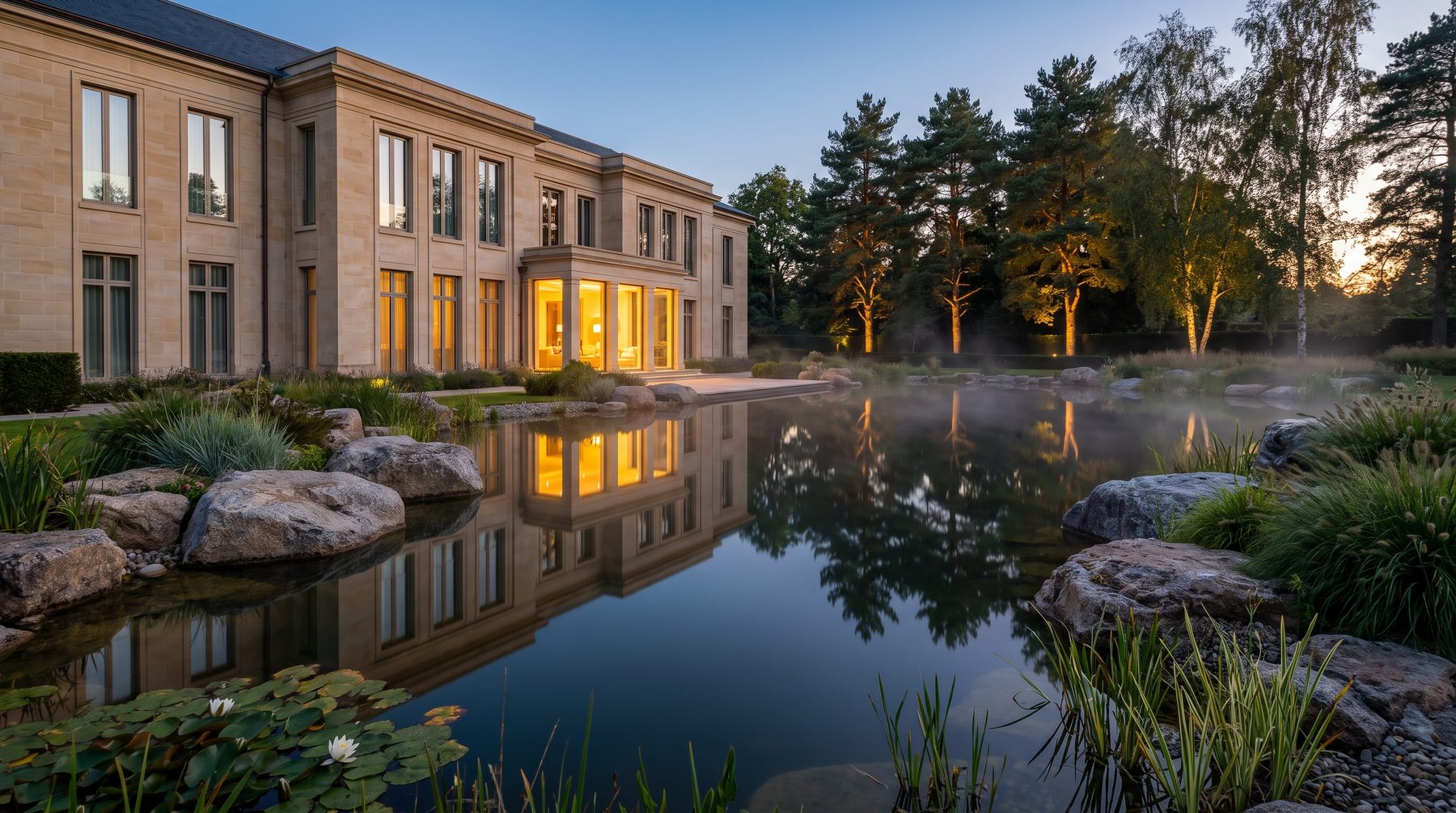
A decorative garden pond is not a landscaping detail. It is a piece of engineering — a basin, a waterproof membrane, pumps, filtration, power supply and an annual maintenance budget. A living pond costs less to run than a swimming pool, but it forgives far fewer mistakes. And it has to be decided before the excavator arrives, not after the housewarming.
A client once showed me a photograph from Bali. Black mirror of water, the house reflected in it, a stone rim, not a ripple, not a single fallen leaf. “I want exactly this, in front of our terrace.” The plot was half a hectare sloping towards the forest, the house had reached weathertight stage, the landscape was next in line. I asked him who would be scooping leaves out of it every morning in October. He laughed. Two years later there was indeed water in front of his terrace — not the water from the photograph, and it is the best thing that happened to that plot.
Three different objects hiding behind one word
When a client says “pond”, he may mean three entirely different things. They differ from one another more than a garage differs from a bathhouse.
A reflecting pool. A shallow basin, twenty to forty centimetres deep, usually with a dark bottom and strict geometry. Its only job is to reflect. This is architecture, not biology. One classic trick of such a basin: the floor near the rim is made slightly deeper than in the centre, which suppresses wave formation and keeps the mirror intact. It holds little water, warms up quickly and blooms enthusiastically, so it survives only on constant circulation and UV. On the upside, in winter you simply drain it.
A living pond with a regeneration zone. An ecosystem: a deep section, shallows, and a planted bio-plateau where marsh plants strip ammonia, nitrites and nitrates out of the water. This is what Europe calls a natural pond. It can hold fish, you can swim in it, it reads as a piece of nature — and it demands attention rather than chemistry.
A swimming pond. Essentially the same living pond, but with proper depth, steps, a timber deck, and a regeneration zone no smaller in area than the swimming part. It is not a pool. The water in July is twenty-one degrees, and that is the entire point of it. Or the entire problem — it depends on the client.
The first conversation is always about this. Until the type is chosen, discussing budget is pointless: the gap between a forty-square-metre reflecting pool and a two-hundred-square-metre swimming pond is the gap between a balcony and a second floor.
What a decorative garden pond actually costs
Start with honest arithmetic. In the Moscow region, specialist contractors price the design of a water feature from around 40,000 roubles — drawings only. A basic equipment set for a small decorative pond — pump, filter, UV lamp — starts at 30,000 to 40,000. A factory-made rigid basin, the kind you simply lower into a pit, starts at 600,000.
Those are the bottom of the market and have little to do with the projects we build. On the grounds of a thousand-square-metre house, a pond is rarely smaller than 150–200 square metres of water surface, and it comes with earthworks, spoil removal, geotextile, waterproofing, stone shoreline work, underwater and bank lighting, a dedicated power line, a plant chamber and, almost always, a retaining wall. Here the numbers run from one and a half to ten or fifteen million roubles — and the main multiplier is not depth but the bank. It is the stone and planting work around the perimeter that decides whether you own a body of water or a puddle with a liner showing at the edges.
The running cost is the more interesting figure. American contractors, who publish these numbers, offer a telling comparison: maintaining a natural pond runs about $15 to $80 a month, while a conventional swimming pool costs $150 to $260 a month, plus roughly $650 a year in chemicals alone. The absolute figures in Russia differ; the logic does not. Living water is cheaper to keep than chlorinated water. Cheaper is not the same as free.
The annual budget of a living pond means spring start-up, seasonal cutting back and dividing of plants, vacuuming the bottom, replacing the UV lamp once a season — it loses output long before it stops glowing — leaf netting in autumn, winter shutdown and aeration through the cold months. On our projects this lands consistently between 150,000 and 400,000 roubles a year for a mid-sized pond. The client needs to hear that number out loud before signing. Otherwise the water turns cloudy in year three and the architect turns out to be the guilty party.
The myths that cost the most
“A pond means mosquitoes.” The most persistent myth, and it is precisely backwards. Mosquitoes breed in standing water with no movement and no predators — in a barrel, an old tyre, a forgotten saucer under a planter. A proper pond with circulation, fish and dragonflies does not produce mosquitoes, it reduces them: both fish and dragonfly larvae feed on the larvae. The classic mosquito fish is the gambusia, once introduced around the world specifically to fight malaria because of its appetite for larvae; in dense planting it outperforms carp, which only works well in open water. Trouble appears where someone built water without movement — a decorative basin topped up by hand “for the summer”.
“The ecosystem will sort itself out.” It will, but not on the timescale the client has in mind. A bio-plateau shows a visible effect in about two weeks — the water clears noticeably. Stable equilibrium, however, takes two to four years to establish. Which means the first summer a new pond will go green, and that is normal. If nobody says this in advance, panic sets in by July and chemicals go into the water, killing everything that had managed to take hold.
“We’ll dig it later, once the house is finished.” This is where most of the money is lost. A pond is the lowest point of a site and its principal water collector. It belongs on the same drawing as the drainage and the levels, not on top of a finished lawn. We went through this mechanism in detail in our piece on site drainage and vertical planning: water on a plot always goes somewhere, the only question is whether you designed its route or it designed itself. A pond cut into a finished landscape three years after handover costs twice as much — machinery has to cross laid paving, mature trees are in the way, and there is nowhere to put the spoil.
“Let’s make it deeper so the water doesn’t bloom.” There is logic in it, but depth solves a different problem — overwintering. Blooming is beaten by shade, plants and UV, not by two metres of water.
Winter is the real examination
This is where landscape design ends and engineering begins. In still water around Moscow, thirty-degree frosts drive ice down to roughly a metre and a half. Hence a simple rule: if fish overwinter in the pond, they need a wintering pit at least two metres deep — comfortably below the frost line, with margin.
The second rule matters more than the first. Fish do not die of cold in winter; they die of oxygen starvation under unbroken ice. Part of the surface therefore has to stay open, which is done with an aerator or a pump lifting warmer water from the bottom. That hole in the ice is not a decorative detail, it is life support — and it runs off the same outdoor circuit as the lighting. Which leads to something obvious that gets forgotten: the supply to the plant chamber goes into the building services design along with everything else, on its own breaker and RCD, rather than being run from the garage on an extension lead in December.
We had a project on the Novorizhskoye direction where the client, on a contractor’s advice, stocked koi in the very first season — beautiful, expensive, imported fish. The wintering pit was there. The aerator was there. And the outdoor breaker tripped in late January while the family was away. Nobody writes about this in landscape design articles, yet this is exactly what decides whether you keep a pond or a memory. Since then we specify a dedicated circuit for aeration with a loss-of-power alert wired into the house system.
A reflecting pool is more honest in this respect: in winter you drain it, leave the basin empty, and owe it nothing. Of course, that means six months of an empty stone bath in front of your terrace — an image worth showing the client in advance.
The basin, the membrane and the water
Waterproofing is where cutting corners stays invisible for about five years. Two grown-up solutions.
EPDM membrane
A butyl rubber sheet based on ethylene propylene rubber. It holds its properties roughly from minus forty-five to plus one hundred and thirty degrees, stretches several times over without tearing — manufacturers claim up to three hundred percent elongation — and shrugs off both UV and tree roots. For complex geometry with inlets, an island and varying depth, this is the workable option: the sheet follows the contours. The critical part is the seams. There should be few of them, and they should be made by people who do it every week.
Bentonite mats
A geosynthetic with a layer of natural bentonite clay inside: on contact with water the clay swells and forms a watertight seal. The result feels closer to a natural pond — the bottom is living clay, not rubber, and it self-heals small punctures. It demands a carefully prepared bed and proper ballasting, but it fears neither time nor sunlight where it stays covered.
On filtration I will be brief, because people have argued about it for decades. We always specify a bio-plateau — a regeneration zone of marsh plants adjoining the main basin. The plants take up the nitrogen load that turns water green and oxygenate it at the same time. Mechanical filtration and UV stay in the system, they simply work in a gentler regime. The area of the bio-plateau is not a decorative number: for a swimming pond it is comparable to the swimming area itself, and it is the first thing anyone tries to trim at costing stage. Trim it, and you have bought a pool with algae.
The bank deserves its own note. Stone that looks natural costs more than stone that looks laid. We usually look at what already exists in the architecture of the house and in the plinth cladding, then continue the same rock along the waterline, so that the limestone on the facade and the boulder at the water’s edge do not argue about colour.
Our approach: water belongs on the masterplan
The practice is straightforward. On projects where we handle both the architecture and the grounds, the pond enters the drawings at the same moment the house is positioned. Three reasons, all of them pragmatic.
First, spoil. A two-hundred-square-metre pond excavation yields several hundred cubic metres of soil. Dig it together with the house and that soil goes into backfill, terracing and raising the driveway platform — it saves money. Dig it three years later and it leaves the site in tipper trucks, a pure loss. All of which is part of the work we do during pre-construction preparation, before the first pile.
Second, the view. A pond only means anything from the points it is seen from: the living room, the dining terrace, the principal bedroom. Which makes its outline a function of the house plan, not of the leftover space on the plot. On one of our projects near Barvikha the water was shifted eleven metres from its original position for a single reason — so that the reflection of the facade would land in the living room glazing in evening light. From a landscape point of view the new spot was worse. From the point of view of living in that house, it was the only right one.
Third, light and services. Underwater lighting, bank fittings, the plant chamber, access hatches, a top-up water supply — these are all routes running beneath future paving. Added later, they turn a finished garden into a trench.
What this looks like when built is better shown than described: in our Sady Meiendorf residence the relationship between the house, the water and the terrain speaks more clearly than any description.
When we talk clients out of it
Not every plot needs water, and there is nothing insulting in that. We say a straight “don’t” in three situations.
If the plot is under twenty sotkas and already carries a house, a garage, a barbecue area and a play zone, the pond becomes a puddle wedged between functions — you cannot walk up to it, you cannot sit around it, and what it reflects is the neighbour’s fence. Better to do one strong thing: a narrow stone rill along the terrace, or a basin with a weir edge. Less water, more effect.
If the client visits the house four times a year. A living pond is like a garden — it is not about ownership but about presence. Without an owner and a gardener it honestly turns into a swamp within one season.
And if there are small children while the budget for fencing and covers has been struck off the estimate. Forty centimetres of water is exactly as dangerous as two metres, and the answer is not conversation but the geometry of the bank: a gentle entry, a shallow shelf around the whole perimeter, no vertical edge anywhere.
In every other case — build it. A pond is the one element of a garden that changes by the hour: morning mist, midday glare, the facade in the evening reflection, a black steaming opening in the ice in January. Houses age. Water does not.
Frequently asked questions
How much does a decorative garden pond cost?
On a premium country estate, a realistic budget for a 150–200 m² pond runs from one and a half to ten or fifteen million roubles, including earthworks, waterproofing, equipment, lighting and the stone bank. The bottom of the market looks different: design from 40,000 roubles, an equipment set for a small basin from 30,000–40,000, a factory-made rigid basin from 600,000. The main cost multiplier is not depth but the quality of the shoreline.
Will a pond bring mosquitoes?
Quite the opposite. Mosquitoes breed in standing water with no movement and no predators — barrels, saucers, old tyres. In a pond with circulation, fish and dragonflies the larvae are eaten: gambusia were historically introduced worldwide precisely as mosquito fish, and dragonfly larvae work alongside them. The problem is created not by a pond but by a decorative basin without a pump, topped up by hand once a week.
How deep must a pond be for fish to overwinter?
At least two metres in the wintering pit. In still water around Moscow, thirty-degree frosts push the ice down to roughly a metre and a half, so the pit is set well below that line. But depth solves only half the problem: in winter fish die from oxygen starvation under solid ice, so an aerator or pump must keep part of the surface open all season.
What does a pond cost to maintain per year?
For a mid-sized pond near Moscow, usually 150,000 to 400,000 roubles a year: spring start-up, care of the bio-plateau planting, bottom cleaning, seasonal UV lamp replacement, autumn leaf netting, shutdown and winter aeration. International practice confirms that living water is cheaper than chlorinated: natural ponds are costed at $15–80 a month against $150–260 for a conventional swimming pool.
If you are at the stage of choosing a plot or sketching the house, this is the best possible moment to settle the question of water. Bring your site plan and topographic survey and we will look together at where water will work for the house — and where it will simply take money. The conversation commits you to nothing and may save a great deal.

Author
Next step
Discuss your project
An hour at the studio with Oleg Reznikov: your site, your brief and relevant studio projects.