
Bookmatched Marble: Why One Wall Costs as Much as a Car
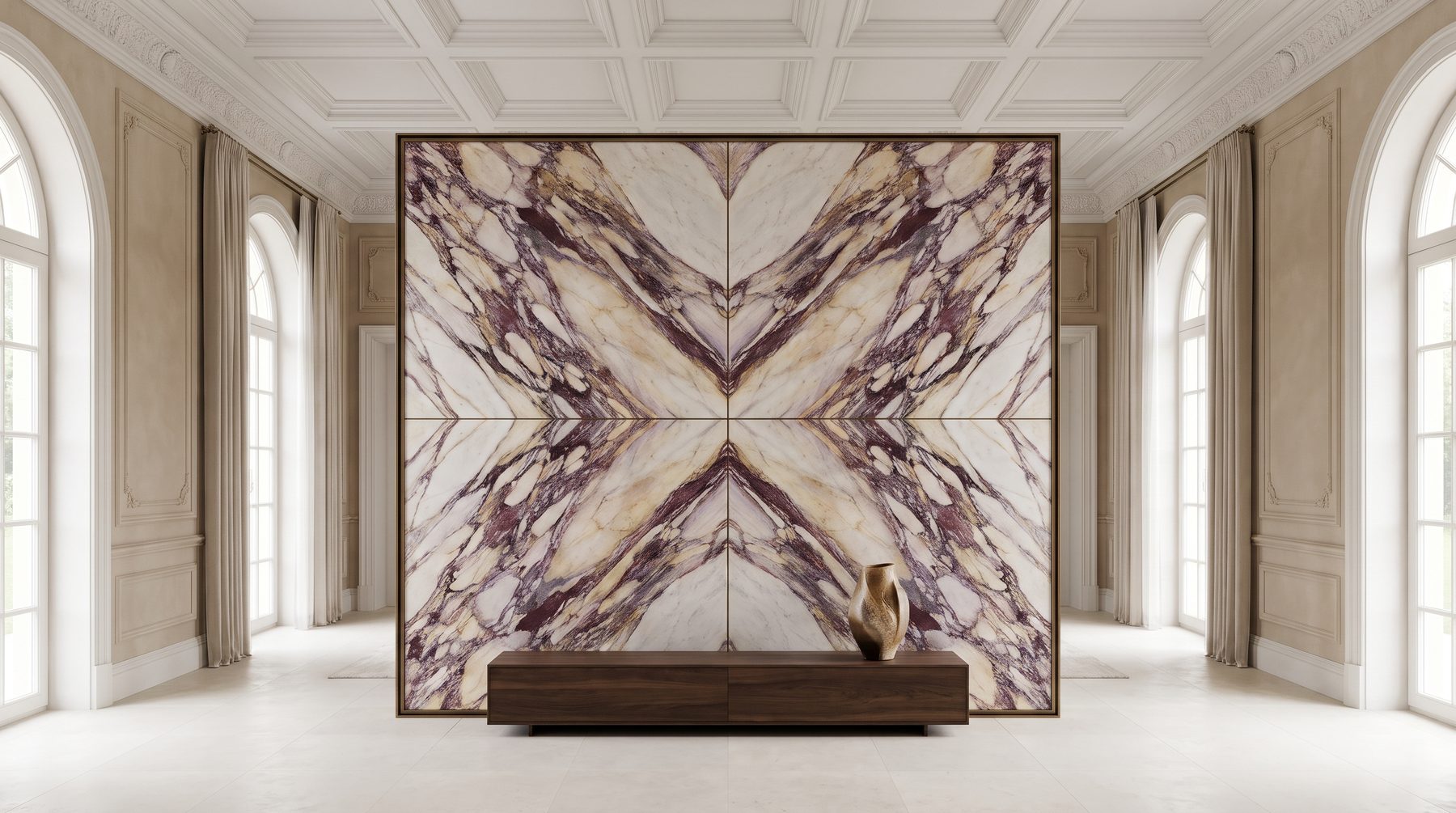
Bookmatched marble is a cladding technique in which two or four consecutive slabs, sawn one after another from the same block, are installed as mirror images so the veins continue across the seam like the pages of an open book. It needs slabs from one cutting sequence, careful selection at the stone yard and a dry layout before installation. That is where the price comes from.
That is the short answer. The long one starts in a cold stone warehouse, where I once spent three hours standing over two slabs.
We were designing a hall with a staircase. The wall facing the front door was about nine metres wide and five metres high, and the client wanted “marble with character”. We proposed turning that wall into a single mirrored picture made of four slabs. At the yard we were shown eight slabs with a strong dark pattern. The numbers on their edges were all over the place: 14, 15, 21, 22, 23, 31. The sales manager assured us that “it’s one block, it will all match”. It would not have. Slabs 15 and 21 are separated by six saw cuts, several centimetres of stone, and in that distance a vein has plenty of room to wander off.
We asked to see the whole bundle. Slabs 21, 22, 23 and 24 were there. Those four consecutive numbers are why that wall costs as much as a decent car.
Book match and quarter match: how mirrored marble works
At the processing plant a marble block is sliced into slabs like a loaf of bread. Neighbouring slabs are separated only by the saw cut: fabricators quote 4–6 mm per cut plus 2–3 mm of surfacing loss on each new face. The inner structure of the stone barely changes over those few millimetres, so two adjacent slabs are almost the same cross-section.
Then comes a simple trick. One slab is flipped over like a page. Its face used to sit against the face of the first slab, so now the pattern reflects across the seam as if in a mirror. That is a book match.
A quarter match is the same idea squared. Four consecutive slabs are arranged in a cross, mirrored across both the vertical and the horizontal seam. The result is a pattern with a centre, sometimes a diamond, sometimes a butterfly. It needs a big wall: one Italian supplier lists a Calacatta Viola slab at 2.42 × 1.5 m, so a quarter match of four such slabs covers roughly 4.8 by 3 metres.
There are other layouts too, such as the unflipped “slip match” and herringbone, but in private homes the first two do almost all the work.
Which stone works and which doesn’t
Bookmatching only makes sense on stone with a bold pattern: Calacatta Viola with its wine-red veins, Arabescato, Statuario, Nero Marquina, Patagonia, onyx and some quartzites. On a calm white Bianco Carrara nobody will notice the mirror except you and the stonemason. Paying for a matched pair there is money thrown away.
This is where most people go wrong. They fall in love with the most dramatic slab in the showroom and only later find out that its neighbour has already been sold to someone else. One spectacular slab without its pair is just an expensive slab.
Why bookmatched marble costs so much
The money does not sit in one big line item. It hides in several small ones.
The stone itself. As a European reference point, a UK supplier lists honed Calacatta Viola at about £522 per square metre in 20 mm and £534 in 30 mm, with bookmatched pairs available “on request” and no price in the catalogue. In mid-2026 American contractors quoted $250 to $350 and up per square foot installed for Viola. A nine-square-metre wall at that rate really does cost as much as a mid-range car.
The sequence premium. Fabricators estimate the surcharge for bookmatching at 20–40% on top of the slab cost. Yards sell the pair together, often the whole bundle, because nobody wants to be left with orphan slabs that will never match anything.
Waste. A mirrored layout is cut to follow the pattern, not to save stone, so the offcuts are larger than with ordinary cladding.
The fabricator’s time. Every seam is fitted so the vein crosses it without a step. That is handwork, and not every shop can do it.
And the point nobody mentions until the first crack: a broken slab cannot be replaced. A slab from another block will not complete the picture, and its neighbours are already on your wall or in the offcut pile. That is why we always try to buy one extra slab from the same sequence. It costs money and will probably sit in storage. Until the day it doesn’t.
Hall, bathroom, fireplace: where a bookmatched marble wall earns its place
Entrance hall and staircase
The most honest place for a quarter match. The wall is seen whole and from a distance, and guests notice the symmetry before they realise it is stone. The viewpoint matters: the centre of the pattern goes on the axis of the front door or the stair flight. If the pattern axis drifts 30 cm off the axis of the hall, the eye catches it at once, even if nobody can say why.
Primary bathroom
Here a simple two-slab book match behind the tub or the double vanity usually works best. The seam runs exactly on the axis, and the taps or the mirror sit on it. But this is where it gets interesting: a bathroom wall is cut for the concealed cistern, pipe outlets and sockets. In a mirrored layout every opening needs a twin, or it has to hide behind an object. Otherwise one side of the “book” gets a hole and the other doesn’t, and the symmetry breaks exactly where you look every morning.
Fireplace surround and kitchen island
Above a fireplace, a mirrored layout turns the firebox into the centre of the composition. Decide early how the stone meets the surround: if the surround is the same marble, cut it from the same slabs, or the pattern will stop dead at the edge. On a kitchen island the book can also run vertically, with the end panel continuing the worktop over a mitred corner. It looks superb, but needs slabs of at least 2 cm and a very careful fabricator.
Common bookmatching mistakes
Over the years we have collected our own set. None of them is about bad stone. All of them are about decisions made in the wrong order.
Buying slabs that are not consecutive. Slabs 15 and 21 “from the same block” are not a pair. Check the numbers on the edges and the block marking, and ideally get a photo of the whole bundle.
Deciding on the mirror after the purchase. Bookmatching has to be planned before the stone is bought and cut. Otherwise the yard sells you what it has, not what you need.
Skipping the dry lay. The slabs are laid out on the workshop floor or on a rack in the order they will go on the wall, photographed and signed off. Stone suppliers say plainly that a dry lay is required: a mistake costs nothing to fix there, and on the wall it stays forever.
Forgetting the floor and the ceiling. The wall is finished, the pattern is perfect, and then a skirting board cuts it off at the bottom and a curtain pocket at the top. Pattern height is calculated from finished levels, not rough ones.
Installing the wall without lighting it. Polished marble on a wall lives by reflection. A linear grazing light from above pulls the veins out, while a spotlight aimed straight at it turns the centre of the composition into a white glare.
Remember the bundle with random numbers from the start? Had we not asked to see all of it, slabs 15 and 21 would have gone on the wall. From a distance, “almost the same”. Up close, the vein stops at the seam and starts again two fingers higher. That is the wall you would see every day walking up the stairs.
Our approach: how we check the layout before installation
For us bookmatched marble is not a line in the budget but a separate detail of the project. This is how we work.
The wall in the drawings. In the interior working drawings we draw the wall elevation with exact slab sizes, the pattern axis, the seams and every opening. If the wall does not divide into slab widths without an ugly filler strip, we find out on paper.
Selection at the yard. We go to the yard ourselves, photograph every slab in the bundle with its number and assemble the photos into a mirrored layout on screen. We choose a sequence, not a single pretty slab. Stone selection is part of our interior procurement service, and the stone suppliers we work with know how to hold a whole bundle for a client.
A cutting map. The fabricator gets not “clad the wall” but a plan: which slab goes where, where the axis is, where the openings and the spare are.
Dry lay and sign-off. The slabs are laid out in the workshop in project order, and the client, or we on their behalf, inspect them in person and sign the photos. Only then does the stone travel to site.
Supervision during installation. The first two slabs go up with us present. During design supervision we watch the seams to the millimetre, the grout colour and that nobody “nudges the centre a little” to fit a socket.
It sounds slow. In practice it is two or three weeks inside the project, and it protects the one thing you cannot buy again: the neighbouring slab.
How to care for a bookmatched marble wall
A wall gets far less abuse than a kitchen worktop, but polished marble is still a soft, acid-sensitive stone. A short checklist:
Clean with a pH-neutral stone cleaner diluted in warm water and a soft cloth. No vinegar, bleach, lemon-based or abrasive products: acids etch the polish and leave dull patches.
Know the difference between a stain and an etch. A stain is something absorbed into the stone; an etch is damage to the polished surface itself. Sealing slows absorption, but it does not stop etching.
Reseal with an impregnating sealer every 6–12 months on walls near a bar, vanity or cooktop, less often on a hall wall that nobody touches. Always test on an offcut or a hidden corner first.
Watch the splash zones. Behind a basin, toothpaste, hand soap and perfume are the usual culprits. A clear, practical rule: wipe splashes the same day.
Leave repolishing to a professional. Light etches can be polished out, but on a large mirrored surface a DIY patch often ends up brighter than the rest of the wall. A stone restorer will feather the polish so it blends in.
Keep the spare slab and the offcuts, labelled with their numbers. If a section ever has to be replaced, they are the only stone in the world that will match.
Is bookmatched marble worth the money?
Honestly, not in every house. If the wall is short, broken up by doors and never seen from a distance, a mirrored layout becomes an expensive detail no one notices. Choose a calmer stone there and spend the difference on lighting or joinery.
But in a hall where one large wall greets you, in a primary bathroom, above a fireplace, bookmatching does something no other material can. It shows that nature painted this picture once, and people found it inside the block and did not lose it along the way. That is what you are paying for.
FAQ
What is bookmatched marble?
It is a layout in which two consecutive slabs from the same block are installed as mirror images: one slab is flipped so the veins continue across the seam, creating a symmetrical pattern like an open book. A quarter match does the same with four consecutive slabs, mirrored both vertically and horizontally.
Can you bookmatch slabs from different batches?
No. A mirror only works with slabs cut one after another from the same block, separated by just a few millimetres of saw cut. Slabs from another block, or even from the same block several numbers apart, will show a different pattern. Check the numbers on the slab edges and buy the sequence together.
How much more does bookmatching cost?
Fabricators typically estimate a 20–40% premium on the slab cost. Add more waste in cutting, hand-fitting of the seams and, in our practice, one spare slab from the same sequence. The difference is most noticeable on expensive, heavily veined stones such as Calacatta Viola.
What if a slab cracks during installation?
An equivalent replacement is almost impossible, because the neighbouring slabs are already used and stone from another block will not repeat the pattern. That is why we buy a spare slab from the same sequence, insist on a dry lay before installation and have the first slabs installed under the architect’s supervision.
Does a marble wall need sealing?
Yes, especially near water or in a bathroom. An impregnating sealer every 6–12 months slows down staining, although it will not protect polished marble from acid etching. Daily care is simply a pH-neutral cleaner and a soft cloth; anything acidic or abrasive stays away from the stone.

Author
Next step
Discuss your project
An hour at the studio with Oleg Reznikov: your site, your brief and relevant studio projects.