
How to Dehumidify an Indoor Home Pool: Windows, Ceiling, Air
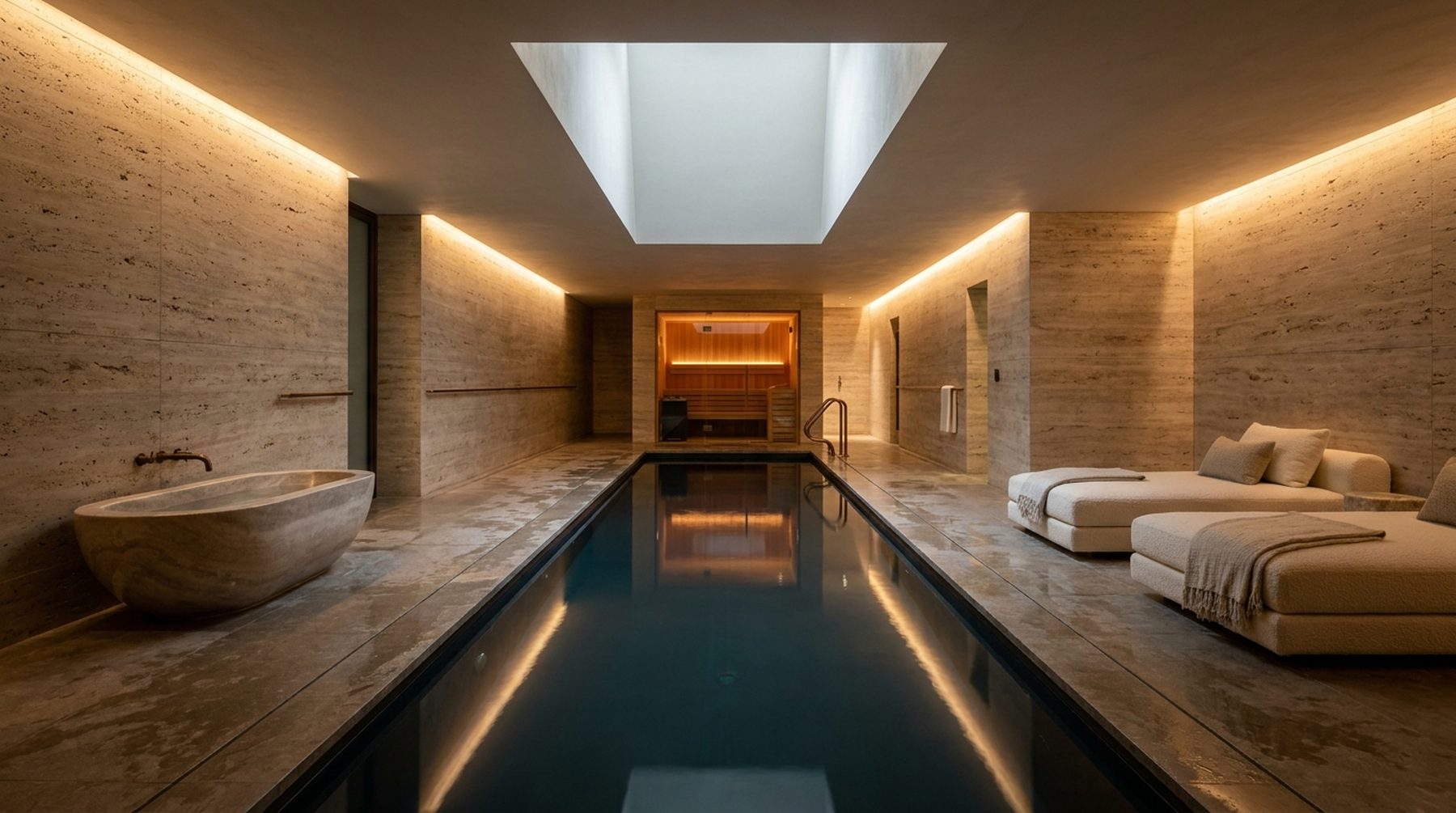
If you want to dehumidify an indoor home pool, start with one number: 50 to 60 percent relative humidity. Below that, swimmers feel chilled when they step out of the water. Above it, the air gets heavy, the glass fogs, and moisture starts travelling into places you never meant it to go. Everything else in this article is about how to hold that range all year without turning the pool hall into an engineering experiment.
I have seen two kinds of pool rooms. In the first, the air was planned together with the architecture, and the glass wall stays clear on the coldest morning. In the second, the pool was built first and “the ventilation will be sorted out later.” Later usually means a suspended ceiling replaced after a few years and a dehumidifier bolted on as a patch.
Where the moisture comes from, and why windows fog first
All the moisture in a pool hall comes from one place: the water surface. The warmer the water and the drier the air above it, the faster it evaporates. Manufacturers of pool air systems give two figures worth remembering: a 10 percent drop in relative humidity raises evaporation by more than 30 percent, and warming the water by just 2 degrees adds roughly 7 percent.
Glass is the coldest surface in the room in winter. When its temperature falls below the dew point of the room air, water settles on it as droplets. The window is not the culprit, it is the indicator. Fogged glass usually means warm, dry air is not reaching it. Condensation on walls or in corners points to a different problem: poor insulation and thermal bridges. The two are fixed differently, and mixing them up is expensive.
Dehumidifier or ventilation with heat recovery
A refrigerant dehumidifier pulls moisture out of the room air and returns it warmer. It is compact, simpler and cheaper to buy, and for a small private pool where a large flow of outside air is not needed, it is a sound choice. Its weakness is that it does not change the air. It brings no fresh air and does not remove chloramines, the by-products of water disinfection that cause the typical “pool smell.”
A ventilation unit with heat recovery extracts warm, humid air, supplies dry outside air and recovers the heat of the exhaust. It handles dehumidification, air exchange and energy savings together. The price is more space for the unit, ducting across the hall and more serious controls.
My position: if the pool is used every day and there are bedrooms and expensive finishes next door, I do not recommend a dehumidifier on its own. I see it as the right tool for a pool that was already built without ventilation and needs rescuing, not for a project that starts from a blank sheet.
Air distribution: how to keep glass clear
Most failures happen here. You can size the unit perfectly and still get wet windows, because the air is delivered to the wrong place. Warm, dry air should sweep across the glazing, especially the lower part of a glass wall and the frames. With large windows the supply grilles belong along the glass, not wherever is convenient in the ceiling.
That is why we design pool hall ventilation together with the architecture: window positions, sill zones, niches for grilles and service shafts all shape the duct routes.
Vapour barrier and materials
The sneakiest damage is the kind you cannot see. Humid air migrates into the building envelope. If the vapour barrier in the ceiling and walls is poor, the insulation gets wet and loses its properties, and ceiling hangers corrode in the chlorinated, humid air. The usual list of pool-hall problems is always the same: condensation on windows, soaked insulation, rusted hangers and sagging ceiling panels.
The rule for the project: the vapour barrier must be a continuous layer with properly designed junctions, all metal parts must suit an aggressive environment, and the ceiling finish must tolerate constant humidity. Discuss this with the contractor before materials are ordered, because a barrier defect can only be fixed by opening the ceiling.
Pool cover: a helper, not a replacement
A cover, roller shutter or slatted blind on the water limits the evaporating area when nobody is swimming. Less open water means less moisture in the air and less heat leaving with the vapour. For a house where the pool sits idle for days, the saving is noticeable. But a cover does not replace ventilation or dehumidification while people are in the water: swimmers, splashing and warm water create the peak load the system is designed for.
How to care for the pool hall: a practical checklist
Check the glass first. Fogging in the lower part of a window is the earliest sign that air distribution needs adjusting.
Keep a humidity reading. A simple hygrometer in the hall tells you more than any complaint from the family. Aim for the 50 to 60 percent range.
Use the cover. Close it whenever the pool is idle for more than a few hours.
Do not overheat the water for guests. Each couple of degrees raises evaporation noticeably.
Service the filters and the heat exchanger on the schedule the manufacturer sets, and inspect metal hangers and fixings in the ceiling void periodically.
Watch the neighbours. If you smell chlorine in an adjoining room or see parquet lifting, moisture is escaping the hall.
Our approach
We treat the pool hall as a separate engineering zone, not as a pretty room with water. First the evaporation and load are calculated, then the decision between air exchange with heat recovery and a stand-alone dehumidifier, and only then the glazing, the ceiling layout and the grille positions. If you already have a pool and the windows are crying, write to us on WhatsApp or by email: we will look at where the air is being lost and tell you honestly whether re-routing the supply is enough or a different unit is needed.
FAQ
What humidity should an indoor home pool have?
Most guidance puts it at 50 to 60 percent relative humidity. Below 50 percent swimmers feel cold when they leave the water, above 60 percent the air feels heavy and vapour spreads into the structure and neighbouring rooms. A designer sets the exact target for your hall and water temperature.
Is a dehumidifier enough for a private indoor pool?
For a small pool that is used occasionally, often yes. For a pool used daily, a ventilation unit with heat recovery is better, because it also brings in fresh air and removes chloramines, which a dehumidifier alone does not do.
Why do the windows fog even though the dehumidifier is running?
Usually warm, dry air is not washing the glass, so the glass cools below the dew point. This is an air distribution issue rather than a capacity issue. Supply grilles should run along the glazing.
Does a pool cover replace dehumidification?
No. A cover cuts evaporation while the pool is idle and lowers the load on the system, but when people are swimming you still need ventilation or dehumidification.
How warm should the air be compared with the water?
Guidance usually says at least 2 degrees Celsius warmer than the water, with some sources giving a band of up to 4 or 5 degrees. The exact figure comes from the design calculation for your hall.

Author

Next step
Discuss your project
An hour at the studio with Oleg Reznikov: your site, your brief and relevant studio projects.