
Infrared vs Traditional Sauna for a Home: How to Choose
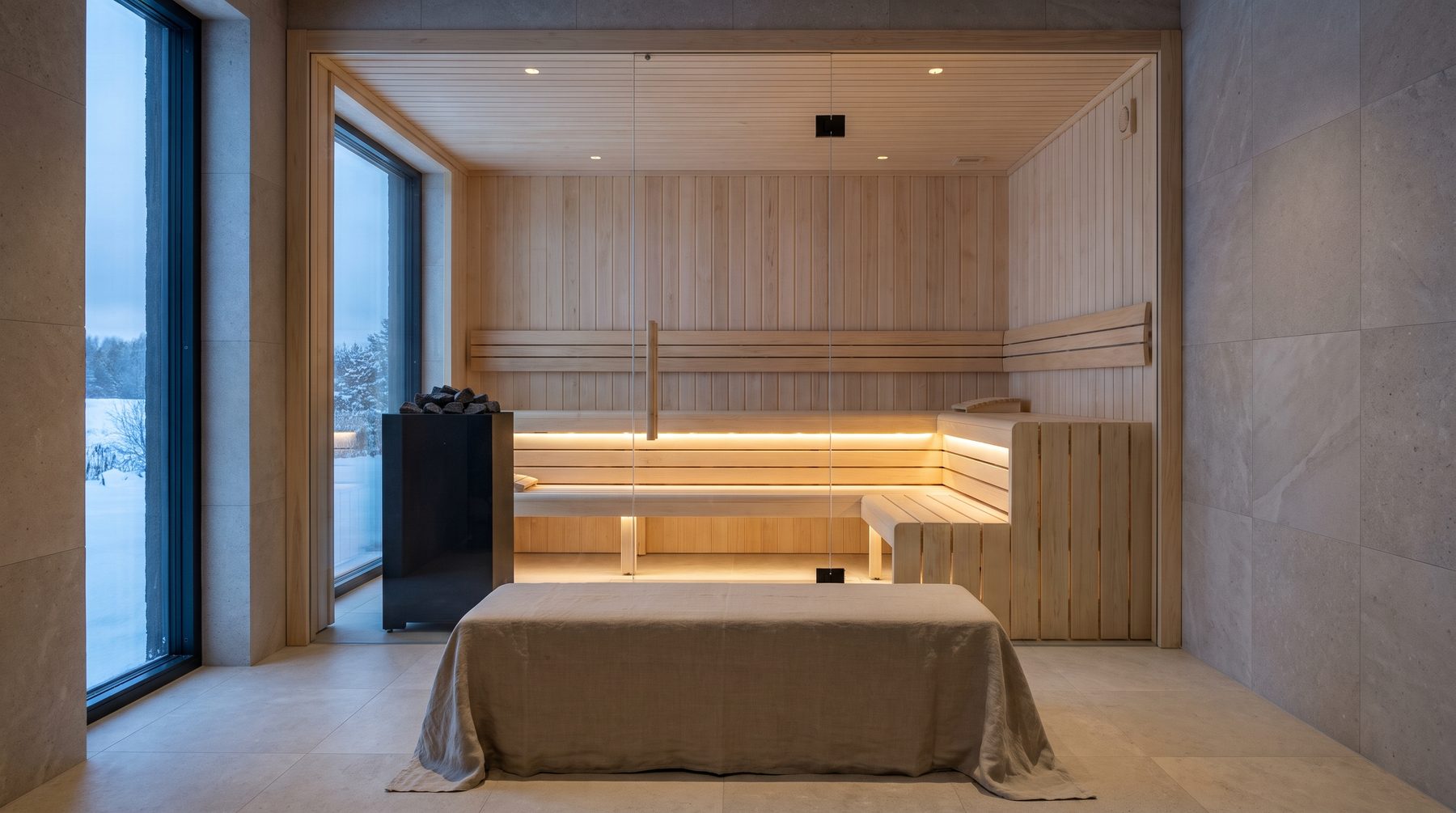
A client once put a catalogue on my desk and asked the question everyone asks: infrared vs traditional sauna for a home, and why does the second one eat so much space and power? The honest answer starts with physics. An infrared cabin heats your body directly. A traditional Finnish sauna heats the air. Everything else follows from that: temperature, wattage, ventilation, room size, and the way you will actually use it.
In short: an infrared sauna is quicker to install, draws roughly 1.5 to 3 kW and needs little ventilation planning. A Finnish sauna gives real heat and steam, but asks for 6 to 9 kW, a dedicated circuit and carefully designed airflow. Here is how that plays out in a house.
What actually differs
A Finnish sauna has a stove with stones. It heats the air to about 65 to 90 °C, the air heats the wood and you. The room needs 30 to 45 minutes to warm up, and you can throw water on the stones for steam. It is a ritual: in, out, cool down, in again.
An infrared cabin works differently. Emitters in the walls deliver heat straight to the body while the air stays noticeably cooler, usually 40 to 60 °C. Warm-up takes 10 to 20 minutes. There is no steam, and that is not a flaw but a different format: you sit longer, sweat more gently, and the session is easier on the heart rate.
These numbers come from manufacturer data, and individual models vary, so always read the spec sheet of the exact unit. Retail guides claim infrared heat is “deeper” and “removes more toxins”. I found no independent evidence for that. Treat it as marketing.
Electrical requirements for a home sauna
An infrared cabin for one or two people typically draws 1.2 to 1.5 kW, for four or five people 2.5 to 3 kW. You need a dedicated circuit with proper protection, but you rarely have to rebuild the panel.
A Finnish electric heater for a small cabin takes 6 to 9 kW. That means its own power cable from the panel, often three-phase, its own breaker and a tidy route to the room. If the house is being designed, we put this line in at the engineering stage: cutting into finished walls for a single heavy cable is expensive and messy. In an existing house, a Finnish sauna can run into the property’s allocated power, and then your conversation is with the utility, not the heater supplier.
Ventilation and moisture
An infrared cabin does not need forced ventilation. The room should simply be able to breathe and should not be sealed or damp. A Finnish sauna works with steam, so it needs fresh air coming in low and an exhaust high on the opposite side. Heater manufacturers publish their own ratios, for example inlet area per kilowatt and 6 to 10 air changes per hour. These are vendor recommendations, so the final scheme must be calculated for your room and checked against the project.
Here is where most people go wrong: a vapour barrier is built where it is not needed, and the sauna exhaust is joined to the bathroom duct. A year later there is mould above the door and the owner blames the wood.
Where to put it and what to build around it
A Finnish sauna is heavy and wet. We place it next to other wet rooms, on the ground or lower level, with a waterproofed floor, a drain and a glass front so the rest room stays bright. Stone or large-format porcelain with tight joints works well around it.
An infrared cabin is simpler: a flat dry room, a power line and the clearances stated by the maker. It can sit in a dressing room or master bath, and we like giving it a glass front so it reads as part of the interior rather than a box.
How to care for and run each type
Infrared cabins need little: wipe the benches, check the emitters, keep water off the panels. A Finnish sauna asks for a routine. Leave the door open after each session so the wood dries, check the stones once a year or two and replace heating elements when they wear. Running a 6 to 9 kW heater for half an hour before use costs noticeably more than a short infrared session, but that is the price of real heat and steam.
A short checklist before you decide
Ask who will use it, how often, and for how long. Check the available power on the site. Decide where the rest area and shower go. Read the spec sheet of the exact model, not a review. And ask your doctor first if you have any heart condition.
What the health research says
The best-known study is Finnish: about 2,300 men followed for roughly twenty years. Those who used a sauna four to seven times a week had a lower risk of fatal cardiovascular events than those who went once a week. But these are Finnish saunas and Finnish men, and healthier people tend to go more often, so cause and effect are hard to separate.
For infrared cabins the data are thinner. A 2018 systematic review in Clinical Cardiology found short-term improvement in cardiac function in heart failure patients, and its authors asked for longer studies. On this evidence you cannot rank infrared above Finnish or the other way round.
Our approach
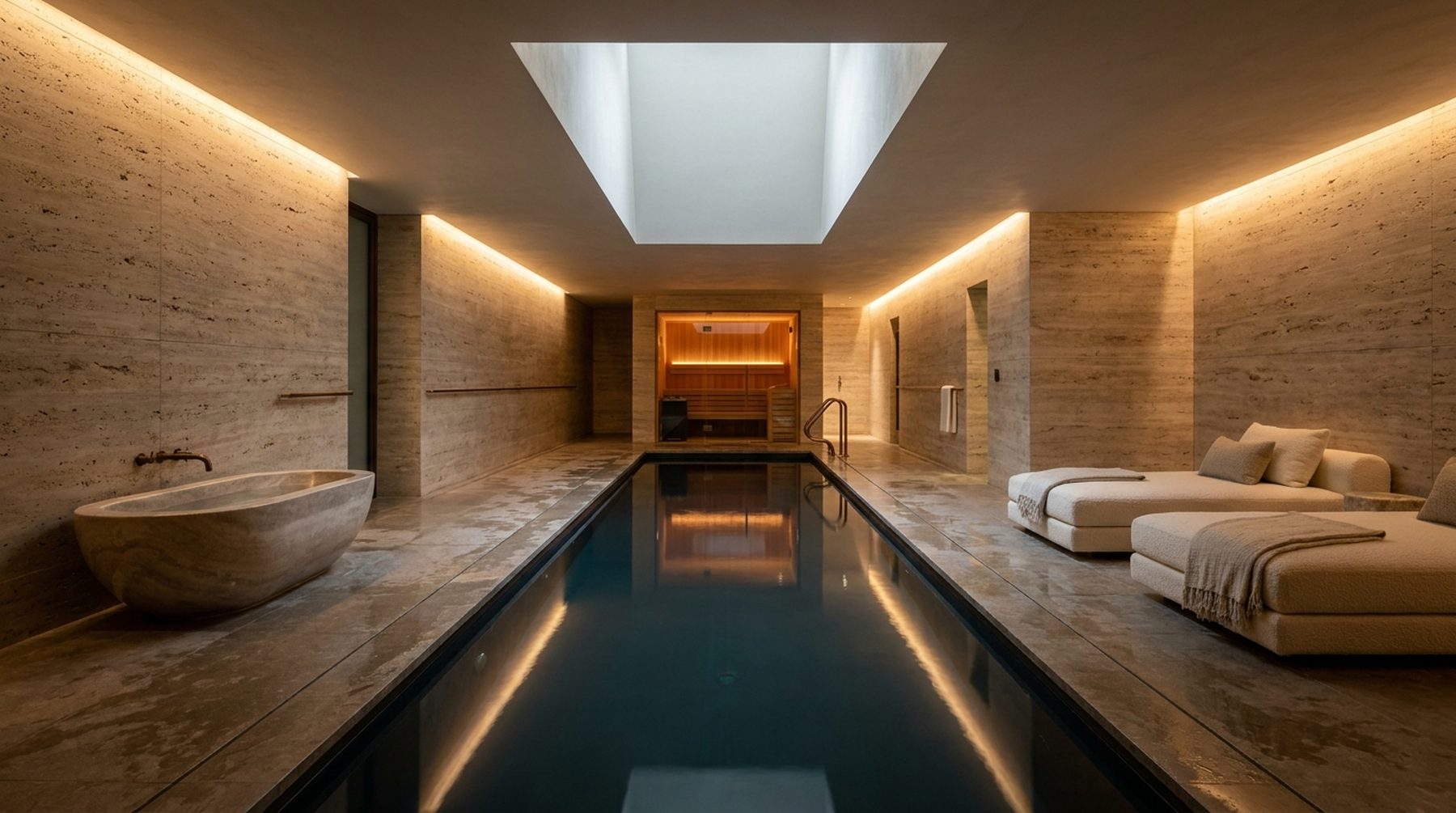
We start with the scenario. If the family gathers for steam at weekends, we choose a Finnish sauna, calculate power and airflow and design the room around it. If the need is a short daily warm-up, especially on an upper floor or in a finished house, we recommend infrared. A third option we like is both in one spa zone: Finnish as the event, infrared for weekdays. It sits well beside a hammam and a cold plunge, and we described the wider idea in our piece on the home wellness floor.
FAQ
Which is better for a home, infrared or traditional sauna?
Neither wins universally. Traditional suits people who want high heat and steam and can give it a 6 to 9 kW circuit and ventilation. Infrared is simpler to install, draws 1.5 to 3 kW and warms up in 10 to 20 minutes, which suits daily use and limited space.
Does an infrared sauna need ventilation?
Usually not forced ventilation, but the room must not be sealed or humid. Being able to air the room is enough. Check the exact requirements in the model’s manual and with your electrician.
How much power does a home sauna use?
An infrared cabin for one or two people draws 1.2 to 1.5 kW, for four or five people 2.5 to 3 kW. A traditional electric heater takes 6 to 9 kW and needs a dedicated, often three-phase, line. Check the available power before buying.
Can I add a sauna to a house that is already built?
An infrared cabin usually yes, if there is a dry room and spare electrical capacity. A Finnish sauna needs cabling, ventilation, waterproofing and sometimes floor reinforcement, so it is best planned at the design stage.

Author

Next step
Discuss your project
An hour at the studio with Oleg Reznikov: your site, your brief and relevant studio projects.