
Onyx vs. Marble: Why the Underdog Wins
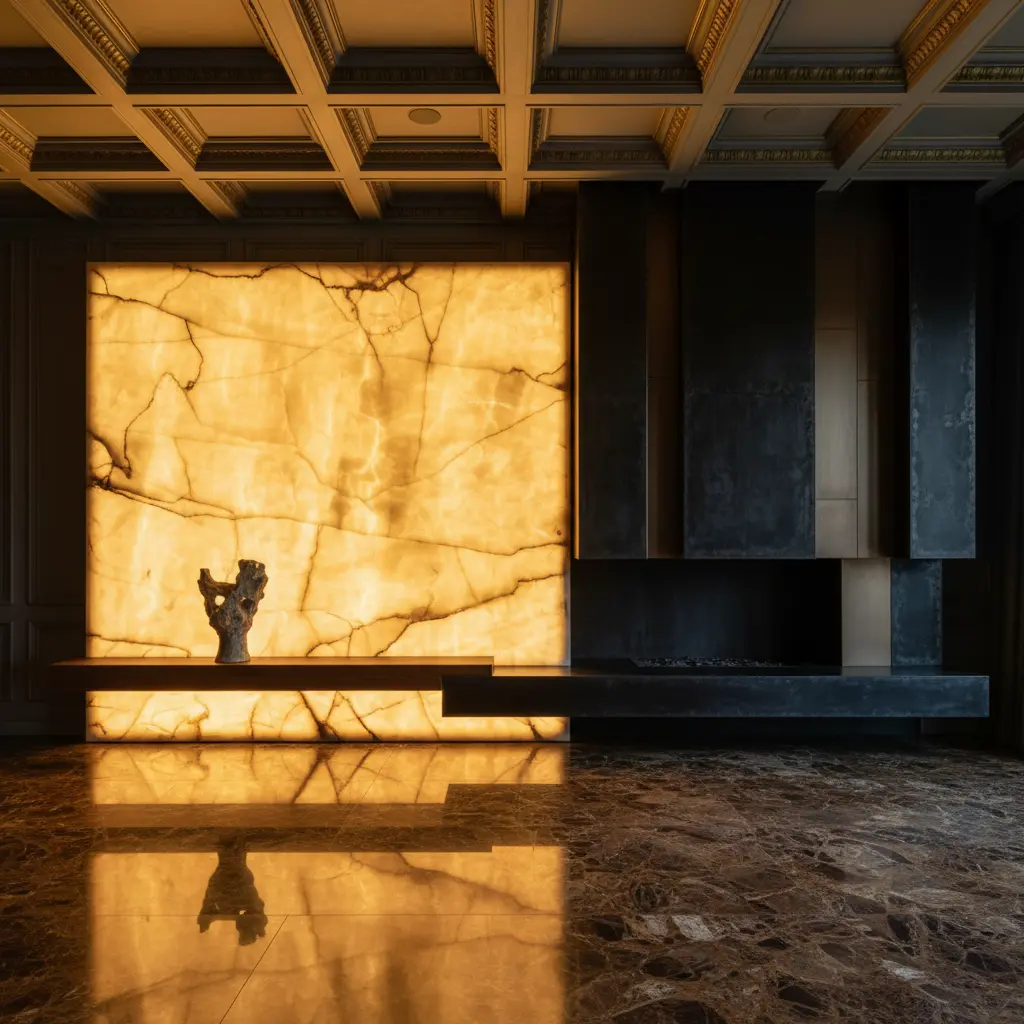
I had a conversation with a client—a man building his third house, accustomed to the best, accustomed to marble. We’re sitting, discussing the living room, and he says: “Oleg, I want the wall behind the fireplace to look like nothing else in this city.” I’m silent for ten seconds. Then I say: “Then forget about marble. You need onyx—a premium estate interior isn’t made of obvious materials.” He looked at me like I’d just suggested covering the walls with shell rock.
And six months later he sent me a photo of his backlit onyx wall at night. Without a caption. Just a photo.
This article is about why marble remains the first choice for 90% of wealthy clients—and precisely why that means it loses. Not in quality. In uniqueness. I’ll be honest: where onyx works, where it turns into an expensive mistake, and how we at the studio decide which material to put in the main place in the house.
Why Marble Became the “Safe Choice”
Marble is an intelligible language of wealth. Carrara, Calacatta, Statuary—these names are known even by those who’ve never held a stone sample in their hands. A client comes in and says “marble,” and everyone nods: yes, expensive, yes, noble, yes, classic.
The problem is that marble today is everywhere. In bank lobbies. In premium shopping malls. In apartments for 30 million and apartments for 300. The difference is only in grade and slab thickness.
When you walk into a house and see a marble portal—you’ve seen it a hundred times. Maybe better or worse executed. But you’ve seen it.
This isn’t a bad material. It’s a material that stopped surprising.
What Onyx Really Is
Onyx isn’t “marble with different veining.” It’s a completely different story. Geologically—a calcite rock formed by slow mineral precipitation in underground voids. Semi-transparent. Layered. With an internal pattern that can’t be repeated even in the neighboring slab from the same block.
Here’s the key word—semi-transparent. Light passes through onyx. And when you place the right temperature strip behind the slab—the wall stops being a wall. It becomes a light object.
Marble can’t do that. It never could. And it never will.
Our most sought-after varieties are honey onyx (warm amber light), green Pakistani (dramatic, for studies), white Iranian with grey veining (for those who want “like marble, but not marble”).
Onyx in a Premium Estate: Where It Works
Right away I’ll say—onyx is not for everything. It’s not a default material, it’s an accent material. One object per house. Two at most.
Wall behind the fireplace in the living room. Classic. Especially when the fireplace is gas or bioethanol—live fire and onyx backlighting together work poorly, they compete. Gas fire is more subdued, and the backlighting reads cleanly.
Wine cellar or bar. A backlit onyx bar in a dimly lit space is what makes guests stay until three in the morning. Proven.
Master bathroom. Wall behind the bathtub, a panel, sometimes—a sink entirely. Here’s what matters: onyx fears acid, lemon juice will leave a stain in a minute. Not for a family with small children.
Bed headboard. Rarer, but one of my favorite scenarios. Soft, warm backlighting—the bedroom becomes something cinematic.
Where onyx doesn’t work: kitchen countertops (soft, scratches easily, stains), floors in high-traffic zones, exterior elements, guest bathrooms with active use.
Why Onyx Is Technically More Difficult (and More Expensive to Install)
Here’s where it gets interesting. The onyx slab itself costs comparably to good marble—sometimes more, sometimes less, depending on grade. But the story isn’t in the stone price.
Onyx is fragile. Very. A slab 2700×1700 at 20 mm thickness can crack from an incautious movement. That’s why almost always—double reinforcement with mesh on the back, sometimes backing with an aluminum honeycomb. This adds to the slab cost.
The backlighting is a separate project. You can’t just screw a strip behind it. You need a light box with even diffusion—otherwise “strips” from the diodes will appear on the wall. You need to test light temperature on the specific slab: warm onyx with cool backlighting gives a dirty-green tint. Cool onyx with warm backlighting—a murky yellow.
We always do a test backlight before installation. We lean the slab against the wall, put temporary light up, look in the evening. Sometimes we change the slab. Sometimes we adjust the strip temperature by 200 kelvins and hit the mark.
With marble, none of this is needed. Brought it, polished it, put it up. That’s the difference.
Typical Client Mistakes with Onyx
In twenty years I’ve seen every possible way to ruin an onyx wall. I’ll list the most common ones.
Mistake One—saving on backlighting. The client agrees to onyx, sees the estimate and decides “we’ll put in regular light, we’ll figure it out later.” You won’t figure it out. Without proper backlighting, onyx looks like second-rate marble. Money wasted.
Mistake Two—backlighting everywhere. The opposite story. “Since we’re doing it—let’s backlight from all sides.” The wall ends up glowing like an airport advertising light box. Backlighting should be one. Maybe adjustable. Maybe with two scenarios (day/night). But not “illumination.”
Mistake Three—too much onyx. Onyx fireplace, onyx bar, onyx headboard, onyx sink. That’s not premium anymore, that’s a mineral museum. One accent per one space—the rule I repeat to every client.
Mistake Four—ignoring the pattern. Onyx is a pattern. Before sawing the slab, you need to see it in person and decide where the central composition will be, where the joints, how to unfold a “book match” with symmetric sawing. That’s the architect’s work, not the mason’s. If the installer does it “as usual”—you get a beautiful stone sawn any old way.
Mistake Five—improper care. Acidic cleaners, abrasives, regular Mr. Clean. After a year—a matte wall with stains. Onyx is washed with special chemistry for natural stone, pampering yearly. It’s not complicated. But you need to know about it.
Onyx or Marble: How We Choose at the Studio
When a client comes in with a request for “expensive natural stone in the living room,” I ask three questions.
First: do you want guests to recognize the material? If yes—marble. Calacatta is read instantly, it’s a status signal.
Second: do you want guests to stop and ask “what is that?” Then onyx. It’s always a question. Always a conversation.
Third—and it matters more than the first two: are you ready to invest in execution? Because poorly done onyx is worse than well-done marble. Much. If you have a budget for the stone but not for light design and careful sawing—I honestly talk you out of onyx. Better to do a neat marble portal than a mediocre onyx wall.
In our practice the ratio is roughly this: out of ten clients considering onyx, three do it. The rest either go back to marble or pick complex travertine varieties or aggregate with interesting texture. That’s normal. Onyx isn’t for everyone. And that’s part of its value.
The Paradox of “One of a Kind”
We had a project—a country house near Istra, 1200 square meters. The client initially wanted marble everywhere, “like at the Bvlgari hotel.” We spent two weeks arguing, I showed references. Eventually we compromised: Calacatta marble in bathrooms and floors, but the main wall in the living room—onyx. Honey-colored, Iranian, with 2700K backlighting.
A year later they shot the house for an interior magazine. Guess what made the cover.
That’s the paradox. Marble is the foundation, the background, the grammar of language. Onyx is one strong word, for which they read the entire text.
Clients building their first big house almost always choose “everything best”—marble everywhere, oak everywhere, brass everywhere. Those building their second or third learn to sacrifice evenness for accent. They understand that luxury isn’t the density of expensive materials, it’s intelligent pauses between them.
Onyx is an accent. Maybe the strongest accent available in natural stone right now.
What’s the Verdict
Marble hasn’t lost. Marble remains the first choice—and in most scenarios it’s the right choice. Durable, intelligible, proven.
But if you’re building a house that you don’t want to be “like all wealthy people”—look at onyx. Not everywhere. In one spot. Where the eye stops, where the family gathers in the evening, where guests have their second glass and the conversation slows.
That one wall will change the whole house. Not because it’s expensive. Because there isn’t another one like it anywhere.
If you’d like to discuss where such an object might appear in your project—write to us. We’ll bring samples, show how they behave under different lighting, and honestly tell you whether you should mess with onyx or stick with marble. Without selling for sales’ sake—we both want a result you’ll be proud to show your friends.

Author

Next step
Discuss your project
An hour at the studio with Oleg Reznikov: your site, your brief and relevant studio projects.