
Terrazzo Flooring at Home: Types, Care and Sealing
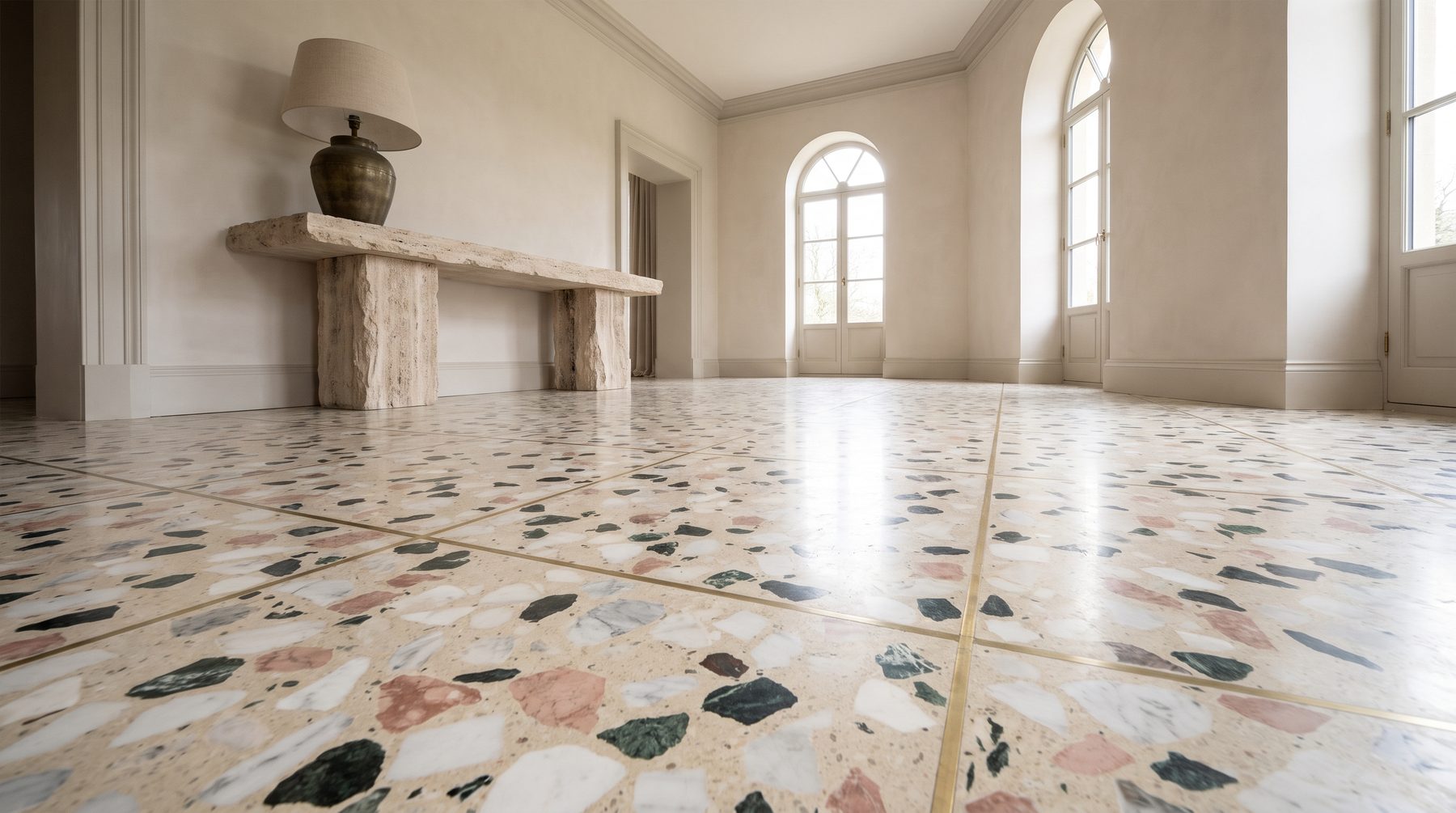
Terrazzo flooring is a surface made of marble, granite or glass chips set in a cement or epoxy binder and ground smooth. It is back in the best houses because it hides daily wear and gives every floor its own pattern. It stays beautiful only if three things are decided early: the binder, the finish and the joints.
A client once brought a palm-sized sample to the site and said, “I want a floor like the one in that Milan bakery.” The sample was lovely: big green and pink chips in a pale matrix, polished like silk. I asked where the floor would go. It turned out to be the entrance hall, where wet boots come in with de-icing salt every November. We talked for half an hour. The floor was built, but it was not the floor in the sample.
What terrazzo actually is
Venetian workers invented it by not throwing away marble offcuts. They pressed the leftovers into mortar and ground the surface flat. Today the formula is the same: aggregate (marble, granite, glass), binder (cement or epoxy) and a finish (honed or polished). Everything else depends on how it is built, not on the name.
The word covers three different things. Poured-in-place terrazzo is cast on site and ground. Terrazzo tile is the same mix made in a factory. And porcelain “terrazzo-look” tile is only a printed pattern. Comparing prices and properties across the three makes no sense, and estimates mix them up all the time.
Poured terrazzo or tile
Poured terrazzo is seamless in spirit, and you draw the visible lines yourself with brass or zinc divider strips. The usual strip is about 1/8 inch (3 mm), though industry guides list anything from 18 gauge to 1/2 inch. Panel size depends on the base: roughly 5 ft or less on a sand cushion, and 6 to 8 ft on a bonded system. This is not a matter of taste. It is crack control.
Tile installs faster and is easier to repair, but it brings back the joints you wanted to avoid in a large room. For a bathroom or a dressing room, tile is often the honest choice. For a grand hall, I would pour.
Cement binder gives the classic soft, matte look but is porous and sensitive to acids. Epoxy is denser, takes brighter colors and can be laid thinner. Industry specifications call for roughly 1/4 inch (6 mm) minimum for epoxy and 1/2 inch (12 mm) for cement, so heated floors and wooden structures must be discussed before the design is frozen.
Three mistakes that spoil a terrazzo floor
The first is gloss. Polished terrazzo is slippery when wet, and nearly every manual says so. For an entrance, a shower room or a terrace choose a honed finish. Keep high polish for dry living rooms and corridors, especially if children or elderly parents live in the house.
The second is the wrong cleaner. Vinegar, citric acid and many all-purpose products etch the cement binder and leave dull patches. The chips then start to stand out like teeth.
The third is hiding the joints. A client asks for “no lines”, the installer pours sixty square meters without dividers, and a season later the floor is a road map of hairline cracks. Joints should be planned. Well placed brass lines read as drawing, not as a defect.
How to care for terrazzo
Terrazzo is durable, not invincible. Use this routine:
- Sweep or dust-mop daily. Grit works like sandpaper under a mop.
- Damp-mop weekly with a pH-neutral stone cleaner. Use a well wrung mop, not a wet one, and dry the floor afterwards.
- Wipe up wine, juice and anything acidic immediately.
- Reseal on the installer’s schedule. Sources quote one to three years for cement terrazzo, sometimes longer for dense epoxy. Prefer a penetrating sealer to a topical coat that can yellow.
- Never use vinegar, lemon, bleach or abrasive powders.
Where terrazzo beats stone, and where it does not
In a hall or kitchen terrazzo is better than natural stone because the speckled surface hides dust, scratches and fingerprints that show instantly on marble or travertine. In a shower it works with a honed finish. On stairs it needs texture and an anti-slip nosing.
It is worse wherever you want a perfectly calm plane. Terrazzo always speaks, and everything else in the room should stay quiet: plain plaster, light wood, soft light. Add striped marble and patterned tile and the room starts to shout.
How we choose terrazzo for a project
We never approve a catalog picture. First we draw the layout: where the dividers run and where the panels end. Then we order two or three samples of at least 30 cm, look at them in day and evening light and test them with water. Finally we ask the installer for a trial panel on the real base. It answers questions no catalog can. Terrazzo likes patient clients, and every time it returns to fashion, the projects that survive are those where the material was chosen for the place. If you have a sample you love, send it to us and we will tell you where in your house it works and where it does not.
FAQ
How often should terrazzo be sealed?
It depends on the binder and traffic. Manufacturers and guides quote anywhere from one to three years for cement terrazzo, and less often for dense epoxy systems. Your installer sets the exact schedule, and the floor must be cleaned with a neutral product before sealing.
Is terrazzo slippery?
Polished terrazzo is slippery when wet. For entrances, showers and terraces choose a honed or lightly textured finish, or add an anti-slip treatment. Keep the mirror polish for dry rooms.
Can I use vinegar to clean terrazzo?
No. Vinegar and other acids etch cement-bound terrazzo and leave dull patches. Use a pH-neutral stone cleaner and a damp mop.
Can terrazzo go over underfloor heating?
Yes, but the system must be chosen in advance: layer thickness, binder, divider spacing and how the base warms up. Agree these with the installer and the engineer at the design stage.
What is the difference between terrazzo and terrazzo-look porcelain?
Real terrazzo contains actual marble or granite chips in a binder and is ground smooth. Porcelain tile only imitates the pattern. It is easier to lay and clean, but it has no depth and cannot be spot-repaired.

Author

Next step
Discuss your project
An hour at the studio with Oleg Reznikov: your site, your brief and relevant studio projects.