
Road Salt and Natural Stone: What Winter Does to Steps
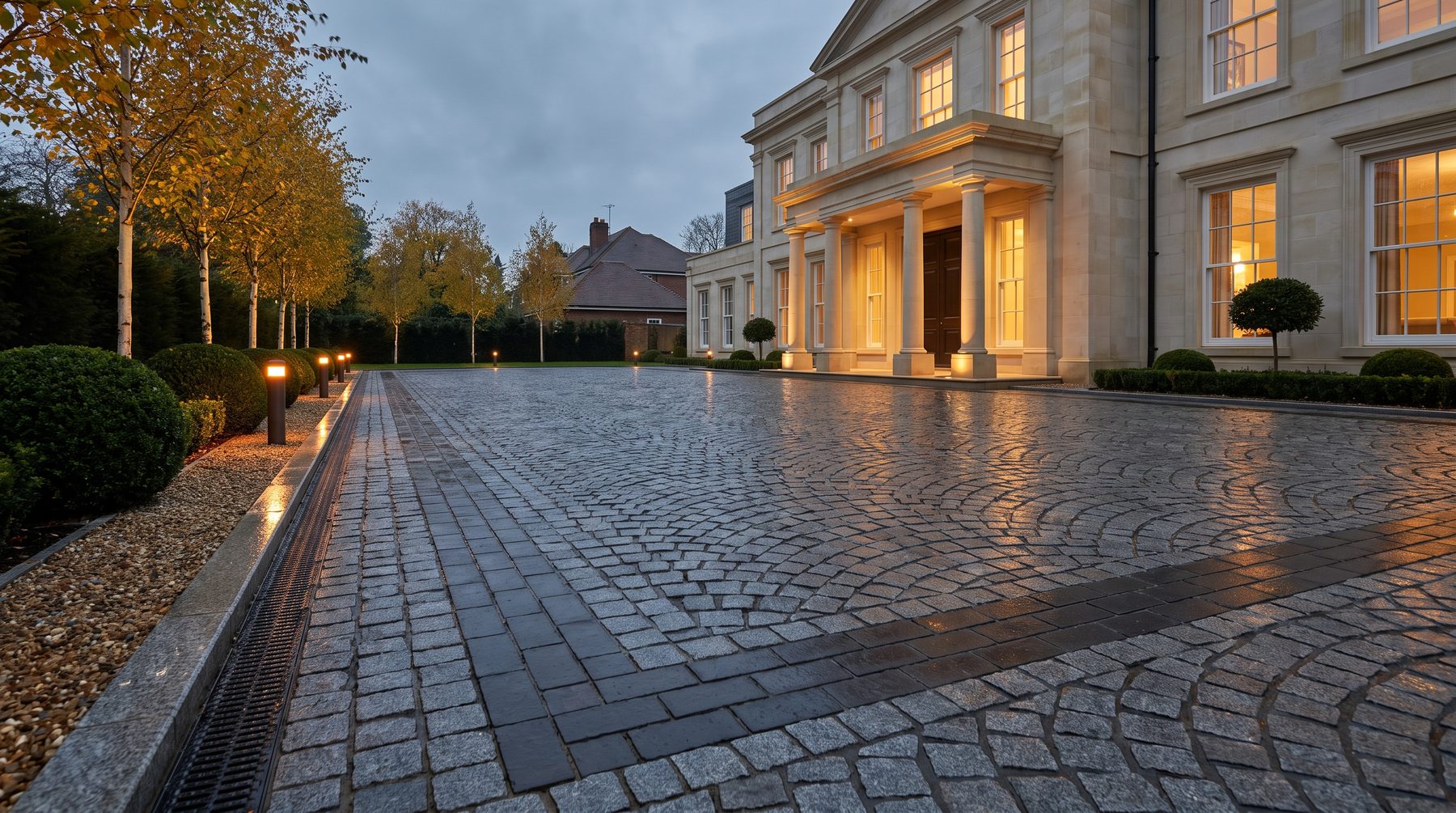
De-icing salt on natural stone is the quiet winter problem nobody mentions at the sample table. Granite steps look the same in March as they did in October. A limestone or travertine step beside them can be white with salt bloom, flaking at the edge, with grout joints turning to crumbs. Here is which stones are afraid of salt, what to use instead, and what to do before the first snow rather than after it.
A client came back to us in spring with a porch we had followed through construction. The pale limestone steps had been handed over in October, and he loved how the stone caught the evening light. By March grey patches had appeared and the lower nosing felt like sandpaper. The caretaker, a conscientious man, had been scattering exactly the mix supplied by the village management company. The stone was not defective. Nobody had told the house that winter has a chemistry of its own.
What salt actually does to stone
Salt does not dissolve stone the way acid does. The mechanism is slower and nastier. The de-icer dissolves in meltwater, the solution travels into the pores, and when the stone dries the salt crystallises inside. A crystal takes up more space than the solution it came from and pushes on the pore walls from within. The next thaw brings a fresh dose of solution, the next frost adds the pressure of ice. After a few cycles a thin skin comes off the surface and the stone scales. Conservators call this salt crystallisation, and it is regarded as one of the main causes of decay in masonry.
That leads to the point that matters more than any table: the enemy is porosity, not salt as such. The more open pores a stone has and the deeper water travels into it, the more it suffers. The same sprinkle of de-icer is harmless to one stone and ruins another in three winters.
Which stone is afraid of road salt, and which is not
Granite and gabbro have almost no open pores. Water does not travel in, so salt has nowhere to crystallise. These are the most dependable stones for steps and a winter drive, which is why we usually specify them for the approach to a house.
Limestone and travertine sit at the other end of the scale. They are carbonate rocks with open porosity. Travertine has voids you can see, factory-filled with resin or filler, but the path for water remains. People who work in stone protection say plainly that for highly porous stones such as travertine, limestone and some sandstones no sealer gives the protection that low-porosity granite has by nature. A sealer lowers the risk. It does not cancel it.
Marble is denser than limestone but reacts to acids, and winter adds frost and edge impact to the list. We have already written about how marble reacts to stains and etching indoors; outside the same rules apply, only harsher.
Sandstone and bluestone tend to flake in layers. For them the winter scenario looks like limestone’s: salt and ice working together.
Here is where most people go wrong. Stone for a porch is chosen for colour and texture, looking at a sample in a warm showroom, and nobody discusses the climate of the plot. Yet a cold continental winter brings many freeze-thaw cycles, and for a light porous stone that is a heavier load than most owners expect.
What to put on steps instead of salt
Most de-icers are built on sodium chloride, ordinary technical salt. To keep working in hard frost, blends add calcium chloride, and such mixes stay active down to about minus thirty. Magnesium versions are often sold as gentle. For porous stone, all chlorides are bad in the same way: they dissolve easily, travel deep into the pores and stay there.
Practical guidance helps here. A New York organisation that protects historic buildings, and spends decades dealing with stone steps, advises shovelling snow first and using a de-icer sparingly. By its figures, plain rock salt stops melting ice somewhere below about minus nine degrees Celsius, so in real frost it is not just harmful but useless.
What people use instead:
- Sand and fine grit. They do not melt ice, but they give traction and dissolve nothing in the stone. Downsides: sand must be swept up in spring or it clogs drains, and a sharp coarse grit can slowly wear soft limestone.
- Calcium magnesium acetate (CMA). The gentlest chemical melter, it works at noticeably low temperatures and does not harm plants. It is expensive: international guides put it at at least ten times the price of rock salt. For a porch of a few square metres that is trivial; for a two-hectare estate it is not.
- Urea. Works only in mild frost, roughly minus four to minus seven, and feeds the lawn and harms plants beside the steps.
- Heating. A cable under the steps and entrance zone solves the problem differently: no ice, no de-icer. We usually lay it only where it cannot be avoided, at the steps and ramp.
To be straight: there is no perfect de-icer for limestone. The best result is a combination: shovel, sand for grip, and spot treatment with CMA at the most dangerous points. If the contract with your village management company says “treatment with de-icers”, add an exception for your plot. It is cheaper than replacing a step.
How to care for stone steps in winter: a checklist
- Autumn, before the first frost: clean the stone, let it dry fully, and apply a penetrating water-repellent sealer. Do not use a glossy film coating: it makes steps slippery and the stone beneath still breathes poorly.
- Test first: treat a spare tile or a hidden corner and leave it a week in the rain. If a water drop still soaks in within minutes, the product or the coat is wrong.
- Joints: check the grout. It is more porous than the stone and salt destroys it first. Use frost-resistant flexible joint compounds and keep a slope so water does not stand between the slabs.
- During winter: shovel early, use sand for grip, CMA only where needed, and wash residue off during long thaws.
- In spring: rinse with clean water and let the stone dry. The white bloom that appears is salt coming out of the pores. Do not scrub it off with acid; it will eat carbonate stone deeper. Water and time work better.
- Every one or two years: renew the sealer, sooner on a driveway.
The mistakes we see most often
A pale travertine porch with no treatment and no talk of de-icers. Paving that is “frost-proof” but has a soft limestone edging right by the road. Steps cleaned with acid in spring to remove the bloom. Heating laid under the whole area because “it is simpler”, followed by a shock at the electricity bill. And a management company salting the entire village because nobody told it about the stone.
None of these takes serious money to fix if you notice before winter. After the first cycle the damage is already done, and a scaling step can only be restored by grinding, which removes stone.
Our approach
We do not forbid clients their favourite stone, but we talk about it honestly. For the entrance and winter steps we specify granite or gabbro: they cost more than limestone but need nothing except a shovel. Pale limestone and travertine we keep for terraces and covered areas where there are no de-icers and less water. If a client wants travertine at the door, we plan the sealer, the joints, the slope, heating where needed, and write a line about de-icers into the operating instructions. Not everyone reads that line. Those who do save themselves a season.
If you are choosing stone for an entrance now, or already have steps that raise questions, settle the winter plan before the first snow, not after it.
FAQ
Can I use salt on granite steps?
Granite has almost no open pores, so salt does not wreck it the way it wrecks limestone. It does damage grout joints, nearby lawns and shoes, and it stops working below about minus nine degrees. A shovel and sand are better, with de-icer only in spots and rinsed off in spring.
What is the best de-icer for travertine or limestone?
The safest option is sand or fine grit for traction. If you need a melter, choose calcium magnesium acetate: it is gentler than chlorides, though much more expensive. Any chloride, including calcium and magnesium types, lingers in the pores of porous stone.
Will a sealer protect stone from de-icing salt?
A penetrating sealer reduces water absorption and slows decay, but it does not make porous stone as resistant as granite. Apply it in autumn before frost and renew it every year or two. Glossy film coatings are not suitable for steps because they are slippery.
How do I remove white salt bloom from stone in spring?
Rinse with clean water and let the stone dry completely. The bloom is salt that has come out of the pores, and repeated rinsing usually reduces it. Never use acidic cleaners on carbonate stone: they dissolve the stone itself.

Author


Next step
Discuss your project
An hour at the studio with Oleg Reznikov: your site, your brief and relevant studio projects.