
Neo-Sensualism in Architecture 2026: Why Tactility Is Becoming the New Luxury

A client enters a house. Stops in the foyer. Silently runs his palm over the wall—rough travertine, which we kept from polishing to a gloss. And exhales. That exhalation is not from admiring the stone. It’s a physiological reaction: in two seconds, cortisol in his blood dropped measurably.
We observe this over and over. And that’s exactly why architectural trends 2026 premium home is shifting toward something that five years ago would have been called strange: from polished visual sterility to architecture that you want to touch, listen to, and breathe. This is called neo-sensualism. We call it the return of common sense.
In this article—why Instagram minimalism finally bored affluent clients, what 2025–2026 neuroarchitecture research says, which materials work on the nervous system and which just pretend, and where the line between luxury and decoration lies.
Why Visual Minimalism Stopped Working
For ten years, clients brought us references from the same sources: white box, panoramic glazing, concrete floor, black blade staircase. Beautiful in photos. Unbearable to live in.
Our practice had a telling case: a family moved into such a house and six months later asked to “do something about it.” They complained of fatigue, that “the house is loud”—although decibels were within normal range. The problem wasn’t noise. It was the absence of a tactile and acoustic anchor. The nervous system had nothing to latch onto—everything was smooth, everything reflected, everything had the same temperature sensation.
Research in neuroarchitecture (ANFA group work, updated in 2025, and Salk Institute data) shows a simple thing: the brain doesn’t rest in a visually perfect environment. It reads it as “incomplete” or “artificial” and maintains background tension. The same that’s measured by cortisol levels in saliva—and rises in minimalist interiors by 12–18% compared to spaces rich in textures.
Rich—not cluttered. These are different things.
What Is Neo-Sensualism and Why It’s Not “Cozy Minimalism”
Neo-sensualism is design through all five senses simultaneously. Not just sight, which got 90% of attention in architecture over the past twenty years.
The principle is simple: every surface a person interacts with physically should feel right. Every room should sound as it should. Air should have its own character in different zones of the house. Light should change temperature throughout the day without the owner’s involvement.
This is not a style. It’s a method. It can look like Japanese wabi-sabi, Alpine chalet, or a brutal villa on a cliff—visually different things. The common thread is the approach to materials and what we call the “sensory density” of space.
The Difference from “Warm Minimalism”
Warm minimalism is when you add oak flooring and linen upholstery to a white box. Checkbox done, client satisfied, architect got paid. But it works only until you start living in it.
Neo-sensualism goes deeper. We don’t think “what material to put” but “what physiological reaction does this surface trigger in a person who touched it at seven in the morning, barefoot, half-asleep.”
Feel the difference?
Materials That Work on the Nervous System
Not everything that looks natural works as natural. And vice versa—some “boring” materials do more for the psyche than expensive Italian marble with a wild pattern.
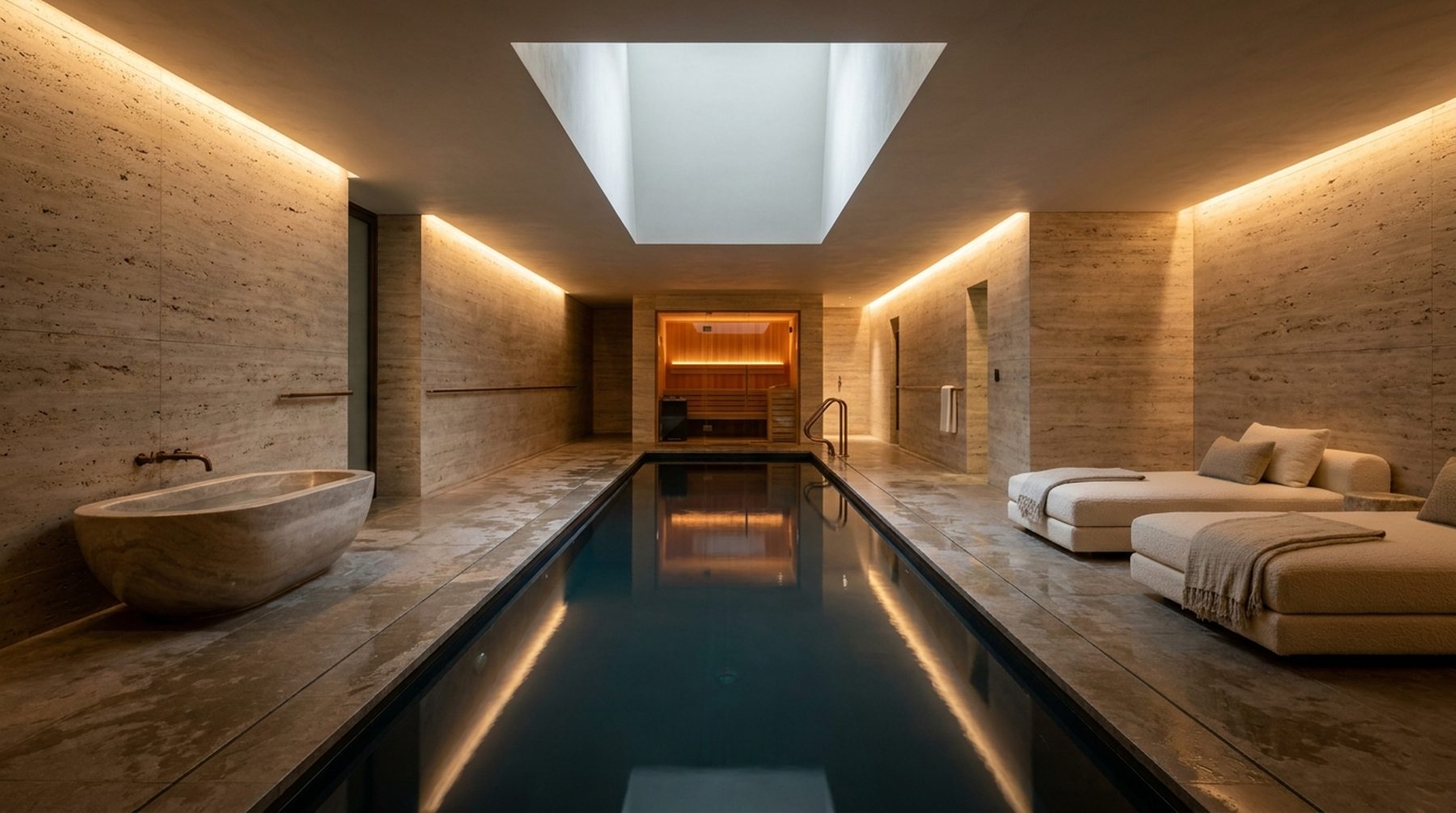
Stone with living texture. Travertine, Jurassic marble, sandstone—not polished to a mirror but with open pores and cut marks. The hand naturally reaches for such a surface. We’ve almost stopped using glossy polish on vertical surfaces in living areas—it visually cools the space and tactilely repels.
Wood that smells like wood. This sounds like a joke, but 80% of “oak” floors in premium homes are covered with varnish that completely kills the wood’s scent. Oil with wax—yes, it’s more expensive to maintain, yes, wine stains appear. But the house smells like home, not a furniture store. Our clients, once they’ve tried it, never go back.
Mineral-filled plasters. Tadelakt, Moroccan lime, Venetian without synthetics. A wall that breathes and you can stroke. The difference from paint is like cashmere to polyester.
Textiles as architectural elements. Heavy linen curtains floor-to-ceiling change a room’s acoustics more than any acoustic panels. And they look like part of the architecture, not a “problem solution.”
Metals with patina. Bronze that darkens. Brass that lives. Not varnished “forever”—but honest, aging with the house.
Acoustics: What Nobody Thinks About Until It’s Too Late
Ask acquaintances what they remember about the last impressive house. They’ll describe the view, materials, light. Nobody mentions sound.
Yet acoustics is 40% of the space experience. A reverberant hall with echo tires you in an hour. A hall with proper reverberation, where voice sounds full and steps don’t cut the ear—you want to stay there.
In our practice, we stopped treating acoustic design as an “option for a home theater” long ago. We do it for the living room. For the bedroom. For the stairwell—especially for it, because that’s where the unpleasant ringing echo happens that turns a three-story house into a well.
The tools are simple: the right ratio of hard and soft surfaces, room volume calculation, local use of acoustic plasters (invisible, they work like a regular wall), rugs where appropriate, and heavy textiles.
One of our projects last year—a 620 m² country house—we delivered with an acoustic passport for each room. The client first looked at it skeptically. After a month of living, he called and said: “Now I understand what I was paying for.”
Light and Air: Invisible Layers of Luxury
Neo-sensualism is also working with what can’t be photographed.
Circadian lighting. Light that changes temperature by itself: soft 2700K in the morning, working 4000K during the day, warm range again in the evening. This isn’t a gadget—it’s a mode embedded in the house’s scenarios. Your body stops fighting the lighting, and sleep improves within three weeks. The cortisol reduction data here is particularly telling.
Texture of light. Smooth ceiling light is an office. Home needs chiaroscuro. Wall sconces, directional light, candles (yes, regular candles—an underestimated architectural tool). Light points should be at different heights.
Air quality as an architectural solution. Supply ventilation with proper humidification is no longer luxury, it’s basic hygiene for a premium home. But we go further: we zone the air. Bedroom is cooler and drier, bathroom slightly warmer and more humid, living room neutral. Your body reads these transitions and relaxes.
How It Looks in Practice: Our Approach
We don’t start a project with layout. We start by asking how the client wakes up. How he drinks morning coffee. Where he relaxes after a flight. Which materials bring back good memories, and which cause irritation (and this happens—one client hated everything polished because he lived in a flat with a polished cabinet as a kid).
From this conversation, we create what we call the “sensory map of the house.” Where which textures, what acoustics, what light, what smells are appropriate. This becomes a document that runs through the entire project—from architectural solutions to door handle selection.
Handles, by the way, are a separate topic. Your hand touches a handle dozens of times a day. If it’s cold, small, and unpleasant—that’s quiet daily stress. We often put more in the budget than clients expect, specifically for hardware. We explain—they agree. Six months later, they thank us.
Typical Mistakes: How a Good Idea Becomes Decoration
Neo-sensualism is trendy now. Which means it’s starting to be imitated—often poorly.
Mistake one: “textured wall” as an accent. One rough plaster wall in a smooth interior doesn’t make the space tactile. It’s just a decorative spot. A sensory environment works only when it permeates the space entirely—floors, walls, ceilings, furniture, textiles.
Mistake two: naturalism for show. Unfinished oak with knots is trendy. But if you place it next to chrome and glossy lacquer, you get theater, not architecture. Materials should speak to each other in one language.
Mistake three: ignoring climate. Tadelakt in a Moscow region country house bathroom without proper ventilation is money down the drain. In two years, you’ll be redoing it. Neo-sensualism materials require engineering support. Without it—only disappointment.
Mistake four: “we’ll do it later.” Acoustics, ventilation, circadian lighting are embedded at the design stage or never. Redo it after finishing—costs as much as half the house.
Mistake five: trust everything to one decorator. Neo-sensualism is the work of an architect, constructor, climate engineer, acoustician, lighting designer, and decorator simultaneously. If you give this task only to a decorator “at the final stage,” you get an expensive but superficial result.
Why This Is About Premium
Frankly: real neo-sensualism is expensive. Not because we decided so, but because engineering, materials, and execution quality here don’t allow corners to be cut.
The mass market will imitate this trend decoratively—”stucco” wallpaper, laminate “under oil wood,” speakers with “live sound imitation.” That’s fine, to each his own.
But in premium segment, the client has already played with visual effects. He’s been to five Aman hotels, lived in four countries, seen everything. Pictures don’t surprise him anymore. Only the genuineness of feeling surprises and holds him—a home he returns to from Zurich or Dubai and physically relaxes within ten minutes of entering.
That’s what they pay for. Not “design.” For a state of being.
What’s Next
We think by 2027–2028, neo-sensualism will stop being a trend and become a standard for quality private housing—like warm glazing or autonomous sewage once did. Those building a home now have an advantage: entering this logic at the design stage instead of redoing it in five years.
Architectural trends 2026 premium home—it’s not about texture fashion. It’s about the affluent client finally asking himself: why do I need a home that’s beautiful only in photos? And answering that question honestly.
If you’re thinking about your future home and want it to work for you, not for your Pinterest feed—write to us. We don’t promise a trendy interior. We promise an environment where you’ll live long and well.
We’ll collect the feed later. If you want.

Next step
Discuss your project
An hour at the studio with Oleg Reznikov: your site, your brief and relevant studio projects.