
Onyx: the material that fears its owners
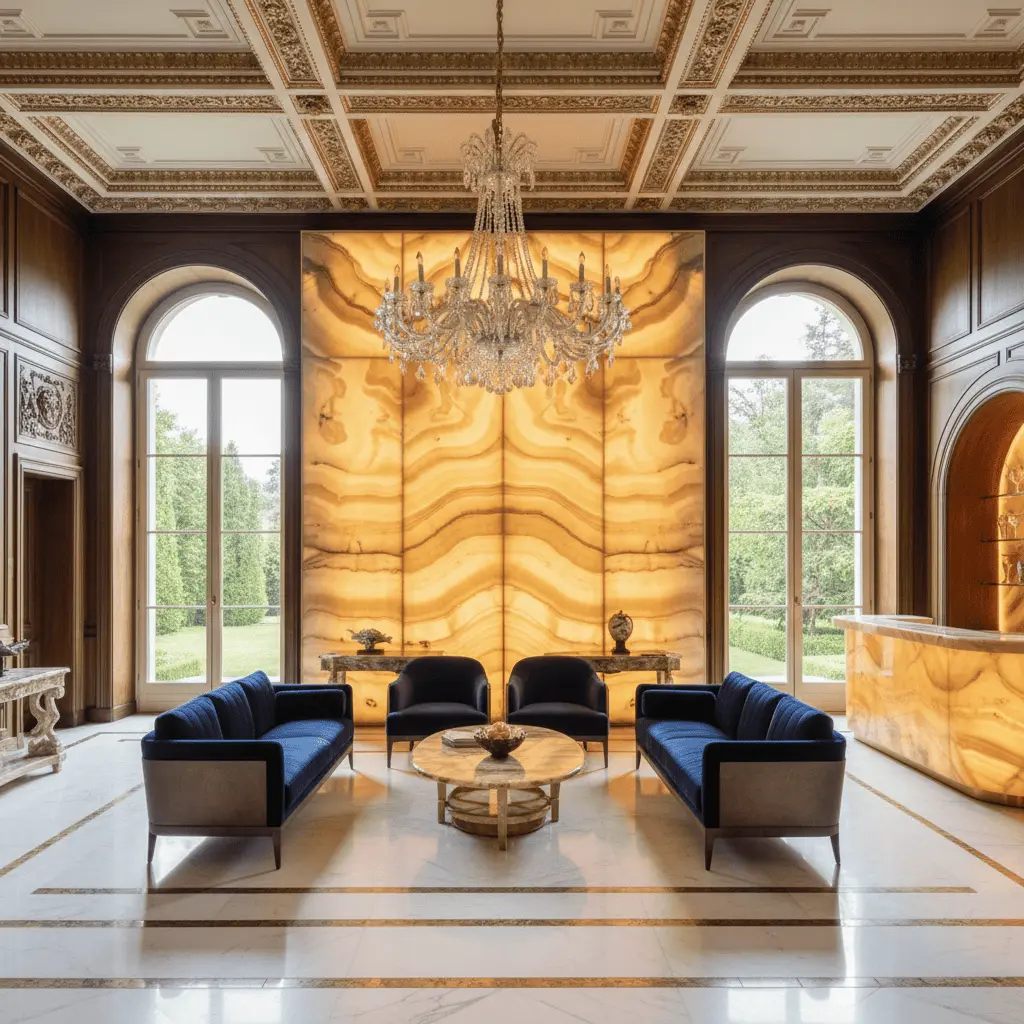
I still remember that call. Sunday, nine in the evening, a client from a country residence near Istra calls and says: “Oleg, our spa onyx has cracked. Right down the middle of the wall. What do I do?” The stone was four months old. The wall was two years old. And the crack—about forty centimeters, straight as if drawn with a pencil.
This was not a supplier defect. This was a defect in expectations.
Onyx is the most complex stone of all I’ve worked with in twenty years. And simultaneously the most sought-after when it comes to onyx interior premium application in high-class residences. Everyone orders it after seeing a backlit bar counter in a hotel on the Côte d’Azur. And they return with complaints—every second one. Today I want to speak honestly: why this happens, how we work with this material in the studio, and to whom I personally do not recommend onyx—even if the budget allows buying three quarries.
What onyx really is—and why photographs lie
Let’s start with geology, because without it the conversation is meaningless. Onyx that you see in magazines is not the onyx that mineralogy knows. Mineralogists call onyx a variety of chalcedony with black-and-white stripes. But in architecture, “onyx” means marble onyx—a carbonate rock formed from mineral deposits in caves. Essentially, it is fossilized stalactites.
And here is its main property: it is semi-transparent. Light passes through a 20 mm plate almost like through frosted glass. This is exactly why it looks so good in photos—the photographer positions backlighting behind it, and the stone begins to glow inside with amber, honey, green water.
But in a poorly lit interior, onyx looks like… dirty marble. Boring. Murky. I’ve seen panels at twelve thousand euros per square meter that in daylight looked like cheap ceramic. Because without backlighting this stone is dead.
Mining, grades, and why “onyx is not all onyx”
Main deposits—Iran, Pakistan, Mexico, Turkey, Afghanistan. Iranian is considered the standard: dense, with clean pattern, no caverns. Pakistani—most dramatic in color, green and honey. Mexican—white with gray veins, beloved by minimalists.
But here’s what’s important to understand: onyx is not mined in ton blocks like marble. A good block is rare. So onyx slabs are often small—2.5 by 1.5 meters ceiling. And each slab is unique. If you need a six-meter wall—that’s already a book layout of three to four plates, and pattern alignment becomes an engineering task.
In our practice there was a project where we waited three months for an Italian supplier to find four slabs from one block—so the veins would match along the edges. They found them. Six months of waiting. But the wall in the guest bathroom turned out so good it was photographed in three publications.
Premium onyx application: where it works and where it doesn’t
I’ll tell you by zones, without theory.
Bar counters and wine rooms. Best scenario. Backlighting from below through a sandwich construction, glass-onyx-glass. Onyx thickness 10–12 mm, laminated to tempered glass. You get both strength and drama. Always works.
Partitions and portals. Backlighting from the edge or from behind. Here the main enemy is light uniformity. LED tape should be spaced no more than 50 mm apart, otherwise you’ll get stripes. We use diffusers and matte underlays. And never—bare tape pressed against it.
Spas, hammams, showers. Difficult. Onyx is porous, absorbs water, darkens with stains. If we do it—only with hydrophobic impregnation every six months and mandatory ventilation. Without good exhaust in a year—disaster. That very case with the crack I mentioned was in a hammam without forced ventilation.
Floors. Categorical no. I don’t do onyx on floors. Period. It’s soft (Mohs hardness 3–4), scratches from keys, dents from heels, darkens from spilled wine in twenty minutes. One owner insisted—a year later they changed it.
Kitchen countertops. Also no. Lemon, coffee, vinegar—all of this leaves traces that can’t be polished away without removing the layer.
Internal backlighting: the technical part everyone misses
This is where most people go wrong. Onyx backlighting is not “put a strip behind the stone.” It’s a separate engineering project.
What we consider:
— Glow temperature. Warm white (2700–3000K) emphasizes honey tones. Cold kills the stone entirely. Never use neutral 4000K—onyx becomes gray.
— Box depth. Between the tape and the stone there must be at least 80–100 mm, otherwise you see LED points. We use frosted glass diffuser in the middle.
— Thermal regime. LED heats. Stone heats. Stone with different density expands unevenly. In a year—micro-cracks. So only COB tapes with heatsinks and box ventilation.
— Service access. Tape lives 5–7 years. If you sealed it tight—get ready to take apart the whole wall. We always make a removable panel on the back or a hidden access hatch.
Typical client mistakes (and why I talk about this)
Part of my job is to talk people out of things. Seriously. And here’s what I hear most often.
“I want like in the Bulgari hotel.” Perfect. Only in the hotel this wall is cleaned every day with special compound, lit with professionally tuned light, and changed after five years under contract. You won’t have this regimen at home.
“Let’s do onyx on the whole wall in the bedroom behind the bed.” You can. But without backlighting this will be an expensive, vague background. With backlighting—you won’t be able to sleep. One client asked us to remove the dimmer after a month: his wife complained the “wall breathes.”
“Let’s take cheaper, Mexican white.” Go ahead. Only Mexican white is the most fragile and crack-prone. You need to pick the grade for the task, not the price.
“What if we put it on radiant floor heating?” Never. Thermal expansion will destroy the plate in one heating season.
The main mistake—ordering onyx from Pinterest photos without visualization in your specific light. Stone in Dubai and stone in a suburban living room are two different stones. Same slab.
Compatibility with lifestyle: honest conversation
Onyx doesn’t like negligence. This is not Stalinist granite and not porcelain that survives a nuclear blast. This is a temperamental material that demands ritual.
If there are small children in the house—onyx at lower levels is undesirable. Hit with a toy on the corner—chip. Irreparable.
If the owners love loud dinners with lots of alcohol—the onyx bar counter will live until the first spilled red wine. Polishing removes it, but the color won’t be the same.
If the family practices “we’ll wipe it ourselves with supermarket chemistry”—onyx loses its shine in a year. Only special pH-neutral products. Only soft cloths. No melamine sponges.
I tell all this at the first meeting. About a third of clients decline. This is normal. Better to decline now than file a complaint in a year.
Our approach in the studio: how we work with onyx
Let me explain the process so you understand why such material is not done “in two weeks by reference.”
Stage one—choosing slabs in person. Either we or the client fly to the supplier’s warehouse, usually in Verona or Carrara. Slabs are backlit with a lamp from behind right in the showroom. Pattern is selected, marked with a marker, photographed. Without this—it’s a lottery.
Stage two—3D pattern layout. High-resolution slab photos are loaded into the project and we virtually lay out the book—where will the seam be, how will the veins go, which plate gets the light. This is no longer design, this is composition.
Stage three—backlighting mock-up in the workshop. Before installing on site, we assemble a 1×1 meter fragment with real tape, real diffuser, real onyx slab. We look at it in darkness, daylight, various power levels. Often we redo the scheme two to three times.
Stage four—installation. Only certified stone workers. Only epoxy adhesives for stone. Only hidden metal anchors at large areas—onyx doesn’t hold its weight on adhesive alone.
Stage five—care manual. The client receives a document: what to wash with, what not to wash with, how often to impregnate, what to do with a chip. This is part of our work. Without it the stone dies in two years.
Who I genuinely recommend onyx to
To those who treat their home like a collection. Who understand that beautiful things need maintenance. Who are ready to call a specialist once a year for polishing. Who won’t wipe the bar with a dish soap sponge.
Onyx is not a material for convenience. It is a material for emotion. When guests enter the living room in the evening and a portal by the fireplace glows with gold—this works. This is remembered. This is that detail a residence is built for, not just a house.
But it only works when the stone is understood, chosen, and installed correctly. And only when the owners understand: they bought not a finish. They bought a living object that will live with them.
—
If you’re thinking about onyx in your project—write me before you place an order. I don’t sell stone. But over twenty years I’ve seen enough mistakes that a twenty-minute conversation can save you a year of nerves and a sum you could buy a car with. It’s free. And it often ends with us choosing a material together much better suited to your residence.

Author

Next step
Discuss your project
An hour at the studio with Oleg Reznikov: your site, your brief and relevant studio projects.